UGC NET Paper 1 Reading Comprehension: Evidence-First Passage Method
Learn one repeatable passage method, then apply it to a fictional library example covering main idea, inference, tone, reference and verification questions.
KnowledgeGate Team
Exam prep & CS education
Updated 20 Aug 20266 min read
An option can sound sensible, repeat a keyword and still be wrong. It may add a cause, certainty, population or judgment the author never supplied. Speed comes from a repeatable locating method for main idea, inference, tone, reference and statement verification. NTA's issued June 2026 Information Bulletin says Paper I assesses reading comprehension. This skill fits within the wider UGC NET CS exam preparation path.
Use a seven-minute evidence-first passage routine
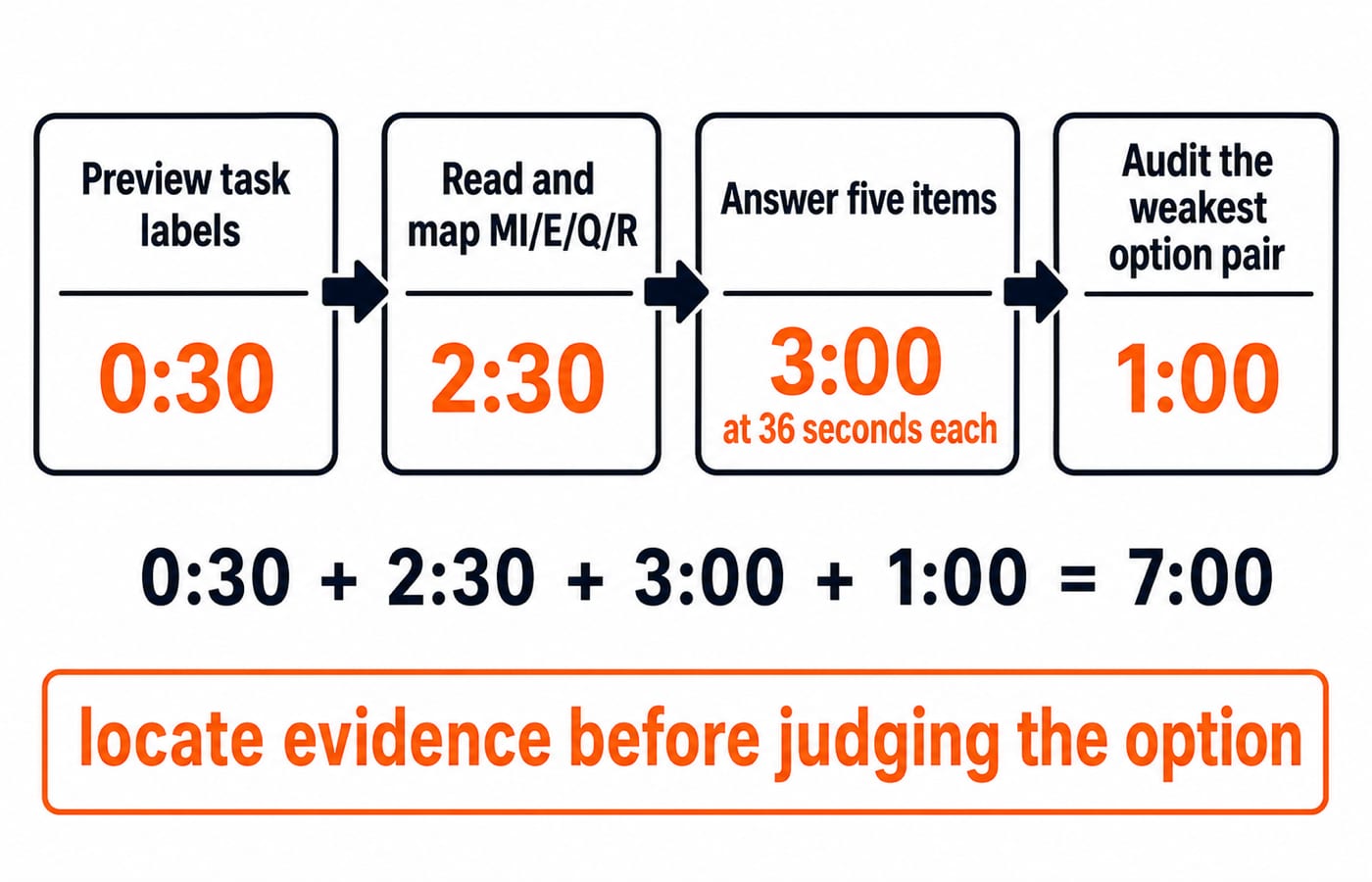
Treat seven minutes as an internal practice budget for one five-question passage, not an official timing rule. Spend 0:30 previewing task labels, 2:30 reading and mapping paragraph jobs, 3:00 answering five items, and 1:00 auditing the weakest option pair. In seconds, 30 + 150 + 180 + 60 = 420, or 7:00. The answer phase averages 180 / 5 = 36 seconds per item.
Place four marks beside the passage: MI for the central claim, E for direct evidence, Q for a qualifier such as may or cannot, and R for a reference whose antecedent needs locating. Write no full summary during the timed pass.
Use this decision loop: identify the task, predict the answer's required force, locate the smallest supporting span, compare every surviving option with that span, then reject any option that is broader or stronger. If two choices remain after 36 seconds, mark the precise difference, such as some/all, may/must or association/cause. Choose only if the text resolves it, and use the final one-minute audit otherwise.
Map paragraph roles before choosing the main idea
Use this fictional practice passage. Its figures are constructed, not real library data.
Paragraph 1: "A municipal library opened its reading room at 7 am instead of 9 am for a four-week pilot. Average weekday entries rose from 240 in the previous four weeks to 300 during the pilot. The change coincided with college examinations, so the rise cannot be attributed to opening time alone."
Paragraph 2: "Of 120 visitors surveyed, 78 had used the early slot at least once and 54 said bus timings influenced when they visited. The survey did not ask whether early access changed examination scores. Staff also recorded less crowding between 4 pm and 6 pm."
Paragraph 3: "The committee called the result promising but recommended an eight-week trial in a non-examination period before adopting the schedule permanently. It noted that winter travel patterns could alter demand."
Map jobs, not subjects: P1 is change + observed rise + confound; P2 is survey evidence + measurement limit + second observation; P3 is cautious evaluation + next test. The main idea needs both the encouraging result and its unresolved limitation.
(a) Opening libraries early always improves examination scores.
(b) A promising rise in library use justifies further testing before permanent adoption.
(c) Bus schedules are the only reason students use libraries.
(d) Winter demand will certainly be lower.
Choose (b). Option (a) adds always and an unmeasured outcome, (c) adds only, and (d) turns caution into certainty.
Solve inference questions with a minimum-evidence test
Ask which conclusion is best supported:
(a) Most surveyed visitors tried the early slot at least once.
(b) Most district students prefer the early slot.
(c) All 54 visitors influenced by bus timings used the early slot.
(d) Opening early caused the reduction in afternoon crowding.
Choose (a) because 78 / 120 = 0.65 = 65%, more than half of the surveyed group. Option (b) changes the population and turns behaviour into preference. Option (d) changes association into causation.
Test option (c) with set bounds. For 120 surveyed visitors, 78 early-slot users and 54 transport-influenced visitors, the overlap can be as low as max(0, 78 + 54 - 120) = 12 and as high as min(78, 54) = 54. Every value from 12 to 54 fits, so the passage cannot establish that all 54 used the early slot.
Choose the weakest claim that must be true. The CAT VARC accuracy plan offers cross-exam practice for resisting scope expansion.
Read tone, reference and context from local evidence
For tone, compare (a) celebratory, (b) cautiously favourable, (c) hostile and (d) indifferent. Choose (b). Promising supplies qualified approval, while but, before adopting the schedule permanently and could alter demand rule out celebration. Require two textual signals for an emotional label.
Check references locally. In P1, The change means opening at 7 am instead of 9 am, not the rise from 240 to 300. In P3, It means the committee, the nearest noun that can logically note a limitation, not the schedule or winter.
In context, promising gives a reason to continue testing, not proof of success. Reject conclusive because the next clause recommends another eight-week trial. For close reference choices, use this order: grammar, nearest sensible antecedent, then the paragraph's argumentative role.
Verify statements by testing number, scope and force
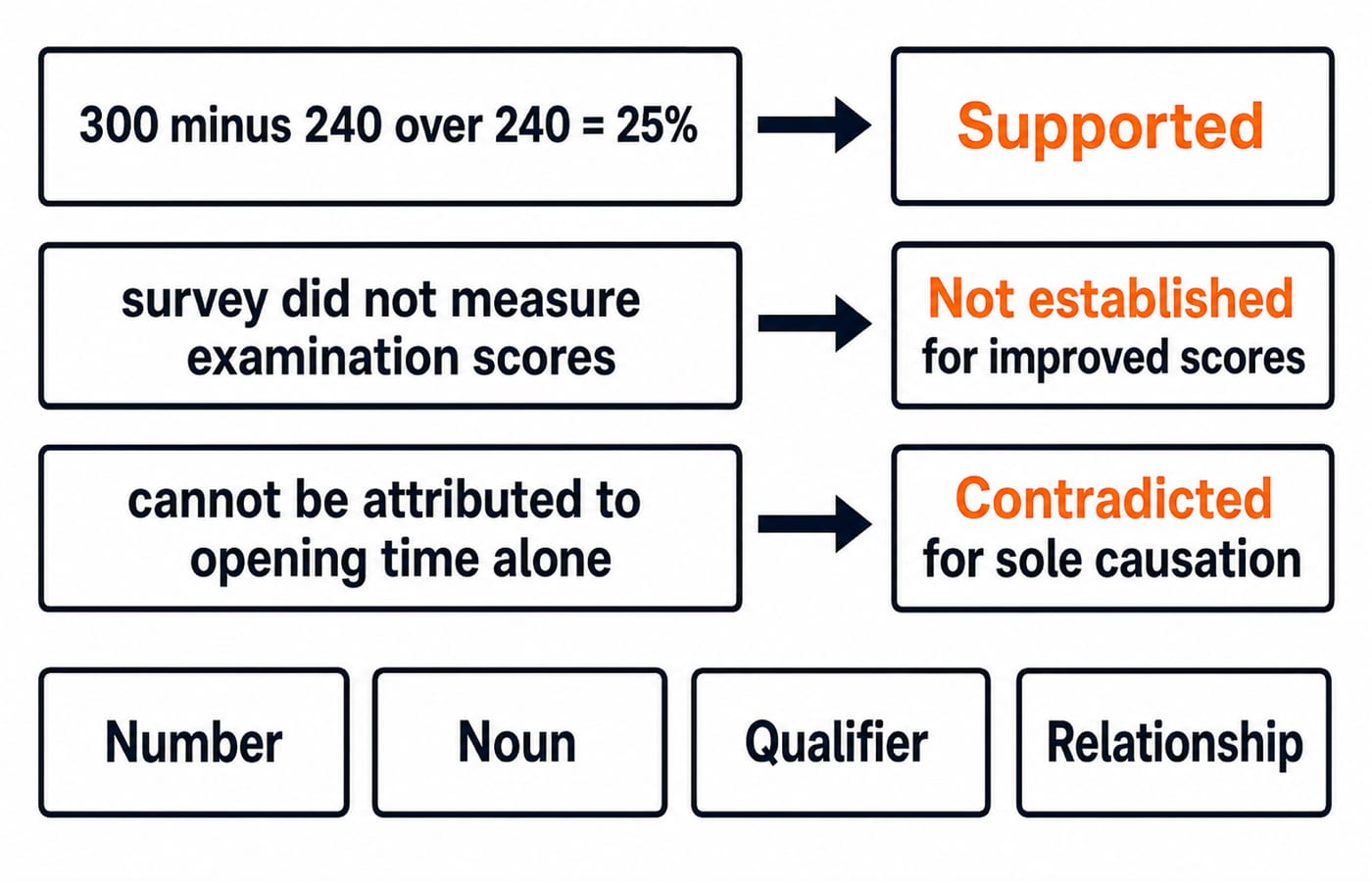
Use four checks in order: number -> noun -> qualifier -> relationship. Recalculate, retain the population, preserve words such as may and alone, and distinguish observation from cause.
Statement | Located evidence or calculation | Verdict | Trap |
|---|---|---|---|
Average weekday entries rose by 25% |
| Supported | Number |
Opening time alone caused the rise | The passage says the rise cannot be attributed to opening time alone because examinations coincided | Contradicted | Sole cause |
65% of surveyed visitors used the early slot at least once |
| Supported | Population |
Early access improved examination scores | The survey did not measure scores | Not established | Unmeasured outcome |
All 54 transport-influenced visitors used the early slot | The overlap is bounded only from 12 to 54 | Not established | Set overlap |
Winter demand will definitely fall | Travel patterns could alter demand, with no direction or certainty given | Not established | Force |
Not established does not mean false. The passage lacks enough evidence to select the statement. This blocks distractors that say more than the text.
Turn a timed set into a targeted repair plan
Use a 30-minute block: attempt two five-question passages in 14:00, audit evidence for 8:00, then log errors for 8:00. Thus, 14 + 8 + 8 = 30 minutes. If Passage A takes 6:40 with 4/5 correct and Passage B takes 7:20 with 3/5 correct, the attempt time is 14:00 and the result is 7/10 = 70%.
Classify the misses. An inference answer expanded surveyed visitors to all students; a tone answer ignored but; a verification answer converted coincidence into causation. Repair each differently: box the population, underline the qualifier, and write association is not cause beside the evidence.
Retest with six fresh items, two per missed type. At 5/6, both tone and verification pass, but one inference item still broadens the population. Carry only inference forward.
The broader Verbal Ability reading-comprehension topic has over 1,500 published questions, though not every item is a UGC NET Paper 1 question. Use the UGC NET Paper 1 Test Series for structured, exam-specific testing.
The short version and next step
Identify the task, map paragraph roles, locate the smallest evidence span, preserve its scope and force, calculate when needed, then eliminate anything added. The guide to UGC NET Paper 1 and Paper 2 separates this Paper 1 skill from subject-specific Paper 2 preparation. For the wider sequence, use the NTA UGC NET Paper 1 Course. Otherwise, repeat the seven-minute routine and six-item retest as a complete practice plan.
Keep learning
FEMA Explained: Objectives, Key Provisions and UGC NET Commerce Examples
Two equal overseas payments can fall into different FEMA categories. Learn to classify transactions, apply an exporter checklist and calculate a penalty ceiling without counting the first day twice.
Updated 9 Oct 20265 min readNET Strategy & Updates
CSIR NET Normalization: Percentile and Normalised Marks Worked Out
Can 120 and 130 raw marks mean the same percentile? Follow a two-shift example from raw marks to percentile and normalised marks, then check which number belongs beside a cutoff.
Updated 5 Oct 20265 min readNET Strategy & Updates

UGC NET Eligibility for CA Holders: Equivalence, Marks and Subject Choice
Completed CA but have no MCom certificate? Understand the equivalence route, check the percentage requirement and resolve marks or subject-entry doubts before applying for NET.
30 Sep 20264 min readNET Strategy & Updates
UGC NET CS Attempt Strategy Without Negative Marking: A Three-Pass Plan
Use a rehearsed 180-minute clock to answer quick recalls first, protect time for technical work, and leave disciplined elimination and guesses until the final pass.
Updated 4 Sep 20265 min readNET Strategy & Updates