UGC NET Paper 1 Logical Reasoning: 6 Question Types and Elimination Traps
Learn to classify six Logical Reasoning formats, translate their claims and eliminate options using worked examples from deduction, syllogisms, fallacies and Indian logic.
KnowledgeGate Team
Exam prep & CS education
Updated 17 Aug 20266 min read
Logical Reasoning options often look almost identical because the real difference is logical force, not vocabulary. A memorised cue such as "all", "probably" or "because" cannot replace testing what the premises support. This guide gives you a classification and elimination method across six common formats. The method matters more than remembering isolated definitions under exam pressure. It also places Paper 1 reasoning within the wider UGC NET CS Exam Preparation path.
1. UGC NET Paper 1 Logical Reasoning question types: classify before solving
Name the required operation first. More than 1,300 published practice questions cover these reasoning topics, although their stories vary.
Question type | Typical task | First check |
|---|---|---|
Argument structure and language | Find premise, conclusion or language use | Separate evidence and claim |
Deduction | Test necessity | Seek a counterexample |
Induction and analogy | Judge strength or relevance | Check sample or shared feature |
Categorical propositions and syllogisms | Translate A/E/I/O and test sets | Mark inclusion and existence |
Formal and informal fallacies | Expose the invalid step | Check form, then content |
Indian logic | Identify pramana, anumana, vyapti or hetvabhasa | Trace source or inference |
Classify first, translate second, and eliminate after the relation is visible. Shared topic words do not guarantee that an option preserves necessity, probability or possibility.
2. Arguments, premises and conclusions: strip away the topic story
Consider: "Of 400 library respondents, 320 requested longer hours. The reading hall currently closes at 6 pm. Therefore, the university should pilot an 8 pm closing time for 4 weeks."
The premises are 320 of 400 requested longer hours and the current closing time is 6 pm. The conclusion is pilot an 8 pm closing time for 4 weeks. Numerically, 320/400 = 0.80 = 80%. That strong response supports the recommendation, but it does not deductively prove that the pilot must be adopted.
Language form matters too. "The form closed at 5 pm" is assertive and truth-evaluable. "Submit the form by 5 pm" is directive. "What a difficult form!" is expressive. An imperative or exclamation does not automatically become a proposition because it sits inside an argument-shaped passage.
Circle conclusion indicators such as "therefore", underline the offered evidence, then reject any option that merely repeats a premise as the conclusion. The same separation of story detail and logical structure appears in Logical Reasoning for Placement Tests.
3. Deductive versus inductive reasoning: certainty, strength and analogy
For a deductive example, let M mean the portal is under maintenance and D mean login is disabled:
If the portal is under maintenance, login is disabled:
M -> D.Login is not disabled:
not D.Therefore, the portal is not under maintenance:
not M.
This is valid modus tollens. If M were true, D would have to be true, which conflicts with not D. Do not reverse the first premise into D -> M; that relation was never given.
Now consider: "68 of 80 randomly sampled submissions passed screening, so submissions from the same process are likely to pass." Here, 68/80 = 0.85 = 85%. The evidence makes the conclusion probable, not necessary. A biased sample could weaken it, unlike the deductive conclusion above.
An analogy must preserve a relevant relation. "A heart pumps blood, so a pump moves fluid" transfers function. "A heart is red, so every pump is red" transfers an irrelevant feature. Do not classify an argument from "always" or "probably" alone. GATE Verbal Aptitude and Reasoning provides cross-exam practice for these validity and analogy habits.
4. Categorical propositions and syllogisms: translate before drawing
The four standard forms are:
A:
All S are PE:
No S are PI:
Some S are PO:
Some S are not P
Their contradiction pairs are A <-> O and E <-> I. Notice that No S are P is not the contradiction of All S are P. Both can be false when some, but not all, S are P.
Work this syllogism:
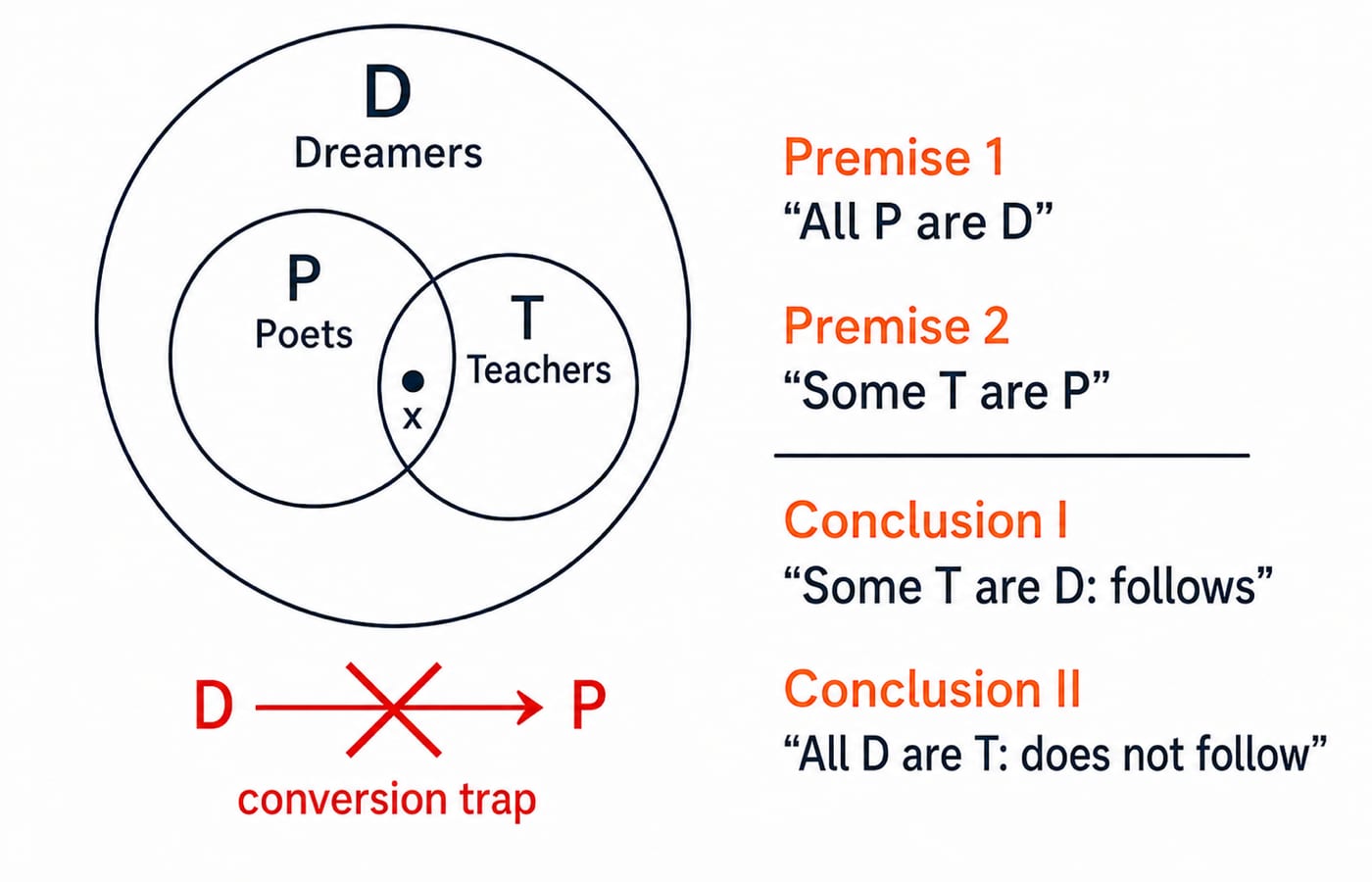
Premise 1: All poets are dreamers.
Premise 2: Some teachers are poets.
Conclusion I: Some teachers are dreamers.
Conclusion II: All dreamers are teachers.
Let P = poets, D = dreamers and T = teachers. Premise 1 gives P subset D. Premise 2 supplies an existing member x in T intersection P. Because every member of P lies in D, x must also lie in D. Conclusion I follows. Conclusion II does not, because neither premise gives D subset T.
Two traps cause many wrong answers. First, never convert All P are D into All D are P. Second, do not infer that P exists from a universal statement alone. Here, the second premise supplies the required member.
5. Formal and informal fallacies: find the broken inference
Take this formal pattern: "If the server is down (S), the portal is inaccessible (I). The portal is inaccessible. Therefore, the server is down." Its form is S -> I, I, therefore S, the fallacy of affirming the consequent.
Scheduled maintenance might block access, making I = true, while the server remains up, making S = false. Both stated premises are true, yet the conclusion is false.
Informal fallacies depend on content. "Reject Meera's view on online assessment because she is a first-year teacher" attacks the person rather than the view, so it is ad hominem. "Scores rose after attendance rose, therefore attendance alone caused the improvement" treats sequence or correlation as proof of cause, so it is post hoc or false-cause reasoning.
Use three checks: Is the error in form or content? Can one counterexample keep the premises true and the conclusion false? Which option names the narrow error instead of merely calling the argument "weak"?
6. Indian logic questions: pramanas, five-member anumana and hetvabhasa
Keep the six pramanas distinct:
Pramana | Source of knowledge |
|---|---|
Pratyaksha | Perception |
Anumana | Inference |
Upamana | Comparison |
Shabda | Reliable verbal testimony |
Arthapatti | Postulation needed to explain known facts |
Anupalabdhi | Knowledge of absence through non-apprehension |
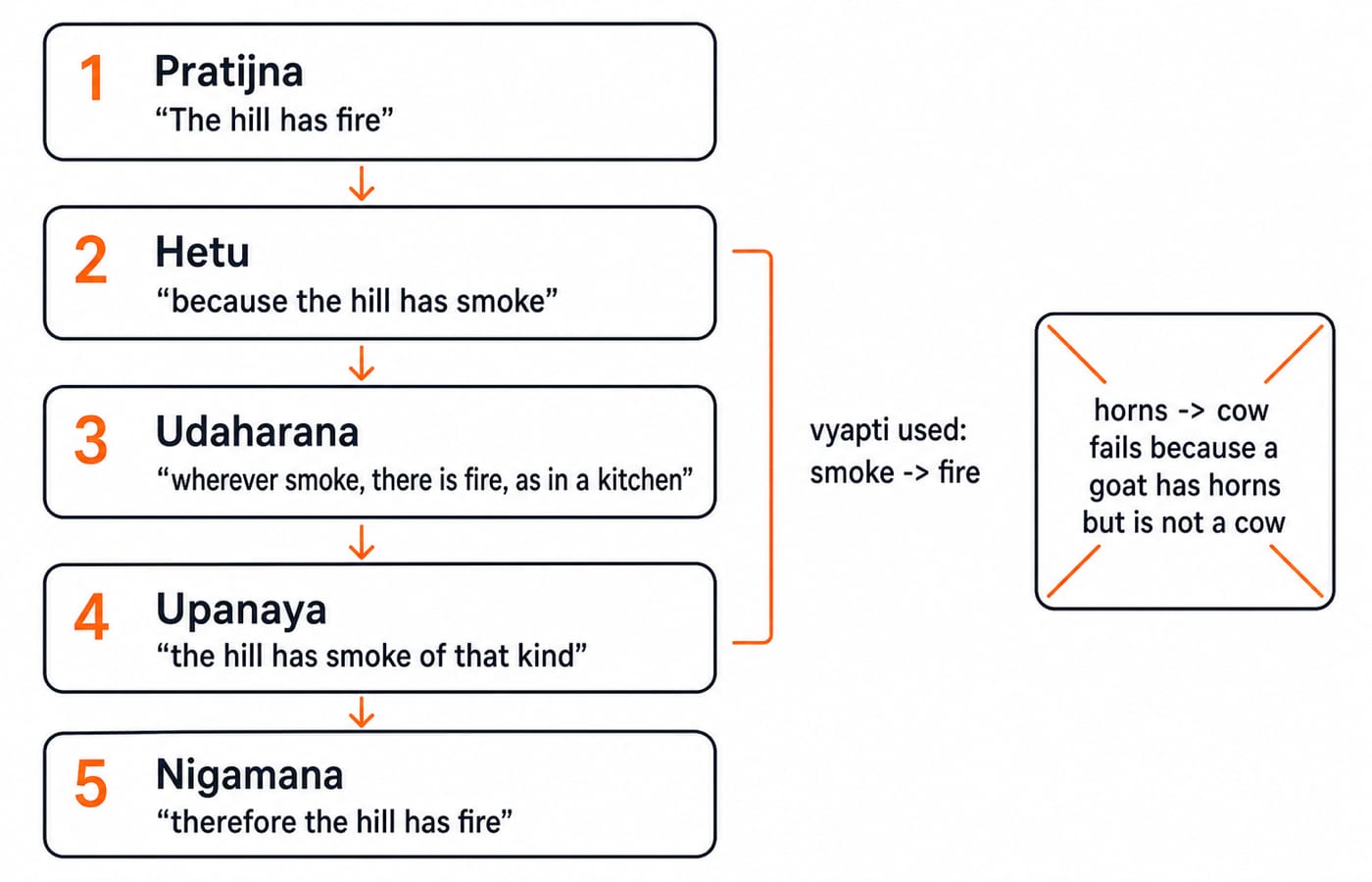
Do not reduce all six loosely to "observation". Keep their functions separate. In the five-member inference, each statement has a particular job:
Pratijna: The hill has fire.
Hetu: Because it has smoke.
Udaharana: Wherever there is smoke there is fire, as in a kitchen.
Upanaya: The hill has smoke of that kind.
Nigamana: Therefore, the hill has fire.
The claimed vyapti, smoke -> fire, connects the reason with the conclusion. A hetvabhasa question tests where such a connection fails. "This animal is a cow because it has horns" is inconclusive, called savyabhicara or anaikantika, because a goat has horns but is not a cow. That counterexample breaks the required pervasion. Test the reason against a counterexample before matching Sanskrit labels by sound.
7. How UGC NET Paper 1 tests Logical Reasoning
NTA's June 2026 Information Bulletin says Paper I is intended to assess reasoning ability alongside reading comprehension, divergent thinking and general awareness. That scope does not fix a Logical Reasoning count or unit weightage. The distinction between Paper 1 reasoning and subject-specific Paper 2 is explained in UGC NET Paper 1 vs Paper 2.
Map task wording directly: "which conclusion follows" means test validity; "contradictory proposition" means use A/O or E/I; "identify the fallacy" means expose the failed step; "correct order" means reconstruct the five-member anumana; and "match the pramana" means classify the source of knowledge.
For a 12-question self-check, solve 4 categorical or syllogism questions, 3 argument or deduction questions, 2 fallacy questions and 3 Indian logic questions. After every miss, record whether translation, inference or terminology caused it.
8. UGC NET Logical Reasoning: the short version and next step
Use one decision order: classify the format, translate the claim, test necessity or strength, seek a counterexample, then choose the narrowest option. If you want all Paper 1 units, unit-wise tests and a planned sequence, the NTA UGC NET Paper 1 Course is the structured next step. If you only need focused reasoning practice, start right now with the 12-question allocation above and classify every error before solving another set.
Keep learning

Scope and Importance of International Business: UGC NET Commerce Examples
Exports, licensing and foreign investment cross borders in different ways. Separate their roles, compare entry modes and work through the opportunity-cost arithmetic behind comparative advantage.
Updated 13 Oct 20266 min readNET Strategy & Updates
FEMA Explained: Objectives, Key Provisions and UGC NET Commerce Examples
Two equal overseas payments can fall into different FEMA categories. Learn to classify transactions, apply an exporter checklist and calculate a penalty ceiling without counting the first day twice.
Updated 9 Oct 20265 min readNET Strategy & Updates

CSIR NET Normalization: Percentile and Normalised Marks Worked Out
Can 120 and 130 raw marks mean the same percentile? Follow a two-shift example from raw marks to percentile and normalised marks, then check which number belongs beside a cutoff.
Updated 5 Oct 20265 min readNET Strategy & Updates

UGC NET Eligibility for CA Holders: Equivalence, Marks and Subject Choice
Completed CA but have no MCom certificate? Understand the equivalence route, check the percentage requirement and resolve marks or subject-entry doubts before applying for NET.
30 Sep 20264 min readNET Strategy & Updates