UGC NET CS vs GATE CS Syllabus: Overlap and Extra Topics
See which GATE CS topics transfer to UGC NET Computer Science, where familiar subjects need extension, and how to schedule the missing Paper I and Paper II work.
KnowledgeGate Team
Exam prep & CS education
Updated 26 Jul 20265 min read86 views
If you have prepared for GATE CS, how much of those notes and practice can you reuse for UGC NET Computer Science, and what must you add? The core transfers strongly, but UGC NET adds a separate Paper I and a much broader Paper II perimeter. Work from two documents and nothing else: the UGC syllabi applicable from June 2019 and IIT Guwahati's completed GATE 2026 syllabi. A coaching weightage chart cannot settle a syllabus question.
UGC NET CS vs GATE CS syllabus: the short answer
Use three buckets. Reuse the common CS core. Extend subjects whose names match but whose listed scope differs. Add UGC NET-only areas and all of Paper I.
Every one of the ten named GATE 2026 CS sections has at least some counterpart in the official UGC NET Paper II syllabus. A counterpart is not equal depth, though, and neither body publishes an overlap percentage. A GATE-prepared candidate should begin with a line-by-line gap audit. A NET-first candidate should protect the mathematics and problem-solving areas that GATE lists more explicitly. The NET category collects the NET route, its courses and its companion posts in one place.
Map the shared core section by section
The official GATE section names and UGC Paper II units map as follows.
GATE 2026 section | UGC NET Paper II home | Reuse boundary |
|---|---|---|
Engineering Mathematics | Unit 1, Discrete Structures and Optimization | Logic, sets, counting, graphs and probability transfer. |
Digital Logic | Unit 2, Computer System Architecture | Boolean algebra, minimisation, combinational and sequential circuits transfer. |
Computer Organization and Architecture | Unit 2, Computer System Architecture | Number representation, instruction formats, pipelining and the memory hierarchy transfer. |
Programming and Data Structures | Units 3 and 7, Programming Languages and Computer Graphics; Data Structures and Algorithms | C and the standard data structures transfer. |
Algorithms | Unit 7, Data Structures and Algorithms | Complexity, core graph algorithms and the standard design techniques transfer. |
Theory of Computation | Unit 8, Theory of Computation and Compilers | Regular and context-free languages, automata and decidability transfer. |
Compiler Design | Unit 8, Theory of Computation and Compilers | Lexical analysis, parsing, syntax-directed translation and code generation transfer. |
Operating System | Unit 5, System Software and Operating System | Processes, synchronisation, memory, storage and files transfer. |
Databases | Unit 4, Database Management Systems | Relational systems, SQL, normalisation, indexing and transactions transfer. |
Computer Networks | Unit 9, Data Communication and Computer Networks | Layering, routing, IP, TCP/UDP and application protocols transfer. |
Read the third column as a starting boundary, not a finish line: every row still needs a line-by-line check against both documents before you trust it. UGC NET Computer Science syllabus areas expands the UGC side unit by unit.
What a NET-first plan must add for GATE CS
The wording matters. GATE 2026 Engineering Mathematics explicitly lists linear algebra, calculus and named probability distributions. UGC Paper II Unit 1 instead foregrounds discrete structures, group theory and optimisation. A NET-first candidate should separately audit matrices and eigenvalues, limits and integration, and distribution-based probability instead of assuming Unit 1 covers them.
There is also a General Aptitude boundary. GATE GA explicitly lists verbal, quantitative, analytical and spatial aptitude. UGC Paper I overlaps in comprehension, mathematical reasoning, logic and data interpretation, but the syllabi are not interchangeable. GATE CS subject weightage ranks the shared core by study priority, and GATE Guidance by Sanchit Sir teaches that core as one sequence.
What a GATE-first plan must add for UGC NET
Paper I
UGC Paper I has ten units. Plan them as teaching and research aptitude; comprehension and communication; mathematical and logical reasoning plus data interpretation; ICT; people, development and environment; and the higher education system. GATE GA partly supports comprehension, quantitative reasoning, logic and data interpretation. It does not replace the other Paper I work.
Paper II
UGC names several areas that IIT Guwahati's GATE 2026 CS syllabus does not name: operations research and optimisation; programming-language concepts, C++, OOP, web programming and computer graphics; software engineering; and AI. It also lists advanced database material such as data warehousing, mining, big data and NoSQL; broader system software, security and distributed systems; and network extensions including mobile technology, cloud computing and IoT.
The NTA-UGC-NET Paper 2 course runs these Paper II areas as one taught sequence, which saves you assembling the bridge reading list yourself.
Avoid the same-name, same-depth trap
Databases: GATE names ER, relational algebra and calculus, SQL, normal forms, file organisation, indexing, transactions and concurrency. UGC additionally names stored procedures, triggers, query optimisation, recovery, enhanced databases, warehousing, mining, big data and NoSQL.
Algorithms: GATE names greedy, dynamic programming and divide-and-conquer. UGC additionally names backtracking, branch and bound, maximum flow, P/NP, approximation, randomised and parallel algorithms.
Networks: GATE names its core protocol stack. UGC additionally names IPv6, SCTP, security, mobile communication, cloud and IoT.
When you log a gap, write not named in this syllabus rather than will not be asked. A syllabus is a topic list, not a question guarantee, and an adjacent unit often absorbs what a section headline leaves out. Build a ledger with three columns, covered, needs extension and new, then paste the relevant official syllabus line beside every decision. The UGC syllabus index links the Paper I and Computer Science and Applications records you need.
Work a 216-hour syllabus-reuse audit
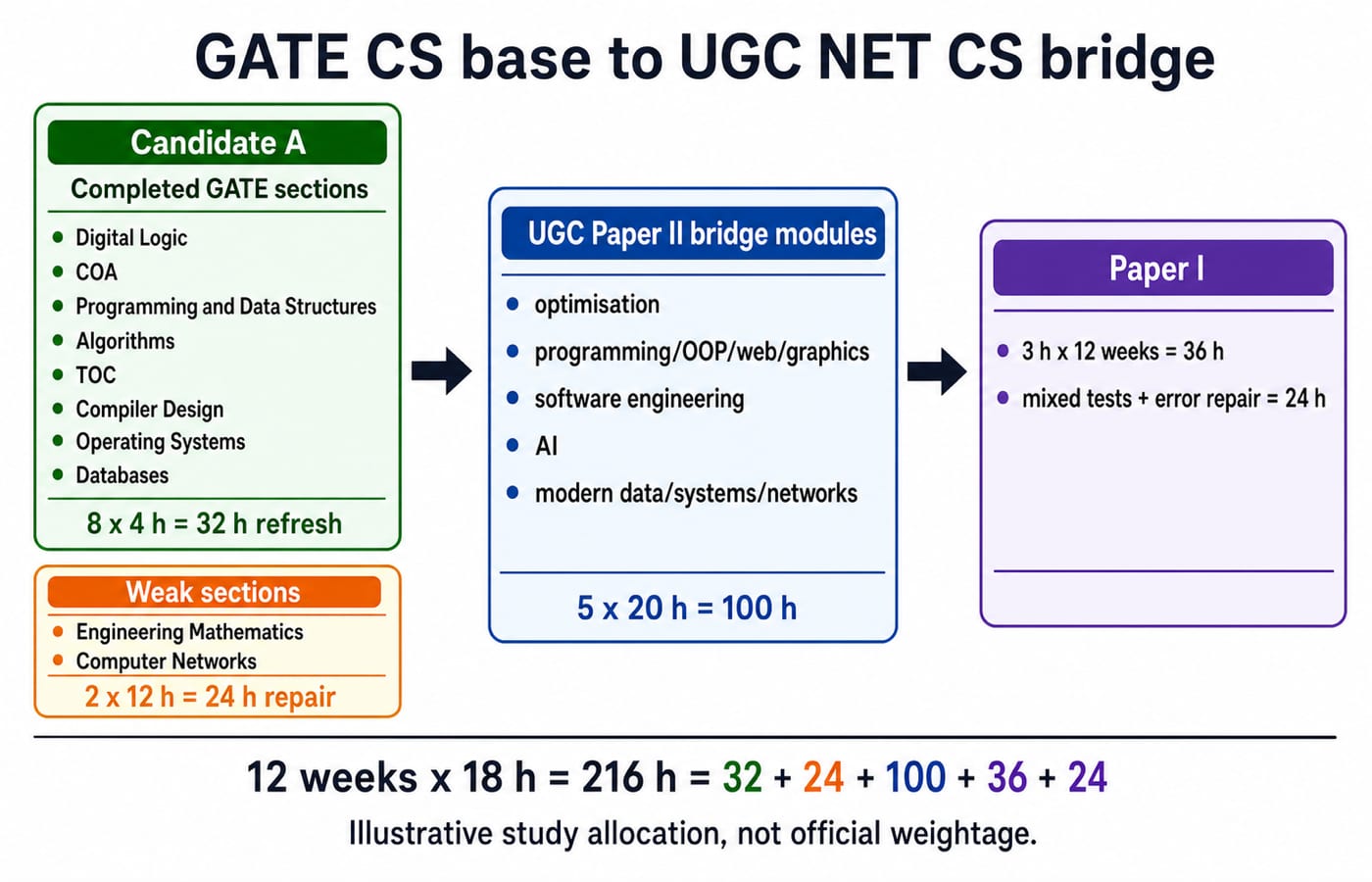
Candidate A has completed eight sections: Digital Logic, COA, Programming and Data Structures, Algorithms, TOC, Compiler Design, Operating Systems and Databases. Engineering Mathematics and Computer Networks are weak. There are 12 weeks x 18 hours = 216 hours before a personal mock deadline.
Refresh and diagnose eight completed shared sections:
8 x 4 = 32 hours.Repair two weak shared sections:
2 x 12 = 24 hours.Study five UGC Paper II bridge modules:
5 x 20 = 100 hours. The modules are optimisation; programming, OOP, web and graphics; software engineering; AI; and modern data, systems and networks.Study Paper I:
3 hours x 12 weeks = 36 hours.Reserve
24 hoursfor mixed tests and error repair.
The check is 32 + 24 + 100 + 36 + 24 = 216. A weaker base requires more weeks, not smaller official topics. Rebuild the same five lines with your own completed sections and your own weekly hours before you fix a mock date.
Choose the right starting point this week
On day 1, download the current official UGC and GATE syllabus files. On days 2 and 3, mark every line covered, extend or new. On days 4 to 7, test one shared core block, one GATE-specific mathematics block, one UGC Paper II bridge block and one UGC Paper I block. Let the results, not the exam label, decide your first study block.
GATE preparation supplies a substantial CS base for UGC NET, but not Paper I or broader Paper II areas. Start with the course matching your diagnosed gap, then use the NET category for the next route. Verify the latest NTA notice before acting on live exam details.
Keep learning
CSIR NET Normalization: Percentile and Normalised Marks Worked Out
Can 120 and 130 raw marks mean the same percentile? Follow a two-shift example from raw marks to percentile and normalised marks, then check which number belongs beside a cutoff.
Updated 5 Oct 20265 min readNET Strategy & Updates
UGC NET Eligibility for CA Holders: Equivalence, Marks and Subject Choice
Completed CA but have no MCom certificate? Understand the equivalence route, check the percentage requirement and resolve marks or subject-entry doubts before applying for NET.
30 Sep 20264 min readNET Strategy & Updates
UGC NET CS Attempt Strategy Without Negative Marking: A Three-Pass Plan
Use a rehearsed 180-minute clock to answer quick recalls first, protect time for technical work, and leave disciplined elimination and guesses until the final pass.
Updated 4 Sep 20265 min readNET Strategy & Updates
UGC NET Paper 1 Higher Education Timeline: Institutions, Commissions, Policies and Digital Initiatives
Turn disconnected Higher Education dates into a classified timeline. Learn the ancient centres, modern bodies, policies and digital initiatives through worked ordering drills.
Updated 3 Sep 20266 min readNET Strategy & Updates