UGC NET CS Mock Tests: Readiness Gates From Units to Full Papers
Build a UGC NET CS mock-test ladder using chapter, unit and separate-paper evidence, then promote to full simulations only when three readiness gates pass.
KnowledgeGate Team
Exam prep & CS education
Updated 18 Aug 20265 min read

You take quizzes, yet a full-paper score is too noisy to guide revision. Harder mocks taken too early mix knowledge gaps, timing trouble and unfinished revision into one number. This four-rung system promotes you through consistency, separate-paper evidence and review quality, not confidence or one lucky score.
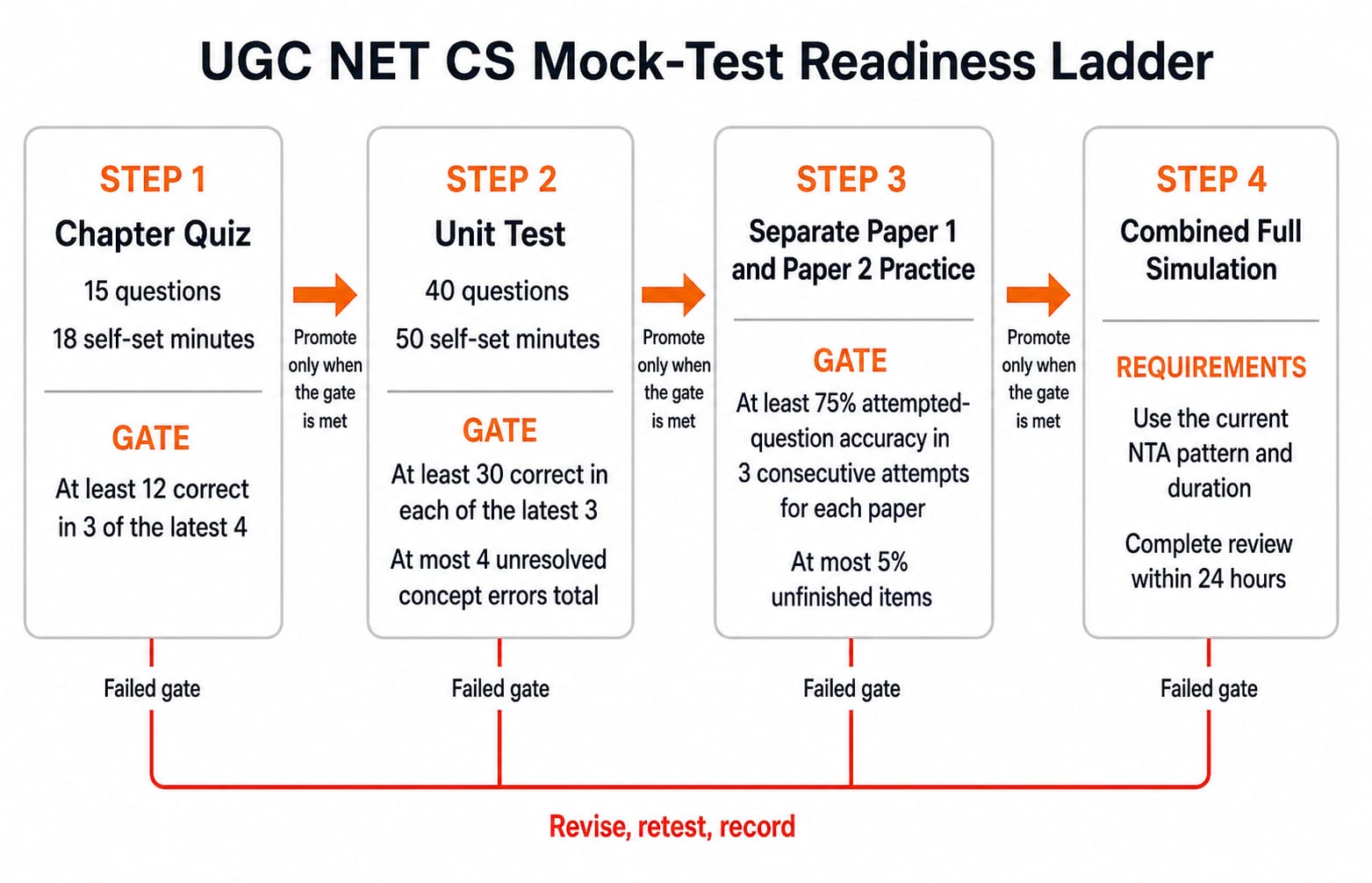
1. UGC NET CS mock tests need four levels, not one pile of papers
Each level answers a different question. These thresholds are a study framework, not NTA rules.
Level | Purpose | Practice rule | Promotion evidence |
|---|---|---|---|
Chapter quiz | Isolate one concept | 15 questions in a self-set 18-minute block | At least 12 correct in 3 of the latest 4 |
Unit test | Switch within a subject | 40 questions in a self-set 50-minute block | At least 30 correct in each of the latest 3 tests, with no more than 4 unresolved concept errors across them |
Separate Paper 1 and Paper 2 practice | Stop a stronger paper hiding a weaker one | Practise the papers on different days | At least 75% attempted-question accuracy in 3 consecutive attempts for each paper, with no more than 5% unfinished items |
Combined full simulation | Test endurance and switching across the complete revision load | Follow the current official pattern and duration under exam conditions | Complete the first review within 24 hours |
Chapter quizzes isolate a concept, unit tests add topic switching, and separate papers expose an imbalance. A combined simulation finally tests endurance across the complete load. Check the official UGC NET portal for its current pattern and duration.
2. A six-week, 12-hour progression from revision to full simulations
Treat this as a route, not a deadline.
Week | Work blocks | Weekly total |
|---|---|---|
1 | 6 hours revision + 3 hours chapter quizzes + 3 hours error review | 12 hours |
2 | 5 hours revision + 4 hours chapter quizzes + 3 hours error review | 12 hours |
3 | 4 hours revision + 4 hours unit tests + 4 hours analysis | 12 hours |
4 | 4 hours revision + 4 hours unit tests + 4 hours analysis | 12 hours |
5 | 3 hours weak-area repair + 3 hours Paper 1 practice + 4 hours Paper 2 practice + 2 hours joint review | 12 hours |
6 | One 4-hour calendar block containing setup and a combined simulation at the current official duration + 4 hours post-mock analysis + 4 hours targeted repair | 12 hours |
If a gate fails, repeat that rung for a week. Use the UGC NET Computer Science last 45 days plan for calendar structure, not permission to skip a gate. Ten honest hours may stretch the model to seven or eight weeks. Do not double sessions.
3. Readiness gate 1: promote consistent topics, not high averages
Four 15-question DBMS quizzes produce 13, 12, 10 and 14 correct, or 86.7%, 80.0%, 66.7% and 93.3%. Together, (13 + 12 + 10 + 14) / 60 = 49/60 = 81.7%. Quizzes 1, 2 and 4 meet the 12-correct gate. Three of four pass, so DBMS moves to a unit test.
Computer Networks scores of 12, 11, 13 and 11 give (12 + 11 + 13 + 11) / 60 = 47/60 = 78.3%. Only quizzes 1 and 3 pass, so remain at chapter level. One easy set can lift an average; repeated passes show consistency.
4. Paper 1 and Paper 2 need separate dashboards before combination
The UGC NET Paper 1 vs Paper 2 explainer shows why they need separate dashboards.
Paper 1 accuracy is 76%, 79% and 81%, with 4%, 4% and 3% unfinished. Paper 2 accuracy is 68%, 72% and 74%, with 12%, 9% and 7% unfinished. The equal-weight diagnostic mean is (76 + 79 + 81 + 68 + 72 + 74) / 6 = 450/6 = 75.0%, not an official score. The mean looks acceptable, yet Paper 2 fails both gates. A full paper is premature.
5. Readiness gate 2: decide when a full paper will teach you something
Apply three independent checks:
Coverage: at least 9 of your 10 planned units are revised with current notes and an error log.
Stability: both separate-paper dashboards reach at least 75% attempted-question accuracy in 3 consecutive attempts.
Endurance: unfinished items stay at or below 5% in 2 consecutive attempts under your declared separate-paper time budgets.
These are study-planning thresholds, not official eligibility or cutoff rules. Coverage of 9/10 passes. Paper 1 is stable, but Paper 2 at 68%, 72% and 74% fails. Its latest unfinished shares of 9% and 7% also fail endurance. Spend another week on Paper 2.
When Paper 2 reaches 76%, 78% and 77%, with 4% and 3% unfinished last, it passes. Paper 1 already finishes at 4% and 3%. All three checks now pass, so move to a combined simulation.
6. Full mock analysis must produce the next 12-hour revision plan
A score cannot prescribe revision. Tag each wrong response as concept, recall or careless. Track low-confidence correct responses separately. The UGC NET mock-test strategy gives the deeper repair loop.
Suppose 29 wrong responses contain 14 concept, 9 recall and 6 careless errors: 14 + 9 + 6 = 29. Mark another 11 correct responses as low-confidence. Allocate the next 12 hours as follows:
5 hours repairing the 14 concept errors across the two weakest units
3 hours of active recall for the 9 recall errors
2 hours of slow-reading or calculation drills for the 6 careless errors
2 hours re-solving the 11 low-confidence items
Since 5 + 3 + 2 + 2 = 12 hours, wait until most repair is complete before the next mock.
7. Missed study days should delay promotion, not destroy the plan
If you planned 12 hours but completed 8, keep 3 hours of error review, 3 hours of weak-unit repair and one 2-hour test block: 3 + 3 + 2 = 8 hours. Move a 2-hour secondary quiz and 2 hours of new-note making forward: 2 + 2 = 4 hours. Do not compress them into a late-night marathon.
Put up to 2 missed hours into the week's flex block. Beyond 2, cut the lowest-priority new quiz before review. Two missed mock or review sessions within seven days mean another week on the rung. A delayed full paper gives cleaner evidence than one taken with unrepaired errors.
8. The short version: earn the next UGC NET CS mock
Apply the 3-of-4 gate to your latest chapter quizzes. Keep separate paper dashboards until coverage, stability and endurance pass. Record date, rung, correct, attempted, unfinished percentage, all three error types and resulting repair hours.
For prepared tests, use the UGC NET CS Test Series, Paper 1 + Paper 2. To map the wider route, start with the UGC NET CS Exam Preparation category. Promote only when the evidence earns the next rung.
Keep learning

Scope and Importance of International Business: UGC NET Commerce Examples
Exports, licensing and foreign investment cross borders in different ways. Separate their roles, compare entry modes and work through the opportunity-cost arithmetic behind comparative advantage.
Updated 13 Oct 20266 min readNET Strategy & Updates

FEMA Explained: Objectives, Key Provisions and UGC NET Commerce Examples
Two equal overseas payments can fall into different FEMA categories. Learn to classify transactions, apply an exporter checklist and calculate a penalty ceiling without counting the first day twice.
Updated 9 Oct 20265 min readNET Strategy & Updates

CSIR NET Normalization: Percentile and Normalised Marks Worked Out
Can 120 and 130 raw marks mean the same percentile? Follow a two-shift example from raw marks to percentile and normalised marks, then check which number belongs beside a cutoff.
Updated 5 Oct 20265 min readNET Strategy & Updates

UGC NET Eligibility for CA Holders: Equivalence, Marks and Subject Choice
Completed CA but have no MCom certificate? Understand the equivalence route, check the percentage requirement and resolve marks or subject-entry doubts before applying for NET.
30 Sep 20264 min readNET Strategy & Updates