Disk Structure and Disk Addressing for GATE: CHS, LBA and Worked Examples
Use one consistent disk geometry to connect platters, surfaces, tracks and sectors with capacity, CHS-to-LBA conversion, address width and access time.
KnowledgeGate Team
Exam prep & CS education
Updated 21 Sep 20265 min read
Platter, surface, track, cylinder, sector and block blur together when a numerical mixes them. Capacity, CHS and LBA conversion, address bits, and access time all use the same geometry. Numbering conventions matter because hidden zero-based or one-based assumptions create off-by-one answers.
Disk structure: platter, surface, track, sector and cylinder
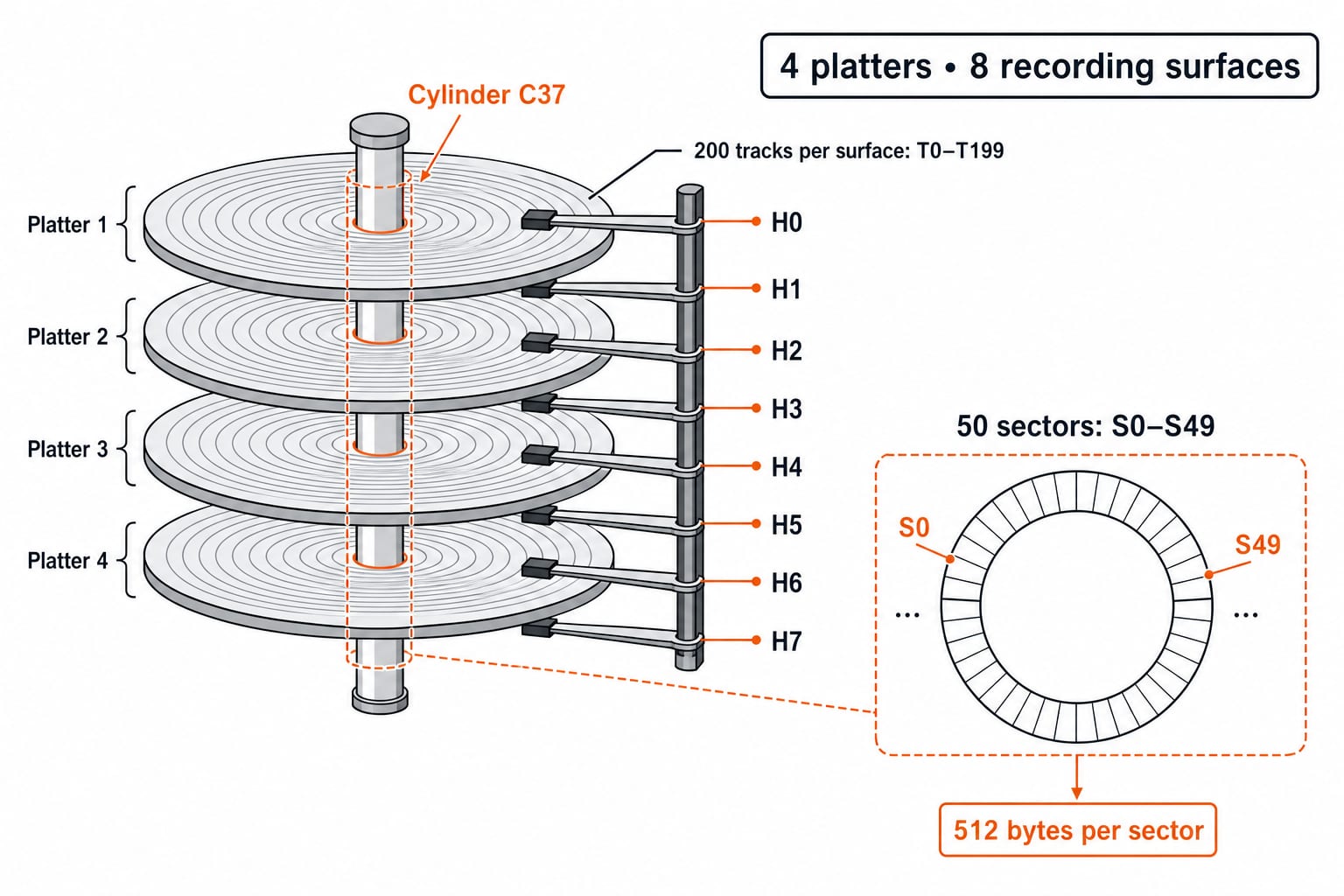
A platter is a circular magnetic disk. When both sides are usable, it has two recording surfaces, each served by one head. A surface contains concentric tracks divided into physical sectors. Aligned tracks at the same radius form one cylinder.
A physical sector is a hardware subdivision. A logical block is the fixed-size unit the operating system addresses. Their sizes may match, but they belong to different layers. File allocation and head-movement policies build on this geometry, as File Systems and Disk Scheduling in OS explains.
The calculation uses this geometry:
4 platters, with both surfaces usable
8 recording surfaces and 8 heads
200 tracks per surface, hence 200 cylinders
50 sectors per track
512 bytes per sector
There are 8 x 200 = 1600 total tracks but only 200 cylinders. A cylinder groups one aligned track from every surface, so heads do not multiply its count.
Disk capacity: count the geometry before multiplying bytes
First count sectors, then introduce bytes:
Total sectors = 4 x 2 x 200 x 50 = 80,000 sectors
Capacity = 80,000 x 512 = 40,960,000 bytes
That is 40.96 MB in decimal units. In binary units:
40,960,000 / 1,048,576 = 39.0625 MiB
Intermediate quantities give a second route:
Object | Count | Bytes |
|---|---|---|
Sector | 1 | 512 |
Track | 50 sectors | 25,600 |
Cylinder | 8 tracks | 204,800 |
Full disk | 200 cylinders | 40,960,000 |
One track stores 50 x 512 = 25,600 bytes, and one cylinder stores 8 x 25,600 = 204,800 bytes. Then 200 x 204,800 = 40,960,000 bytes. Treat this as a cross-check, not another formula.
Disk addressing: convert CHS to LBA and back
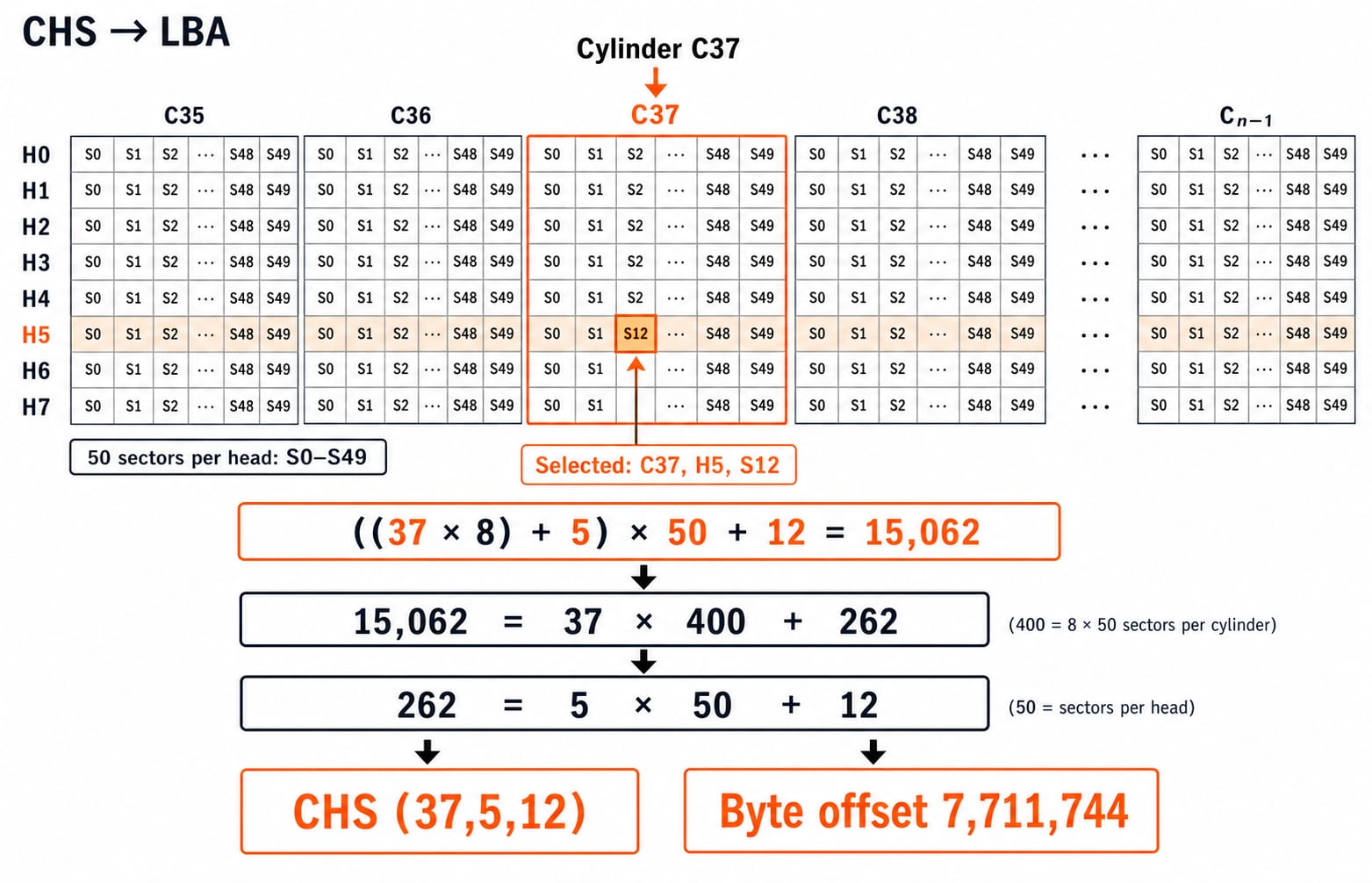
Declare the convention: cylinders are C0...C199, heads are H0...H7, and sectors are S0...S49. Sectors vary first, then heads, then cylinders. For H = 8 and S = 50:
LBA = ((c x H) + h) x S + s
Convert CHS (37, 5, 12):
((37 x 8) + 5) x 50 + 12
= (296 + 5) x 50 + 12
= 301 x 50 + 12 = 15,062
Its byte offset from the start is 15,062 x 512 = 7,711,744 bytes.
Reverse it as a check. A cylinder contains 8 x 50 = 400 sectors:
15,062 = 37 x 400 + 262, so the cylinder is 37.262 = 5 x 50 + 12, so the head is 5 and sector index is 12.
Thus LBA 15,062 maps back to (37, 5, 12). With sector labels 1...50, use (sector label - 1). Label 13 then means zero-based index 12.
Disk address bits: calculate field widths without rounding down
Minimum field width is ceil(log2 count), not floor(log2 count).
Cylinders need 8 bits because
2^7 = 128 < 200 <= 256 = 2^8.Heads need 3 bits because
8 = 2^3.Sectors need 6 bits because
32 < 50 <= 64.
Fixed-width CHS needs 8 + 3 + 6 = 17 bits. LBA also needs 17 bits because 65,536 < 80,000 <= 131,072. Equal widths do not make the representations identical.
There are 2^17 = 131,072 CHS bit patterns, but only 200 x 8 x 50 = 80,000 real sectors. The cylinder field leaves 56 codes unused, and the sector field leaves 14 codes unused.
Disk access time: separate seek, rotation and transfer
Seek moves the head to the cylinder, rotational latency waits for the sector, and transfer time moves data after positioning.
Access time = seek time + rotational latency + transfer time
Assume 7200 RPM, an average seek time of 8 ms, and 50 sectors per track. Controller and queueing overhead are excluded.
One rotation takes 60 / 7200 = 1/120 second, or 8.333... ms. Average rotational latency is half a rotation, 4.166... ms. One-sector transfer time is 8.333... / 50 = 0.166... ms. Keep precision until the final step:
8 + 4.166... + 0.166... = 12.333... ms, or 12.333 ms.
For 10 consecutive sectors on the same track, transfer takes (10 / 50) x 8.333... = 1.666... ms. Average access becomes 8 + 4.166... + 1.666... = 13.833... ms, or 13.833 ms.
For repeated random-sector access, best, average and worst rotational waits, IOPS and throughput, use Disk Access Time and Performance: Formulas, Worked Example and GATE Traps. Here, the same 4-platter, 8-surface CHS geometry stays fixed for one-sector and ten-sector timing. This calculation assumes one positioning event. Choosing the service order for several cylinder requests is a separate problem covered in Disk Scheduling MCQs: FCFS, SSTF, SCAN.
Disk structure and addressing mistakes that cost marks
The common mistakes are multiplying cylinders by heads again, treating platters as surfaces, rounding address bits down, mixing units, hiding the sector convention, and using a full rotation as average latency.
Multiplying cylinders by heads again: 200 tracks per surface means 200 cylinders and 1600 total tracks, not 1600 cylinders.
Treating four platters as four surfaces: both sides are usable here, so there are 8 surfaces and heads.
Rounding address bits down: non-power-of-two counts require a ceiling, producing 17 bits.
Mixing decimal and binary units: the capacity is 40.96 MB but 39.0625 MiB.
Hiding the sector convention:
(37, 5, 12)gives LBA 15,062 only withS0...S49.Using a full rotation as average latency: at 7200 RPM, average latency is about 4.167 ms, not 8.333 ms. A full rotation is used for a complete revolution or proportional transfer.
Geometry determines capacity and addresses. FCFS, SSTF, SCAN and C-SCAN determine request order. A combined question still requires the address calculation.
Disk structure in GATE-style questions: recognise the requested quantity
Questions usually ask for capacity, address conversion, minimum bits, or access time. Match your first scratch-paper line to the ask:
Write the unit chain for capacity.
Declare indexing for CHS and LBA.
Bracket the object count between powers of two for bits.
Expand seek plus rotation plus transfer for access time.
Here, write 8 heads, compute 400 sectors/cylinder, declare S0...S49, and keep the 7200 RPM calculation in milliseconds. Check that LBA 15,062 reverses to (37, 5, 12). Use GATE CS Exam Preparation to place the topic within the broader route.
Disk structure and addressing: the short version and next step
Keep this reusable checklist:
surfaces = platters x usable sidescylinders = tracks per surfacecapacity = surfaces x tracks/surface x sectors/track x bytes/sectorLBA = ((c x heads) + h) x sectors/track + sbits = ceil(log2 count)access = seek + average rotation + transfer
For this disk, the results are 40,960,000 bytes, CHS (37, 5, 12) equals LBA 15,062, the minimum address width is 17 bits, and average one-sector access is 12.333 ms under the stated assumptions. Redo the reverse conversion and 10-sector timing without looking.
For structured study of Operating Systems and GATE CS, continue with GATE Guidance by Sanchit Sir.
Keep learning

Multiprocessor Classification: Flynn Taxonomy, Memory Models and Exam-Style Worked Examples
Learn how to choose the right multiprocessor classification axis, then solve a four-lane SIMD trace and a NUMA average-access-time problem step by step.
Updated 27 Sep 20266 min readComputer Organization & Architecture
Interrupt-Driven I/O Explained: CPU Handshake, Worked Timing Example and GATE Traps
Trace an interrupt from device request to return-from-interrupt, then compare polling, per-event interrupts, and DMA through worked timing examples.
Updated 25 Sep 20267 min readComputer Organization & Architecture
Interface Addressing Explained: Memory-Mapped vs Isolated I/O with Worked Examples
Understand what an interface address selects, how memory-mapped and isolated I/O differ, and why partial decoding creates multiple addresses for the same register.
Updated 23 Sep 20266 min readComputer Organization & Architecture

Instruction Structure in Computer Organization: Fields, Encoding and Exam Problems
Learn how opcode, register, mode and displacement fields divide an instruction word. Follow checked examples for address forms, decoding and expanding opcodes.
Updated 22 Sep 20265 min readComputer Organization & Architecture