
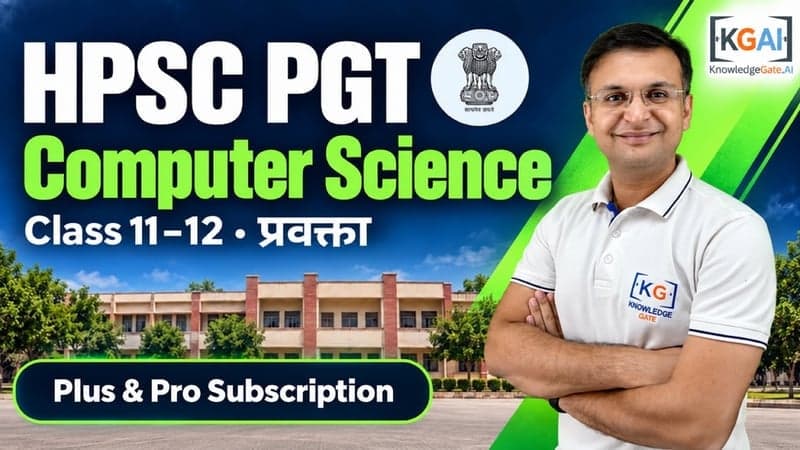
HPSC PGT Computer Science (कक्षा 11–12)
(Complete Course)
Need help choosing this course?
Our counsellor will help with pricing, syllabus, and enrollment.
About HPSC PGT Computer Science (कक्षा 11–12)
Prepare for the HPSC PGT CS 2026 interview with complete guidance, mock interviews, all CS videos, PYQs, practice questions, tests and notes.
Compare HPSC PGT Computer Science (कक्षा 11–12) with all coursesHPSC PGT Computer Science 2026 is a complete preparation programme for candidates who have qualified the written stages and are now preparing for the Interview/Viva-Voce . Against 1,672 advertised vacancies , HPSC has currently shortlisted 1,089 candidates for the interview stage. Final selection still depends on eligibility and document verification, category- and cadre-wise vacancies, written-examination marks and performance before the interview panel. The Interview/Viva-Voce carries 12.5% weightage in the final merit . The dedicated HPSC Interview Preparation Programme covers the interview blueprint, CV preparation, document verification, travel and interview-day planning, dress and grooming, etiquette, body language, and important personal, teaching-related and subject-specific questions. KnowledgeGate will also conduct mock interviews for realistic panel-style practice, to improve answers, communication and confidence. Students also continue to receive the entire HPSC PGT Computer Science course : all major Computer Science subjects, recorded video lessons, notes, PYQs, practice questions, topic-wise tests and full-length mock tests, useful for revising subject questions that may be asked in the interview. The programme combines complete interview guidance and complete Computer Science revision for shortlisted candidates.
Select Your Plan
Compare plansPro includes
- Concept Videos · All videos
- Video Solutions · Unlimited
- Test Series · All tests as per academic calendar + AI tests
- PYQs · Unlimited
- Notes & PDFs · Download
- Course Captain · Priority
What you get
- Validity
- Until 31 Dec 2027
Course Curriculum
HPSC Interview Preparation70 lessons
- Interview Preparation70 lessons
Python Language309 lessons
- Introduction to Python15 lessons
- Tokens, Variables, Data Types, I/O20 lessons
- Operators & Expressions20 lessons
- Control Flow & Looping24 lessons
- Collections & Strings61 lessons
- Functions & Modules39 lessons
- File Handling & Data Analysis75 lessons
- DSA using Python55 lessons
Data Structure & Algorithms375 lessons
- Introduction to DS6 lessons
- Array28 lessons
- Stack37 lessons
- Queue15 lessons
- Linked List20 lessons
- Tree59 lessons
- Graphs13 lessons
- Hashing15 lessons
- Algorithm Analysis9 lessons
- Sorting Algorithms43 lessons
- Minimum Spanning Trees4 lessons
- Time Complexity Analysis57 lessons
- Graph Theory58 lessons
- Shortest Path Algos11 lessons
Computer Networks259 lessons
- Introduction to CN34 lessons
- Data Communication7 lessons
- DLL: Access Control28 lessons
- DLL: Flow Control14 lessons
- Data Link Layer - Ethernet10 lessons
- Net Layer: IPv4 & Proto28 lessons
- Net Layer: IP Addressing31 lessons
- Transport Layer Services22 lessons
- TL: Congestion & UDP19 lessons
- Application Layer27 lessons
- Hardware basics9 lessons
- Network Security30 lessons
Computer System & Organisation169 lessons
- Basics of COA31 lessons
- Cache Memory Organization43 lessons
- Input Output Organisation23 lessons
- Pipelining18 lessons
- Instr Formats & Modes20 lessons
- Control Unit Design12 lessons
- Programming the Basic Computer22 lessons
Database Management System216 lessons
- Basics of DBMS18 lessons
- ER Diagram18 lessons
- Relational Model & Functional Dependencies20 lessons
- Keys & Integrity Constraints11 lessons
- Normalization (1NF - BCNF)18 lessons
- Decomposition Properties & 4NF11 lessons
- SQL47 lessons
- File Organization & Indexing25 lessons
- Transaction Management32 lessons
- Concurrency Control15 lessons
Operating Systems182 lessons
- Introduction to OS23 lessons
- Process Management13 lessons
- CPU Scheduling28 lessons
- Process Synchronization24 lessons
- Deadlock21 lessons
- Threads & Process Creation5 lessons
- Memory Management35 lessons
- Virtual Memory22 lessons
- Disc Scheduling11 lessons
Digital Logic & Circuits162 lessons
- Digital Systems & Boolean Basics5 lessons
- Logic Gates & Hardware14 lessons
- Boolean Expression19 lessons
- Boolean Minimization25 lessons
- Combinational Circuit39 lessons
- Sequential Circuits41 lessons
- Number System7 lessons
- Number Representation11 lessons
Theory Of Computation201 lessons
- Introduction to TOC17 lessons
- Deterministic FA (DFA)49 lessons
- Non-Deterministic FA31 lessons
- Regular Expressions27 lessons
- Grammar22 lessons
- Regular Language Properties14 lessons
- Pushdown Automata & CFG22 lessons
- Turing Machines19 lessons
Compiler Design128 lessons
- Intro to Compilers14 lessons
- Lexical Analysis5 lessons
- Grammar & CFG35 lessons
- Syntax Analysis: Top-Down20 lessons
- Syntax Analysis: Bottom-Up22 lessons
- Semantic Analysis & SDT11 lessons
- Intermediate Code Gen7 lessons
- Code Optimization11 lessons
- Run Time Environment3 lessons
Software Engineering128 lessons
- Fundamentals of Software Engineering18 lessons
- Software Requirements and Quality Assurance21 lessons
- Software Design, Estimation and Metrics26 lessons
- Software Testing23 lessons
- Software Maintenance and Configuration Management8 lessons
- Data Warehousing & Mining32 lessons
Introduction to Emerging Trends176 lessons
- Emerging Trends and AI44 lessons
- Sets, Relations, Functions and Discrete Mathematics / समुच्चय, संबंध, फलन और विविक्त गणित
- Trade, Marketing and Consumer Protection / व्यापार, विपणन एवं उपभोक्ता संरक्षण
- Internet of Things37 lessons
- Cloud Computing27 lessons
- अनुक्रम, श्रेणी और संयोजन / Sequences, Series and Combinatorics16 lessons
- आव्यूह और रैखिक बीजगणित / Matrices and Linear Algebra
- वास्तविक और सम्मिश्र विश्लेषण / Real and Complex Analysis2 lessons
- Mathematics Pedagogy / गणित शिक्षणशास्त्र
- International Economics / अंतर्राष्ट्रीय अर्थशास्त्र
- Electrostatics and Current Electricity / स्थिरवैद्युतिकी और धारा विद्युत
- Optics and Photonics / प्रकाशिकी और फोटोनिकी
- Folk Art and Crafts / लोक कला और हस्तशिल्प
- Analysis of Financial Statements / वित्तीय विवरणों का विश्लेषण
- Business Foundations and Entrepreneurship / व्यवसाय के आधार एवं उद्यमिता1 lesson
- Number Systems and Number Theory / संख्या पद्धति और संख्या सिद्धांत
- Solid State Physics and Electronics / ठोस अवस्था भौतिकी और इलेक्ट्रॉनिकी
- Number System / संख्या पद्धति30 lessons
- Multimedia11 lessons
- Network Access Technologies8 lessons
Digital Society & Cyber Law68 lessons
- Society, Law & Ethics15 lessons
- Teaching Aids and Educational Technology / शिक्षण सहायक सामग्री एवं शैक्षिक तकनीकी13 lessons
- Digital India and Online Services2 lessons
- Culture, Socialisation and Social Control / संस्कृति, समाजीकरण और सामाजिक नियंत्रण2 lessons
- Communication Contexts and Media / संचार के संदर्भ और माध्यम
- Public Administration and Governance / लोक प्रशासन और सुशासन3 lessons
- MS Office Applications15 lessons
- Language Design2 lessons
- Web Publishing & Hosting9 lessons
- C Fundamentals2 lessons
- Internet Fundamentals5 lessons
HPSC PGT Previous Year Paper2 lessons
HPSC Assistant Professor Previous Year Paper
Live Sessions71 lessons
- HPSC Live Sessions23 lessons
- EMRS TGT/PGT Live Class48 lessons
Full Mock Test4 lessons
HPSC PGT - MOCK Test Series5 lessons
Instructors
Sanchit Jain, Ekagra Jha, Dinesh Jakhar, Ankush Saklecha
Latest from the Blog
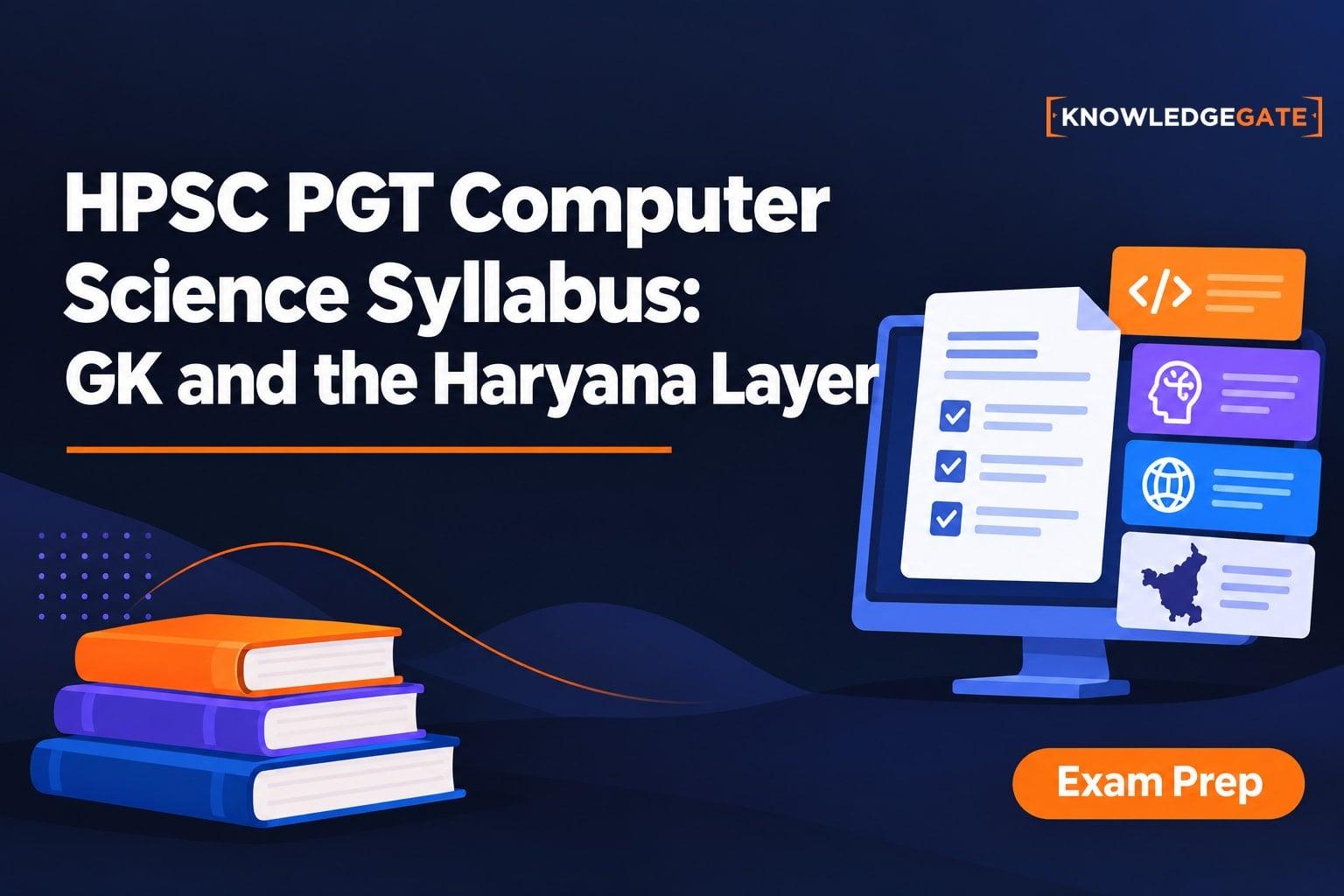
HPSC PGT Computer Science Syllabus: Subject Knowledge, GK and the Haryana Layer
See how the computer-science core, Haryana GK, general awareness and pedagogy fit together, then turn that scope into a balanced preparation plan.
Updated 30 Oct 20265 min readTeaching Recruitment (Computer Science)
HPSC PGT Computer Science: A Recurrence-Based Revision Order for the Subject Paper
Use topic recurrence from past HPSC PGT Computer Science papers to order revision, while keeping the official syllabus and current paper structure in control.
Updated 30 Oct 20267 min readTeaching Recruitment (Computer Science)

HPSC PGT Computer Science Eligibility 2026: Degree, HTET and Age Rules, Explained
Check your degree route, teaching qualification, HTET status and age against the HPSC advertisement before you invest time in the application or subject preparation.
Updated 29 Oct 20265 min read401 viewsTeaching Recruitment (Computer Science)
Frequently Asked Questions
HPSC PGT is a recruitment conducted by the Haryana Public Service Commission for Post Graduate Teacher posts, including Computer Science, at Haryana government schools. It is a subject-specific exam aimed at candidates qualified to teach at the PGT level, which generally expects a stronger and more detailed grasp of the subject than a TGT-level exam.
The HPSC PGT Computer Science 2026 course is a structured and exam-oriented preparation course designed for aspirants aiming to qualify the Haryana PGT Computer Science recruitment, covering the relevant syllabus in a systematic way. It is meant to be paired with the HPSC PGT (CS) Test Series once you have gone through the material, so you can gauge your preparation under exam-like conditions.
Yes, KnowledgeGate offers the HPSC PGT (CS) Test Series, a structured and performance-driven mock test programme designed to help aspirants prepare effectively for the Haryana PGT Computer Science exam, meant to be used alongside the main course. It is intended for use once you have worked through the syllabus, so you can practice under exam-like conditions and track your readiness before the exam.
The HPSC PGT Computer Science course is structured to take aspirants through the syllabus systematically, which works for candidates starting preparation from scratch as well as those revising specific areas, with the test series available to check preparation as you progress.
A reasonable approach is to work through the HPSC PGT Computer Science 2026 course to build up the syllabus, then use the HPSC PGT (CS) Test Series to get performance-driven mock test practice closer to the exam. This lets you build subject understanding first and then focus on exam-taking speed and accuracy as your preparation progresses.
KnowledgeGate offers dedicated Computer Science preparation courses and test series for several state and central teaching recruitments, including DSSSB, TPSC, RSSB, UPPSC, UP LT, MPPSC, KVS, NVS, EMRS, BPSC, and HPSC. Each exam has its own course built around that board's specific syllabus and pattern. Since every recruiting body sets its own eligibility and exam structure, it is best to open the specific exam page for the recruitment you are preparing for rather than relying on one general computer science course.
The courses under this category are structured around each exam's syllabus, so they work both for candidates preparing full-time and for those already teaching or working who are studying alongside their job. Recorded, structured content lets you go through the syllabus at your own pace, and where a test series is included, you can use it to check your preparation whenever it suits your schedule.
For the exams that have dedicated courses on KnowledgeGate — DSSSB, TPSC, RSSB, UPPSC, UP LT, MPPSC, BPSC, and HPSC — the courses are structured around that exam's computer science syllabus, and most are paired with a separate test series for practice. What exactly is included can vary by exam, so check the individual exam page for the specific course and test series available for that recruitment.
The course is structured as a syllabus-based preparation programme that can be worked through at your own pace via recorded content. This makes it usable both for candidates preparing full-time for UPPSC Polytechnic Lecturer recruitment and for those currently working who are studying alongside their job.
The course for either level is meant to build up the syllabus in a structured way first; the corresponding test series (BCI or SCI) is then meant for practicing under exam conditions once you have gone through the relevant topics. Using both together is how the two are designed to complement each other.
What Our Students Say
Real results, in our students' own words.