

HEXAWARE Superset
Complete Hexaware Preparation
Need help choosing this course?
Our counsellor will help with pricing, syllabus, and enrollment.
About HEXAWARE Superset
Prepare for the Hexaware placement exam with Yash Jain Sir — aptitude, English and technical sections with previous year papers and practice.
Compare HEXAWARE Superset with all coursesPrepare for HEXAWARE Placement Exam with India's No.1 Placements Trainer, Mr. Yash Jain sir who cracked 9 IT companies. This course contains Video Content covering Aptitude, English & Technical Section, Hexaware Previous Year Papers, Practice Questions
KGAI Learning Platform Features
- Hexaware Exam Complete Preparation
- Concepts & Previous Year Questions
- Topic Wise Videos, Test Series & 100+ Short Tricks
- 35,000+ Students Placed

Select Your Plan
Compare plansPro includes
- Concept Videos · All videos
- Video Solutions · Unlimited
- Test Series · All tests as per academic calendar + AI tests
- PYQs · Unlimited
- Notes & PDFs · Download
- Course Captain · Priority
What you get
- Validity
- 180 days
Course Curriculum
Quantitative Ability508 lessons
- Speed Mathematics and Basic Mathematics22 lessons
- Percentage32 lessons
- Ratio and Proportion (Ratios)32 lessons
- Average26 lessons
- Profit and Loss32 lessons
- Simple Interest and Compound Interest38 lessons
- Time and Work20 lessons
- Pipe and Cistern2 lessons
- Speed Time and Distance62 lessons
- Number System36 lessons
- HCF LCM48 lessons
- Data Interpretation20 lessons
- Age Problems2 lessons
- Mixture and Alligation62 lessons
- Partnership2 lessons
- Algebra28 lessons
- Sequence and Series (Series)16 lessons
- Mensuration and Geometry24 lessons
- Arithmetic4 lessons
Reasoning Ability245 lessons
- Puzzle Solving (Puzzles)4 lessons
- Seating Arrangements4 lessons
- Coding Decoding32 lessons
- Blood Relations4 lessons
- Directions (Direction Test)4 lessons
- Syllogisms6 lessons
- Data Sufficiency23 lessons
- Ranking, Order and Sequence4 lessons
- Series (Number and Letter Series) (Numerical Relations and Reasoning)34 lessons
- Logical Sequence Of Words14 lessons
- Calendar50 lessons
- Clock4 lessons
- Cubes & Dices12 lessons
- Analytical Reasoning (Counting Figures Reasoning)8 lessons
- Data Arrangement
- Non Verbal Reasoning (Spatial Aptitude) (Spatial Reasoning) (Visual Reasoning)32 lessons
- Deductive and Inductive Reasoning (Logical Deduction and Induction) (Prepositional Reasoning)10 lessons
Verbal Ability161 lessons
- Comprehension / Reading Comprehension / Unseen Passages (Critical Reasoning) (Paragraph Questions)15 lessons
- Cloze Test (Cloze Passage)4 lessons
- Sentence Re-arrangements (Para Jumbles) (Narrative Sequencing)4 lessons
- Vocabulary53 lessons
- Sentence Completion (Fill in the blanks)11 lessons
- Active Passive Voice (Voice)16 lessons
- Direct and Indirect Speech20 lessons
- Subject Verb Agreement (Verb Noun Agreement)4 lessons
- Tenses16 lessons
- Preposition4 lessons
- Articles2 lessons
- Sentence Correction (Error Correction)12 lessons
Programming Basics (MCQs + Interview)224 lessons
- C Programming by Yash Sir40 lessons
- Programming in C++105 lessons
- Java29 lessons
- Python for Placements by Yash Sir50 lessons
OOPs (MCQs + Interview)8 lessons
- Object Oriented Programming (OOPS)8 lessons
DBMS (MCQs + Interview)181 lessons
- Basics of DBMS18 lessons
- ER Diagram18 lessons
- Relational Model & Functional Dependencies18 lessons
- Keys & Integrity Constraints11 lessons
- Normalization (1NF - BCNF)14 lessons
- Transaction Management28 lessons
- Decomposition Properties & 4NF5 lessons
- Concurrency Control15 lessons
- Database Recovery9 lessons
- File Organization & Indexing21 lessons
- Relational Algebra16 lessons
- Database Security & Authorization8 lessons
SQL (MCQs + Interview)44 lessons
- SQL44 lessons
Operating Systems (MCQs + Interview)200 lessons
- Introduction to OS22 lessons
- Process Management14 lessons
- CPU Scheduling25 lessons
- Deadlock21 lessons
- Threads & Process Creation5 lessons
- Memory Management35 lessons
- Virtual Memory20 lessons
- Process Synchronization19 lessons
- Disc Scheduling12 lessons
- File Management18 lessons
- Security9 lessons
Computer Networks (MCQs + Interview)326 lessons
- Introduction to CN37 lessons
- Data Communication8 lessons
- DLL: Access Control28 lessons
- DLL: Flow Control14 lessons
- DLL: Error Control20 lessons
- DLL: Framing7 lessons
- Data Link Layer - Ethernet11 lessons
- Net Layer: IPv4 & Proto29 lessons
- Net Layer: IP Addressing31 lessons
- Net Layer:Routing Protocol16 lessons
- Transport Layer Services23 lessons
- TL: Congestion & UDP20 lessons
- Application Layer34 lessons
- Hardware basics10 lessons
- Network Security35 lessons
- Cloud Computing and IoT1 lesson
- Cyber and Info Security2 lessons
Coding59 lessons
- Coding Questions by Yash Sir59 lessons
HR Interview9 lessons
- MR & HR Interview Preparation9 lessons
Instructors
Yash Jain
Latest from the Blog
Hexaware Interview Questions and Answers: Technical, Coding and HR Rounds
Prepare answers that survive follow-up questions. This guide covers CS fundamentals, a worked SQL query, a coding trace, project defence, HR responses and a timed mock.
Updated 11 Nov 20266 min readCompany-Specific Prep
Hexaware Coding Questions: 4 Patterns with Worked Examples
Learn four coding patterns through exact dry runs: a reverse scan, sliding window, prefix-suffix products and spiral traversal. Each example includes complexity and edge cases.
Updated 10 Nov 20265 min readCompany-Specific Prep
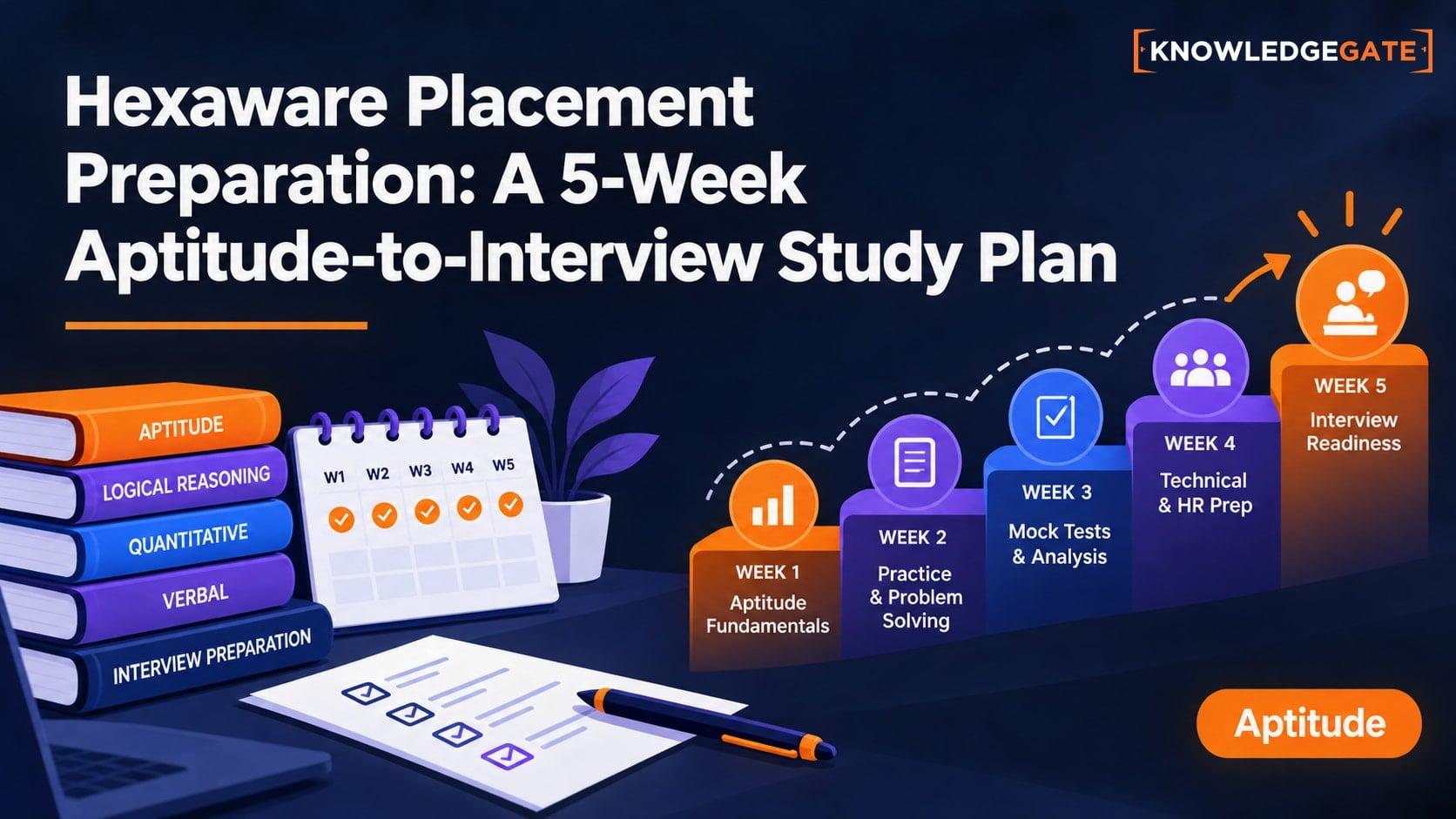
Hexaware Placement Preparation: A 5-Week Aptitude-to-Interview Study Plan
Turn your current Hexaware drive instructions into a practical five-week schedule. Diagnose gaps, protect 12 hours each week, practise under time and finish with matched simulations.
Updated 9 Nov 20266 min readCompany-Specific Prep
Frequently Asked Questions
Yes. The Deloitte NLA preparation course is built for Deloitte's National Level Assessment, and HEXAWARE Superset by Yash Jain Sir prepares you for Hexaware's placement exam, alongside the courses for Infosys, Capgemini, Cognizant, LTI Mindtree, Wipro and Accenture. Together with the other Superset courses, this rounds out coverage for most of the major IT recruiters students commonly appear for during placement season.
KnowledgeGate's placement preparation spans the full drive: a TCS track for TCS's hiring exams, a Company Specific track for exams run by Infosys, Wipro, Accenture, Cognizant, Capgemini, LTI Mindtree, Deloitte and Hexaware, an IT Recruitment Exams track for AMCAT, CoCubes, eLitmus and CDAC C-CAT, plus standalone Aptitude and Resume & Interview courses. You can pick the track that matches the stage or exam you are preparing for.
This category includes dedicated courses in C, C++, Java and Python, each covering concepts from basic to advanced level. Alongside these, there are placement-focused programmes — DSA Using Java and Coding For Placements — which build on language fundamentals and apply them to data structures, algorithms and the kind of coding and MCQ questions asked in placement drives and technical interviews.
The C Language or Python course is a good starting point, as both cover programming from basic to advanced concepts. C gives you a grounding in how programming works at a lower level, while Python is often considered easier to pick up first — either works as a foundation before moving into DSA Using Java or Coding For Placements.
Computer Science Fundamentals for Placements bundles the six core subjects recruiters ask about most, including DBMS, Operating Systems and Computer Networks, into one course, so you can prepare for interview questions across these areas together. The course is taught by Sanchit Sir and works well both as a first structured pass through these subjects and as focused revision closer to placement season.
If you are not sure which company's drive you will appear for, start with the Aptitude track, since quantitative aptitude, logical reasoning and verbal ability are tested across most placement and recruitment exams. Once you know which company or exam you are targeting, move to the matching Company Specific, TCS or IT Recruitment Exams course for exam-specific practice.
You can start working on your resume and interview skills at any point, but most students take this course once they are close to or past the written round of a drive, when interview and HR rounds are the immediate next step.
Both, depending on which exam you pick. Semester/College, built around ZERO TO HERO, is oriented toward university semester exam preparation, while Placement, built around Sanchit Sir's Computer Science Fundamentals for Placements, is oriented toward campus placement interview preparation. ZERO TO HERO takes learners from foundational to advanced-level topics, while the placement course bundles the subjects recruiters ask about most into one place.
The course is built around core computer science subjects generally rather than one specific university's syllabus, so it works as a general foundational-to-advanced route through CS concepts that overlap with most semester exam patterns. Since it is not mapped to any single university's exact syllabus, it is worth cross-checking the topics covered against your own semester schedule before relying on it as your sole study resource.
The course is taught by Sanchit Sir and is built specifically around the core computer science subjects that come up most often in campus placement interview rounds, including DBMS, Operating Systems and Computer Networks. It bundles these subjects into a single course so you can prepare for interviews across all of them together rather than through separate resources.