Boolean algebra and K-map minimization: a worked GATE guide
K-map minimization becomes routine once you can read the groupings. Six Boolean identity pairs, DeMorgan's two theorems, the SOP and POS canonical forms, and a four-variable map traced loop by loop from seven minterms and three don't-cares down to F = B' + A'D.
KnowledgeGate Team
Exam prep & CS education
Updated 15 Jul 20265 min read107 views

Minimization is where marks are won or lost in Digital Electronics. Two students can reach the same correct truth table, but the one who reduces it to the fewest literals answers faster and avoids the algebra slips that cost partial marks. The toolkit is small: six identity pairs, DeMorgan's two theorems, the SOP and POS canonical forms, and a Karnaugh map read in Gray-code order, where don't-cares work for you instead of against you.
Related reading: Boolean minimization and SOP and POS forms.
Boolean algebra: the laws that do the work
Boolean algebra operates on two values, 0 and 1, with three operations: AND (product, written as juxtaposition or a dot), OR (sum, written +), and NOT (complement, written with an overbar or a prime). A handful of identities carry almost every simplification.
Identity: A + 0 = A, and A . 1 = A.
Null: A + 1 = 1, and A . 0 = 0.
Idempotent: A + A = A, and A . A = A.
Complement: A + A' = 1, and A . A' = 0.
Absorption: A + A B = A, and A (A + B) = A.
Distributive: A (B + C) = A B + A C, and A + B C = (A + B)(A + C).
The two identities students forget under pressure are absorption and the second distributive law, and they are exactly the ones that collapse a long expression quickly. The consensus theorem, A B + A' C + B C = A B + A' C, is worth memorising too, because it removes a redundant term that a K-map would also drop.
DeMorgan's theorems
DeMorgan's two laws connect AND, OR and NOT, and they are the most tested single fact in Boolean algebra:
The complement of a sum is the product of the complements: (A + B)' = A' . B'.
The complement of a product is the sum of the complements: (A . B)' = A' + B'.
In words, break the bar and flip the operator underneath it. They generalise to any number of variables and they are the reason NAND and NOR gates are functionally complete: with DeMorgan you can rewrite any AND-OR-NOT expression using only NANDs or only NORs. When you push a complement inward through nested brackets, apply DeMorgan one level at a time and the sign errors disappear.
SOP and POS: the two canonical forms
Any Boolean function can be written in two standard shapes.
Sum of Products (SOP): an OR of AND terms, for example A B + A' C. The minterm form is the canonical SOP, where every term contains all the variables. A minterm is a product that is 1 for exactly one input combination, so you write the function as the OR of the minterms for which the output is 1: F = sum of m(1, 3, 5).
Product of Sums (POS): an AND of OR terms, for example (A + B)(A' + C). The maxterm form is the canonical POS, an AND of the maxterms for the input rows where the output is 0. Take the same three-variable F: its 1-rows are 1, 3 and 5, so its 0-rows are 0, 2, 4, 6 and 7, and F = product of M(0, 2, 4, 6, 7).
Minterms and maxterms are complementary indexings of the same truth table, which is why an SOP built from the 1-rows and a POS built from the 0-rows describe the same function. Choose SOP when the function has few 1s and POS when it has few 0s; the smaller list is less error-prone.
A four-variable K-map, traced group by group
A Karnaugh map is a truth table redrawn so that physically adjacent cells differ in exactly one variable, which is why the rows and columns are labelled in Gray-code order (00, 01, 11, 10) rather than binary counting order. Grouping adjacent 1s into rectangles of size a power of two lets you read off the minimal SOP directly.
Take F(A, B, C, D) = sum of minterms m(0, 1, 2, 5, 8, 9, 10) with don't-cares d(3, 7, 11). Place a 1 in each listed minterm cell, an X in each don't-care cell, and 0 everywhere else, on a map with AB labelling the rows and CD the columns.
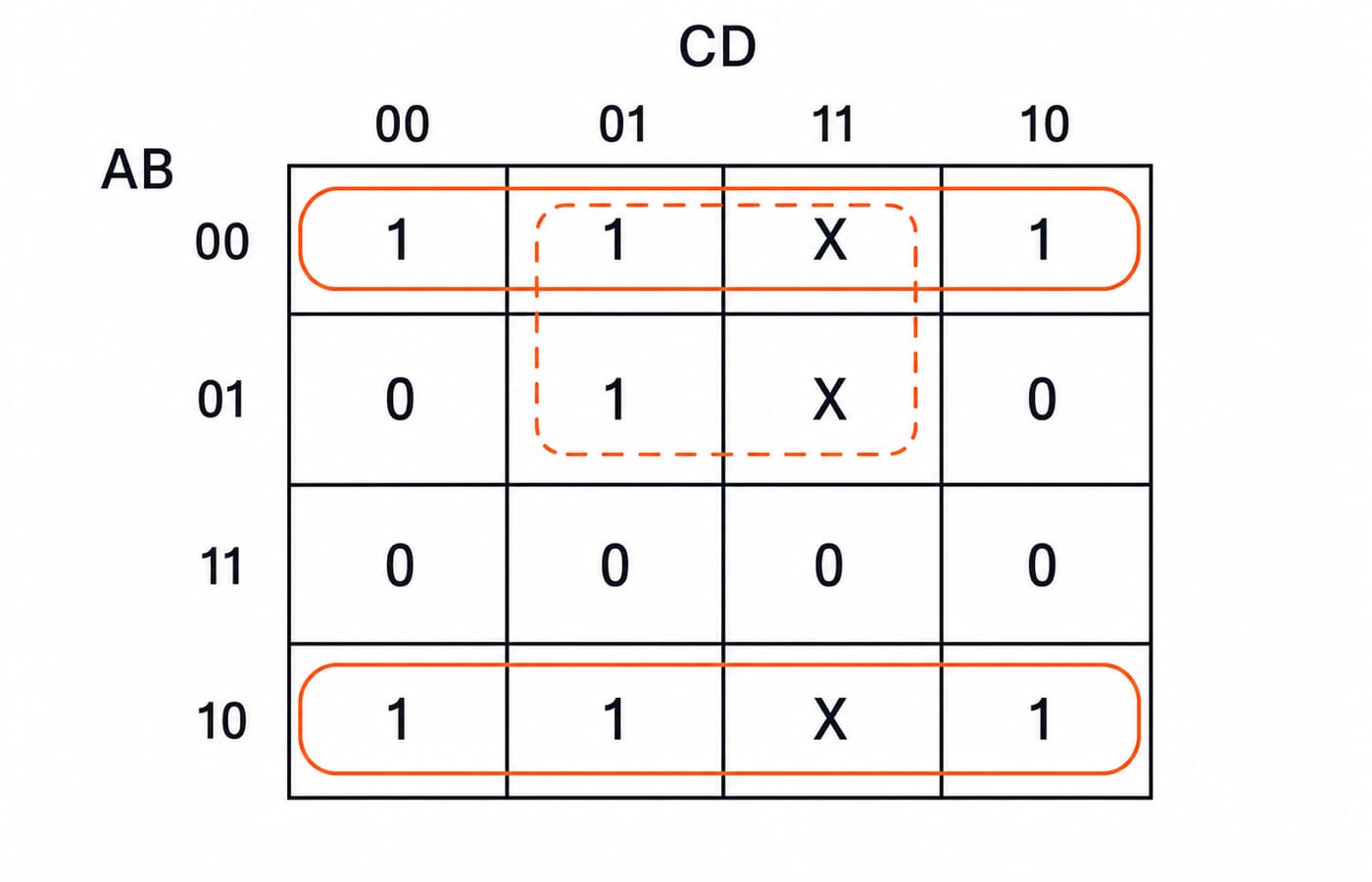
Now group, always making each loop as large as possible and using don't-cares only when they enlarge a group:
The eight cells where B = 0 (rows AB = 00 and AB = 10) hold 1s and the usable don't-cares at 3 and 11, forming a group of eight. A group of eight in a four-variable map leaves one variable, and here every cell has B = 0, so this group reduces to the single literal B'.
Minterms 1 and 5, with the don't-cares at 3 and 7 assisting, form the quad {1, 3, 5, 7} where A = 0 and D = 1, reducing to A' D. Reading the shared literals of the loop gives the term directly.
Minterms 0, 1, 2, 8, 9 and 10 all sit inside the size-eight B' group, so they need no term of their own. The only 1 left over is minterm 5, which the A' D quad picks up, so two terms cover the whole function.
Reading the loops off the map, the minimal expression is F = B' + A' D. Two terms, three literals, down from seven minterms of four literals each. That is the entire payoff of the method: the map does the absorption and consensus steps visually so you do not have to grind them algebraically. The one discipline that matters is to loop the largest legal rectangle first and to include a don't-care only when it grows a group, and the fastest way to make that automatic is to work through a dozen more maps on the Boolean Minimization learn module.
How this is tested in GATE
Boolean minimization is a dense pool: over 250 practice questions sit under Boolean Minimization and over 150 more under Boolean Expression, inside a Digital Electronics set of over 1,500 questions in all. The exam patterns are steady. You will see a "minimum number of literals" or "minimum number of gates" question that is really a K-map in disguise, a DeMorgan or consensus simplification asked as an equivalence, and a prime-implicant counting question where don't-cares change the answer. Essential prime implicants, the groups that cover a 1 no other group can, are a favourite because candidates rush the grouping and miss one.
The recurring mistake is grouping in binary order instead of Gray order, which breaks adjacency and produces wrong terms. The second is treating a don't-care as a mandatory 1, which over-constrains the solution. Both vanish with practice on real maps.
The short version
Memorise absorption, DeMorgan and consensus, learn to read minimal SOP straight off a K-map, and always loop the biggest rectangle first. For the full GATE build-up, where Boolean algebra follows number systems and leads into combinational design, GATE Guidance by Sanchit Sir sequences it properly, and the CS Fundamentals category gathers the rest.
Keep learning
NOT, OR and AND Gates: Evolution, Truth Tables and a Worked Circuit
Learn how NOT, OR and AND gates developed from switching ideas, then trace F=(A+B')C node by node and confirm it with a complete truth table.
Updated 23 Oct 20265 min readDigital Logic
Binary Arithmetic Operations Explained: Rules and Worked Examples
Learn binary addition, subtraction, multiplication and division with aligned worked examples, then separate carry, borrow and two's-complement overflow.
Updated 19 Oct 20266 min readDigital Logic

1's Complement Explained: Binary Conversion, Addition and Worked Examples
Learn how fixed-width 1's complement numbers represent negatives, why zero has two encodings, and how end-around carry works through exact examples.
Updated 15 Oct 20266 min readDigital Logic
Decimal Conversion Explained: Binary, Octal and Hexadecimal Worked Examples
Learn one dependable method for converting values between decimal, binary, octal and hexadecimal, including fractions, shortcuts and checks.
Updated 11 Oct 20265 min readDigital Logic