Digital Electronics for GATE: Official Syllabus Map, Weightage Logic and Prep Order
Turn the compact GATE CS Digital Logic syllabus into a practical study sequence, then learn how to audit past-paper weightage without treating it as a forecast.
KnowledgeGate Team
Exam prep & CS education
Updated 4 Aug 20265 min read
Coaching material calls the subject Digital Electronics, while the official GATE 2026 CS syllabus calls it Digital Logic and covers it in one compact line. That line runs from Boolean algebra to computer arithmetic and stops there. It also sets no marks quota for the subject, which is why the weightage figures traded around in prep groups have no official source behind them. Two things work instead: a year-and-session count from completed papers, and a prerequisite order built from the official wording.
Related reading: Boolean algebra and K-maps and sequential circuits.
Digital Logic in the official GATE CS syllabus
IIT Guwahati's GATE 2026 CS syllabus PDF listed Boolean algebra, combinational and sequential circuits, minimisation, number representations, and computer arithmetic, including fixed and floating point.
Official phrase | What to learn | Typical task |
|---|---|---|
Boolean algebra | Identities, gates, canonical SOP/POS | Simplify an expression |
Minimisation | K-maps and implicants | Find a minimum form |
Combinational circuits | MUX, decoders, encoders, adders | Realise a function |
Sequential circuits | Latches, flip-flops, registers, counters | Trace clocked state |
Number representation and arithmetic | Complements, range, overflow, floating point | Interpret bits or detect overflow |
That wording is the boundary. Analog electronics and semiconductor-device theory may belong to a broader college course, but not to this GATE CS Digital Logic line.
What Digital Electronics weightage can honestly mean
The official GATE 2026 pattern assigned 15 marks to General Aptitude, 13 to Engineering Mathematics and 72 to CS subject questions in a 100-mark paper. It did not reserve a fixed number for Digital Logic.
Take a completed paper that carries two 1-mark Digital Logic questions and one 2-mark question; the same arithmetic works for any paper you audit. The contribution is:
1 + 1 + 2 = 4 marks
That is 4/72 × 100 = 5.56%, or about 5.6%, of the core-subject marks. It is also 4/100 × 100 = 4% of the whole paper.
Build a sheet with one row per question and columns for year, session, question number, topic, question type and marks. Keep multiple CS sessions separate. One session is evidence about that paper, not a permanent rule.
Use practice density to choose depth, not predict marks
KnowledgeGate's Digital Electronics practice set runs to over 1,500 questions, and it is deepest around number systems and representation, Boolean expressions and minimisation, combinational circuits, and sequential circuits. Those four areas are where you can drill until the patterns become automatic. Density tells you where practice is available, not how many marks a future paper will carry.
For the wider paper context, use the GATE CS Exam category. Keep three things separate: the official syllabus defines scope, completed-paper audits describe history, and the practice set supports learning.
An 18-session preparation order
Use 18 focused sessions of 90 minutes each:
Sessions 1 to 3: number systems, complements, ranges and fixed-point arithmetic.
Sessions 4 to 6: gates, Boolean laws and canonical forms.
Sessions 7 to 9: K-map minimisation.
Sessions 10 to 12: MUX, decoder, encoder, adders and subtractors.
Sessions 13 to 15: latches, flip-flops, registers and counters.
Session 16: floating-point representation and overflow.
Session 17: mixed previous-year questions.
Session 18: a timed subject test followed by error-log review.
Six sessions per week takes three weeks; three per week takes six. If you miss a day, move the session instead of squeezing two tired sessions together. GATE Guidance by Sanchit Sir follows the same prerequisite logic through Boolean basics, gates, expressions, minimisation, circuits, number systems and representation.
Worked examples: K-map to multiplexer, and an overflow check
Consider:
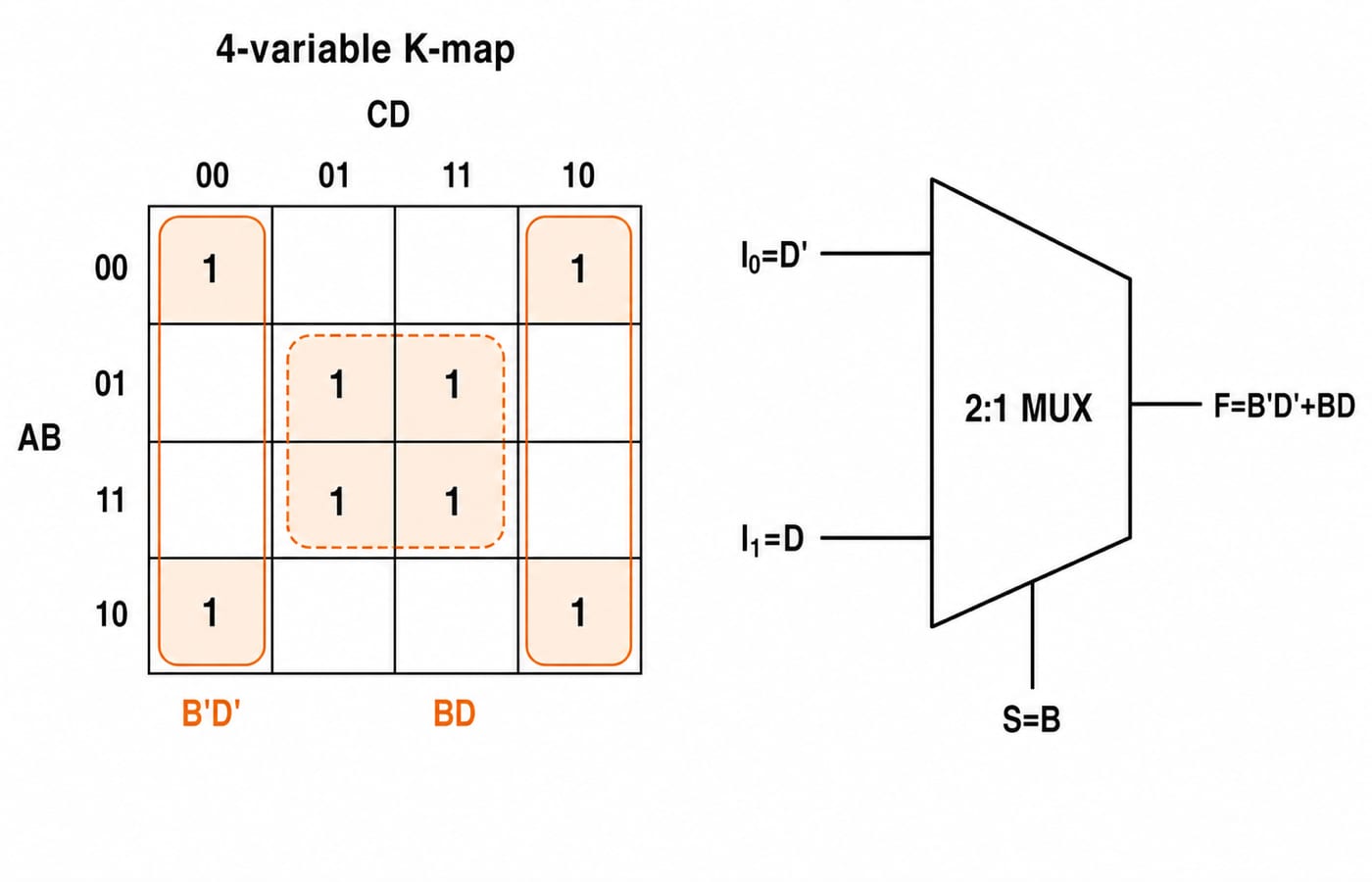
F(A,B,C,D) = Σm(0,2,5,7,8,10,13,15)
On a four-variable K-map, group {0,2,8,10}. Here B = 0 and D = 0 stay constant while A and C vary, giving B'D'.
Group {5,7,13,15}. Here B = 1 and D = 1 stay constant while A and C vary, giving BD.
So:
F = B'D' + BD = B XNOR D
Each quartet spans both values of A and C, so they disappear. The Boolean algebra and K-map guide develops this method.
Realise it with one 2:1 multiplexer. Choose B as select, with I0 = D' and I1 = D. Check the (B, D) pairs: 00 -> 1, 01 -> 0, 10 -> 0, 11 -> 1, the XNOR truth table. The combinational circuits guide connects expressions to MUX implementations.
Number representation carries the same demand: finish the computation, do not stop at the bit pattern. Add 0111 + 0011 in 4-bit two's complement and the register holds 1010, which reads as -6, while the true sum is 10. Four bits span only -8 to +7, so the sum has left the range. The signature to look for is two positive operands producing a negative result, which is always overflow.
How GATE can test one concept in three formats
Under the official GATE 2026 pattern, MCQ, MSQ and NAT questions carried 1 or 2 marks. A wrong 1-mark MCQ lost one-third mark, and a wrong 2-mark MCQ lost two-thirds. MSQ and NAT had no negative marking, and MSQ had no partial marks. Confirm these rules on the organising institute's official GATE portal for your own exam cycle.
The function could become an MCQ for the minimal expression, an MSQ for equivalent implementations, or a NAT for minimum gate count. Sequential topics get the same treatment as a state trace: a 3-bit modulo-8 counter runs 000 -> 001 -> 010 -> 011 -> 100 -> 101, and after 13 rising edges from 000 it sits at 101, because 13 mod 8 = 5.
Four mistakes that distort preparation
Memorising a fixed 4-mark label. Papers vary, and the official pattern sets no Digital Logic quota. Replace the label with a year-and-session audit.
Stopping after Boolean simplification. Practise expression-to-circuit and circuit-to-expression conversion, as in the K-map-to-MUX example.
Skipping fixed and floating-point arithmetic. The GATE 2026 CS syllabus explicitly kept both inside Digital Logic.
Reading counter notes without drawing states. Trace every clock edge and record errors instead of relying on passive revision.
The short version and the next action
Read the official line, follow prerequisites, audit completed papers, solve mixed formats, then test under time pressure. Start with sessions 1 to 3, solve 25 mixed questions, and tag each miss as concept, algebra, state trace or arithmetic.
After all 18 sessions, use the GATE Test Series, which includes a dedicated Digital Electronics block. Your own accuracy, error patterns and timing will give you a better preparation signal than any fixed weightage claim.
Keep learning
Functional Completeness in Digital Logic: NAND, NOR and Worked Examples
Learn what makes a Boolean operator set complete, how NAND and NOR recover a standard basis, and how to verify a four-gate NAND construction.
Updated 2 Oct 20266 min readDigital Logic
Boolean Function Counts: Formulas, Worked Examples and Exam Traps
Build the master Boolean-function formula from output choices, then learn how common restrictions change the count through combinations, pairing and inclusion-exclusion.
Updated 27 Sep 20266 min readDigital Logic
Analog-Digital Conversion Basics: ADC, DAC, Worked Examples and Exam Patterns
Build ADC and DAC basics from one consistent transfer model, then practise code selection, reconstruction error, flash and SAR conversion, and bit-depth calculations.
Updated 25 Sep 20266 min readDigital Logic

Universal Realization with NAND and NOR Gates: Concepts, Worked Example and Exam Patterns
Learn why NAND and NOR are universal, then implement one three-variable function using four NAND gates and four NOR gates with verified input traces.
Updated 23 Sep 20265 min readDigital Logic