CAT Profile Factors in IIM Selection: What Counts After the Test
See how selected IIM policies convert academics, eligible work experience, diversity and interview performance into shortlist and final-score components.
KnowledgeGate Team
Exam prep & CS education
Updated 7 Aug 20266 min read
Your CAT score has arrived. Now the questions shift to Class 10, Class 12, graduation, a fresher profile, work experience and interview performance. CAT can qualify your file for consideration, but each IIM independently builds its shortlist and final merit score. IIM Ahmedabad, IIM Calcutta and IIM Lucknow each turned the same profile into points differently for 2026-28, so the work now is converting your own marks and months into each institute's scale, not predicting admission from one percentile.
Related reading: CAT score normalisation and CAT mock analysis.
CAT is one input across two selection stages
The usual sequence is CAT result, institute-specific eligibility screening, shortlist calculation, a written ability test (WAT at IIM Lucknow and Calcutta, AWT at IIM Ahmedabad) with a personal interview (PI), then a final composite score. A factor can carry one weight before PI and another after it, or appear at only one stage.
The official 2026-28 policies, based on CAT 2025, show this independence clearly. IIM Ahmedabad said its AWT-PI shortlist was independent of other IIMs. IIM Calcutta said meeting minimum eligibility did not ensure shortlisting. A published minimum permits consideration. It does not guarantee a call or offer.
Use the PG Entrance Exams category as a route to broader MBA and CAT preparation, but use the relevant institute policy for selection calculations.
Academic marks become converted points
For its 2026-28 shortlist, IIM Calcutta assigned up to 56 points to CAT, 10 to Class 10, 15 to Class 12 and 4 to gender diversity, totalling 85. Its tables converted school percentages into points.
Candidate R has 78% in Class 10 and 82% in Class 12, landing in bands worth 8 + 15 = 23 academic points out of 25. Candidate S has 81% and 74%, giving 10 + 9 = 19 out of 25. S is ahead on Class 10 and still 4 points behind, because Class 12 carries 15 of those 25 and the bands move in steps, not as a percentage carried across. Read your own two percentages off the institute's conversion table before totalling, and note that neither total is a percentage or an admission probability.
IIM Ahmedabad used a different conversion rule for that batch: 0.35 times a normalised Application Rating plus 0.65 times a normalised CAT score for shortlisting. A CAT percentile must never be inserted directly as points out of 100.
Work experience means eligible months with proof
IIM Lucknow's 2026-28 MBA shortlist used WE = min((x - 6) × 0.50, 10) for completed eligible months x above six. The calculation is:
6 months: 0 points.
18 months: (18 - 6) × 0.50 = 6 points.
26 months: (26 - 6) × 0.50 = 10 points.
36 months: (36 - 6) × 0.50 = 15, capped at 10 points.
That was IIM Lucknow's rule for one batch's shortlist, not a general CAT formula: its own final table capped work experience at 5 points, half the shortlist cap.
Under that Lucknow example, full-time work after graduation counted. IIM Calcutta's cited policy excluded internships, apprenticeships, articleship, training, curricular projects and unpaid work. Keep employer letters showing dates, designation and role, the requested payslips, and accepted registration, licence or tax proof for self-employment. Do not round months up or treat an offer letter as completed service.
Diversity uses defined categories and stages
IIM Lucknow's 2026-28 MBA shortlist awarded 5 points for a non-engineering bachelor's discipline and 5 for female gender. Its final table combined diversity into a 5-point component, so shortlist points could not simply be carried forward.
IIM Calcutta's final academic-diversity table gave 0 to an engineering bachelor's category, 4 to a non-engineering bachelor's category and up to 6 for specified professional-qualification combinations. Its shortlist separately gave 4 gender-diversity points to female and transgender candidates.
Classify the degree exactly as the institute defines it, submit the specified proof, and model both zero and awarded cases. Do not convert informal internet labels into official categories.
WAT, AWT and PI can reorder candidates
The same file is scored three different ways at the final stage, and the personal interview is the largest single block in all three. IIM Lucknow used CAT 30, Class 12 5, graduation 5, diversity 5, work experience 5, WAT 10 and PI 40. IIM Calcutta used CAT 30, PI 48, WAT 8, academic diversity 6 and work experience 8. IIM Ahmedabad used multipliers of 0.50 for PI, 0.10 for AWT, 0.25 for CAT and 0.15 for Application Rating.
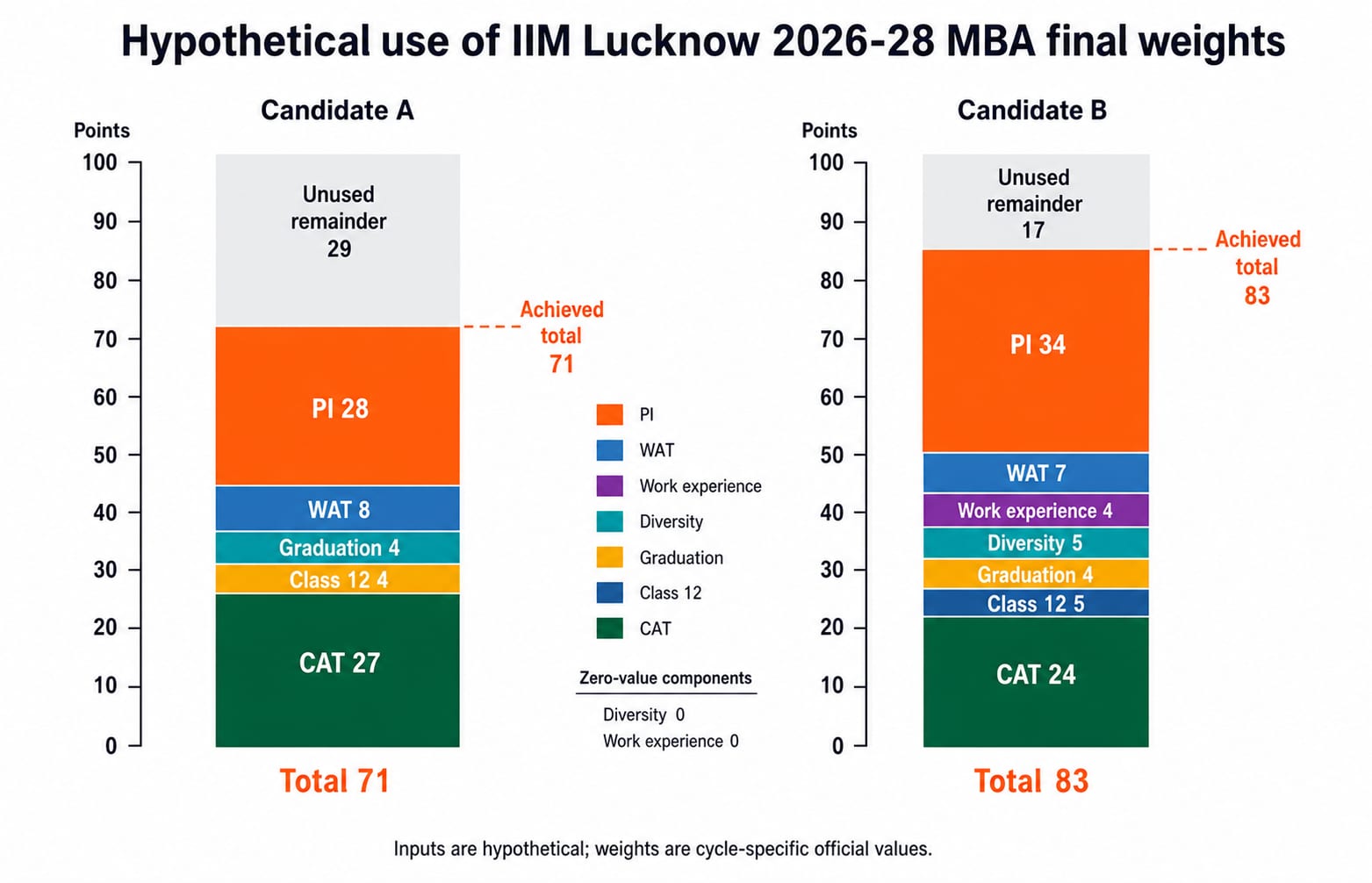
Inside Lucknow's 100-point framework, after all institute conversions:
Candidate A: 27 + 4 + 4 + 0 + 0 + 8 + 28 = 71.
Candidate B: 24 + 5 + 4 + 5 + 4 + 7 + 34 = 83.
Candidate B is 3 points lower on CAT but gains 10 profile points across Class 12, graduation, diversity and work experience, loses 1 on WAT, and gains 6 on PI. Strip PI out and B still leads 49 to 43, so the profile points reverse the CAT order on their own. The ceiling cuts the other way: A at a perfect 40 in PI would reach 83 and only draw level, so a 40-point interview block reorders candidates who arrive a few points apart, not one who arrives twelve behind. That policy also required at least 12 out of 40 in PI for the 2026-28 MBA final merit list.
Reject common CAT profile myths
A very high CAT percentile does not guarantee a call. Minimum cutoffs are gates, while separate composite formulas, category-wise merit lists and actual shortlist thresholds still matter.
A fresher, engineer, gap year or low school score has no single fixed penalty across IIMs. Zero work-experience points for a fresher are not a universal rejection, and a gap should be explained honestly in PI without inventing a numerical deduction.
Internships and family-business claims also do not automatically count. Track eligible months, excluded periods and proof gaps separately.
Build a post-CAT action sheet
Create one row per institute and one column for everything that can move your number:
Policy URL and batch year.
Eligibility gates as the policy prints them.
Shortlist components with their maximum points.
Final components with their maximum points, which usually differ from the shortlist ones.
Your converted points, read off the institute's own tables.
Missing documents, one line per proof you cannot yet produce.
WAT or AWT format.
The PI minimum where one is printed (IIM Lucknow's was 12 out of 40).
The application deadline.
Begin at the official CAT portal and recheck each institute page before submitting, because every new cycle reissues these numbers.
For PI answers, adapt the claim, evidence, result and reflection structure from HR Interview Questions for Freshers and Answers. The resume guide for freshers can sharpen evidence and achievement wording, but the IIM form and required proofs override job-resume conventions.
The short version
CAT gets the file considered. Academics, eligible experience and defined diversity rules shape institute-specific scores, while WAT, AWT and PI can change the final order. Only the current official policy settles the calculation. For a future attempt or a structured rebuild across CAT sections, the CAT Preparation Course sequences the section work for you. What no course can move is an institute's weights, which is exactly why the scorecard is worth building.
Keep learning

CAT Mock Analysis: Diagnose Time, Accuracy and Question Choice
Turn one mock into a practical review sheet. Separate execution, selection and reach problems, then test one measurable rule per section.
Updated 22 Aug 20265 min readMBA Entrance (CAT)

CAT for Non-Engineers: Build a Quant Foundation Before Chasing Shortcuts
Use this 12-week quant plan to find your real gaps, rebuild core relationships, revisit errors and add timed mixed practice only when the foundation is ready.
Updated 20 Aug 20266 min readMBA Entrance (CAT)

CAT Preparation for Working Professionals: A Sustainable 10-Hour Week
Build a repeatable CAT week around a full-time job, then use completed work and error patterns to decide what the next 600 minutes should contain.
Updated 18 Aug 20266 min readMBA Entrance (CAT)
CAT Quant for Non-Engineers: A 16-Week Foundation Plan Without Shortcuts
Rebuild CAT quant in dependency order: a 24-question diagnostic, a 16-week 160-hour map, an exact 10-hour week, an accuracy gate and a missed-day rule.
Updated 16 Aug 20265 min readMBA Entrance (CAT)