CAT Exam Pattern: Balance VARC, DILR and Quant Without Equal Study Time
A balanced CAT result does not demand a 4:4:4 study split. Use mock evidence to give each section the practice time and block length it currently needs.
KnowledgeGate Team
Exam prep & CS education
Updated 5 Aug 20265 min read

A first-time aspirant may assume a balanced CAT result requires one-third of study time for each section. It does not. The output can be balanced while the training input follows the size and type of each weakness. If DILR is where whole sets get abandoned and VARC is already accurate, the two should not draw the same weekly hours, and the split should move again as soon as the mock evidence moves. Diagnose first, allocate second, and treat every ratio as a starting position that a checkpoint can overturn.
CAT exam pattern: what to use and what to recheck
CAT is a computer-based test built from three sections taken in a fixed order: Verbal Ability and Reading Comprehension (VARC), then Data Interpretation and Logical Reasoning (DILR), then Quantitative Ability (QA). Each section runs on its own clock, and once that clock ends you cannot go back to it. That is the structural reason the three behave like three preparation tracks rather than one syllabus: a section you under-prepare cannot be rescued with spare minutes borrowed from a section you find easy.
The scorecard reports a sectional percentile alongside the overall percentile, and many institutes screen on both. A strong VARC percentile therefore does not always cover a weak DILR percentile, and each institute publishes its own screening rule.
Question counts, sectional timing, total marks and negative marking do change between cycles. Take those numbers from the current notification and the mock instructions on the official CAT website before planning around any exact figure. What does not change: separate sections need separate diagnoses, and separate diagnoses almost never produce equal weekly hours.
Why VARC, DILR and QA consume time differently
The work unit changes by section. VARC rewards reading, passage decisions and option elimination. DILR needs uninterrupted set selection, representation and solving. QA combines concept repair, timed questions and retests.
Three practice blocks make the difference concrete:
VARC: two RC passages plus six verbal questions in 35 minutes, then 15 minutes of review. Total: 35 + 15 = 50 minutes.
DILR: inspect and attempt two sets in 45 minutes, then spend 25 minutes rebuilding the table or diagram. Total: 45 + 25 = 70 minutes.
QA: attempt 20 mixed questions in 45 minutes, then classify and re-solve errors for 30 minutes. Total: 45 + 30 = 75 minutes.
Equal session counts create unequal hours. Identical blocks can cut off useful DILR and QA review.
Diagnose the bottleneck before dividing the week
Start with one current-format mock and three section drills. Record attempts, correct and wrong answers, abandoned DILR sets, the reason for each error, and review time. One mock locates the largest leak; it does not settle a level. Take a second before you trust any accuracy figure, because one bad passage can swing an 18-question sample by several points.
Suppose Aditi records this baseline:
Section | Baseline | Diagnosis |
|---|---|---|
VARC | 18 attempted, 13 correct, 5 wrong; 13/18 = about 72% practice accuracy | Option-level accuracy needs review |
DILR | 4 sets inspected, 1 completed; 3 abandoned after 8, 12 and 15 minutes | Selection and persistence are leaking time |
QA | 14 attempted, 7 correct, 7 wrong; 4 concept errors, 2 calculation errors, 1 rushed read | Concept repair is the largest gap |
The initial hours should follow these diagnoses, not the mere fact that CAT has three sections.
Worked example: divide a 12-hour week unequally
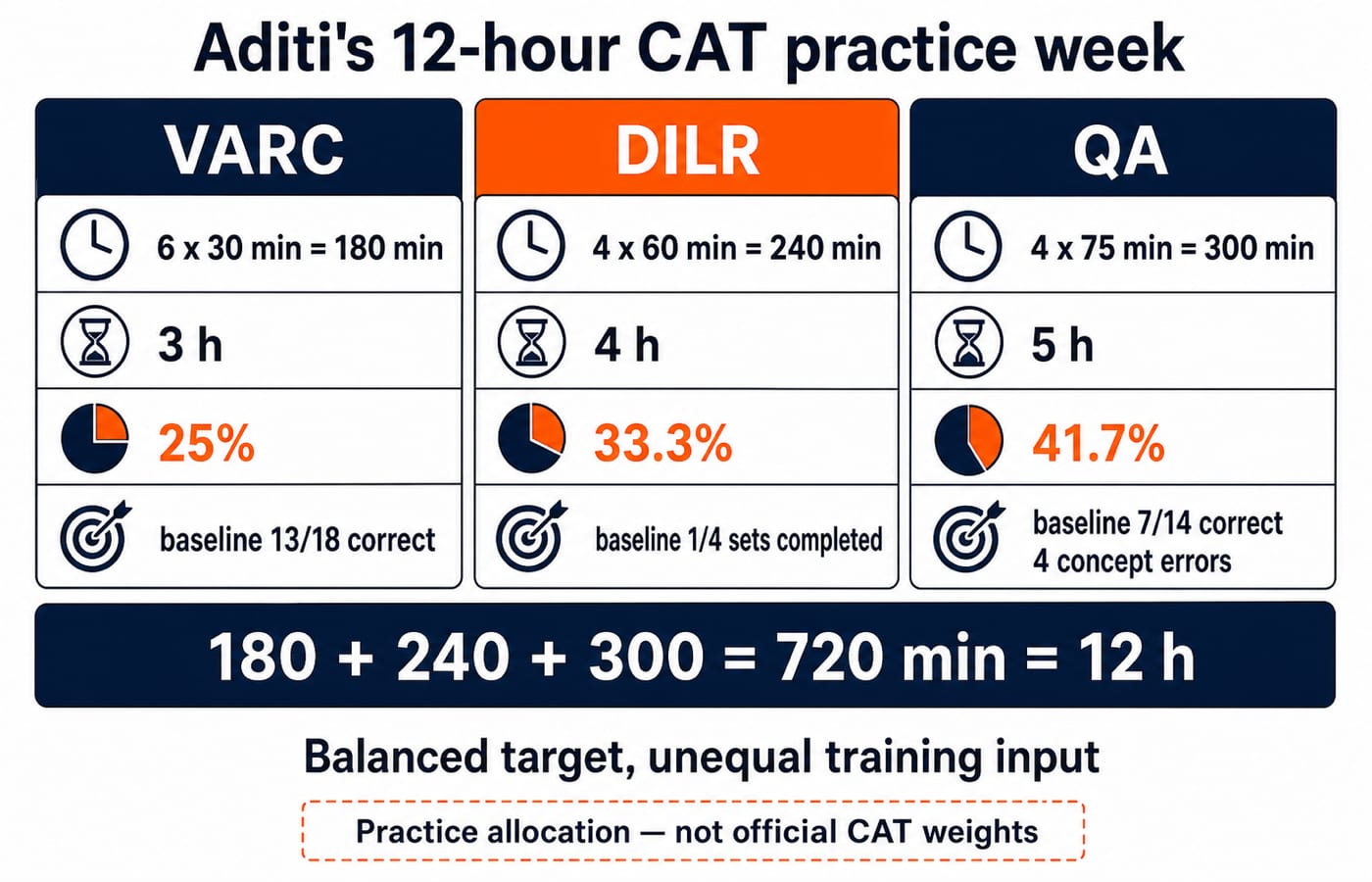
Twelve hours gives Aditi 12 x 60 = 720 minutes. Allocate 180 minutes to VARC, 240 to DILR and 300 to QA.
Section | Minutes | Share | Executable shape |
|---|---|---|---|
VARC | 180 | 180/720 = 25% | 6 x 30-minute contacts |
DILR | 240 | 240/720 = 33.3% | 4 x 60-minute protected blocks |
QA | 300 | 300/720 = 41.7% | 4 x 75-minute blocks |
The check is 180 + 240 + 300 = 720 minutes, a 3:4:5 split of practice hours. The ordering comes straight from the baseline. QA carries four concept errors, and concepts need teaching time before timed practice, so it takes the largest share. DILR loses whole sets, so it needs blocks long enough to select, solve and rebuild one. VARC is already at 13 of 18, so it needs frequent maintenance rather than repair.
A 60-minute DILR block is only worth its length if the first 10 minutes pick a set worth finishing. Run the four-step filter in CAT DILR Set Selection: The Four-Step Filter during that scan, and log an abandoned set as a selection failure rather than a solving failure.
Put different work inside each section's hours
Split VARC's 180 minutes into 120 for passage and verbal practice and 60 for option review. That review hour, not the passage count, is where accuracy is built, and CAT VARC Reading Accuracy: A 6-Week Plan sets out a longer version of it. In each DILR block, spend 10 minutes scanning and selecting, 35 solving and 15 reconstructing. Thus, 10 + 35 + 15 = 60 minutes and 4 x 60 = 240 minutes.
Split QA's 300 minutes into 120 for concept repair, 120 for timed mixed practice and 60 for error-log retests. After a 10-question ratio drill gives 6 correct and 4 wrong, label the errors: two equation-setup errors, one arithmetic slip and one rushed read. Re-solve all four without notes, then retest them two days later with changed values.
Send that concept-repair time to arithmetic and algebra before any advanced topic, because a shaky ratio or percentage base makes every later chapter slower. CAT Quant Preparation: Arithmetic and Algebra First gives the order to work through.
Rebalance after two weeks, not after one bad day
At the two-week checkpoint, repeat the process measures. Suppose VARC moves from 13/18 to 15/18 correct, DILR from 1/4 to 2/4 sets completed, and QA from 7/14 to 10/14 correct. Two readings show a direction, not a level, so wait for the third checkpoint before calling a section fixed.
DILR remains the clearest bottleneck while QA's concept errors fall. Next fortnight, move one hour from QA to DILR: VARC 3 hours, DILR 5 hours and QA 4 hours. The total remains 3 + 5 + 4 = 12 hours.
Change only one or two hours at a checkpoint, and keep contact with every section. If a difficult week loses two hours, remove one lower-priority 60-minute block from each stronger area rather than deleting the weak section entirely.
Equal-time traps, the short version and the next step
Three traps are common: a neat 4:4:4 split without evidence, hours assigned by enjoyment, and passive lectures counted as practice. Replace them with this loop: diagnose, allocate, practise, review and rebalance.
Keep VARC contact frequent, protect DILR blocks long enough to select and finish sets, and concentrate QA time where concept errors recur. Balanced preparation neglects no section in practice. It does not mean identical minutes.
Tonight, record the process measures from your latest mock, draft a 12-hour 3:4:5 week, and schedule the first checkpoint. If you would rather start from a sequence someone has already built, the CAT Preparation Course carries the section-wise plan and the mock cycle together. If MCA or other management entrances are also on your shortlist, the PG Entrance Exams category collects those guides.
Keep learning

CAT Mock Analysis: Diagnose Time, Accuracy and Question Choice
Turn one mock into a practical review sheet. Separate execution, selection and reach problems, then test one measurable rule per section.
Updated 22 Aug 20265 min readMBA Entrance (CAT)

CAT for Non-Engineers: Build a Quant Foundation Before Chasing Shortcuts
Use this 12-week quant plan to find your real gaps, rebuild core relationships, revisit errors and add timed mixed practice only when the foundation is ready.
Updated 20 Aug 20266 min readMBA Entrance (CAT)

CAT Preparation for Working Professionals: A Sustainable 10-Hour Week
Build a repeatable CAT week around a full-time job, then use completed work and error patterns to decide what the next 600 minutes should contain.
Updated 18 Aug 20266 min readMBA Entrance (CAT)

CAT Quant for Non-Engineers: A 16-Week Foundation Plan Without Shortcuts
Rebuild CAT quant in dependency order: a 24-question diagnostic, a 16-week 160-hour map, an exact 10-hour week, an accuracy gate and a missed-day rule.
Updated 16 Aug 20265 min readMBA Entrance (CAT)