CAT for Non-Engineers: Build a Quant Foundation Before Chasing Shortcuts
Use this 12-week quant plan to find your real gaps, rebuild core relationships, revisit errors and add timed mixed practice only when the foundation is ready.
KnowledgeGate Team
Exam prep & CS education
Updated 20 Aug 20266 min read

You may recognise the symbols in a quant solution yet be unable to explain why its setup works. Collecting tricks then feels productive. But a shortcut remembered without its conditions fails when the numbers or wording change. If your degree was in commerce, arts, law or the life sciences, the last time anyone taught you to turn a worded condition into an equation was probably school. The gap is disuse, not ability, and twelve weeks of the right contact closes it.
CAT quant for non-engineers: what your background costs and what it does not
Coverage is not the problem. The four areas this plan drills, arithmetic, algebra, geometry and number systems, are school-level topics that a B.Com, BA, BSc or LLB graduate has already met, and none of them needs calculus. A technical degree buys no extra topics, only years of daily contact with numbers. You are short of contact, not coverage, and contact rebuilds in weeks.
Three reflexes decay first, and each has a cheap drill. Fraction and percentage interchange: hold 7/8 = 0.875 = 87.5%, so 87.5% of 640 is 640 - 640 / 8 = 640 - 80 = 560, with no long multiplication. Estimation before arithmetic: 37 x 43 = (40 - 3)(40 + 3) = 1600 - 9 = 1591, faster than the long method and close enough to reject a wrong option on sight. Translation: take three worded lines a day and write only the equation, never the solution. Ten minutes of this at the start of a session is enough; reflexes return with frequency, not with hours.
Use four stages: understand the relationship, drill one skill, retrieve it after a gap, then use a timed mixed set. Advance on evidence, not playlists.
Test every shortcut three ways: derive it, name its valid condition, and solve one changed-value case unaided. A failed check sends it to the concept notebook, not the formula sheet. The Aptitude for Placements guide is the broader map across every placement aptitude section. CAT quant is narrower and deeper, where marks turn on choosing the right question and setting it up cleanly rather than on carrying the most formulas.
Start with a 20-question diagnostic, not a confidence label
Make an untimed baseline of four arithmetic, algebra, geometry, number-system and mixed questions each. Record attempts, outcomes and time; classify misses as concept, setup, calculation or reading.
Attempted/correct/wrong/unattempted by area could be: arithmetic 4/3/1/0; algebra 4/1/3/0; geometry 3/2/1/1; number system 3/3/0/1; mixed 3/1/2/1. Totals are 17 attempted, 10 correct, 7 wrong and 3 unattempted. Attempt accuracy is 10 / 17 x 100 = 58.8%.
Label the wrong answers as four concept gaps, two setup errors and one calculation slip. Give the next two weeks three algebra blocks, two geometry blocks and one mixed-setup block, not “more maths”. That 58.8% is useful only as the number your next diagnostic has to beat.
Follow a 12-week CAT quant foundation plan at 10 honest hours a week
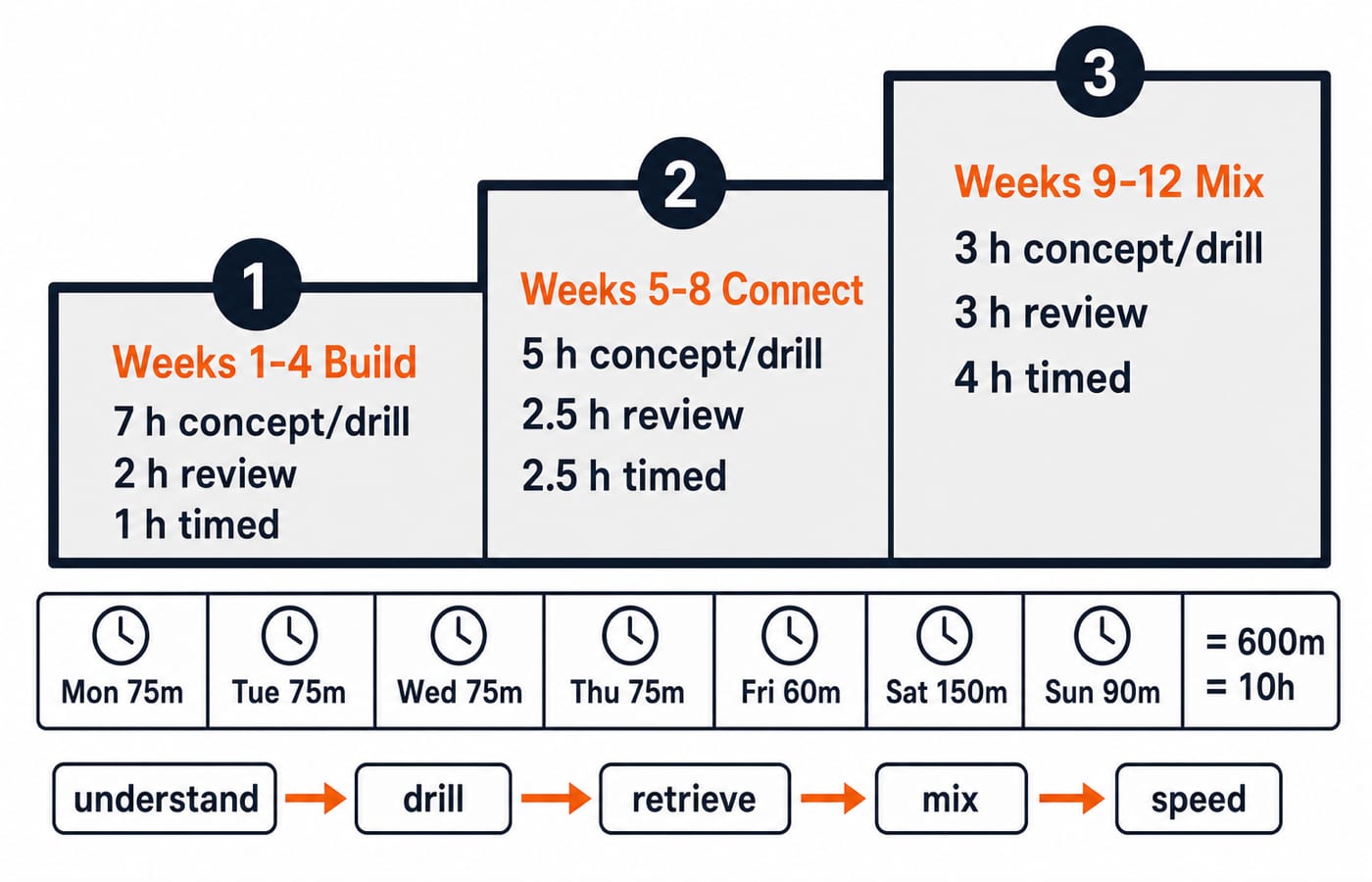
Use this weekly clock: Monday 75 minutes concept, Tuesday 75 minutes drill, Wednesday 75 minutes concept, Thursday 75 minutes drill, Friday 60 minutes mixed retrieval, Saturday 150 minutes practice and review, and Sunday 90 minutes error re-solves, including a 30-minute recovery buffer. Check: 75 + 75 + 75 + 75 + 60 + 150 + 90 = 600 minutes = 10 hours.
Phase | Weeks | Main job | Concept/drill | Review | Timed mixed work |
|---|---|---|---|---|---|
Build | 1-4 | Arithmetic relationships and clean setup | 7 h | 2 h | 1 h |
Connect | 5-8 | Algebra, geometry and number-system fluency | 5 h | 2.5 h | 2.5 h |
Mix | 9-12 | Selection, mixed sets and controlled speed | 3 h | 3 h | 4 h |
Each row is 10 hours. Speed rises after concept and retrieval accumulate.
Weeks 1-4: rebuild arithmetic through relationships, not trick lists
Week 1: percentages and fractions. Week 2: ratios and averages. Week 3: time-work and time-speed relationships. Week 4: mixed arithmetic. Each concept gets one solved model, eight untimed same-skill questions, a closed-notes explanation and four changed-value questions after 48 hours.
If 800 learners grow by 15%, 800 x 1.15 = 920. A 15% fall then gives 920 x 0.85 = 782. That is 18 below the start, and 18 / 800 x 100 = 2.25%. Equal rises and falls do not cancel because the bases are 800 and 920. Now compress it to 1.15 x 0.85 = 0.9775.
The Week 4 gate is 9 correct in a 12-question untimed set, with every setup explained aloud. At 8 or fewer, repeat only the two weakest relationships rather than restarting the month.
Weeks 5-8: connect algebra, geometry and number systems with exact drills
Week 5: linear equations and inequalities. Week 6: exponents and number-system patterns. Week 7: triangles and basic mensuration. Week 8: mixed connections. On a one-page “why it works” sheet, each shortcut needs its condition and derivation.
Algebra: From
x + y = 7and2x + 3y = 19, usex = 7 - y:14 - 2y + 3y = 19, soy = 5,x = 2. Check:2 + 5 = 7and2(2) + 3(5) = 19.Geometry: For sides 13, 14 and 15,
s = (13 + 14 + 15) / 2 = 21. Heron's area issqrt(21 x 8 x 7 x 6) = sqrt(7056) = 84square units.Number system:
7^103 mod 5 = 2^103 mod 5. Powers of 2 repeat remainders 2, 4, 3, 1. Since103 mod 4 = 3, the remainder is 3.
The Aptitude for Placement course carries a structured question bank across the same percentage, ratio, algebra, number-system and mensuration topics, which helps when one weak relationship needs forty more questions instead of four.
Weeks 9-12: earn speed through mixed sets and question selection
Change one variable at a time: mix topics untimed in Week 9, time individual questions in Week 10, time one eight-question set in Week 11, then choose, solve and review two sets in Week 12. A timer diagnoses; it never removes written setup or error classification.
A workshop has 120 attendees in Arts, Science and Commerce in the ratio 3:5:4. Its 12 parts give 120 / 12 = 10 per part, so groups are 30, 50 and 40. If 20% of Arts and 10% of Science leave, departures are 0.20 x 30 + 0.10 x 50 = 6 + 5 = 11, leaving 120 - 11 = 109. Identify ratio before percentage.
A Week 11 set takes 36 minutes for 5 correct and 3 wrong. A comparable Week 12 set takes 28 minutes for 7 correct and 1 wrong. That is 8 minutes faster and 2 more correct, if the sets are genuinely comparable.
Use spaced error review and an honest missed-day rule
Give each error four appointments: correct it with a reason on Day 0, re-solve cold on Day 2, change values on Day 7, and retrieve the method on Day 21. Close it only after a correct solution and explanation.
For the percentage error, Day 0 records “+15% and -15% cancel”. Day 2 re-solves 800 -> 920 -> 782. Day 7 uses 600 x 1.15 x 0.85 = 586.5, a 2.25% fall. Day 21 retrieves (1 + r)(1 - r) = 1 - r^2 for r = 0.15. The fall is 2.25% at every starting value, which is exactly what that identity buys you.
For one missed 75-minute block, use Sunday's 30-minute buffer and add 45 minutes to Saturday. If Tuesday and Thursday are missed, recover one block and carry the other named concept into next week, replacing a lower-priority repeat drill. Never stack 150 extra minutes or sacrifice error review. Common placement preparation mistakes covers the wider version of this failure: grinding practice without learning the pattern behind it, and leaving aptitude until it is too late.
The short version: concepts first, speed last
Diagnose 20 questions. Build arithmetic in Weeks 1-4; connect algebra, geometry and number systems in Weeks 5-8; mix and time in Weeks 9-12; keep errors on the Day 0/2/7/21 loop. Success means better setup and retrieval, not more shortcuts.
For an organised path, explore the CAT Preparation Course. Alternatively, browse PG Entrance Exams, or use the wider aptitude course for foundation practice. The pattern, sectional timing and marking rules for your cycle sit in the official CAT notification at iimcat.ac.in.
Keep learning

CAT Mock Analysis: Diagnose Time, Accuracy and Question Choice
Turn one mock into a practical review sheet. Separate execution, selection and reach problems, then test one measurable rule per section.
Updated 22 Aug 20265 min readMBA Entrance (CAT)

CAT Preparation for Working Professionals: A Sustainable 10-Hour Week
Build a repeatable CAT week around a full-time job, then use completed work and error patterns to decide what the next 600 minutes should contain.
Updated 18 Aug 20266 min readMBA Entrance (CAT)

CAT Quant for Non-Engineers: A 16-Week Foundation Plan Without Shortcuts
Rebuild CAT quant in dependency order: a 24-question diagnostic, a 16-week 160-hour map, an exact 10-hour week, an accuracy gate and a missed-day rule.
Updated 16 Aug 20265 min readMBA Entrance (CAT)

CAT DILR Set Selection: Score and Rank Sets in the First Pass
Use a written scorecard to compare DILR sets, break close calls with evidence, and leave a poor start before it consumes the rest of your mock.
Updated 14 Aug 20266 min readMBA Entrance (CAT)