CAT DILR Set Selection: Score and Rank Sets in the First Pass
Use a written scorecard to compare DILR sets, break close calls with evidence, and leave a poor start before it consumes the rest of your mock.
KnowledgeGate Team
Exam prep & CS education
Updated 14 Aug 20266 min read

You can solve DILR sets in practice yet lose a mock by entering the first familiar-looking set. The missing skill is deciding which set deserves the next few minutes while every option is partly unknown. A repeatable first pass replaces that mood-based guess with a written rank, a first choice, and a clear exit condition.
CAT DILR set selection is a payoff decision, not an easy-set hunt
The first pass estimates each set's mix of entry, branching, execution, and payoff; it need not find the easiest set.
Scan recognises structure. Select ranks starts. Solve begins only after the written rank. Familiar sets may branch heavily; unfamiliar tables may offer immediate computation.
Set B below is the familiar shape: eight runners, nine ordering conditions, the kind of puzzle every aspirant has drilled. It still scores 5, because its branches multiply instead of collapsing, two at 90 seconds and eight by three minutes. Set D is a distance table nobody rehearses, and it scores 9, because its numbers can be added the moment you read them. Recognition is not payoff.
Two skills sit under a good first pass. Judging one set on its representation, anchors, branching and payoff is worked through set by set in CAT DILR Set Selection: Choose the Right Set With a Four-Step Filter. The layer above that judgement is the clock it runs on, the commit and exit gates, and the audit that tells you whether the rank you wrote was right. If the arithmetic itself is what slows the scan, repair it through the Aptitude & Reasoning Blog, not through more selection drills.
Run a six-minute rehearsal scan with the same five checks every time
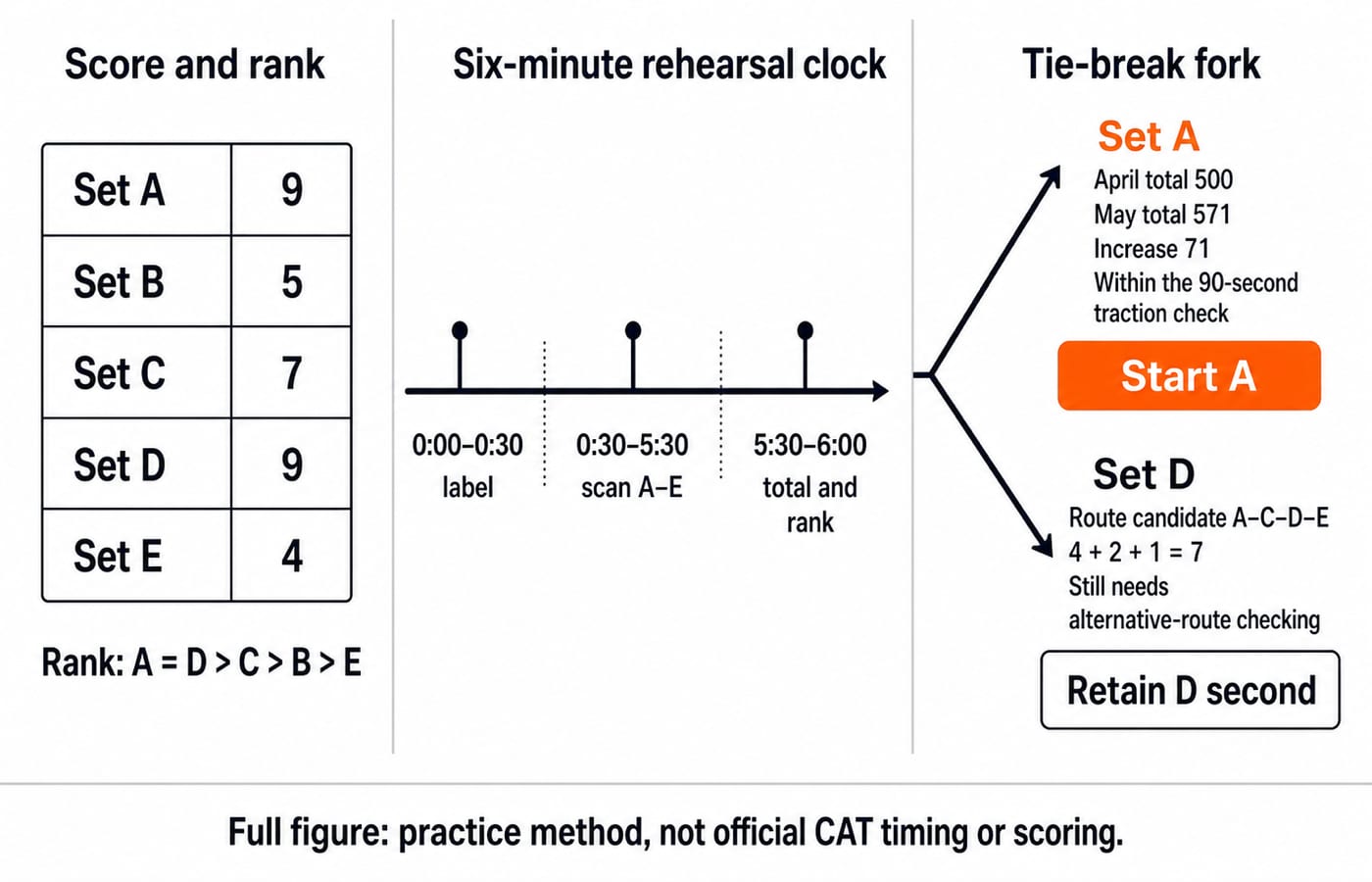
The five sets below are teaching examples rather than a real paper, and six minutes is a training budget; the set count and sectional timing for your cycle are stated in the official CAT notification at iimcat.ac.in. Label A-E from 0:00-0:30. Give each one minute from 0:30-5:30: read setup and questions, sketch the likely representation, then stop before casework. Total and rank from 5:30-6:00.
Score each check from 0 to 2:
Entry: 0 no clear first move, 1 plausible move, 2 immediate move.
Organisation: 0 scattered prose, 1 build a table or diagram, 2 data already structured.
Forcing: 0 many live branches, 1 two or three, 2 early forced relation.
Execution: 0 heavy arithmetic or casework, 1 moderate work, 2 light work.
Payoff: 0 one useful-looking question, 1 two or three, 2 four or five linked questions.
The total out of 10 ranks starts, not marks. For a section with more or fewer sets, keep the same five checks and stretch or shrink the one-minute slots to fit.
Worked five-set first pass: score the evidence, then break the tie
Set | What the one-minute scan reveals | Entry | Organisation | Forcing | Execution | Payoff | Total |
|---|---|---|---|---|---|---|---|
A, two-month sales table | April P 120, Q 150, R 90, S 140; May P 144, Q 165, R 108, S 154; five linked total, change, share questions | 2 | 2 | 2 | 1 | 2 | 9 |
B, eight-runner order | J, K, L, M, N, P, Q, R; nine conditions, including | 1 | 1 | 0 | 1 | 2 | 5 |
C, talk schedule | Talks A-F; rooms R1-R3; slots 9, 10, 11; eight constraints, including C in R2 at 10, A immediately before B, D not with F; four questions | 1 | 1 | 1 | 2 | 2 | 7 |
D, warehouse network | Nodes A-E; undirected distances AB 7, AC 4, BC 3, BD 6, CD 2, CE 5, DE 1; four route questions | 2 | 2 | 2 | 1 | 2 | 9 |
E, league table | Teams W, X, Y, Z; win 3, draw 1, loss 0; six results missing from a partial points table; three questions | 1 | 1 | 1 | 0 | 1 | 4 |
Rank A = D > C > B > E. Break the tie with a 90-second traction test.
For A, April totals 120 + 150 + 90 + 140 = 500; May totals 144 + 165 + 108 + 154 = 571; the increase is 571 - 500 = 71. Both totals feed straight into the change and share questions. D's shortest visible A-to-E candidate is A-C-D-E = 4 + 2 + 1 = 7, but other routes need checking. Start A, retain D second.
Commit for 90 seconds, then use a three-minute exit gate
By 90 seconds, require a table, grid, graph, or variable list plus a forced relation or reusable calculation. If only the representation exists, mark amber for 90 more seconds. At 3:00, require two useful deductions or one clear answer path.
Open B at 6:00. At 7:30, J and R still split into two branches. At 9:00, eight live cases remain without a direct path. Exit, record branch explosion for 15 seconds, and open D at 9:15. You lose 3 minutes 15 seconds, not an untracked 10-minute sunk cost.
Copying conditions is not progress. Nor is one isolated answer with the rest opaque.
Train set selection for six honest hours a week
Weeks 1-2: 2 x 45-minute no-solve scans, 2 x 75-minute solve-and-check blocks, one 60-minute sectional drill, and 60-minute review. Total: 90 + 150 + 60 + 60 = 360 minutes = 6 hours.
Weeks 3-4: 2 x 90-minute timed drill-plus-analysis blocks, 3 x 40-minute selection sprints, and one 60-minute audit. Total: 180 + 120 + 60 = 360 minutes.
Each no-solve scan produces five scored rows and a rank. Each solve block tests the top-ranked set's early traction. Each audit identifies one scan error, exit error, or execution gap and assigns one bounded repair. Run the Aptitude 30-Day Practice Routine to hold the daily habit steady, and keep the scorecard on top of it rather than in place of it.
Miss 90 minutes: recover 45 on the weekend and drop 45. The week is 360 - 90 + 45 = 315 minutes, or 5 hours 15 minutes. Nothing rolls over, and the next day is not doubled.
Audit the decision after the mock, not just the final score
Log predicted rank, start, time to first useful deduction, exit or finish, attempts, correct answers, and error class. Classes: scan error, misread structure; solve error, wrong deduction; exit error, overstayed gate; execution error, arithmetic or transcription.
For predicted A > D > C, A takes 9 minutes for 4 correct, D takes 14 for 3, and C takes 6 for 0. Efficiency is 4 / 9 = 0.44, 3 / 14 = 0.21, and 0 / 6 = 0 correct per active minute. Compare the three against each other rather than against a benchmark; the gap between A and D is what staying with a structurally sound but slow set actually cost.
If C failed its three-minute gate, record an exit error. Run two scheduling scan-and-exit rehearsals, leaving by three minutes without a forced relation. If D's structure was sound but arithmetic slipped, repair calculation checks, not ranking.
CAT DILR set selection: the short decision card and next step
Use one card: scan, score, rank, commit, check traction, exit or continue, then audit. Score entry, organisation, forcing, execution, and payoff. The CAT Preparation Course carries the concept work and sectional practice this card assumes you already have, and the CAT & MBA Entrance Preparation category collects the rest of the section-wise material. Then apply the card in your next mock and audit the decision honestly.
Keep learning

CAT Mock Analysis: Diagnose Time, Accuracy and Question Choice
Turn one mock into a practical review sheet. Separate execution, selection and reach problems, then test one measurable rule per section.
Updated 22 Aug 20265 min readMBA Entrance (CAT)

CAT for Non-Engineers: Build a Quant Foundation Before Chasing Shortcuts
Use this 12-week quant plan to find your real gaps, rebuild core relationships, revisit errors and add timed mixed practice only when the foundation is ready.
Updated 20 Aug 20266 min readMBA Entrance (CAT)

CAT Preparation for Working Professionals: A Sustainable 10-Hour Week
Build a repeatable CAT week around a full-time job, then use completed work and error patterns to decide what the next 600 minutes should contain.
Updated 18 Aug 20266 min readMBA Entrance (CAT)
CAT Quant for Non-Engineers: A 16-Week Foundation Plan Without Shortcuts
Rebuild CAT quant in dependency order: a 24-question diagnostic, a 16-week 160-hour map, an exact 10-hour week, an accuracy gate and a missed-day rule.
Updated 16 Aug 20265 min readMBA Entrance (CAT)