CAT Quant for Non-Engineers: A 16-Week Foundation Plan Without Shortcuts
Rebuild CAT quant in dependency order: a 24-question diagnostic, a 16-week 160-hour map, an exact 10-hour week, an accuracy gate and a missed-day rule.
KnowledgeGate Team
Exam prep & CS education
Updated 16 Aug 20265 min read

If formal maths ended at school, engineering classmates can seem to possess a shortcut. They do not, but CAT quant needs rebuilding. Vocabulary, fractions, equation translation and written practice must precede speed tricks. Sixteen weeks at ten honest hours a week is enough to rebuild the base, provided the order runs upward from fractions and the clock is the last thing you touch.
CAT quant for non-engineers starts with a diagnostic, not a degree label
Set a self-designed 24-question, 60-minute baseline: 8 arithmetic, 6 algebra, 4 geometry and mensuration, 3 number-properties and 3 mixed translation. The weighting leans on arithmetic because that is where school-level gaps usually sit. Leave a question blank rather than guess, and chase no score: a clean map of what is missing is the whole output.
Example: 15 attempted, 9 correct, 6 wrong, 9 unattempted. Attempted accuracy is 9 / 15 x 100 = 60%; whole-set correct coverage is 9 / 24 x 100 = 37.5%. Tag the 15 non-correct outcomes: 5 concept + 4 translation + 3 calculation + 3 selection or time = 15. Those tags decide month one, not your degree.
Run it against the material in CAT & MBA Entrance Preparation, so each tagged gap points at a topic you can open next.
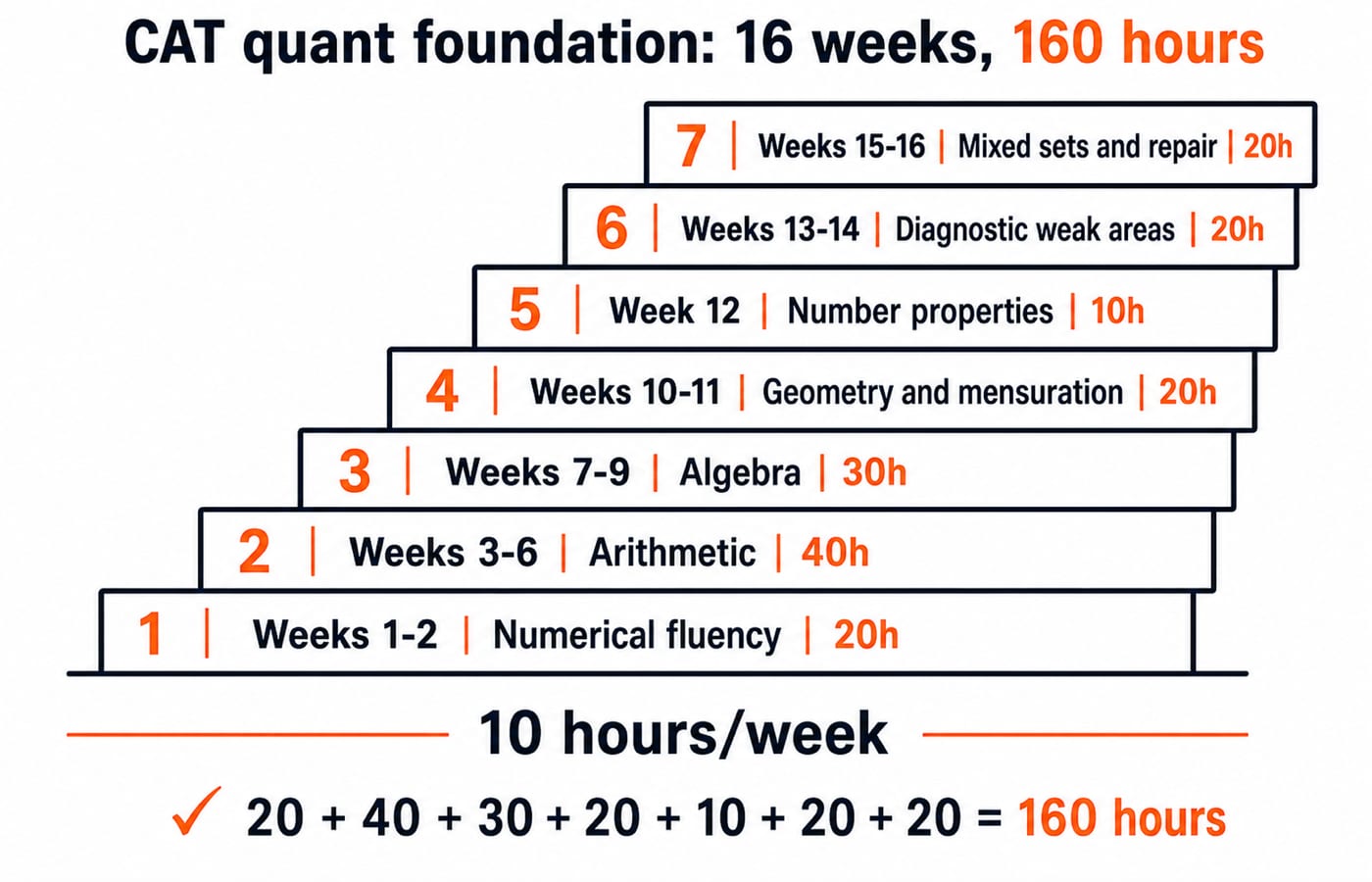
Build the CAT quant foundation in a fixed 16-week order
Weeks | Foundation job | Hours | Exit evidence |
|---|---|---|---|
1-2 | Numerical fluency: fractions, decimals, percentages, ratios | 20 | Fluent |
3-6 | Arithmetic translation and applications | 40 | Accurate |
7-9 | Algebra: expressions, equations, inequalities | 30 | Solved |
10-11 | Geometry and mensuration with diagrams | 20 | Explained |
12 | Number properties | 10 | Justified |
13-14 | Remaining weak areas revealed by practice | 20 | Repaired |
15-16 | Mixed sets and error repair | 20 | Passed |
Check 20 + 40 + 30 + 20 + 10 + 20 + 20 = 160 hours. Applications gate: convert 3/8 = 0.375 = 37.5% and reduce 42:70 to 3:5. Algebra gate: translate “20% fewer than x” as 0.8x, not x - 20. Geometry gate: explain why side 5 becoming 10 makes area 25 become 100, fourfold.
The same arithmetic-before-algebra order, paced over six weeks instead of sixteen, is worked out in CAT Quant Preparation: Arithmetic and Algebra First. Use that one if fractions are already fluent and only the topic sequence is missing.
The exact 10-hour CAT quant week
Day | Minutes | Visible output |
|---|---|---|
Monday | 75 | One bounded idea, 12 untimed questions |
Tuesday | 75 | Continue, 12 fresh questions |
Wednesday | 60 | Translate 10 word problems |
Thursday | 75 | Next concept, 12 questions |
Friday | 45 | Closed-book recall, re-solve 5 errors |
Saturday | 180 | 60-minute mixed set, 90-minute review, 30-minute repair |
Sunday | 90 | 60 minutes on weakest tag, 30 minutes planning |
Check 75 + 75 + 60 + 75 + 45 + 180 + 90 = 600 minutes = 10 hours. Purpose split: 180 learning + 150 untimed drilling + 90 timed drilling + 60 mixed testing + 90 review + 30 planning or error-log maintenance = 600. Each session produces marked attempts or a re-solved error, not only video.
The Friday habit of re-solving five tagged errors is drilled day by day in Aptitude for Placements: A 30-Day Practice Routine.
Work one ratio-percentage problem from language to equation
A group has non-engineering and engineering graduates in ratio 3:2. One day, 20% of the first and 10% of the second are absent. If 84 attend, how many were originally present?
Let groups be 3x and 2x. Attendance is 80% of 3x + 90% of 2x = 2.4x + 1.8x = 4.2x. Since 4.2x = 84, x = 20. Original groups: 60 and 40, total 100. Check: 80% of 60 = 48, 90% of 40 = 36, and 48 + 36 = 84.
Fraction check: (4/5)(3x) + (9/10)(2x) = 12x/5 + 9x/5 = 21x/5 = 84, hence x = 20. A practice score rising 48 to 60 rises by 12/48 = 25%; falling 60 to 48 falls by 12/60 = 20%. Unequal bases produce unequal percentages.
Earn speed through an accuracy gate, then shorten the clock
Use three fresh 20-question sets. Set A: 18 attempted, 12 correct, 6 wrong, 2 unattempted. Attempted accuracy is 12/18 = 66.7%; correct coverage is 12/20 = 60%. Its 8 non-correct items are 4 concept + 2 translation + 1 calculation + 1 time or selection = 8. Stay untimed; repair concept and translation.
After repair, Set B is 17 attempted, 14 correct, 3 wrong, 3 unattempted: 14/17 = 82.35%. Set C is 18 attempted, 15 correct, 3 wrong, 2 unattempted: 15/18 = 83.33%. Start timing only after two consecutive results above 80% with at most 2 concept-tagged outcomes each. Sets B and C clear the accuracy half of that gate, so once their concept tags are down to 2 or fewer the clock starts at Set D.
Shorten fresh 20-question caps: 60 minutes, then 45, then 35, preserving accuracy at each step. If accuracy falls below 80% at a new cap, return to the previous cap for two sets before trying again. Bank PO Quant: High-Yield Topics First makes the same case: speed follows fluency and question selection, never the other way round.
Repair the four gaps that shortcuts hide
Number fluency: derive
7/20 = 35/100 = 35%; drill ten fraction-percentage pairs.Equation language: replace “20% fewer than x” as
x - 20withx - 0.2x = 0.8x.Meaningless formula memory: explain side
5 to 10and area25 to 100.Premature timing: stop rushing unstable methods.
Date | Topic | Trigger phrase | Wrong move | Correct principle | Retest dates |
|---|---|---|---|---|---|
Today | Ratio-percentages | 20% absent | Subtract 20 from ratio part 3 | Take 80% of actual quantity | After 2 and 7 days, changed values |
A 30-minute repair: 5 recall, 10 reconstructing an example, 10 on 4 near-transfer questions, 5 logging. Below 3 of 4 correct, repeat the concept before timing.
Missed days change the week, not the goal
Miss Tuesday and Thursday: 75 + 75 = 150 minutes lost. Recover 60 by adding 30 each to Saturday and Sunday. Completion is 600 - 150 + 60 = 510 minutes = 8 hours 30 minutes. Drop 90 instead of sleep; restart Monday.
Preserve, in order: error review, current concept, small written drill, enrichment. Never combine two missed concept lessons. Below 16 of 20 two-week phase hours, extend the phase a week.
Four weeks give 4 x 600 = 2,400 planned minutes. Completing 2,070 is 2,070 / 2,400 x 100 = 86.25%, or 34 hours 30 minutes. Compare the 9/24 baseline with a matched-difficulty set; promote only through the two-set gate. Week 17 is adjustment, not failure.
The short version: concepts, written practice, accuracy, then speed
Diagnose gaps, follow dependency order, complete 600 useful minutes weekly, then shorten the clock after two accurate sets. “Non-engineer” describes an academic path, not a fixed quant ceiling. Dates, eligibility and exam structure are published on the official CAT website and its bulletin. The CAT Preparation Course gives you the same sixteen weeks already sequenced, if you would rather follow a plan than assemble one.
Keep learning

CAT Mock Analysis: Diagnose Time, Accuracy and Question Choice
Turn one mock into a practical review sheet. Separate execution, selection and reach problems, then test one measurable rule per section.
Updated 22 Aug 20265 min readMBA Entrance (CAT)

CAT for Non-Engineers: Build a Quant Foundation Before Chasing Shortcuts
Use this 12-week quant plan to find your real gaps, rebuild core relationships, revisit errors and add timed mixed practice only when the foundation is ready.
Updated 20 Aug 20266 min readMBA Entrance (CAT)

CAT Preparation for Working Professionals: A Sustainable 10-Hour Week
Build a repeatable CAT week around a full-time job, then use completed work and error patterns to decide what the next 600 minutes should contain.
Updated 18 Aug 20266 min readMBA Entrance (CAT)

CAT DILR Set Selection: Score and Rank Sets in the First Pass
Use a written scorecard to compare DILR sets, break close calls with evidence, and leave a poor start before it consumes the rest of your mock.
Updated 14 Aug 20266 min readMBA Entrance (CAT)