CAT and OMET Preparation Plan: One Shared Core, Four Exam Layers
Build quant, verbal and reasoning once, then add focused CAT, XAT, SNAP and NMAT practice. Split 168 hours across 12 weeks using your own diagnostic results.
KnowledgeGate Team
Exam prep & CS education
Updated 10 Aug 20266 min read

CAT and the OMETs, the other management entrance tests, mean four separate MBA entrance papers: CAT, XAT, SNAP and NMAT. Writing a separate plan for each one repeats percentages and reading comprehension while neglecting XAT Decision Making or SNAP drills. Build quant, verbal and reasoning once, then add decision, pace and interface habits. Formats move between cycles, so read the current rules on the official CAT website and each OMET's site first.
1. Draw the shared-core map before opening four study plans
Layer | Contents |
|---|---|
Shared core | Quant foundations; reading/verbal reasoning; logical reasoning/DI |
Exam layer | CAT selection/section discipline; XAT Decision Making/additional areas; SNAP speed/compact English; NMAT section order/one-question-at-a-time practice |
KnowledgeGate's CAT and MBA Entrance Preparation hub holds the coursework behind that shared core. The official XAT 2026 instructions (xatonline.in) included Decision Making with VA/LR and QA/DI; the SNAP 2025 structure page (snaptest.org) specified 60 questions in 60 minutes; the official NMAT About page (mba.com) describes individually timed Language, Quantitative and Logical Reasoning sections, chosen order and ability-based selection. Check all three again for your own cycle.
2. Use one diagnostic to decide how much core work you need
Build your own 120-minute diagnostic of 18 quant, 18 verbal and 18 reasoning/DI questions; keep official papers for later simulations. Learner A records quant 14 attempted, 11 correct, 3 wrong, 40 minutes; verbal 16, 13, 3, 35; reasoning/DI 12, 9, 3, 45.
Attempted:
14 + 16 + 12 = 42Correct:
11 + 13 + 9 = 33Attempted-question accuracy:
33 / 42 = 78.6%Coverage:
42 / 54 = 77.8%Section accuracy: quant
11 / 14 = 78.6%, verbal13 / 16 = 81.3%, reasoning/DI9 / 12 = 75.0%
Reasoning/DI gets most repair time on all three counts: lowest accuracy (75.0%), lowest coverage (12 of 18) and the most minutes (45). Add eight XAT-style decision items in 40 minutes, a 15-question speed set in 15, and two section-order trials using three comparable 12-question blocks.
3. Convert the diagnosis into a 12-week, 168-hour calendar
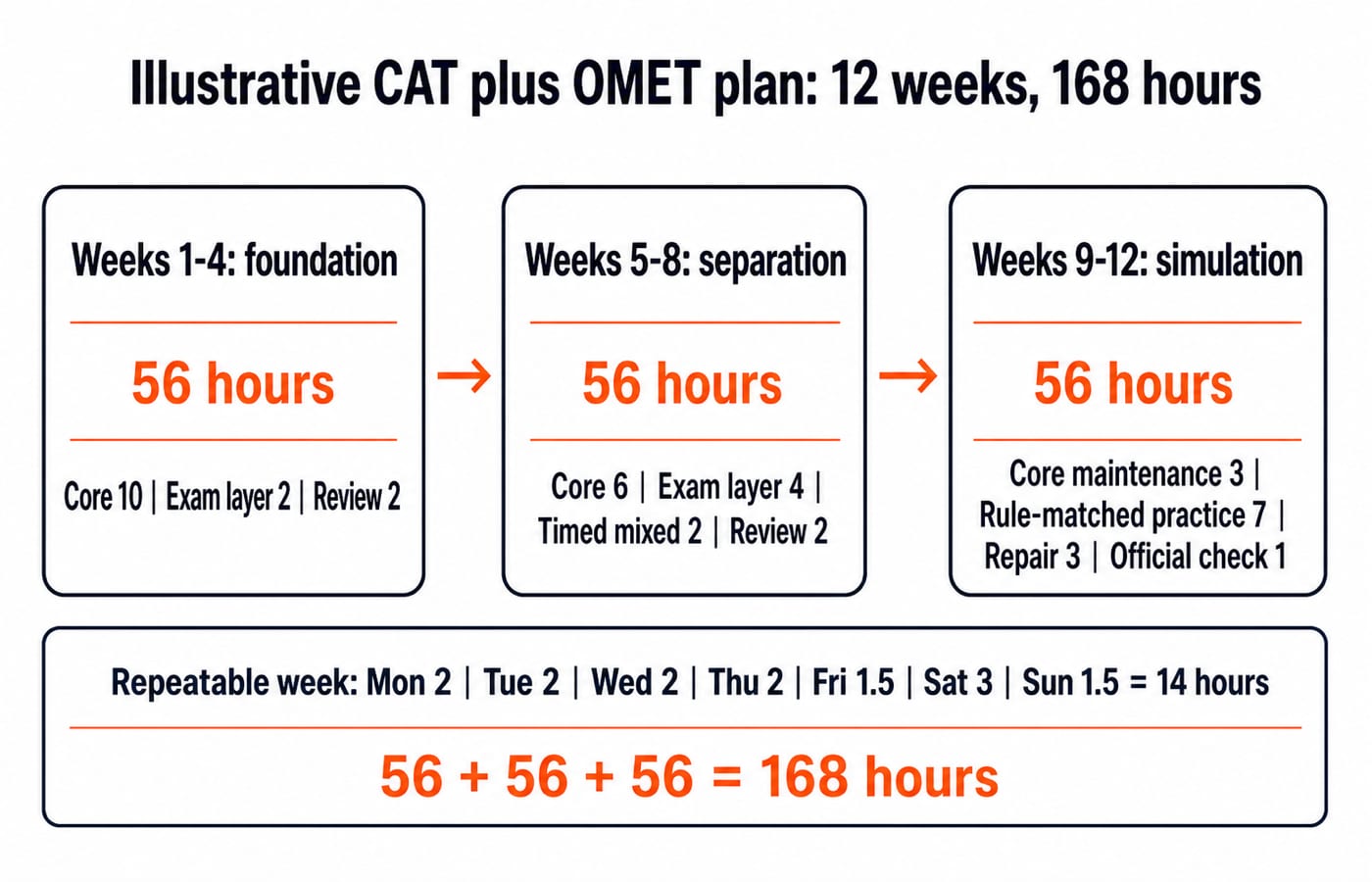
Weekly: Monday 2 hours quant; Tuesday 2 verbal; Wednesday 2 reasoning/DI; Thursday 2 mixed core; Friday 1.5 exam layer; Saturday 3 timed work and analysis; Sunday 1.5 error repair and planning. Total: 2 + 2 + 2 + 2 + 1.5 + 3 + 1.5 = 14 hours. Those slots hold all twelve weeks; Saturday's three hours re-split by phase, so the same week reads as 10 core hours early and 6 later.
Weeks 1-4, foundation:
10 core + 2 layer + 2 review = 14 hours/weekWeeks 5-8, separation:
6 core + 4 layer + 2 timed mixed + 2 review = 14 hours/weekWeeks 9-12, simulation:
3 core maintenance + 7 official-rule-matched simulation/section work + 3 repair + 1 official-rule check = 14 hours/week
Each phase is 4 x 14 = 56 hours; total 56 + 56 + 56 = 168 hours. Inside the 10 core hours of weeks 1-4 the diagnostic sets the split, weakest first: Learner A gets reasoning/DI 4, quant 3.5, verbal 2.5, since 4 + 3.5 + 2.5 = 10. A weak-verbal reader inverts those three numbers; the 14-hour shell does not move. Miss Wednesday? Recover one hour Sunday and replace a low-value drill next week with the other. Do not drop analysis or add a punishment session. The 30-day aptitude practice routine is a shorter companion.
4. Train the common skill once, then vary the clock and context
Each block is 10 minutes recall + 30 solving + 15 review + 5 error log = 60. The block never changes; the clock does: 40 minutes for a CAT drill, 15 for a SNAP speed set, one timed section at a time for NMAT.
A figure of 800 rises 25%, then falls 20%: does it finish 5% up? A 25% rise gives 800 x 1.25 = 1000. Then 20% of 1000 = 200, so 1000 - 200 = 800. Net change: (800 - 800) / 800 x 100 = 0%, not +5%.
For DI, groups A/B/C have 240/300/360 applicants and 60/75/72 selections. Rates: 60 / 240 = 25%, 75 / 300 = 25%, 72 / 360 = 20%. Combined: 60 + 75 + 72 = 207; 240 + 300 + 360 = 900; 207 / 900 = 23%.
Accuracy rising from 70% to 82% across eight drills is a direction, not a proven cause without a control. Use the quant, reasoning and verbal aptitude guide for core work, and pull sets from KnowledgeGate's Mathematics and Aptitude, Reasoning, and Verbal Ability (English) question banks: general aptitude sets, not exam-shaped papers.
5. Add CAT selection discipline and XAT Decision Making
Run a 40-minute CAT selection drill. Set A: eight-variable table, scan 3 minutes, solve 18, get 3 of 4 correct. Set B: five-constraint schedule, scan 2, spend 2 without a stable deduction, then leave. Set C: bar-chart caselet, scan 2, solve 13, get 4 of 4 correct. Total: 3 + 18 + 2 + 2 + 2 + 13 = 40 minutes. Leaving B cost 4 minutes: leave any set where two minutes give no stable deduction. For the scoring filter that decides which sets to open first, work through CAT DILR Set Selection: The Four-Step Filter, then time those choices with this drill.
The official XAT 2026 instructions include Decision Making. In a worked case, 100 requests include eight safety-critical items; the team can verify 12 today. Random choice ignores urgency; false closure hides the queue. Verify the eight safety items plus the four oldest, then disclose the remainder. Record stakeholders | constraints | rejected alternatives | decision.
6. Add SNAP pace and NMAT section-order practice without relearning the core
The official SNAP 2025 structure specified 60 questions in 60 minutes. Scale it for pace only: a 15-question, 15-minute drill. First: 12 attempted, 10 correct, 2 wrong; 10 / 12 = 83.3% accuracy. After reviewing two slow calculations and one vocabulary miss: 14 attempted, 12 correct, 2 wrong; 12 / 14 = 85.7%. Two more questions reached, accuracy still above 83%: pace from removing slow work, not from rushing.
The official NMAT About page describes three individually timed sections, adaptive selection and candidate-chosen order. Test comparable 12-question blocks: Quant-Logic-Language = 10 + 9 + 7 = 26/36; Language-Logic-Quant = 9 + 9 + 9 = 27/36. The second order is steadier, since no block drops below 9; repeat before choosing. Practise one item at a time, the way the official page describes the sections running.
7. Let mock analysis decide when the exam layer gets more hours
Weeks 1-4 get one mixed test weekly; weeks 5-8, one CAT simulation plus a rotating XAT/SNAP/NMAT drill; weeks 9-12, two simulations matching the nearest exam's current rules, each followed by analysis. Four exams do not require four weekly mocks.
Simulation 1: 46 attempted, 34 correct, 12 wrong; 34 / 46 = 73.9% accuracy; 18 minutes lost to two dead-end reasoning sets. After a first-pass check, Simulation 2 has 43 attempted, 35 correct, 8 wrong: 35 / 43 = 81.4%. Three fewer attempts bought one more correct answer and four fewer wrong ones.
Code errors CK concept, SL slow route, SEL poor selection, FMT format habit. Sunday: if 5 of 9 = 55.6% of the repeated errors are FMT, shift two core hours into that layer; if 6 of 9 = 66.7% are CK, leave the core hours alone.
8. Keep a minimum viable week and take the next useful step
For a disrupted week, keep eight hours: 2 weakest core + 2 second-weakest core + 2 nearest-exam layer + 2 timed set and analysis = 8. Resume 14 next week without debt.
Diagnose once, build the overlap, separate layers gradually, and follow reviewed errors. The CAT Preparation Course is an optional structured route. Copy current official rules, take the 54-question diagnostic, and build the first 14-hour week from its results.
Keep learning

CAT Mock Analysis: Diagnose Time, Accuracy and Question Choice
Turn one mock into a practical review sheet. Separate execution, selection and reach problems, then test one measurable rule per section.
Updated 22 Aug 20265 min readMBA Entrance (CAT)

CAT for Non-Engineers: Build a Quant Foundation Before Chasing Shortcuts
Use this 12-week quant plan to find your real gaps, rebuild core relationships, revisit errors and add timed mixed practice only when the foundation is ready.
Updated 20 Aug 20266 min readMBA Entrance (CAT)

CAT Preparation for Working Professionals: A Sustainable 10-Hour Week
Build a repeatable CAT week around a full-time job, then use completed work and error patterns to decide what the next 600 minutes should contain.
Updated 18 Aug 20266 min readMBA Entrance (CAT)

CAT Quant for Non-Engineers: A 16-Week Foundation Plan Without Shortcuts
Rebuild CAT quant in dependency order: a 24-question diagnostic, a 16-week 160-hour map, an exact 10-hour week, an accuracy gate and a missed-day rule.
Updated 16 Aug 20265 min readMBA Entrance (CAT)