CAT Preparation for Working Professionals: A Sustainable 10-Hour Week
Build a repeatable CAT week around a full-time job, then use completed work and error patterns to decide what the next 600 minutes should contain.
KnowledgeGate Team
Exam prep & CS education
Updated 18 Aug 20266 min read

A working professional can often protect ten honest preparation hours in a normal week, but cannot copy a full-time aspirant's daily schedule. The real risks are arriving home mentally tired, allowing one late meeting to destroy the week, and taking mocks without reviewing them. Ten hours holds only when its shape is fixed in advance: four short weekday sessions, a weekend block that exists for review rather than new material, and a recovery rule that takes time back from content instead of from sleep.
CAT preparation with a job begins with a 10-hour weekly ceiling
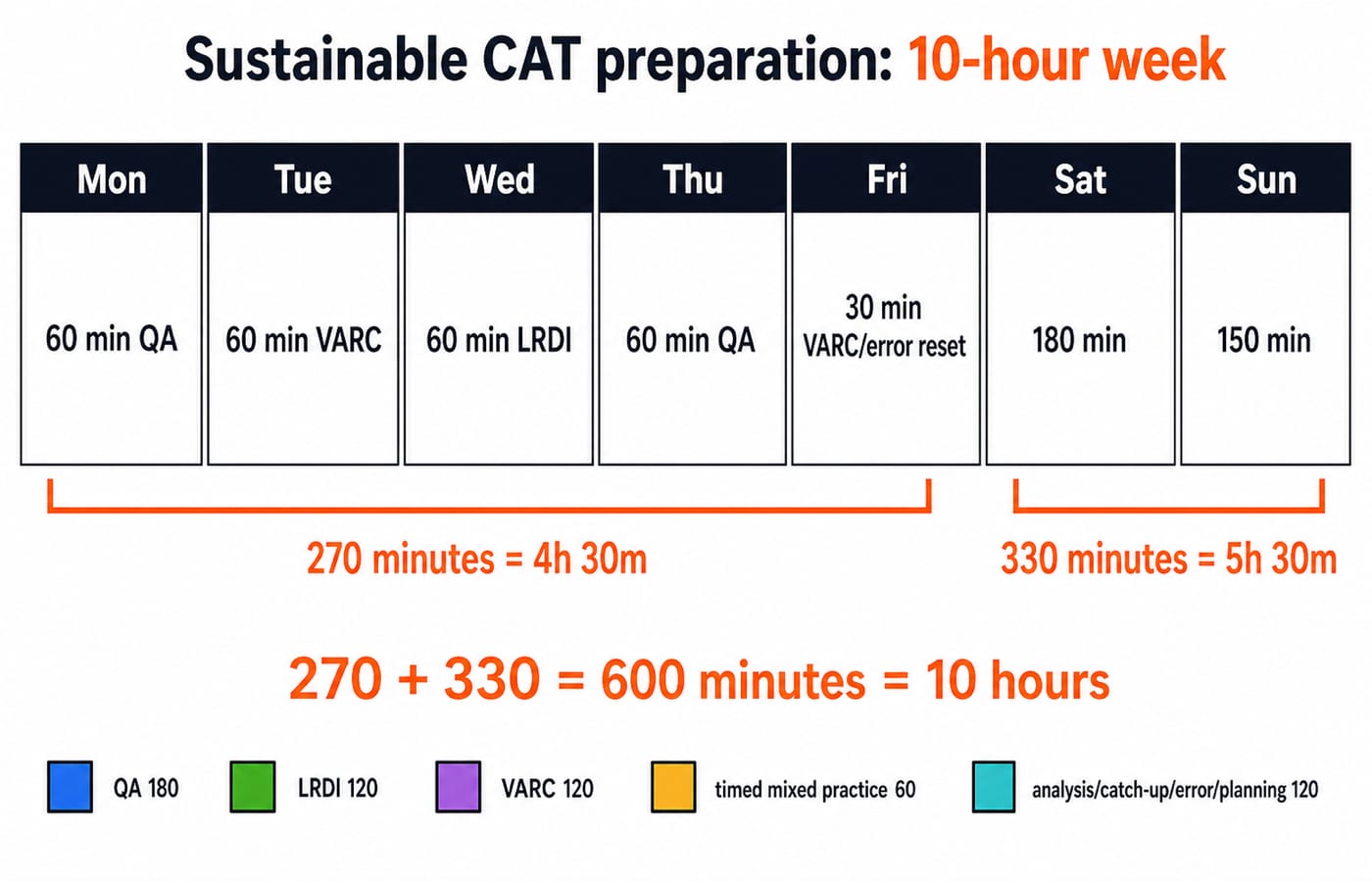
Capacity comes first: 270 weekday minutes + 330 weekend minutes = 600 minutes = 10 hours. Schedule four 60-minute weekday sessions, a 30-minute Friday reset, 180 minutes Saturday, and 150 Sunday. It must fit ordinary weeks.
Protect timed mixed practice, full analysis, and a visible error log. Rotate Quantitative Aptitude (QA), Logical Reasoning and Data Interpretation (LRDI), and Verbal Ability and Reading Comprehension (VARC), the three streams the CAT Preparation Course is built around. If your target is a different exam under the same constraint, UGC NET Preparation for Working Professionals: Weekly Plan applies the same capacity-first method to that syllabus.
The exact 10-hour CAT weekly timetable
Day | Minutes | Output | Running total |
|---|---|---|---|
Monday | 60 | QA concept plus drill | 1h |
Tuesday | 60 | VARC passage plus analysis | 2h |
Wednesday | 60 | One LRDI set plus review | 3h |
Thursday | 60 | QA timed drill plus error rework | 4h |
Friday | 30 | VARC reading and error-log reset | 4h 30m |
Saturday | 180 | QA, LRDI and catch-up/error work | 7h 30m |
Sunday | 150 | VARC, timed mixed practice, analysis and planning | 10h |
Saturday is 60 QA + 60 LRDI + 60 catch-up/error repair; Sunday is 30 VARC + 60 timed mixed practice + 45 analysis + 15 planning. Weekly totals: QA 180, LRDI 120, VARC 120, mixed practice 60, and analysis/catch-up/error/planning 120. Check: 180 + 120 + 120 + 60 + 120 = 600 minutes.
Short weekdays ease starting; weekends hold review. At eight hours (480 minutes), hold analysis, catch-up and planning at 120 and cut each practice stream by a quarter: QA 135, LRDI 90, VARC 90, mixed practice 45, which is 360 + 120 = 480. At twelve, add targeted practice, not untouched lectures.
Turn the CAT weekly plan into a 16-week, 160-hour cycle
Weeks | Primary job | Weekly mix | Phase hours |
|---|---|---|---|
1-4 | Foundations and baseline | 5h concepts + 3h untimed practice + 1h analysis + 1h buffer | 40h |
5-8 | Timed topic work | 3h concept repair + 4h timed practice + 2h analysis + 1h buffer | 40h |
9-12 | Sectional integration | 2h repair + 3h section practice + 3h mixed simulation and review + 1h VARC reading + 1h buffer | 40h |
13-16 | Mock-led consolidation | 2h revision + 4h current-format mock and review + 2h weak-area repair + 1h VARC reading + 1h buffer | 40h |
Each row totals 10 hours weekly and 40 per phase, so 4 × 40 = 160 hours. With 24 weeks, repeat the first three phases for evidence-led repair; with 10, compress the week counts but keep the order, because timed work before integration is what makes the mock phase readable. CAT Preparation Strategy for Working Aspirants: A Six-Month Plan runs the same sequence over 24 weeks at a 12-hour ceiling, if your job allows the extra two hours.
Exit evidence: Week 4, an error log with a real baseline in it; Week 8, timed sets you finish inside their bound; Week 12, pacing decisions you can state out loud; Week 16, a mock-analysis loop you repeat without improvising. Each one is checkable on your own desk in a single evening, which is why these are the phase gates rather than a target percentile.
Every after-work session must end with a measurable output
Monday's QA hour: 5 minutes closed-book formula recall, 20 learning one method, 25 solving 10 selected questions, and 10 reworking errors. If 10 attempted = 7 correct + 3 wrong, tag each wrong answer as concept, method selection, or careless.
Tuesday: 20 minutes reading one selected VARC passage, 20 answering five questions, and 20 tracing each answer to its sentence or inference. For 3 correct + 2 wrong = 5, record why each rejected choice tempted you.
Wednesday uses a self-created LRDI set with four people (A, B, C, D), projects (P, Q, R, S), and slots (1, 2, 3, 4): 35 minutes solving, 20 rebuilding, and 5 recording the first wrong inference. The rest of the CAT material on the site is collected under CAT & MBA Entrance Preparation. Thursday and the two weekend blocks take the same shape: a stated minute split, a countable result, and a tag on every wrong answer.
A minimum viable session keeps difficult workdays from breaking the chain
On a long day, use a 25-minute replacement: 5 recalling from the error log, 15 solving five preselected questions or revisiting a short passage segment, and 5 tagging the result. Never add it at midnight.
If Tuesday and Thursday lose 60 minutes each, 60 + 60 = 120 missed. Recover 60, adding 30 on Saturday and Sunday: 600 - 120 + 60 = 540 minutes = 9 hours. Drop the rest; reset Monday. Spend 30 on timed-work analysis, 20 on repeated-error repair, and 10 planning. Never borrow sleep, deadline time, or unsafe commute time.
CAT mock cadence should grow with review capacity
Take one baseline current-format mock after Week 4; one in Weeks 6 and 8; one in Weeks 10 and 12; then weekly in Weeks 13-16: 1 + 2 + 2 + 4 = 9 mocks. A mock counts only once its analysis is finished, and that analysis has to be done before the next mock starts. Nine reviewed mocks are worth more than twenty unread ones.
Reserve four of the ten late-phase hours for mock plus review. Check duration, question count, order, marking, and score conversion at iimcat.ac.in, never from memory. The sitting uses its current duration; immediate review gets the remainder. If unfinished, reduce new content, not sleep or the next review.
Mock analysis must change next week's 600 minutes
Run the loop on a 50-question home diagnostic you set and mark yourself. Say it returns VARC 18 attempted, 12 correct, 6 wrong; LRDI 10, 8, 2; QA 14, 9, 5; plus 8 unattempted. Thus 42 attempted = 29 correct + 13 wrong, and 29 ÷ 42 × 100 = 69.0% accuracy.
Accuracy: VARC 12 ÷ 18 × 100 = 66.7%, LRDI 8 ÷ 10 × 100 = 80%, QA 9 ÷ 14 × 100 = 64.3%. Now tag all 13 wrong + 8 unattempted = 21 non-scoring outcomes: 7 concept gaps + 4 method-selection + 4 careless + 6 time-pressure = 21. Five of those concept gaps are QA's five wrong answers; VARC's six wrong answers are method-selection and careless slips, not missing content; and all six time-pressure tags sit on unattempted questions.
So the minutes move from your strongest section to your weakest, not to whichever section produced the most wrong answers. QA goes from 180 to 210 and LRDI from 120 to 90, because 80% accuracy can hold its ground on less time. VARC stays at 120: choice errors and slips are repaired by slower answer-tracing inside the hours you already give it. Mixed practice holds at 60 and analysis/catch-up/error/planning at 120: 210 + 90 + 120 + 60 + 120 = 600. The same tag-then-reallocate loop runs on a much shorter horizon in Aptitude for Placements: A 30-Day Practice Routine.
The short version: protect ten useful hours, then improve the mix
Sunday dashboard fields: planned minutes, completed minutes, questions attempted, attempted-question accuracy, and most repeated error. Example: 600 planned, 540 completed, 84 attempted, 59 correct; 59 ÷ 84 × 100 = 70.2%. If late QA method choice repeats, keep 600 minutes and add one 30-minute repair block.
Use short weekday outputs, protect the weekend analysis block, let evidence move time between streams, and reset cleanly after disruption. Those four rules are what keep ten hours running for a year rather than a month. If you would rather not sequence QA, LRDI and VARC yourself, the CAT Preparation Course already has that order built.
Keep learning

CAT Mock Analysis: Diagnose Time, Accuracy and Question Choice
Turn one mock into a practical review sheet. Separate execution, selection and reach problems, then test one measurable rule per section.
Updated 22 Aug 20265 min readMBA Entrance (CAT)

CAT for Non-Engineers: Build a Quant Foundation Before Chasing Shortcuts
Use this 12-week quant plan to find your real gaps, rebuild core relationships, revisit errors and add timed mixed practice only when the foundation is ready.
Updated 20 Aug 20266 min readMBA Entrance (CAT)

CAT Quant for Non-Engineers: A 16-Week Foundation Plan Without Shortcuts
Rebuild CAT quant in dependency order: a 24-question diagnostic, a 16-week 160-hour map, an exact 10-hour week, an accuracy gate and a missed-day rule.
Updated 16 Aug 20265 min readMBA Entrance (CAT)

CAT DILR Set Selection: Score and Rank Sets in the First Pass
Use a written scorecard to compare DILR sets, break close calls with evidence, and leave a poor start before it consumes the rest of your mock.
Updated 14 Aug 20266 min readMBA Entrance (CAT)