BTSC Lab Assistant Syllabus: Topic Map for Science, Lab Work, Maths and Computers
Organise BTSC Lab Assistant preparation into four lanes, then practise density, dilution, percentage error, unit conversion and binary conversion step by step.
KnowledgeGate Team
Exam prep & CS education
Updated 5 Aug 20265 min read
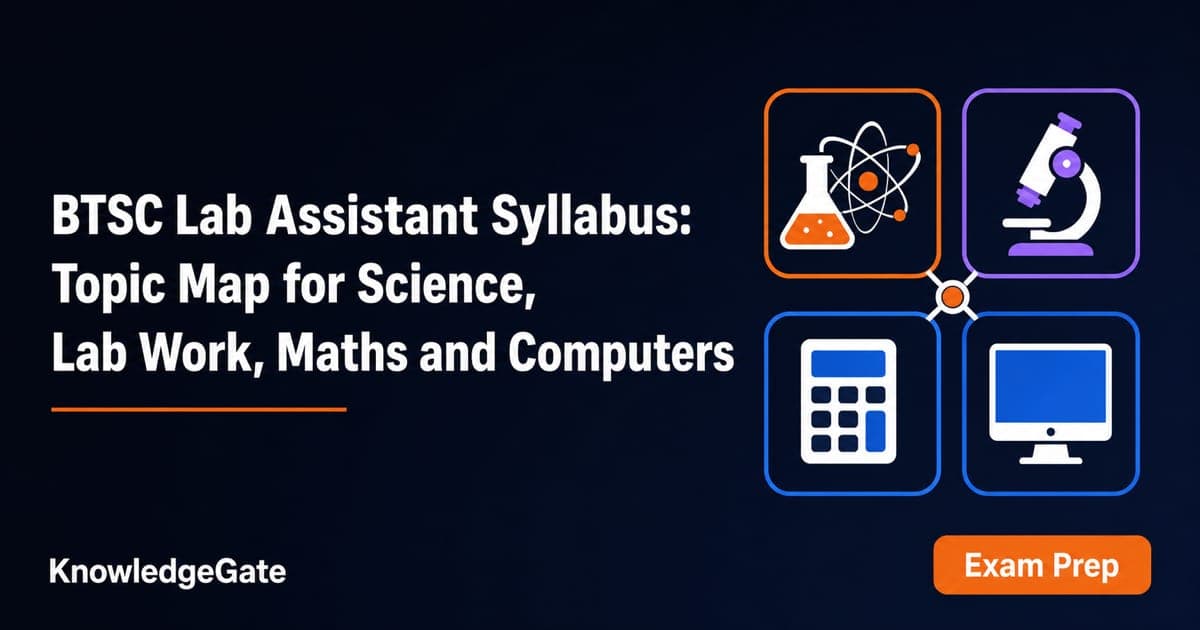
A syllabus label can look like one list while demanding four kinds of preparation: science concepts, laboratory judgement, quantitative handling and computer recall. Sorting every topic into one of those four lanes, and attaching one worked check to each, is what turns a flat list into something you can study rather than reread. Where a coaching summary differs from the current BTSC notice, the commission's notice controls.
Related reading: BTSC computer science syllabus and BTSC eligibility.
Read the BTSC Lab Assistant syllabus as four lanes
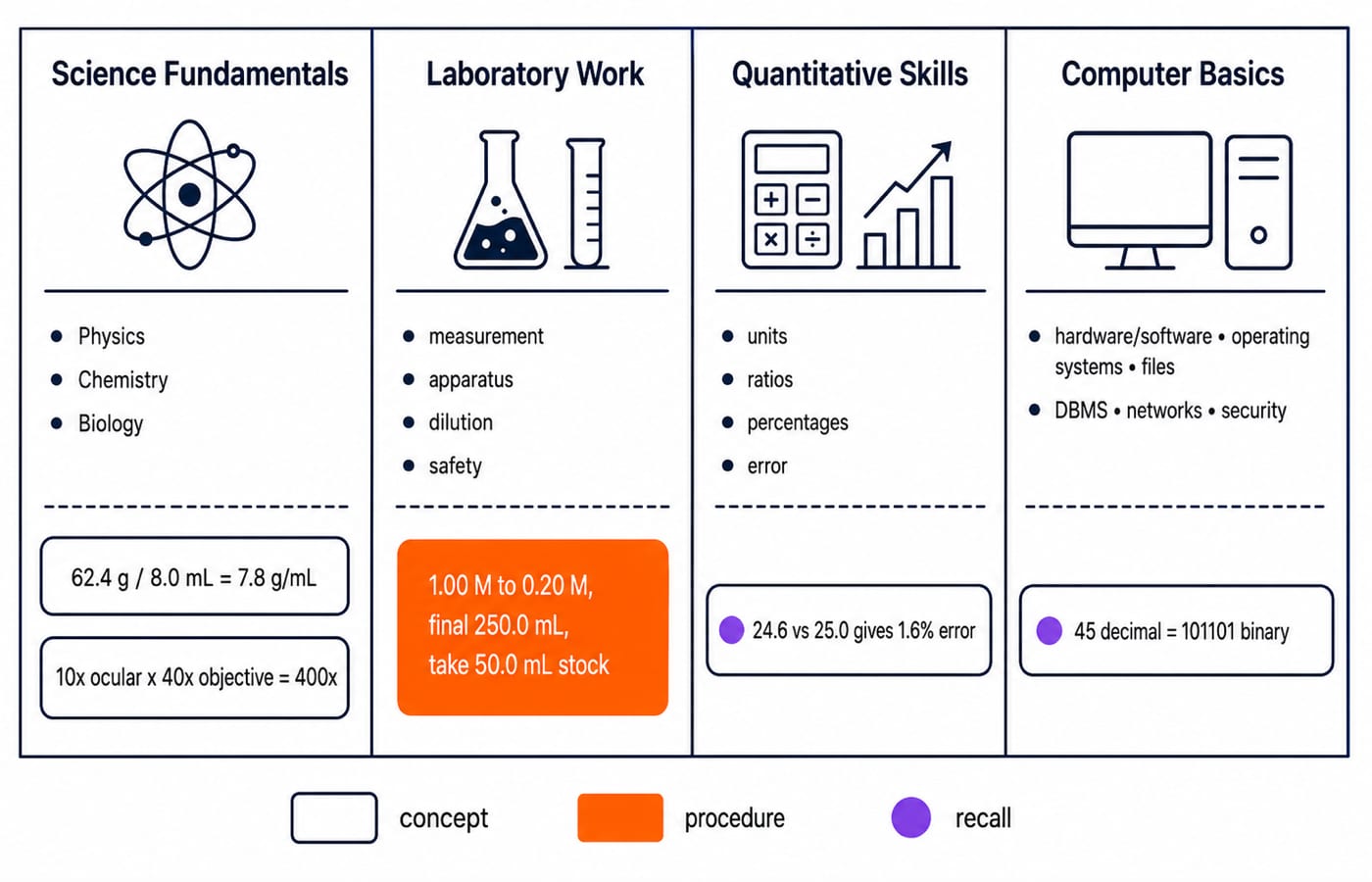
Use four lanes: science fundamentals, laboratory practice and safety, quantitative skills, and computer basics. The split is not cosmetic. It matches how preparation for this recruitment is actually built under Govt Jobs, where the technical computer subjects get a course of their own while general science sits in the practice papers. Section order and weightage are a separate question, and only the current BTSC notice settles those.
Place each item in a lane before studying it. Ohm's law needs concept understanding and calculation. A safety symbol needs accurate recall. A balance reading needs a procedure. Binary conversion needs a repeatable method.
Science fundamentals: revise relationships
Organise physics into connected families such as mechanics, heat, electricity, optics and measurement, then check those families against the current BTSC syllabus. For a measurement example, suppose an irregular metal sample has mass 62.4 g. Water rises from 50.0 mL to 58.0 mL, so the displaced volume is 58.0 minus 50.0 = 8.0 mL. Density is mass divided by volume:
Density = 62.4 g / 8.0 mL = 7.8 g/mL.
The 8.0 mL measurement has two significant figures, so the density is reported as 7.8 g/mL, not with unsupported extra digits.
For chemistry and biology, connect reactions with solutions and safe handling, then cells with physiology, botany and microscopy. A 10x eyepiece with a 40x objective gives 10 x 40 = 400x total magnification. After revising a family, ask three questions of it: can I state the relationship, can I substitute the units, and can I explain what the number means?
Laboratory work: connect measurement and safety
Use one procedure frame: identify the quantity, choose suitable apparatus, check least count or calibration, take the reading, record it with units, prevent contamination, then store or dispose of the material safely. A volumetric pipette transfers a fixed accurate volume. A beaker mainly holds or mixes, so it is not the first choice for an exact transfer.
Suppose you must prepare 250.0 mL of 0.20 M solution from 1.00 M stock. Using C1V1 = C2V2:
V1 = (0.20 x 250.0) / 1.00 = 50.0 mL.
Measure 50.0 mL of stock, transfer it to a 250.0 mL volumetric flask, add solvent to the calibration mark, stopper, and mix. Follow the reagent's own instructions for PPE and for addition order, and never combine chemicals whose reaction you cannot predict.
Three checks catch common errors:
Writing only 50 is incomplete because the unit is missing.
Adding stock after measuring 250.0 mL of solvent overshoots the required final volume.
Reading the meniscus away from eye level introduces parallax error.
Quantitative skills: units before formulas
Write values with units, convert before substitution, calculate, then check magnitude and significant figures. If a measured value is 24.6 and the accepted value is 25.0, the absolute difference is 25.0 minus 24.6 = 0.4. Percentage error is (0.4 / 25.0) x 100 = 1.6%.
Two more illustrative checks:
0.75 L = 750 mL, because 1 L = 1000 mL.
In a 3:2 mixture totalling 500 mL, five parts equal 100 mL each. The components are 3 x 100 = 300 mL and 2 x 100 = 200 mL.
Sign conventions, least count and rounding decide most of the marks in this lane, and BTSC Lab Assistant Units, Measurement Error and Lab Safety works through each of them example by example.
Computer basics: build a connected model
Group computer basics into hardware and input/output, software and operating-system functions, files and storage units, word processors and spreadsheets, DBMS fundamentals, networking, the internet and safe digital practice. Where those categories blur into one another, Computer Fundamentals for CS Teaching Exams sets out the definitions and the tested distinctions side by side. Treat every category as examinable until the notice narrows it.
Convert decimal 45 using place values 32, 16, 8, 4, 2 and 1. Select 32 + 8 + 4 + 1, so the bits are 1, 0, 1, 1, 0, 1. Therefore, 45 decimal = 101101 binary. Reverse-checking gives 32 + 0 + 8 + 4 + 0 + 1 = 45.
Classification should include the reason: a keyboard sends input, RAM is volatile primary memory, an operating system manages system resources, and a DBMS organises and retrieves structured data.
Separate concept, procedure and recall practice
Use three queues. Concept: density, electricity, reactions, biological functions and binary conversion. Procedure: apparatus choice, measurement, dilution, recording and safety. Recall: units, symbols, hardware categories, file terms and shortcuts.
Study one concept, solve two numerical checks, narrate one lab procedure aloud, answer ten recall prompts, then record the exact error. For example: "Used 250.0 mL as solvent volume instead of final solution volume; redraw the volumetric-flask sequence before the next set." For the computer lane, the BTSC Lab Assistant (CS) 2026 course runs those same three queues across programming, data structures, operating systems, DBMS, computer networks and computer fundamentals, so that sequencing is already done for you.
Check official sources for pattern details
Open the Bihar Technical Service Commission website and read the current notification next to this map. Six details are worth copying out by hand, because studying against a wrong version of any of them wastes weeks: the marks total, the paper duration, the negative-marking rule, the eligibility clause for your discipline, the vacancy break-up and the application dates. If the current notice is not out yet, leave those six lines blank rather than filling them from a coaching summary or from memory.
For timed diagnosis, the BTSC Lab Assistant (CS) Test Series 2026 runs thirteen unit tests across the technical computer subjects plus general knowledge and general science, then seven full-length mock tests at CBT pace. Use it to find which lane is costing you marks, and the notice to settle what the paper itself is.
Short version
Before moving on, check four abilities:
Explain one science relationship.
Execute one lab calculation safely.
Solve one unit or percentage problem.
Convert and classify one computer concept.
Check those four against the current BTSC notice, then act on whichever one failed. If the computer lane failed, the CS course already sequences it. If all four cleared on paper but none of them cleared under time, the test series will show which breaks first. Either way, chase that one specific gap instead of collecting another untested list.
Keep learning
BTSC Lab Assistant Physics Lab: Instruments, Readings and Error Calculations
Learn a fixed method for selecting lab instruments, reading their scales, correcting zero error and reporting calculated results with sensible uncertainty.
Updated 16 Aug 20266 min readBTSC Lab Assistant

BTSC Lab Assistant Biology Lab: Microscopy and Specimen Handling Guide
Build an exam-ready microscopy workflow through a labelled onion wet mount, a checked cell-size estimate, safe specimen handling, and six common errors.
Updated 14 Aug 20265 min readBTSC Lab Assistant
BTSC Lab Assistant Job Profile: Records, Equipment Care and Daily Lab Workflow
Build a realistic CS/IT Laboratory Assistant role model around readiness checks, auditable registers, safe fault handling and evidence-based handover.
Updated 12 Aug 20265 min readBTSC Lab Assistant
BTSC Lab Assistant PYQ Analysis: Sort Common and Trade Topics
Turn a mixed PYQ score into a useful repair plan. This method separates common and trade topics, codes each miss and assigns revision time from your own errors.
Updated 10 Aug 20266 min readBTSC Lab Assistant