BTSC Lab Assistant Units, Measurement Error and Lab Safety: Worked Examples and Traps
Learn how to convert units, round measured values, separate accuracy from precision, calculate error and choose safe actions in objective questions.
KnowledgeGate Team
Exam prep & CS education
Updated 23 Jul 20266 min read
An objective question may change only a unit prefix, the last reported digit, the meaning of accuracy or one unsafe action. Measuring, recording, judging a reading, quantifying the error and acting on a hazard are one chain in a lab assistant's working day, so memorising them as five separate definitions is what creates avoidable traps. Work from one record instead: a teaching sample labelled S-17, a reference volume of 25.00 mL, three sets of repeated readings and three lab-safety scenarios. The BTSC Lab Assistant category carries the course and test-series options for this recruitment.
Units and conversions: preserve the quantity before moving the decimal
A quantity names what is measured; a unit supplies scale. SI examples are length in metre (m), mass in kilogram (kg), time in second (s) and temperature in kelvin (K). A prefix applies a power of ten: 1 mm = 10^-3 m, 1 cm = 10^-2 m, 1 mL = 1 cm^3 and 1 L = 10^-3 m^3.
Area and volume square or cube the factor: 1 cm^2 = 10^-4 m^2 and 1 cm^3 = 10^-6 m^3.
Volume:
250 mL = 250 × 10^-3 L = 0.250 L.Density: since
1 g = 10^-3 kgand1 mL = 10^-6 m^3,2.46 g/mL = 2.46 × (10^-3 kg)/(10^-6 m^3) = 2.46 × 10^3 kg/m^3, or2460 kg/m^3. The scientific notation shows three significant figures.
Prefix | Multiplier | Example |
|---|---|---|
milli |
|
|
centi |
|
|
kilo |
|
|
Significant figures and rounding: report only the precision the data supports
In 0.00450, leading zeros do not count, but the final zero does, giving three significant figures. The value 1200 is ambiguous, while 1.20 × 10^3 clearly has three significant figures. Decimal places differ: 12.30 has two decimal places and four significant figures.
For addition or subtraction, round to the least number of decimal places among the inputs:
12.4 mL + 0.56 mL + 3.217 mL = 16.177 mL
The least precise input, 12.4 mL, has one decimal place, so the reported result is 16.2 mL.
For multiplication or division, use the fewest significant figures among the inputs:
2.40 cm × 3.1 cm = 7.44 cm^2
Because 3.1 has two significant figures, report 7.4 cm^2.
Keep guard digits and round only at the end. The value 2.36 to one decimal place is 2.4. For a halfway value such as 2.35, use the question's stated convention.
Accuracy versus precision: use repeated readings, not slogans
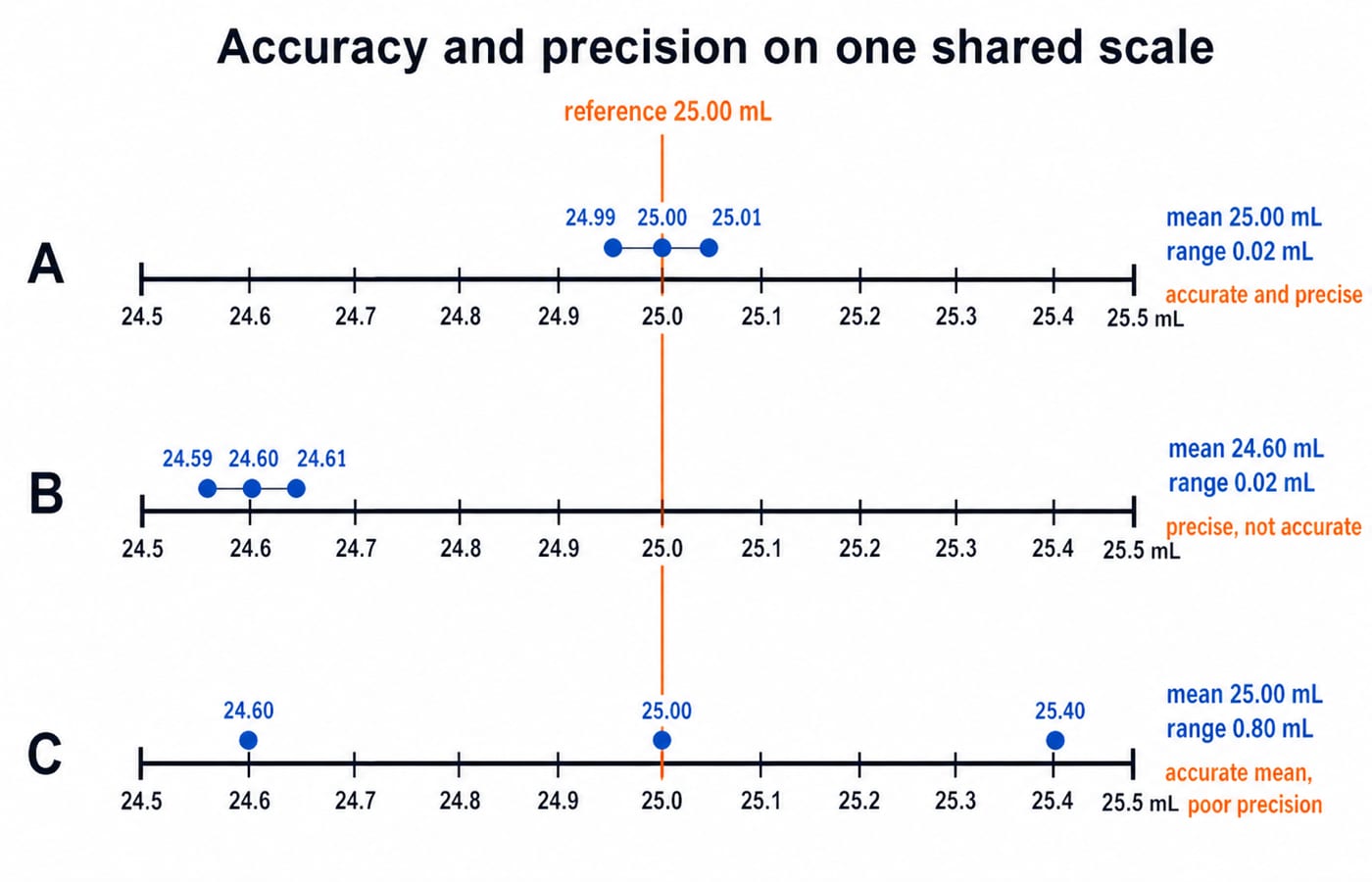
Accuracy is closeness to an accepted reference. Precision is closeness among repeated readings. Take 25.00 mL as the accepted reference.
Set A is
24.99, 25.00, 25.01 mL. Its mean is(24.99 + 25.00 + 25.01)/3 = 75.00/3 = 25.00 mL. Its range is25.01 - 24.99 = 0.02 mL. It is accurate and precise.Set B is
24.59, 24.60, 24.61 mL. Its mean is73.80/3 = 24.60 mL, and its range is also0.02 mL. It is precise but not accurate against25.00 mL.Set C is
24.60, 25.00, 25.40 mL. Its mean is75.00/3 = 25.00 mL, but its range is25.40 - 24.60 = 0.80 mL. Its mean is accurate, while its readings are not precise.
An accurate mean from scattered readings does not make the process precise. Repeatability clues point to precision; reference closeness points to accuracy. Neither proves the other.
Measurement error: calculate the sign, magnitude and percentage separately
Systematic error shifts readings in one direction, as calibration bias or zero error can. Random error creates unpredictable scatter across repeats. Gross error is a preventable mistake, such as recording 42.6 as 24.6.
Use Set B's mean as the measured value:
Accepted reference:
x_ref = 25.00 mLMeasured mean:
x_meas = 24.60 mLSigned error:
x_meas - x_ref = 24.60 - 25.00 = -0.40 mL. The negative sign means the reading is low.Absolute error:
|-0.40| = 0.40 mL.Relative error:
0.40/25.00 = 0.016. Relative error is dimensionless.Percentage error:
0.016 × 100 = 1.6%.
For 10.2, 10.4, 10.3 cm, the mean is 30.9/3 = 10.3 cm, the range is 10.4 - 10.2 = 0.2 cm, and the half-range is 0.2/2 = 0.1 cm. Report 10.3 ± 0.1 cm only when the stated method uses half-range. It is not a universal instrument rule.
Least count, meniscus and parallax: read the instrument before doing arithmetic
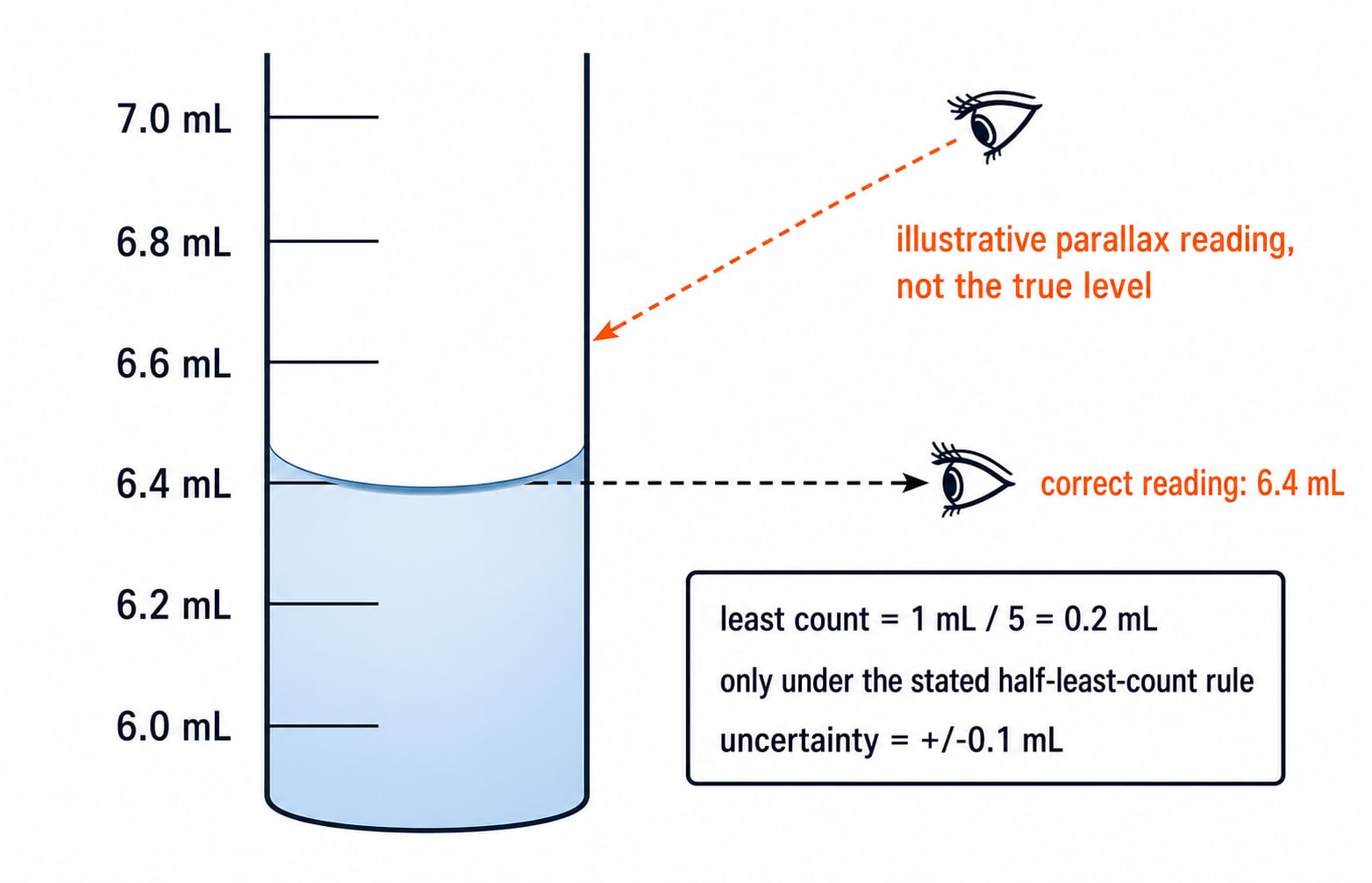
Least count is the smallest marked division available. A 10 mL cylinder has numbered marks 1 mL apart and five equal intervals between them, so its least count is 1 mL / 5 = 0.2 mL. Sample S-17 has the concave meniscus bottom at 6.4 mL.
Identify the scale direction and least count, bring your eye to meniscus level, read the correct part and record the unit. Apply uncertainty only when supported. Under a stated half-least-count convention, record 6.4 ± 0.1 mL because 0.2/2 = 0.1 mL.
Zero error exists before measurement; parallax comes from an angled sight line. Repeating that angle does not remove its bias.
Lab safety controls: decide from the hazard, not from habit
Identify the hazard and exposed person, stop or isolate the activity, then follow the label, Safety Data Sheet (SDS) and local standard operating procedure (SOP). Apply specified controls and required PPE. PPE is the final barrier, not permission to guess. Never choose a neutraliser without knowing the substance and procedure.
Scenario A:
10 mLfrom a container marked onlyS-17, with no visible identity, spills. Do not smell, touch or mix it. Alert the responsible person, keep others away and follow the unidentified-spill procedure.Scenario B: A
100 mLbeaker cracks. Stop using it, isolate the fragments and follow the broken-glass method. Never use bare fingers.Scenario C: A hot plate has damaged cable insulation. Stop, keep it out of use and report it for authorised inspection. Never wrap and continue.
Hazard controlled | Safe action | Tempting wrong action |
|---|---|---|
Eye or foot exposure | Required goggles and closed footwear | Replace PPE with care |
Misidentification | Labels face the reader | Ignore an unreadable label |
Ingestion | Never mouth-pipette | Pipette by mouth |
Test-tube splash | Opening points away from people | Point it at someone |
Electrical shock | Dry hands near controls | Use wet hands |
Blocked evacuation | Keep exits clear | Store items in exits |
How objective questions combine the concepts and where candidates get trapped
Run these six checks cold. Each one turns on a single rule from above, and the confusion table after it names the pair that most often costs the mark.
Check | Answer | Reason |
|---|---|---|
Convert |
| centi is |
Significant figures in | Three | leading zeros do not count, final zero does |
Classify Set B | Precise, not accurate | tight cluster away from reference |
Absolute error of |
| magnitude ignores sign |
Cylinder least count |
|
|
Unknown spill | Follow label, SDS and local procedure | never guess a neutraliser |
Do not confuse | Resolving clue |
|---|---|
Unit versus quantity | Scale versus what is measured |
Decimal places versus significant figures | Decimal digits versus meaningful digits |
Accuracy versus precision | Reference closeness versus repeatability |
Signed versus absolute error | Direction versus magnitude |
Random versus systematic error | Scatter versus one-direction bias |
Least count versus uncertainty | Scale division versus stated estimate |
Hazard control versus PPE | Isolate danger versus final barrier |
The same concept-first method, applied to science questions in another paper, is worked through in SSC CGL General Awareness Approach. Once these rules run without hesitation, put them under time pressure in the BTSC Lab Assistant Test Series.
The short version and the next study step
Use this recall chain: identify the quantity and unit, convert with powers of ten, retain guard digits, round by the correct rule, separate accuracy from precision, calculate error against the reference, then choose a safety action from the actual hazard and local procedure.
Without looking back, reproduce these three results: 2.46 g/mL = 2.46 × 10^3 kg/m^3, Set B mean = 24.60 mL, and percentage error = 1.6%. For a structured next step, continue with the BTSC Lab Assistant (CS) course. Syllabus documents and recruitment notices for the current cycle are published by the Bihar Technical Service Commission itself.
Keep learning
BTSC Lab Assistant Physics Lab: Instruments, Readings and Error Calculations
Learn a fixed method for selecting lab instruments, reading their scales, correcting zero error and reporting calculated results with sensible uncertainty.
Updated 16 Aug 20266 min readBTSC Lab Assistant

BTSC Lab Assistant Biology Lab: Microscopy and Specimen Handling Guide
Build an exam-ready microscopy workflow through a labelled onion wet mount, a checked cell-size estimate, safe specimen handling, and six common errors.
Updated 14 Aug 20265 min readBTSC Lab Assistant
BTSC Lab Assistant Job Profile: Records, Equipment Care and Daily Lab Workflow
Build a realistic CS/IT Laboratory Assistant role model around readiness checks, auditable registers, safe fault handling and evidence-based handover.
Updated 12 Aug 20265 min readBTSC Lab Assistant
BTSC Lab Assistant PYQ Analysis: Sort Common and Trade Topics
Turn a mixed PYQ score into a useful repair plan. This method separates common and trade topics, codes each miss and assigns revision time from your own errors.
Updated 10 Aug 20266 min readBTSC Lab Assistant