BTSC Lab Assistant Chemistry: Solutions, Titration and Lab Safety
Connect solution preparation to acid-base titration through a checked HCl and NaOH example. Learn the apparatus, calculations, error directions and safe lab sequence.
KnowledgeGate Team
Exam prep & CS education
Updated 7 Aug 20266 min read
Knowing that molarity means moles per litre is not enough if you select the wrong glassware, treat solvent volume as final solution volume, overshoot an endpoint or handle acid carelessly. Preparing a standard solution and running a routine titration are ordinary lab-assistant duties, so this chain is worth owning cold: dilute 1.000 mol L⁻¹ HCl to 250.0 mL of 0.1000 mol L⁻¹, titrate a 25.00 mL portion of unknown NaOH against it, and report 0.09932 mol L⁻¹. Each number comes out of the two equations C = n/V and C₁V₁ = C₂V₂, so the same arithmetic survives a different stock concentration or aliquot size.
Build the solution vocabulary before using a formula
Start with labelled 1.000 mol L⁻¹ HCl as the stock solution used to prepare a weaker one. HCl is the solute, distilled water the solvent, and their uniform mixture the solution. Dilute the stock to 250.0 mL of 0.1000 mol L⁻¹ HCl, then use it as the titrant delivered from a burette. A 25.00 mL portion, or aliquot, of unknown NaOH is the analyte.
The core relationships are:
Molarity: C = n/V, with V in litres.
Amount: n = C × V.
Dilution: C₁V₁ = C₂V₂, because the amount of solute transferred is conserved.
The dilution equation does not say that the two volumes are simply added. Also, 25.00 mL = 0.02500 L. Using 25.00 directly in n = CV would make the amount 1000 times too large. Prefix arithmetic, significant figures and rounding rules are worked out separately in BTSC Lab Assistant Units, Measurement Error and Lab Safety.
Work the dilution from numbers to apparatus
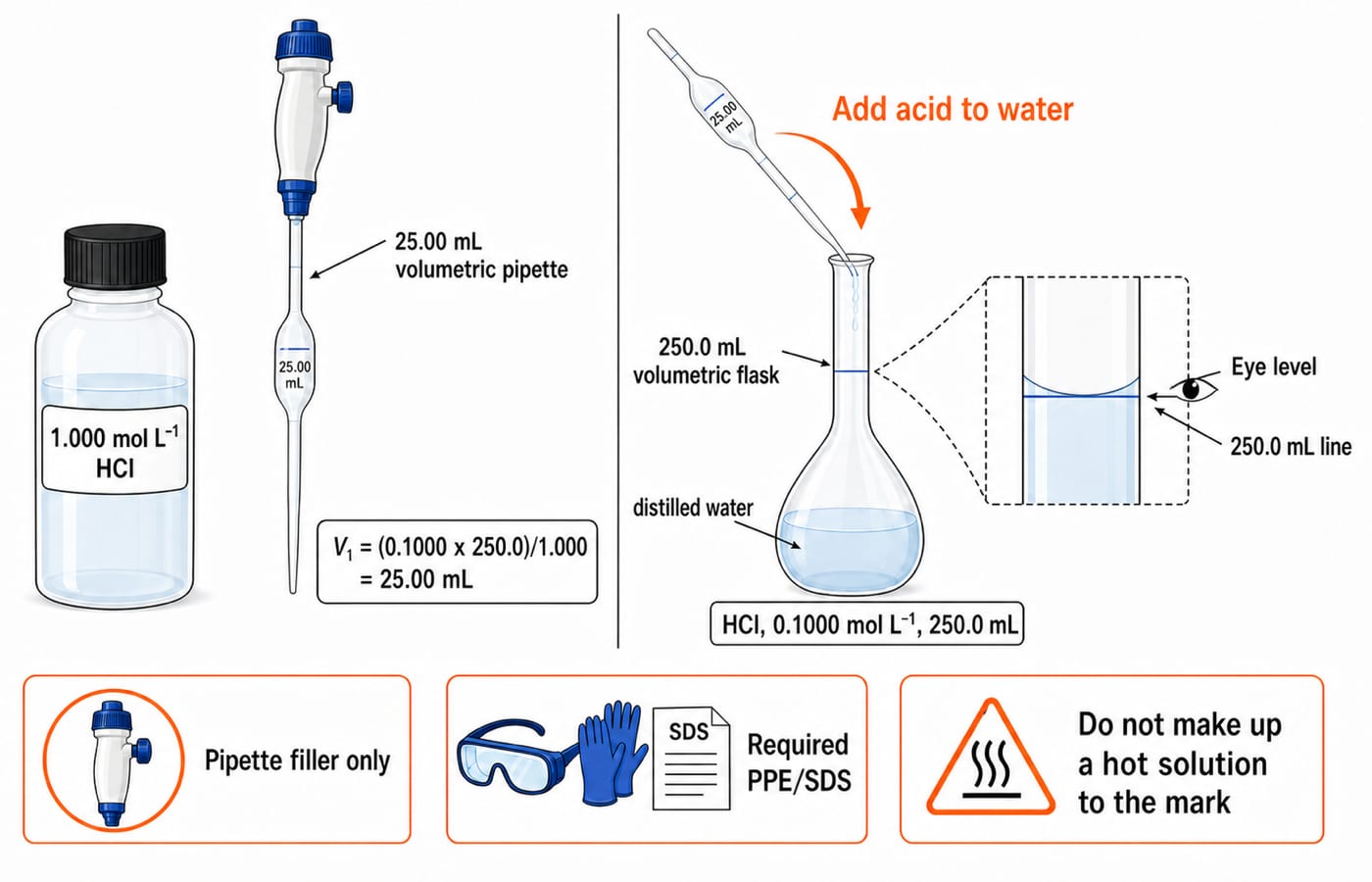
Calculate the stock volume first:
V₁ = (C₂ × V₂)/C₁ = (0.1000 mol L⁻¹ × 250.0 mL)/(1.000 mol L⁻¹) = 25.00 mL
Use a 25.00 mL volumetric pipette and filler, a 250.0 mL volumetric flask, a wash bottle and a labelled reagent bottle. A measuring cylinder or beaker is less accurate for this exact transfer.
Check the HCl label and local procedure, then wear the PPE required by the laboratory and safety data sheet (SDS). Part-fill the flask with distilled water. Transfer 25.00 mL stock acid using the filler, never by mouth, and swirl. Add acid to water, not water to concentrated acid. If it warms, let it return to room temperature. Add water until the meniscus bottom meets the mark at eye level, stopper, invert repeatedly, and label identity, concentration and preparation details.
Set up the acid-base titration without contamination
The reaction is HCl(aq) + NaOH(aq) → NaCl(aq) + H₂O(l).
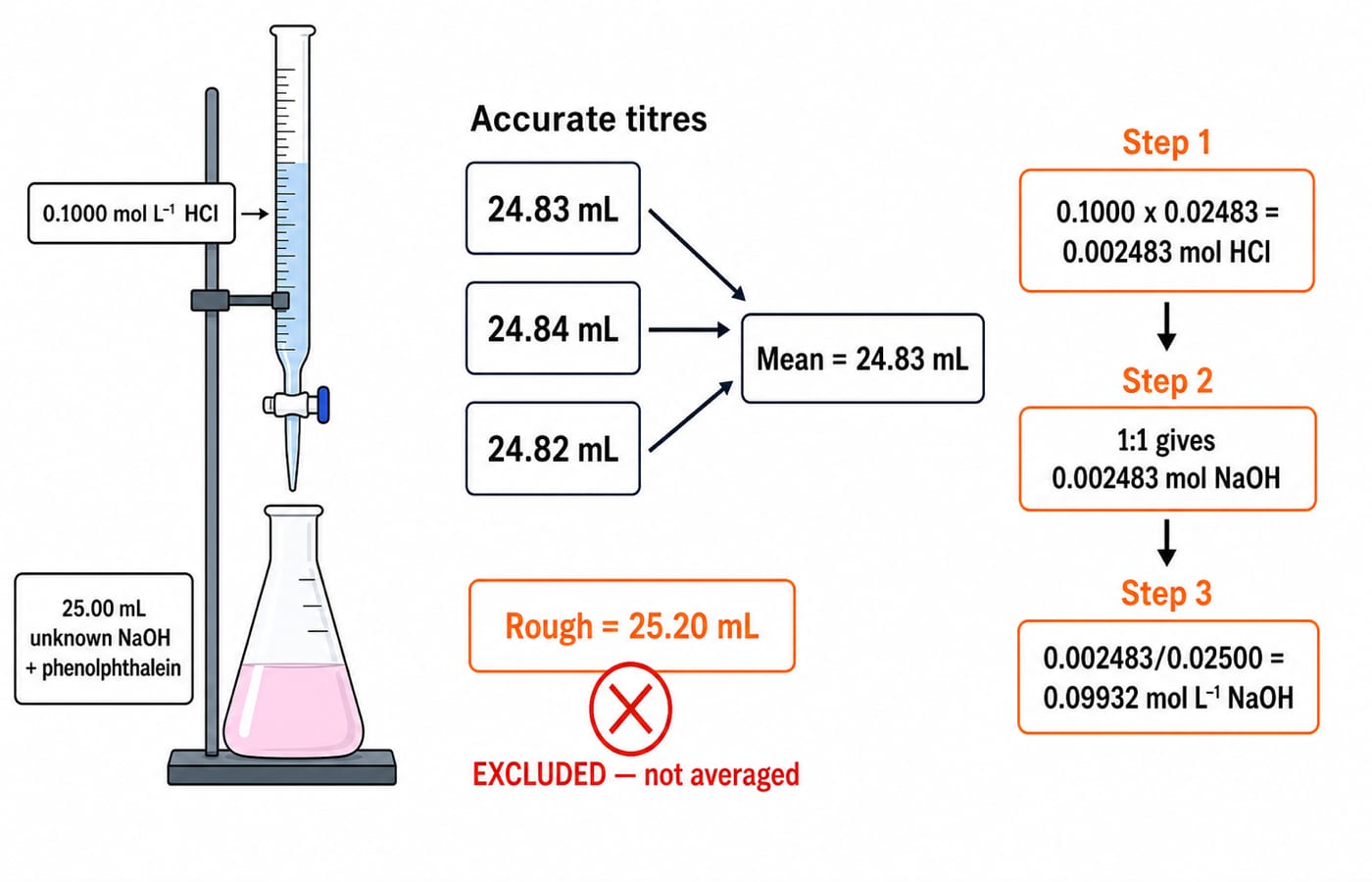
Its mole ratio is 1:1. Put 0.1000 mol L⁻¹ HCl in the burette. Transfer 25.00 mL unknown NaOH with a volumetric pipette to a conical flask, then add a few drops of phenolphthalein.
Rinse the burette with a little HCl titrant and the pipette with NaOH analyte. Fill the burette, remove the funnel, clear its tip of air and read the initial meniscus at eye level. Rinse the conical flask only with distilled water because extra water changes total volume, not analyte moles. Swirl continuously, wash splashes from the wall with distilled water and add HCl dropwise near the endpoint.
The basic NaOH with phenolphthalein starts pink and becomes colourless as HCl is added. A briefly colourless swirl is not enough. Take the endpoint at the first drop that leaves the flask permanently colourless, with no pink returning on further swirling.
Turn concordant burette readings into concentration
Subtract each initial reading from its final reading:
Trial | Initial reading (mL) | Final reading (mL) | Titre (mL) | Use |
|---|---|---|---|---|
Rough | 0.10 | 25.30 | 25.20 | Exclude |
Accurate A | 0.20 | 25.03 | 24.83 | Include |
Accurate B | 0.10 | 24.94 | 24.84 | Include |
Accurate C | 0.30 | 25.12 | 24.82 | Include |
The accurate titres span only 0.02 mL. Their mean is (24.83 + 24.84 + 24.82)/3 = 74.49/3 = 24.83 mL.
Do not include the rough result. Convert the mean titre to litres before calculating amount:
n(HCl) = 0.1000 mol L⁻¹ × 0.02483 L = 0.002483 mol
The 1:1 equation gives 0.002483 mol NaOH in the 25.00 mL aliquot. Therefore:
C(NaOH) = 0.002483 mol/0.02500 L = 0.09932 mol L⁻¹
This is reasonable. The titre and aliquot volumes are close, the reaction is 1:1, and the NaOH concentration is correspondingly close to 0.1000 mol L⁻¹.
Keep endpoint, equivalence point and indicator choice separate
The equivalence point is where reacting amounts match the balanced equation. Here, 24.83 mL of 0.1000 mol L⁻¹ HCl supplies 0.002483 mol HCl. The endpoint is the observed indicator change. Phenolphthalein becoming colourless signals proximity to equivalence, but does not define it.
Choose an indicator whose transition range falls within the steep part of the relevant titration curve:
A strong acid with a strong base has a steep pH change, so more than one common acid-base indicator can suit it.
A weak acid with a strong base generally suits phenolphthalein.
A strong acid with a weak base generally suits methyl orange.
A weak acid with a weak base usually needs an instrumental method rather than a simple visual indicator.
More indicator is not better. It is a chemical participant, so a few drops give a visible signal without needlessly affecting the mixture.
Diagnose which errors change the calculated concentration
Trace each mistake through the recorded titre to the calculated concentration.
Mistake | Immediate effect | Result |
|---|---|---|
Air bubble initially in burette tip | Some measured HCl fills the tip before reaching the flask | Recorded titre too large, so calculated NaOH concentration is too high |
Endpoint overshot | Excess HCl is delivered | Titre and calculated concentration are too high |
Meniscus read from above or below | Parallax shifts a reading | Error can shift either way |
Burette rinsed only with water | Remaining water dilutes HCl | Delivered HCl is weaker than the assumed 0.1000 mol L⁻¹, so the titre runs long and the calculated NaOH concentration is too high |
Distilled water in the conical flask changes total volume, not NaOH amount, so the correct equivalence volume is unchanged. Putting 250.0 mL water in the volumetric flask before adding acid creates more than 250.0 mL solution and invalidates the dilution.
Sort the errors before you correct them. An uncleared bubble, a water-rinsed burette and a habitually angled sight line are systematic: they push every trial the same way, so three concordant titres will agree with each other and still be wrong together. Scatter that changes size and sign between trials is random, and averaging the three accurate titres is what handles it.
Make safe handling part of every answer
Before: Read the HCl label and its SDS, hold the pipette and burette up to the light for chips or a sticking tap, confirm where the eyewash and acid spill kit are, and keep the 1.000 mol L⁻¹ stock away from the NaOH. During: Fill the pipette with a filler and never by mouth, run acid into water, clamp the burette so it cannot swing while you swirl, keep the reagent label facing you, and never tip surplus HCl back into the stock bottle. After: At the endpoint the flask holds little more than sodium chloride solution, but it still goes to the designated waste stream rather than the sink unless local procedure says otherwise. Rinse the glassware, wash your hands, and report any splash or exposure immediately.
Never smell, touch or taste a reagent, mix unknown waste, or neutralise a spill unless local procedure directs it. The label, SDS and laboratory procedure govern reagent-specific PPE, first aid, incompatibilities and disposal.
A question can ask you to calculate a dilution, pick the right glassware, turn burette readings into a titre, separate endpoint from equivalence, choose an indicator or say which way an error moves the answer. Marks, question counts and any negative marking for the paper are stated in the recruitment notice published by the Bihar Technical Service Commission. For recall practice, the KnowledgeGate question bank carries over 170 general-awareness chemistry questions, and the SSC CGL General Awareness approach shows how to build that recall without cramming.
The short version and next step
Check that you can explain C = n/V, calculate the 25.00 mL stock volume, narrate a safe acid-to-water preparation, average three concordant titres to 24.83 mL, reach 0.09932 mol L⁻¹ NaOH and name the direction of one error. For other government recruitment tracks, start from the Govt Jobs category. The BTSC Lab Assistant (CS) course and the BTSC Lab Assistant (CS) test series build the computer-science side of the same recruitment.
Keep learning
BTSC Lab Assistant Physics Lab: Instruments, Readings and Error Calculations
Learn a fixed method for selecting lab instruments, reading their scales, correcting zero error and reporting calculated results with sensible uncertainty.
Updated 16 Aug 20266 min readBTSC Lab Assistant

BTSC Lab Assistant Biology Lab: Microscopy and Specimen Handling Guide
Build an exam-ready microscopy workflow through a labelled onion wet mount, a checked cell-size estimate, safe specimen handling, and six common errors.
Updated 14 Aug 20265 min readBTSC Lab Assistant
BTSC Lab Assistant Job Profile: Records, Equipment Care and Daily Lab Workflow
Build a realistic CS/IT Laboratory Assistant role model around readiness checks, auditable registers, safe fault handling and evidence-based handover.
Updated 12 Aug 20265 min readBTSC Lab Assistant
BTSC Lab Assistant PYQ Analysis: Sort Common and Trade Topics
Turn a mixed PYQ score into a useful repair plan. This method separates common and trade topics, codes each miss and assigns revision time from your own errors.
Updated 10 Aug 20266 min readBTSC Lab Assistant