BTSC Lab Assistant PYQ Analysis: Sort Common and Trade Topics
Turn a mixed PYQ score into a useful repair plan. This method separates common and trade topics, codes each miss and assigns revision time from your own errors.
KnowledgeGate Team
Exam prep & CS education
Updated 10 Aug 20266 min read
A PYQ score hides two different problems: common-core misses in science or general studies, and trade-lane misses in computer basics or deeper CS/IT. Tag each traceable question by lane and bucket so revision follows your errors, not borrowed weightage, then take the weak buckets back to the BTSC Lab Assistant category for the underlying material. The whole audit runs on one sheet of paper and questions you have already attempted.
1. Use two lanes and four buckets, not one long topic list
Common contains Shared science and General studies; Trade contains Computer basics and Discipline knowledge. For CS/IT, the last covers programming, data structures, OS, DBMS and networks. Other trades must substitute their discipline.
Ask whether the same item could be set for several trades. If it could, start in Common. If it needs trade terminology, a mechanism, a calculation or a rule, use Trade. Inside Trade, recognising a digital fact is Computer basics; code, protocol, database or OS behaviour, or a technical calculation, is Discipline knowledge.
Four sample items, written for the method rather than taken from a BTSC paper:
540 g / 200 cm^3 = 2.7 g/cm^3: Common > Shared science.“Which river flows through Patna? A Yamuna, B Ganga, C Narmada, D Tapi”: Common > General studies, B.
“Which is volatile memory? A RAM, B ROM, C SSD, D DVD”: Trade > Computer basics, A.
The
/26item below: Trade > Discipline knowledge.
Sort on the knowledge a question demands, not the words it contains.
2. Build one question ledger before deciding what to revise
Record only questions whose source you can name. Create: Question ID | paper/source | result | time | lane | bucket | subject/topic | miss code | one-line repair | retest date. Mark guessed-correct G, never mastered. A small labelled set beats an unsorted pile, as Why PYQs Beat Buying Another Question Bank explains.
One learner's 60-question pass, tallied by bucket:
Bucket | Correct | Wrong | Blank | Total |
|---|---|---|---|---|
Shared science | 8 | 3 | 1 | 12 |
General studies | 6 | 3 | 1 | 10 |
Computer basics | 11 | 2 | 1 | 14 |
Discipline knowledge | 17 | 5 | 2 | 24 |
Total | 42 | 13 | 5 | 60 |
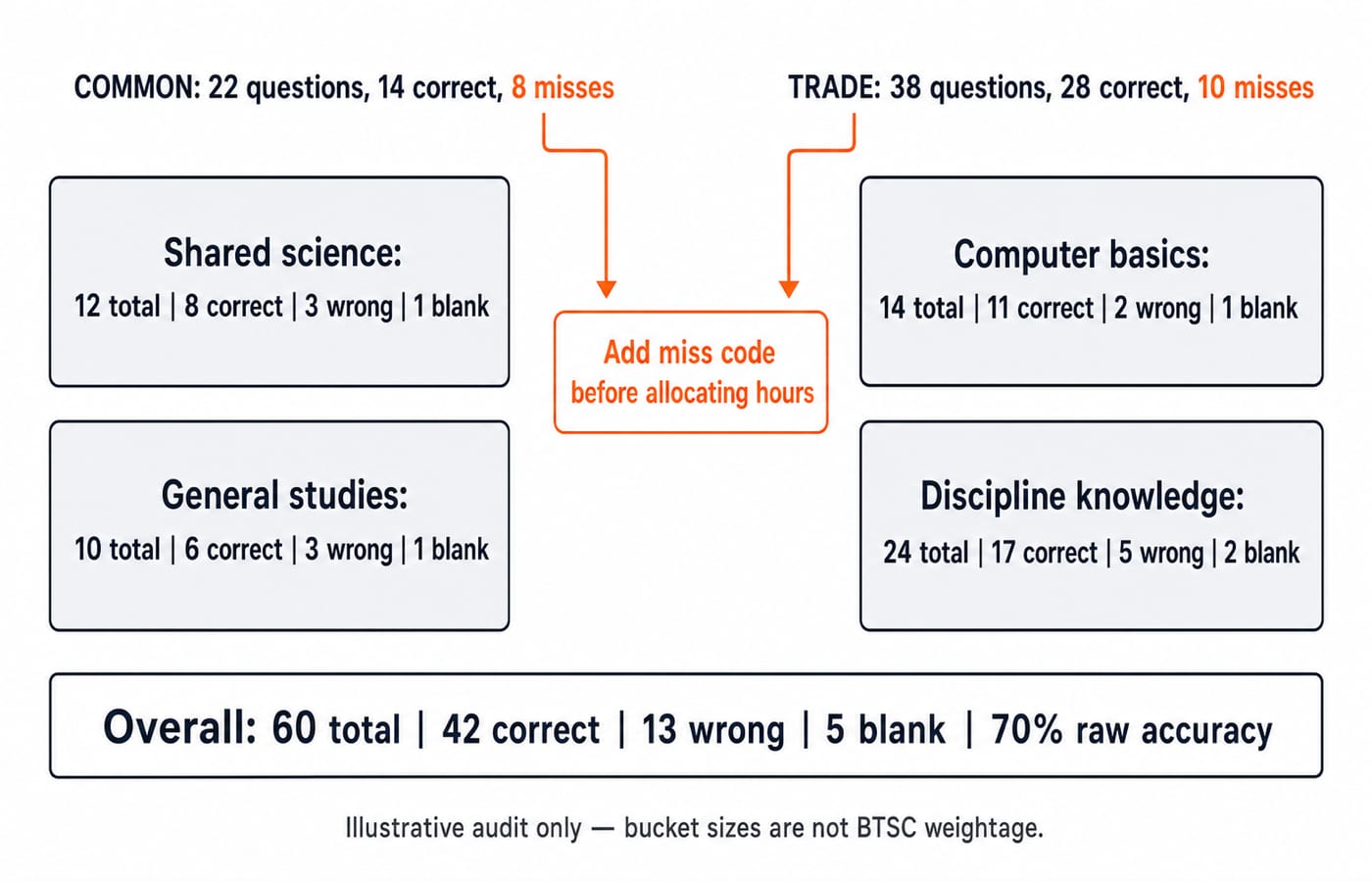
Thus 42/60 = 70%, with 18 visible misses before G or slow items join. Common is 22 total, 14 correct, 8 misses; Trade is 38 total, 28 correct, 10 misses. Ten Trade misses do not automatically outrank eight Common ones; repair depth decides the hours.
3. Worked examples: classify the knowledge, then diagnose the miss
A sample Common > Shared science item: “How much 2.0 M stock makes 500 mL of 0.5 M solution?” A 100 mL, B 125 mL, C 200 mL, D 250 mL. Using C1V1 = C2V2, 2.0 x V1 = 0.5 x 500; therefore V1 = 250/2 = 125 mL, B. A blank after 110 seconds means: “Derive the relation once, then solve two different-unit variants.”
A sample Trade > Discipline knowledge item: “For IPv4 network 192.168.10.0/26, how many usable hosts?” A 30, B 62, C 64, D 126. Host bits: 32 - 26 = 6; addresses: 2^6 = 64; usable: 64 - 2 = 62, B. Choosing C in 95 seconds is an application error: “Subtract network and broadcast.”
The volatile-memory item needs plain retrieval: you either recall that RAM loses its contents without power, or you do not. The subnet item needs a rule applied and a number computed, so repair it by re-deriving on fresh values.
4. Fix the four classification habits that distort a PYQ audit
Four habits distort the buckets and send hours to the wrong place.
Filing every computer-word item under Discipline knowledge. A question that names RAM but only asks you to recognise it is one fact, not a mechanism.
Filing every laboratory-context item under Trade. Density, dilution and measurement are shared science; the lab setting is scenery, not the knowledge tested.
Clearing a lucky guess because the mark was right. It stays in repair until you can reject all three wrong options out loud.
Tagging one question with five topics. Assign one primary bucket by the decisive step, plus at most one secondary tag.
SSC CGL Tier 1 Paper Analysis: Topic-wise Distribution shows the same tally built for a different paper; the method transfers, the numbers do not.
5. Give every flagged item a repair code and a measurable next action
Use CK concept unknown, RC recall failure, AP rule misapplied, RD missed condition, and TM time stop. “Silly mistake” is not a code, because it names no task. For a guess, code the reason you could not rule the other options out.
Question and bucket | Result and time | Code | Repair | Retest |
|---|---|---|---|---|
SCI-SOL-04, Common > Shared science | blank, 110 s | CK | Relearn | Day 2 |
CB-MEM-03, Trade > Computer basics | guessed A, correct, 28 s | RC | Explain why ROM, SSD and DVD are non-volatile | Day 2 |
CN-IP-07, Trade > Discipline > Networks | chose C, 64, 95 s | AP | Subtract network and broadcast after finding | next day |
CK gets a short lesson plus two fresh questions; RC, closed-book retrieval at 24 hours and seven days; AP, one derivation plus two changed-value problems; RD, underline and re-solve; TM, a stop rule plus timed retry. Repeated CK may need the structured BTSC Lab Assistant complete course, not another key.
6. Turn the audit into an 18-hour week with four phases
Score each flagged item by how much work its repair needs: CK/AP score 3, RC scores 2, and RD/TM score 1.
Shared science:
2 CK + 1 RC + 1 RD = 6 + 2 + 1 = 9.General studies:
1 CK + 2 RC + 1 RD = 3 + 4 + 1 = 8.Computer basics:
1 CK + 1 RC + 1 TM = 3 + 2 + 1 = 6.Discipline knowledge:
3 CK + 2 AP + 1 RC + 1 TM = 9 + 6 + 2 + 1 = 18.
Total: 9 + 8 + 6 + 18 = 41. Phase A is 2 hours classifying. Phase B is 11 repair hours: 2.5 Shared science, 2 General studies, 1.5 Computer basics, 5 Discipline knowledge. Phase C is 3 hours mixed work plus correction; Phase D, 1 hour auditing; buffer, 1 hour. Recalculate the split after the next audit; the hours follow your errors.
If a 3-hour Discipline block disappears, use the 1-hour buffer and take the other 2 hours from the lowest-priority new-question work. Do not cancel a due retest, and do not schedule a six-hour catch-up you will not finish. If two days go, keep the highest-point CK/AP repair and the weekly mixed set, and carry the rest forward.
7. Retest the lanes separately and let the result choose the next week
Retest with 60 fresh items matched to the illustrative bucket sizes. Suppose Common moves from 14/22 = 63.6% to 18/22 = 81.8%, Trade from 28/38 = 73.7% to 33/38 = 86.8%, and overall from 42/60 = 70% to 51/60 = 85%. Your own numbers will differ; what matters is that each lane moved. Reusing questions you have already seen invalidates the retest.
Below 75% on your own retest, or with repeated CK/AP, keep concept repair. At or above 80% but still slow, reduce theory and add timed mixed practice. If guesses remain, retrieve until all three wrong alternatives can be rejected.
The short version
Tag each source-labelled PYQ by lane and bucket, code misses, allocate hours by repair depth, then retest fresh matched items. Classify 20 questions today. For scheduled practice, use the BTSC Lab Assistant CS test series, then repeat the analysis after every test.
Keep learning
BTSC Lab Assistant Physics Lab: Instruments, Readings and Error Calculations
Learn a fixed method for selecting lab instruments, reading their scales, correcting zero error and reporting calculated results with sensible uncertainty.
Updated 16 Aug 20266 min readBTSC Lab Assistant

BTSC Lab Assistant Biology Lab: Microscopy and Specimen Handling Guide
Build an exam-ready microscopy workflow through a labelled onion wet mount, a checked cell-size estimate, safe specimen handling, and six common errors.
Updated 14 Aug 20265 min readBTSC Lab Assistant
BTSC Lab Assistant Job Profile: Records, Equipment Care and Daily Lab Workflow
Build a realistic CS/IT Laboratory Assistant role model around readiness checks, auditable registers, safe fault handling and evidence-based handover.
Updated 12 Aug 20265 min readBTSC Lab Assistant
BTSC Lab Assistant Chemistry: Solutions, Titration and Lab Safety
Connect solution preparation to acid-base titration through a checked HCl and NaOH example. Learn the apparatus, calculations, error directions and safe lab sequence.
Updated 7 Aug 20266 min readBTSC Lab Assistant