AMCAT Preparation Plan: A Six-Week Module-Wise Schedule
Turn six weeks into a workable AMCAT study cycle with a diagnostic, rotating module priorities, an error ledger and timed practice. The plan scales from 12 hours a week to the time you have.
KnowledgeGate Team
Exam prep & CS education
Updated 7 Aug 20266 min read
You have six weeks, but English, quant, reasoning and a role-specific module sit in separate lists. This plan spends 12 hours a week, 72 in all: one week to measure, four to rotate a lead module, one to rehearse under a clock. With fewer hours, scale every block instead of dropping a module.
Map the current AMCAT modules
MyAMCAT's current pages list English Ability, Quantitative Ability, Logical Reasoning and the AMCAT Personality Inventory as compulsory, and add one domain module that you pick yourself. The timings there run quant 16 questions in 18 minutes, English 18 in 16, reasoning 14 in 16 and personality 90 in 20, with domain counts that vary by module. Recheck MyAMCAT before your slot, since the list and the timings change. How employers read the four scores is set out in AMCAT Exam Pattern: Modules, Domains and Score Use.
Four of the modules are trainable in the usual sense: quant, English, reasoning and your domain choice. The personality inventory is not a study target, so answer its 90 questions consistently rather than guessing at a preferred answer. All 72 hours therefore go to the four graded modules.
Build and scale a 72-hour plan
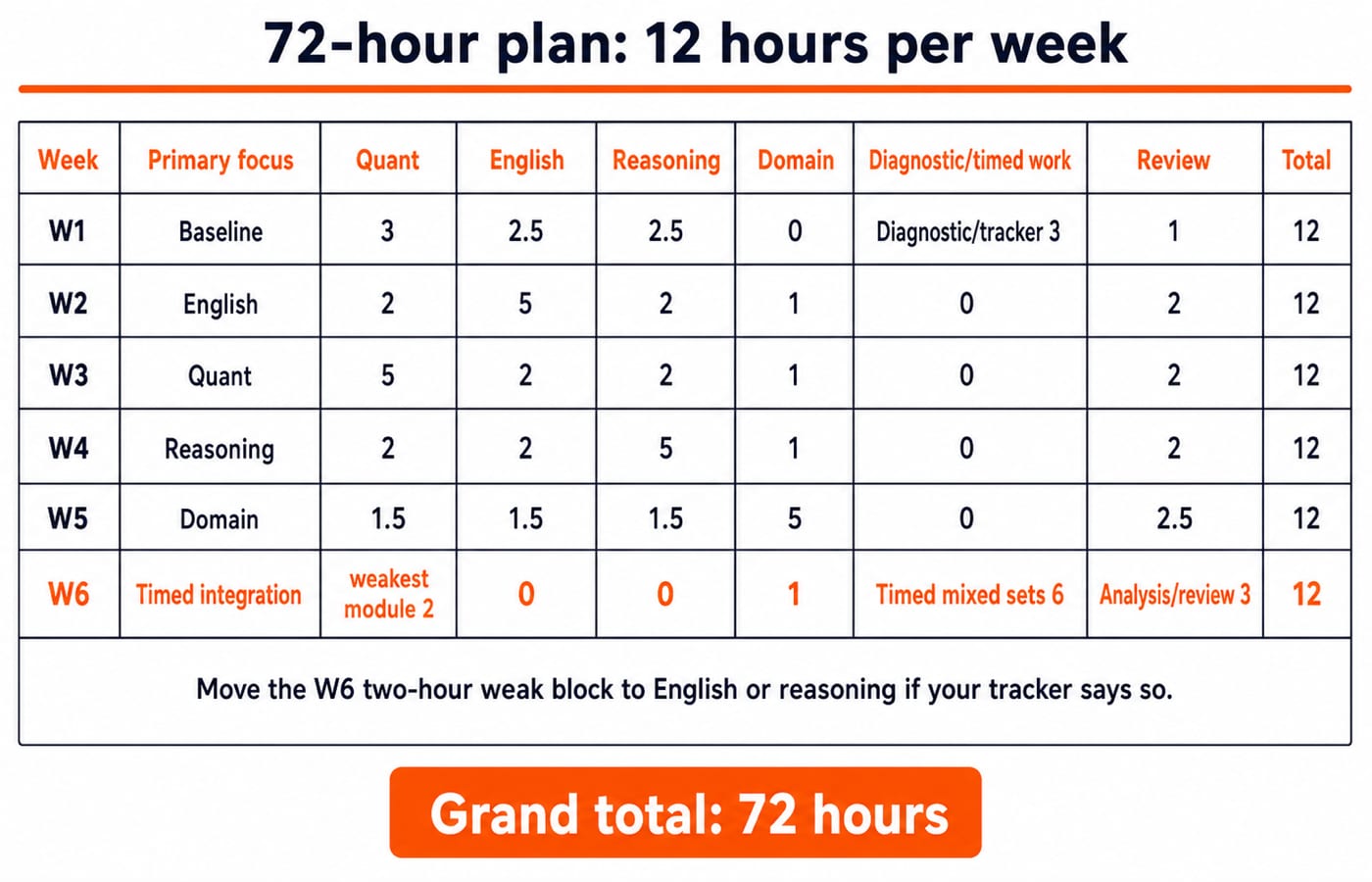
Use six 2-hour sessions a week and keep Sunday as a recovery buffer: 12 hours/week x 6 weeks = 72 hours.
Week | Diagnostic/timed | Quant | English | Reasoning | Domain | Review | Total |
|---|---|---|---|---|---|---|---|
1, baseline | 3h | 3h | 2.5h | 2.5h | 0 | 1h | 12h |
2, English | 0 | 2h | 5h | 2h | 1h | 2h | 12h |
3, quant | 0 | 5h | 2h | 2h | 1h | 2h | 12h |
4, reasoning | 0 | 2h | 2h | 5h | 1h | 2h | 12h |
5, domain | 0 | 1.5h | 1.5h | 1.5h | 5h | 2.5h | 12h |
6, integration | 6h | 2h, weakest | 0 | 0 | 1h | 3h | 12h |
For an 8-hour week, multiply blocks by 8/12 = 2/3. Week 2 becomes English 3 h 20 min, quant 1 h 20 min, reasoning 1 h 20 min, domain 40 min and review 1 h 20 min. Check: 200 + 80 + 80 + 40 + 80 = 480 minutes = 8 hours. Never compress it into a weekend marathon.
Week 1: diagnose and build an error ledger
Build a fixed set mirroring the live counts: 16 quant, 18 English, 14 reasoning, so 48 questions in 18 + 16 + 16 = 50 minutes. Session one is 10 minutes of setup, 50 of questions, 60 of review; hour three sets priorities and tidies the ledger. Already sat a real mock? The deeper review loop is in AMCAT Mock Analysis: A Method to Review Adaptive Tests.
Baseline: quant 9/16 = 56.25%, English 12/18 = 66.67%, reasoning 8/14 = 57.14%. Total: 9 + 12 + 8 = 29; 29/48 = 60.42%. Quant is weakest, but by only 57.14 - 56.25 = 0.89 percentage points, so read time and error type before choosing a lead module. The ledger needs seven columns: module, topic, question, seconds, result, error type, repair action.
One row, worked: a value rises from 24,000 units to 27,600. Increase: 27,600 - 24,000 = 3,600. Percentage: (3,600 / 24,000) x 100 = 15%. Dividing by 27,600 returns 13.04% instead, so the error type is concept: wrong base rather than carelessness, and the repair is one rule: percentage change always divides by the starting value. If the same error type survives three weeks, the gap is foundational, and Aptitude Courses for Exams and Placements is the place to relearn it.
Week 2: lead with English without dropping the others
Split English into grammar 2 h, comprehension 1 h, contextual vocabulary 1 h and a timed set 1 h. Retain quant 2 h, reasoning 2 h, domain 1 h and review 2 h, so English takes 5 of the 12 hours and nothing falls to zero.
Change “Each of the developers have submitted the report” to “Each of the developers has submitted the report.” Each, not developers, controls has. Write the rule, then solve five fresh items.
Each 2-hour session runs the same 60-minute shape twice: 25 minutes concept, 25 untimed questions, 10 of error notes, with round two timed. Record 18 attempts, 14 correct, four classified errors and two rules to carry into Saturday's review session. 14/18 = 77.78% against week one's 66.67% counts only if those four errors are new.
Week 3: turn quantitative ability into a method
Split the 5 hours the table gives quant: arithmetic 2 h, algebra 1 h, data interpretation 1 h, timed set 1 h. Arithmetic leads because its rules carry from one question to the next: a percentage change always divides by the starting value, a ratio is settled by finding the value of one part, and an average is handled through the total rather than the individual values.
Five scores averaging 42 total 5 x 42 = 210. Replace 56 with 41: 210 - 56 + 41 = 195; 195/5 = 39. Check: the 15-point fall lowers the average by 15/5 = 3, from 42 to 39.
For a 20-question set, compare Monday's 11 correct at a 78-second median with Saturday's 15 at 64: 11/20 = 55% becomes 15/20 = 75% at 14 seconds less per question. Review the five misses before another set.
Week 4: externalise logical constraints
Allocate arrangements 2 h, coding and series 1 h, data sufficiency 1 h, timed set 1 h. Write every constraint down before testing an arrangement, since most misses here are memory failures rather than logic failures.
Practice: A, B, C, D take seats 1 to 4. B is immediately right of A, C is not at an end, D is left of A. Only three A-B pairs exist. A-B at 1-2 dies at once, since no seat is left of 1 for D. A-B at 2-3 puts D in 1 and forces C into 4, an end. A-B at 3-4 leaves C in 2 and D in 1. Order: D, C, A, B, and all three constraints hold.
Week 5: deepen the domain module
Pick the domain module by what your target roles ask for. A CS or IT candidate can split the 5 hours as programming and tracing 2 h, data structures 1 h, DBMS and SQL 1 h, operating systems and algorithms 1 h. Move an hour to whichever area the ledger keeps flagging.
Domain questions are often traces. Take sum = 0, then for i = 1 through 4 add i*i: the accumulator reads 1, 5, 14, 30, so the output is 30 after four iterations. Write one line per iteration. The AMCAT Preparation course carries the concepts, previous-year questions, topic-wise videos and test series, and over 900 AMCAT practice questions sit on the site's question pages.
Week 6: integrate under time and recover sensibly
Run three cycles of a 50-minute fixed core set plus 50 minutes of review, 100 minutes each, so 300 minutes = 5 hours, and re-solve the misses in hour six. AMCAT adapts, picking your next question from your last answer, so a fixed-set percentage measures your progress and never predicts an AMCAT score. Read 29/48 = 60.42%, 34/48 = 70.83% and 38/48 = 79.17% as a curve, trusted only while concept errors fall and timing holds.
The other 6 hours: 2 h on the weakest module, quant here, 1 h domain, 3 h for analysis, rule cards, a pattern recheck and test-day logistics. Miss Tuesday? Use Sunday for 60 minutes of priority practice plus 30 of ledger review, dropping 30 minutes of low-priority work. Lose four hours or more? Keep the module order and move the finish date.
The short version
Measure first, rotate the lead module, and let the ledger decide what week 6 rehearses. If six weeks is more than you have, the 30-day aptitude routine compresses the same order into a shorter run, while the AMCAT Preparation course lays the material out module by module.
Keep learning

TCS NQT Eligibility: Check Backlogs, Gaps and Degree Rules
Use a closed TCS hiring notice as a worked checklist for degree, backlog, course-duration and academic-gap rules, then verify the current drive.
Updated 2 Sep 20264 min readIT Recruitment Exams

CoCubes Preparation Plan: Six Weeks for Campus Hiring Tests
Build a practical six-week CoCubes study plan around the modules in your own test invitation, your diagnostic results, and 72 hours of focused work.
Updated 1 Sep 20266 min readIT Recruitment Exams

eLitmus Retake Decision: Read Section Percentiles Before Testing Again
Do not retake eLitmus on disappointment alone. Use your section pattern, target-job evidence, and fresh timed practice to decide whether to go, wait, or rebuild.
Updated 30 Aug 20264 min readIT Recruitment Exams

eLitmus Mock Analysis: Diagnose Knowledge Gaps and Attempt Errors
A worked mock-review method to separate concept gaps from calculation, reading and decision errors, recover marks, and plan the next four weeks.
Updated 29 Aug 20265 min readIT Recruitment Exams