AMCAT Mock Analysis: Review an Adaptive Test Without Guesswork
Raw accuracy cannot explain an adaptive path. This review loop keeps the mock report separate from your own fixed practice sets, classifies weak and fragile answers, and schedules comparable retests.
KnowledgeGate Team
Exam prep & CS education
Updated 25 Jul 20267 min read

A mock review often asks only how many answers were right. In an adaptive test that number means little, because each response decides what the next question looks like. The official AMCAT help centre states the rule plainly: correct leads to a harder question, incorrect to an easier one, so two people can finish on the same percentage having sat different tests. A fragile correct answer and an early misconception need different repairs too. Review four things instead of one: the evidence your report is allowed to show, accuracy on fixed practice sets, response time, and confidence. The figures below are a worked example: copy the method and fill in your own numbers.
1. Separate the Adaptive Report From Your Follow-up Practice Data
Create one ledger with these columns: source, module or practice block, report metric, topic label, outcome, time used, confidence 1-3, first failure point, repair action, changed-value retest, retest date, retest result.
Tag every row adaptive mock report or fixed follow-up set, and never average the two into one percentage. Copy only what the report puts on screen. Where per-item time, item difficulty or answer review is not exposed, write not exposed rather than estimating it, because an estimate soon reads back as evidence. The stems are confidential, so the ledger stores the concept, never the question. Your own follow-up questions carry no such limit: keep the full working beside the concept label, so the error stays diagnosable.
One ledger can serve more than one assessment. The IT Recruitment Exams category shows the other campus tests you are likely to sit, and the tagging rule above holds for each.
2. See Why Equal Accuracy Can Hide Two Adaptive Paths
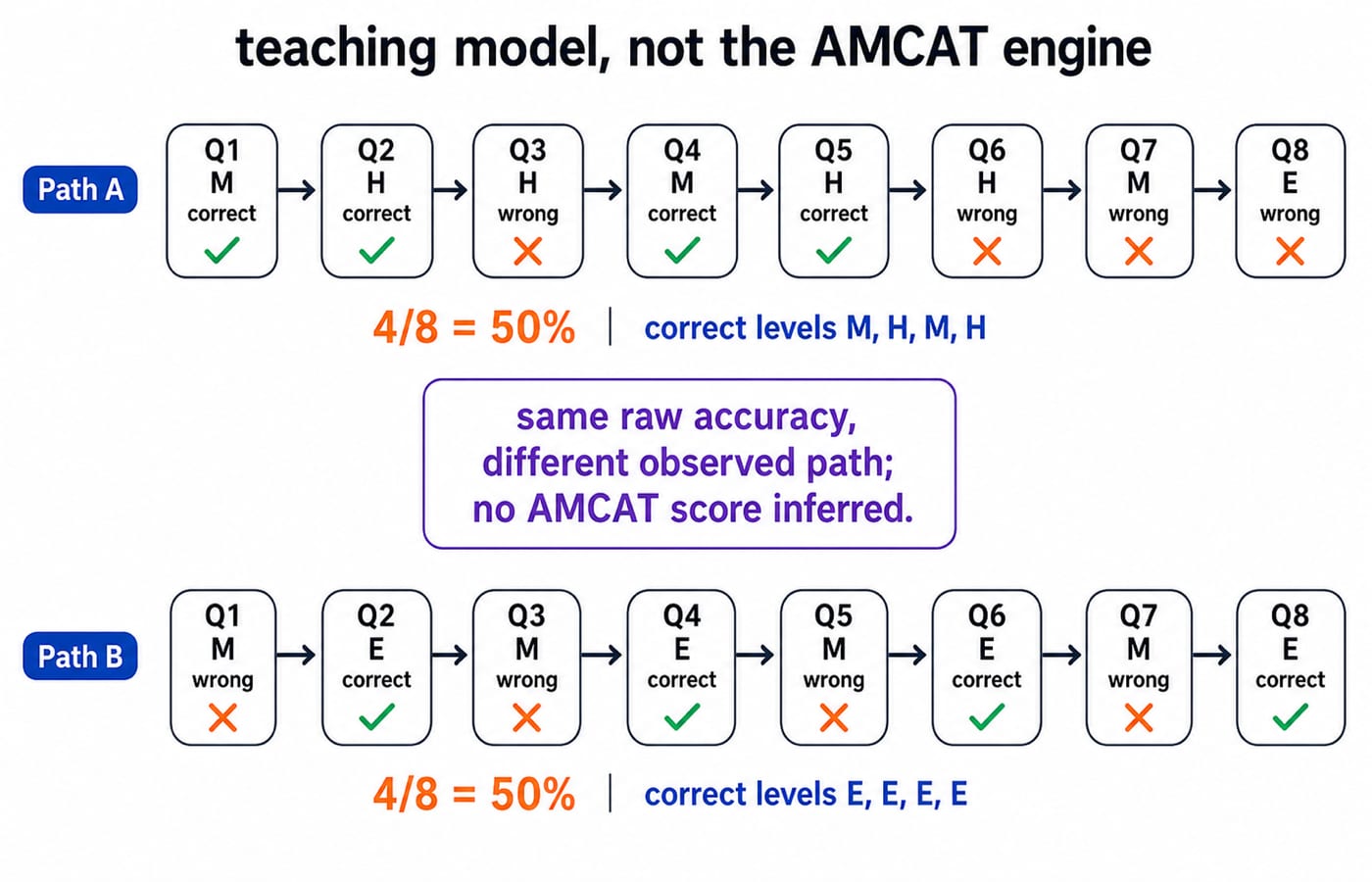
AMCAT's help centre also says the score depends on the levels you answer correctly, but it publishes no weights behind them. That is exactly why the pattern of levels tells you more than the percentage does.
Consider a simplified ladder: start at Medium, move up after a correct answer, move down after a wrong one, and hold at the boundary. Path A is M correct, H correct, H wrong, M correct, H correct, H wrong, M wrong, E wrong. Path B is M wrong, E correct, M wrong, E correct, M wrong, E correct, M wrong, E correct. Both give 4/8 = 50%. But A's correct answers land at M, H, M, H and B's at E, E, E, E: A is holding at hard questions and fading late, B never left the easy rung. Raw accuracy describes neither. The ladder is a teaching model, not AMCAT's engine: it shows why the percentage is the wrong headline, not what your score would be.
CoCubes and eLitmus score on different logic, so this review habit does not transfer wholesale. AMCAT, CoCubes and eLitmus compared sets out what changes.
3. Run a Fixed 48-Question Diagnostic
Since adaptive paths are not comparable week to week, build the comparable measurement yourself: three blocks of your own questions at a fixed planned difficulty. The worked example runs like this. Verbal has 18 questions, 13 correct, 5 wrong, 22 minutes, so 13/18 = 72.2%. Quantitative aptitude has 16 questions, 9 correct, 7 wrong, 31 minutes, so 9/16 = 56.3%. Logical reasoning has 14 questions, 10 correct, 4 wrong, 19 minutes, so 10/14 = 71.4%. The combined 32/48 = 66.7% looks respectable and hides the block actually costing marks.
Now diagnose one quantitative miss. A value starts at 800, rises by 25% to 800 x 1.25 = 1,000, then falls by 20% to 1,000 x 0.80 = 800. Net change is 0%, not a 5% gain. Tag it concept gap: successive percentage multipliers.
Set the changed-value retest immediately: 1,200 x 1.20 = 1,440, then 1,440 x 0.90 = 1,296. The gain is 96, which is 8% of 1,200.
4. Classify Misses and Fragile Correct Answers
Classify all 16 wrong answers. Verbal has 1 concept, 1 execution, 2 misreads, 1 selection/time; quantitative has 4 concept, 2 execution, 0 misreads, 1 selection/time; logical has 1 concept, 1 execution, 1 misread, 1 selection/time. Also flag 7 correct-but-fragile answers at confidence 1: verbal 2, quantitative 3, logical 2.
Rank the causes by how much repair each earns, weighting a concept gap heaviest because it recurs across every topic that uses it: concept 3, execution 2, misread 2, selection/time 1, fragile correct 0.5.
Verbal:
(1x3)+(1x2)+(2x2)+(1x1)+(2x0.5)=11Quantitative:
(4x3)+(2x2)+(0x2)+(1x1)+(3x0.5)=18.5Logical:
(1x3)+(1x2)+(1x2)+(1x1)+(2x0.5)=9
Quantitative goes first at 18.5, roughly twice logical's 9, so it earns roughly twice the study time. That ordering came from the errors, not from a section's reputation. Sitting another mock before running this classification only adds unprocessed data, one of the common placement preparation mistakes.
5. Cross Accuracy With Time and Confidence
Calculate average response time for each fixed block: verbal 22 x 60 / 18 = 73.3 seconds, quantitative 31 x 60 / 16 = 116.3 seconds, and logical 19 x 60 / 14 = 81.4 seconds. Quantitative is taking about 60 percent longer per question than verbal and returning the lowest accuracy of the three. Slow and wrong together is what punishes you under a clock.
Sort responses into four quadrants: correct and confident, correct but fragile, wrong and fast, wrong and slow. Q11 wrong in 38 seconds, confidence 3 points at a confident misconception. Q14 correct in 184 seconds, confidence 1 stays on the repair list because its method is unstable. Check the working, or run a changed-value test, before assigning the final label.
Once the ledger names the same concept gap twice, you need drill material aimed at that gap, not another mock. The Aptitude for Placement course is the structured route through aptitude, reasoning and verbal ability if you would rather not assemble the drills yourself.
6. Turn the Diagnosis Into an Eight-Hour Repair Week
Allocate quantitative 2.5 hours, verbal 1.25 hours, logical 1.25 hours, mixed fixed-difficulty retest 1.5 hours, ledger review 0.5 hour, and buffer 1 hour. The 18.5 quantitative repair score earns the largest block. The buffer protects the plan when a day is missed.
Monday:
90 minutes quantitative conceptsTuesday:
45 minutes verbal + 45 minutes logicalWednesday:
60 minutes quantitative execution and changed valuesThursday:
30 minutes verbal + 30 minutes logical + 30 minutes ledgerSaturday:
90 minutes mixed retestSunday:
60 minutes buffer
That is 480 minutes = 8 hours. If Wednesday is lost, move its 60 minutes into Sunday and preserve Saturday's retest. If Tuesday is lost, recover 60 minutes on Sunday, carry 30 minutes into next week, and do not create a punishment session or take another adaptive mock early.
7. Retest Changed Values and Compare Like With Like
Use Day 0 correction, Day 3 changed example, Day 10 mixed set and Day 24 final check. On Day 3, solve 1,200 -> 1,440 -> 1,296 and explain why the net gain is 8% without memorising a shortcut.
Compare fixed sets of the same length and planned difficulty, not adaptive paths:
Fixed set | Verbal | Quantitative | Logical | Block times |
|---|---|---|---|---|
A |
|
|
|
|
B |
|
|
|
|
C |
|
|
|
|
Fix your readiness gate before you see the results, so it cannot be renegotiated afterwards: every block at least 75% across two comparable sets, no more than 2 confidence-1 correct answers across those sets, and no concept-gap label appearing twice. Set B clears the accuracy half at 83.3%, 75.0% and 78.6% but carries 4 fragile corrects, so it fails the confidence half; C carries 2 and clears both. Sit one more fixed set before booking another adaptive mock.
8. AMCAT Mock Analysis in One Repeatable Loop
Short version: record only what the report actually shows you, respect the adaptive path, use fixed follow-up sets for comparable accuracy and time, classify the failures, repair the highest-priority cause, then retest with changed values.
Create the ledger now, while the mock is still fresh. Enter the 800 -> 1,000 -> 800 miss and the 38-second confident wrong row, then book Monday's 90-minute repair block. If you would rather follow a module order than build one, the AMCAT preparation course walks through them in sequence; the ledger still does the diagnosing.
Keep learning

TCS NQT Eligibility: Check Backlogs, Gaps and Degree Rules
Use a closed TCS hiring notice as a worked checklist for degree, backlog, course-duration and academic-gap rules, then verify the current drive.
Updated 2 Sep 20264 min readIT Recruitment Exams

CoCubes Preparation Plan: Six Weeks for Campus Hiring Tests
Build a practical six-week CoCubes study plan around the modules in your own test invitation, your diagnostic results, and 72 hours of focused work.
Updated 1 Sep 20266 min readIT Recruitment Exams

eLitmus Retake Decision: Read Section Percentiles Before Testing Again
Do not retake eLitmus on disappointment alone. Use your section pattern, target-job evidence, and fresh timed practice to decide whether to go, wait, or rebuild.
Updated 30 Aug 20264 min readIT Recruitment Exams

eLitmus Mock Analysis: Diagnose Knowledge Gaps and Attempt Errors
A worked mock-review method to separate concept gaps from calculation, reading and decision errors, recover marks, and plan the next four weeks.
Updated 29 Aug 20265 min readIT Recruitment Exams