TCS NQT PYQ Analysis: Track Stable Skills Across Changing Papers
Learn a repeatable way to separate unreliable paper labels from useful evidence, find the skills beneath changing question wrappers, and build a personal repair order.
KnowledgeGate Team
Exam prep & CS education
Updated 20 Aug 20267 min read
You download files labelled TCS NQT previous paper, yet find different topic mixes and formats. Predicting the next paper from surface counts is a mistake. Use the TCS placement-preparation hub to see what the exam actually covers, then record source quality, tag each underlying skill, separate depth from time cost, and turn repeated evidence into practice priorities.
Audit the source before calling a question a PYQ
Start with a source register containing these fields: set ID | page or file URL | claimed exam or drive | claimed date | publisher | official / memory-based / recreated / unknown | answer-key status | duplicate-of. Use neutral IDs S1, S2 and S3 until provenance is clear.
A coaching reconstruction or candidate-recalled set provides practice but is not an official paper. For example:
S1-Q04 | memory-based | arithmetic modelling | keep with caveatS2-Q09 | recreated practice | code tracing | practice onlyS3-Q02 | unknown scan | language precision | exclude from trend count until sourced
If two websites reproduce the same ordered stems, count one source, not two confirmations. Use TCS NQT Exam Structure for orientation, and copy the assessment map from your current TCS invitation or official test portal before you simulate it. The cleanest evidence you will ever hold is a paper you attempted yourself under a timer, because its provenance needs no auditing at all. TCS NQT Mock Analysis works that source end to end. A downloaded set carries no such guarantee, which is exactly why it needs the register.
Tag the skill, depth and time cost beneath every surface topic
Use six stable skill labels: arithmetic modelling, constraint tracking, language precision, data reading, code-state tracing, and implementation design. A profit percentage and rate problem can both test arithmetic modelling. A seating arrangement and order-of-operations puzzle can both require constraint tracking. A pseudocode-output item is code-state tracing even when its syntax changes. Map the labels onto the sections the NQT names, so a skill total always points at somewhere to practise: Numerical Ability draws on arithmetic modelling and data reading, Reasoning Ability on constraint tracking, Verbal Ability on language precision, Programming Logic on code-state tracing, and the Coding section, where you write and run a program against test cases, on implementation design.
Add depth codes: D1 = retrieve or recognise one fact, D2 = apply one rule or transformation, and D3 = combine steps, maintain state or construct a solution. Record C = correct with a reproducible reason, G = guessed correct, W = wrong, or U = unattempted. Every G, W and U is risky.
Record home-practice seconds. Mark overrun against a limit you set yourself for comparable items, and take the per-section timing you simulate from your own TCS invitation rather than from a figure quoted inside a download. Keep one row shape: set-question | wrapper | stable skill | D1/D2/D3 | C/G/W/U | seconds | overrun yes/no | failure note.
Read a 36-item sample without inventing TCS weightage
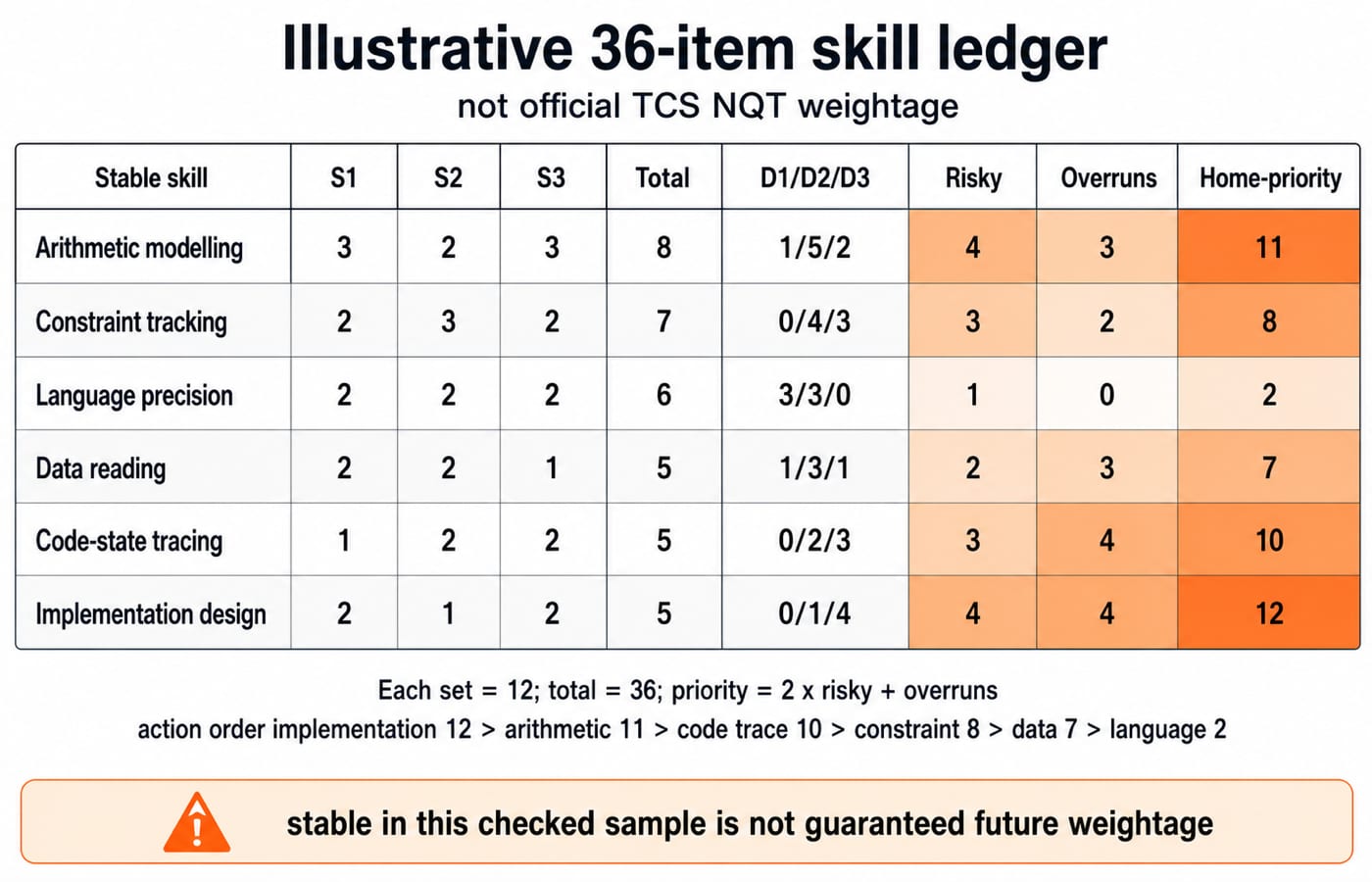
The three 12-item sets below were checked independently of each other. The numbers are invented for the worked example rather than recovered from a real TCS NQT sitting, so read the shape of the ledger and not the values.
Stable skill | S1 | S2 | S3 | Total | D1/D2/D3 | Risky | Overruns | Home-priority |
|---|---|---|---|---|---|---|---|---|
Arithmetic modelling | 3 | 2 | 3 | 8 | 1/5/2 | 4 | 3 | 11 |
Constraint tracking | 2 | 3 | 2 | 7 | 0/4/3 | 3 | 2 | 8 |
Language precision | 2 | 2 | 2 | 6 | 3/3/0 | 1 | 0 | 2 |
Data reading | 2 | 2 | 1 | 5 | 1/3/1 | 2 | 3 | 7 |
Code-state tracing | 1 | 2 | 2 | 5 | 0/2/3 | 3 | 4 | 10 |
Implementation design | 2 | 1 | 2 | 5 | 0/1/4 | 4 | 4 | 12 |
The checks are S1 12 + S2 12 + S3 12 = 36 and D1 5 + D2 18 + D3 13 = 36. Risky items total 4 + 3 + 1 + 2 + 3 + 4 = 17; overruns total 3 + 2 + 0 + 3 + 4 + 4 = 16.
Every skill appears in all three checked sets, so inside this sample all six count as stable. The formula home-priority = 2 x risky items + overruns gives implementation 12, arithmetic 11, code trace 10, constraint 8, data 7, and language 2. The ranking is a repair order for your own week: implementation design and arithmetic modelling get worked first because they cost the most accuracy and the most seconds. It says nothing about how TCS distributes marks.
Work the stable method, then change the wrapper
A line runs at 14 files per minute for 6 minutes, producing 14 x 6 = 84 files. A faster line runs at 22 files per minute for 4 minutes, producing 22 x 4 = 88. Together they produce 84 + 88 = 172 files in 6 + 4 = 10 minutes, so the combined rate is 172 / 10 = 17.2 files per minute.
The unweighted mean (14 + 22) / 2 = 18 is wrong because the durations differ. Tag this arithmetic modelling | D2. For an answer of 18 after 135 seconds, record W | overrun | averaged rates without weighting.
Change the wrapper. A vehicle covers 150 km at 50 km/h in 150 / 50 = 3 hours, then 150 km at 75 km/h in 150 / 75 = 2 hours. It covers 300 km in 5 hours, so average speed is 300 / 5 = 60 km/h, not (50 + 75) / 2 = 62.5 km/h. Transfer means recognising total output or distance / total time when the nouns change.
Turn each high-priority skill into fresh-value proof
A skill leaves the repair queue after two fresh variants on separate days. For constraint tracking, arrange A, B, C, D, E with C third, B immediately after A, D after C, and E before D. The unique order is A, B, C, E, D.
For language precision, Each of the reports is complete uses is with singular Each. For code-state tracing, start sum = 0 over [4, -1, 3, -2], adding positives and subtracting 1 for each non-positive. The states are 4, 3, 6, 5, so the output is 5. For data reading, a table showing 120, 150 and 90 units sold over three months answers which month beat the quarterly average by first computing (120 + 150 + 90) / 3 = 120, so only the 150 month clears it and the 120 month merely matches it.
For implementation design, find the first non-repeating character in LEVEL. The counts are L2, E2, V1, so the answer is V; the edge input AABB returns none. Use TCS NQT Coding Questions for more of the shapes worth drilling. Arithmetic modelling already earned its fresh variant when the same total-over-total method was re-run on distance instead of output.
Run the analysis inside a four-week, 24-hour cycle
Set aside 6 weekly hours: 60 minutes Monday to Thursday and 120 on Saturday, with Friday for recovery and Sunday for rest.
Week 1:
2 hours source audit and deduplication + 3 hours tagging + 1 hour calculation = 6.Week 2:
2 hours implementation repair + 2 hours arithmetic and code-trace repair + 1 hour constraint/data maintenance + 1 hour retests = 6.Week 3:
3 hours fresh variants + 1.5 hours coding implementation + 1.5 hours review = 6.Week 4:
2 hours current-rule-matched simulation + 2 hours full review + 1 hour targeted repair + 1 hour retest = 6.
The cycle is 4 x 6 = 24 hours. Move one missed weekday hour to Friday. If two are missed, recover the higher-priority block on Friday, preserve Saturday's review, and roll lower-priority work forward.
The TCS NQT and Smart Hiring Test Series gives you timed sets to run the week-4 simulation against, which keeps the seconds column meaning the same thing from one cycle to the next.
Keep every trend claim smaller than the evidence
Use stable in my sample for 3/3 independently checked sets, recurring in my sample for 2/3, and single observation for 1/3. Copied sets count once. A repeated wrapper is not automatically a durable skill, and absence from three sets cannot exclude a future appearance. Take current section, duration, navigation, language, score-use and hiring details from the TCS communication for your own drive, not from notes someone posted about an earlier cycle.
In the next 60 minutes, spend 15 registering and deduplicating sources, 30 tagging one 12-item set, and 15 totalling skill, depth, risky and overrun counts. Use: audit source -> tag skill -> count evidence -> repair with fresh values -> retest.
Keep learning

TCS NQT Eligibility: Check Backlogs, Gaps and Degree Rules
Use a closed TCS hiring notice as a worked checklist for degree, backlog, course-duration and academic-gap rules, then verify the current drive.
Updated 2 Sep 20264 min readIT Recruitment Exams

CoCubes Preparation Plan: Six Weeks for Campus Hiring Tests
Build a practical six-week CoCubes study plan around the modules in your own test invitation, your diagnostic results, and 72 hours of focused work.
Updated 1 Sep 20266 min readIT Recruitment Exams
eLitmus Retake Decision: Read Section Percentiles Before Testing Again
Do not retake eLitmus on disappointment alone. Use your section pattern, target-job evidence, and fresh timed practice to decide whether to go, wait, or rebuild.
Updated 30 Aug 20264 min readIT Recruitment Exams
eLitmus Mock Analysis: Diagnose Knowledge Gaps and Attempt Errors
A worked mock-review method to separate concept gaps from calculation, reading and decision errors, recover marks, and plan the next four weeks.
Updated 29 Aug 20265 min readIT Recruitment Exams