TCS NQT Scorecard Analysis: Build a Section-Wise Retake Plan
Convert your section results into priorities, a 54-hour study calendar and an evidence-based retake decision without treating a private target as a cutoff.
KnowledgeGate Team
Exam prep & CS education
Updated 22 Aug 20266 min read
An overall result can hide a weak section. One low section score also cannot tell you whether the cause was a concept gap, poor question selection, time loss or one bad attempt. Worked properly, a scorecard yields three things: a section diagnosis, a six-week repair calendar, and a retake decision kept separate from the decision to apply. One learner's scorecard runs as the example throughout, so read the numbers as that learner's own, never as a TCS cutoff. Broader TCS practice material sits on the TCS NQT and TCS exams preparation hub.
1. Copy the scorecard evidence before judging it
Record exactly: section label | score or band | scale | percentile, if shown | date | attempt notes. If a field is not printed on your scorecard, leave it blank. An estimated mark or an invented accuracy will corrupt every calculation that follows it. Where sections come on different scales, or as bands rather than numbers, keep them exactly as issued.
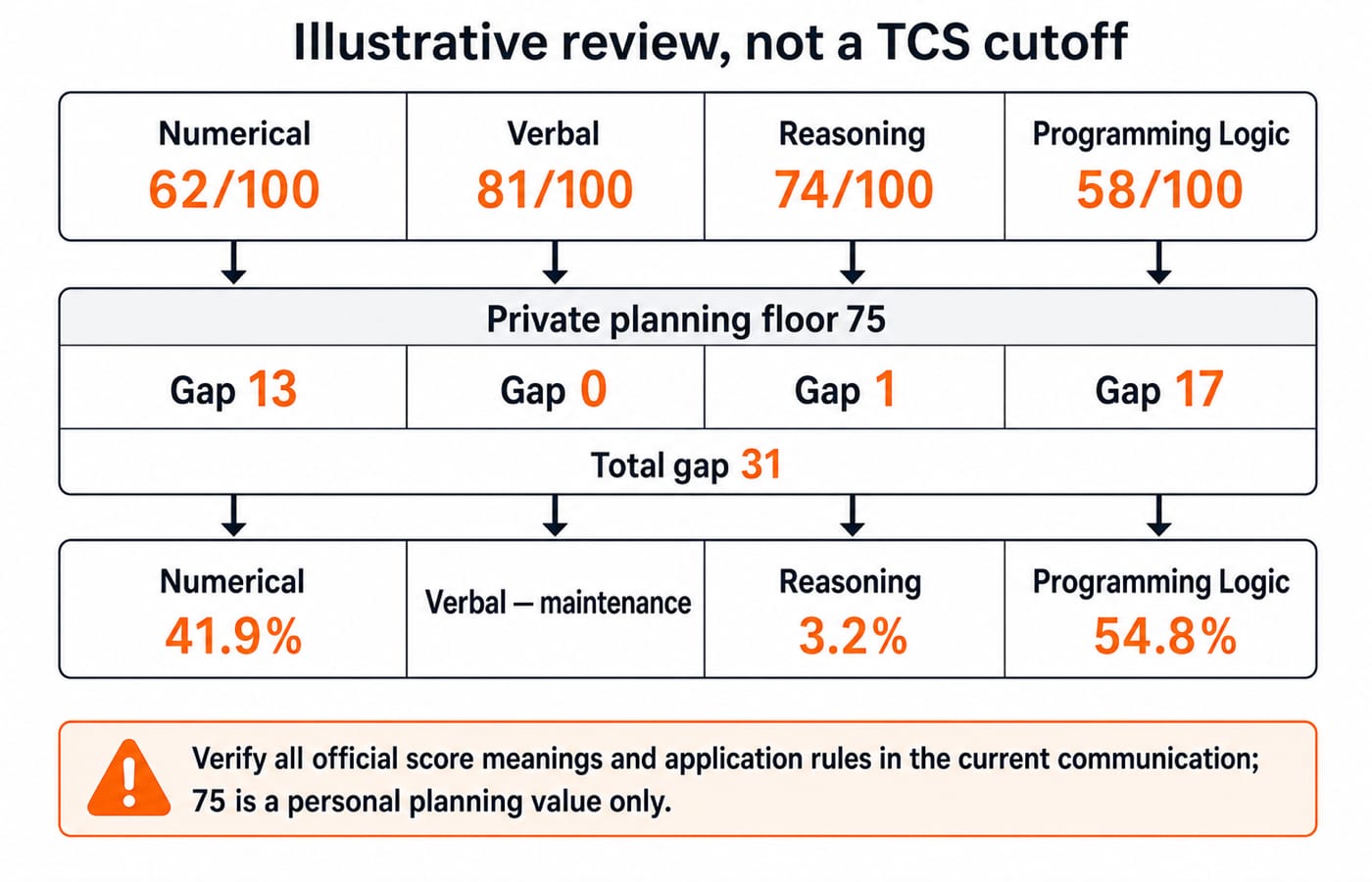
The example puts all four sections on one 100-point scale: Numerical 62/100, Verbal 81/100, Reasoning 74/100 and Programming Logic 58/100. Their simple average is:
(62 + 81 + 74 + 58) / 4 = 275 / 4 = 68.75
The range is 81 - 58 = 23 points. The average hides the 58, so it cannot set priorities. If you need a refresher on what each section actually tests, TCS NQT Exam Structure, Explained Section by Section covers it. Where that description and your own scorecard disagree, the scorecard wins.
2. Turn section scores into a gap profile, not a verdict
Set a private planning floor of 75/100 for this example. Use gap = max(0, 75 - score). Numerical has 13, Verbal 0, Reasoning 1 and Programming Logic 17. Total: 13 + 0 + 1 + 17 = 31.
Among non-zero gaps, Programming Logic takes 17/31 = 54.8%, Numerical 13/31 = 41.9% and Reasoning 1/31 = 3.2%. Use these shares to allocate practice time. They rank the work, and say nothing about anyone's chance of selection. The 75 is this learner's own planning number, not an employer rule. With unequal scales, compare each section against its own documented scale, or keep bands such as needs work and stable. Never average unlike measures.
3. Run short audits to find the cause
Run one comparable 20-question audit per bucket. Label misses concept gap | method error | reading error | time skip | unsupported guess.
Section | Audit result | Cause pattern | Accuracy |
|---|---|---|---|
Numerical | 13 correct, 5 wrong, 2 skipped | 3 concept, 1 calculation, 1 reading, 2 time skips |
|
Verbal | 17 correct, 2 wrong, 1 skipped | 1 grammar, 1 reading, 1 time skip |
|
Reasoning | 15 correct, 3 wrong, 2 skipped | 1 concept, 2 method, 2 time skips |
|
Programming Logic | 11 correct, 6 wrong, 3 skipped | 4 concept, 2 trace, 3 time skips |
|
Programming Logic needs concepts and tracing. Numerical needs concepts and timed selection, Reasoning light method practice, and Verbal maintenance. Audit accuracy is measured on 20 questions you picked yourself, so it will not reproduce the scorecard and should not be read as a forecast of the next attempt. For ready-made sets to audit against, the TCS NQT and Smart Hiring Test Series carries sectional papers and full-length simulations.
4. Build a six-week, 54-hour retake calendar
Study one hour Monday to Thursday (4 hours), rest or recover on Friday, then study 3 hours Saturday and 2 Sunday. Therefore, 9 hours/week x 6 weeks = 54 hours.
Week 1, evidence and audits:
9 hoursWeeks 2 to 4, targeted repair:
27 hoursWeeks 5 and 6, mixed simulations and review:
18 hours
Check: 9 + 27 + 18 = 54. Split repair into Programming Logic 12 hours, Numerical 9, Reasoning 3 and Verbal 3, totalling 27. Split the final 18 into mixed simulations 8, review 6 and targeted rework 4. Each repair hour is 15 minutes of recall, 30 of solving and 15 of correction.
Move one lost weekday block to Friday. After two losses, recover one and remove a repeated maintenance drill. Protect weak-section work and simulation review. For the wider sequence this six-week block sits inside, see TCS NQT Preparation: Sections and Study Plan. If the audits show concept gaps rather than timing problems, taught sessions close them faster than solo practice, and the TCS NQT Live Course runs that syllabus end to end.
5. Repair each error, then retest it 48 hours later
For each miss: label its cause, re-solve unaided, learn the rule, solve three near-transfer items, then retest after 48 hours. Log item | section | result | time | cause | correction | retest result.
Numerical N7 says a value becomes 600 after a 20% rise. If the original is x, 1.20x = 600, so x = 600 / 1.20 = 500. The answer 600 x 0.80 = 480 is wrong because reversing a rise requires division by the growth factor.
For Programming P11, find the second-largest distinct value in [4, 9, 4, 2, 9, 7]. Remove duplicates and sort: 9, 7, 4, 2. The answer is 7, not 9.
Numerical moves from 13/20 = 65% to 15/20 = 75% in Week 2 and 16/20 = 80% in Week 4. Programming Logic moves from 11/20 = 55% to 14/20 = 70%, then 15/20 = 75%. Count improvement only with comparable topic mix and difficulty.
Near-transfer items are the hard part to source. KnowledgeGate's bank carries over 20,000 questions across Mathematics and Aptitude, Reasoning and Verbal Ability, which is enough to pull three fresh items on any rule you have just repaired. It spans many exams rather than TCS alone, so select by topic and not by exam label.
6. Separate the application decision from the retake decision
Ask separately: Can this score be used under the rules that opportunity publishes? and Could another attempt produce a stronger profile? A weak section does not cancel valid applications. An application does not make a retake unnecessary.
Opportunity A's official communication allows the score. Apply and repair in parallel.
Opportunity B has an unverified role condition. Do not guess from
68.75. Check the employer's current official notice.Opportunity C uses its own assessment. Apply there and decide about an NQT retake separately.
Before you pay for or book anything, check the score's meaning and validity window, the assessment variant, the role conditions, the retake rule, the fee and the schedule against the official notice you are applying under.
7. Use a readiness gate before committing
Set a personal rule: both weak sections must reach 75% in two of three comparable simulations, each reviewed within 24 hours, with no repeated concept gap left unresolved. That 75 is the same planning floor from section 2, carried through to the exit test.
In order Numerical, Verbal, Reasoning, Programming Logic, A is 70, 83, 76, 68, B is 76, 84, 78, 74, and C is 79, 86, 81, 78. Numerical clears the floor in B and C. Programming Logic clears it only in C, so the gate is not met, and what is short is tracing practice rather than calendar time. Take one more comparable simulation. If Programming Logic clears 75 in it, the latest three simulations carry two clears in each weak section and the gate is met.
The short version
Transcribe the scorecard, calculate the gaps, run four 20-question audits and reserve 54 hours across six weeks. Spend the repair hours in proportion to the gaps, retest every corrected error after 48 hours, and keep the application decision separate from the retake decision. Commit to the retake only when both weak sections clear your own floor in two of three comparable simulations.
Keep learning

TCS NQT Eligibility: Check Backlogs, Gaps and Degree Rules
Use a closed TCS hiring notice as a worked checklist for degree, backlog, course-duration and academic-gap rules, then verify the current drive.
Updated 2 Sep 20264 min readIT Recruitment Exams

CoCubes Preparation Plan: Six Weeks for Campus Hiring Tests
Build a practical six-week CoCubes study plan around the modules in your own test invitation, your diagnostic results, and 72 hours of focused work.
Updated 1 Sep 20266 min readIT Recruitment Exams
eLitmus Retake Decision: Read Section Percentiles Before Testing Again
Do not retake eLitmus on disappointment alone. Use your section pattern, target-job evidence, and fresh timed practice to decide whether to go, wait, or rebuild.
Updated 30 Aug 20264 min readIT Recruitment Exams

eLitmus Mock Analysis: Diagnose Knowledge Gaps and Attempt Errors
A worked mock-review method to separate concept gaps from calculation, reading and decision errors, recover marks, and plan the next four weeks.
Updated 29 Aug 20265 min readIT Recruitment Exams