TCS NQT Exam Pattern: What Each Section Tests and How the Score Enters Hiring
Separate the reusable TCS iON score route from a named TCS hiring drive, then learn how to read sections, use diagnostics and follow the right application path.
KnowledgeGate Team
Exam prep & CS education
Updated 9 Aug 20266 min read
TCS NQT can mean the TCS iON assessment that produces a reusable scorecard, or an NQT run inside a specific Tata Consultancy Services hiring drive. Treating them as one form is how aspirants prepare the wrong sections, or believe they have applied to TCS when they have only bought a score product. The two routes name different sections, produce different outputs and end in different places, so settle which one you are on before you plan a single hour.
1. First separate the two routes called TCS NQT
Route | What the candidate receives | Where the next application happens | What must be rechecked |
|---|---|---|---|
TCS iON NQT score product | Section-wise scorecard | TCS iON portal or accepting corporate site | Variant, score terms and vacancy rules |
TCS company hiring drive | Drive-specific selection process | Current TCS Careers route, including | Active notice, route and applied status |
The first route follows the current TCS iON NQT page; the second follows a named TCS Careers notice. A TCS iON product does not automatically create a TCS vacancy application. Neither route guarantees an offer.
2. What the section families are trying to measure
The cognitive core is easy to read once you treat each part as evidence of something specific. Numerical Ability tests whether a calculation survives a clock, so it shows how fast you turn a worded situation into numbers and how often that speed costs you accuracy. Verbal Ability tests comprehension and precise language use, so a weak result there usually means marks lost to hurried reading rather than to vocabulary. Reasoning Ability tests structured inference, and it is the family where setup discipline shows, because candidates far more often mis-draw the arrangement than mis-apply the logic. Those three labels come from the current TCS iON Cognitive option.
Role-oriented variants ask for a second kind of evidence on top of that. The current TCS iON IT option adds advanced coding to basic and advanced aptitude and pairs both with a psychometric assessment, so one candidate can finish with a cognitive score, a coding score and a workplace-personality profile that recruiters read separately. A TCS company notice may cut the same ground differently, with a Foundation group of timed cognitive parts and an Advanced group carrying the harder quantitative work and the coding task. What that regrouping changes is which parts are compulsory for which role band, not what the underlying skill is.
Question counts, marks, timers, navigation rules and which parts are compulsory move between variants and between cycles, so read those off the variant page you registered on or the invitation in your inbox. The topic lists sitting behind each family are set out in our section-by-section breakdown.
3. Worked official-pattern read: add the parts, then label the source
The now-closed TCS All India NQT Hiring notice carrying March 2026 dates gave Part A Foundation three timed components:
Numerical Ability: 25 minutes
Verbal Ability: 25 minutes
Reasoning Ability: 25 minutes
So, 25 + 25 + 25 = 75 minutes for Foundation.
Part B Advanced gave 25 minutes to Advanced Quantitative and Reasoning Ability and 90 minutes to Advanced Coding. Therefore, 25 + 90 = 115 minutes. The full test time in that notice was 75 + 115 = 190 minutes.
The same closed notice made Advanced mandatory for candidates aspiring to Digital or Prime offers, and used performance across the two parts to qualify candidates for Prime, Digital or Ninja interviews. That mapping belonged to that cycle. A later notice can hold the 190 minutes and move the role bands, or hold the bands and change the timing, which is why the cycle name has to travel with every number you copy.
Source + cycle + status first; numbers second.
4. Worked preparation read: turn section evidence into the next 10 hours
Meera is a worked example rather than a real candidate, and the numbers below come from her own timed practice sets, not from a TCS scorecard. Her results are Numerical 18/25 = 72%, Verbal 20/25 = 80%, Reasoning 14/25 = 56%, and Advanced Quantitative and Reasoning 12/20 = 60%. In coding, one task passes 8 of 10 hidden tests, while another passes 3 of 10.
Her weakest evidence is reasoning setup and coding edge cases. A sensible next block is:
Reasoning setup and review: 4 hours
Coding edge cases: 3 hours
Numerical speed: 2 hours
Verbal maintenance: 1 hour
Check the allocation: 4 + 3 + 2 + 1 = 10 hours. The order matters as much as the split. Run a timed diagnostic first so the percentages exist at all, spend the reasoning hours writing setups out by hand rather than reading solutions, and aim the coding hours at edge-case practice on the empty input, the single-element case and the largest allowed value, which is usually where a 3 of 10 sits. Then re-run the same diagnostic: if reasoning moves from 56% into the mid-seventies and the weaker task clears more hidden tests, the split was right and you repeat it.
5. What an NQT score can do, and what it cannot do
Under the reusable-score route, a candidate takes the selected TCS iON NQT variant, receives a scorecard showing section-wise performance, and may then apply to jobs on the TCS iON platform or on corporate sites that accept that score. The platform itself advertises listings from more than 4,000 corporates. The TCS iON page puts scorecard validity at two years from the date of result publishing and sets no limit on re-attempts, so a weak first score is repairable rather than terminal.
Three filters still follow. The vacancy must accept the relevant score or variant. You must meet its degree, experience and other eligibility rules. The employer then controls shortlisting and later stages. Employers may verify scores, shortlist profiles and schedule interviews through their own process.
A score is not a job application, a universal cutoff certificate or an interview guarantee. A high score does not override separate eligibility conditions.
6. Worked hiring path: follow two lanes without merging them
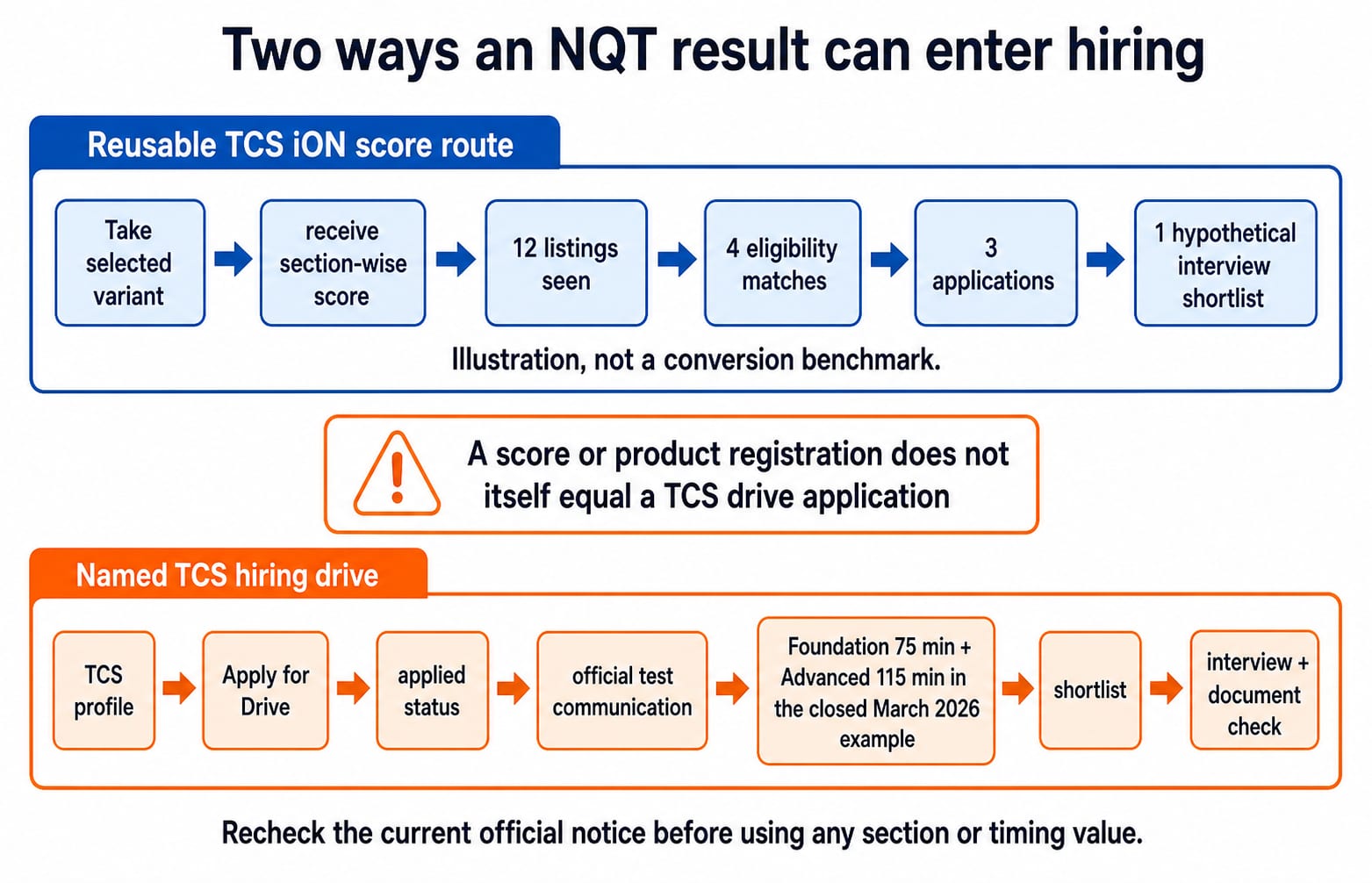
Suppose Arjun sees 12 listings after receiving his NQT score. Four match his degree, passing year and location constraints. He applies to three, and one employer shortlists him. The path 12 -> 4 -> 3 -> 1 shows filtering, not an expected conversion rate.
The TCS-drive lane is different: create or update the required TCS profile, click Apply for Drive on an active notice, confirm applied status, receive test communication through the named official partner, take the drive-specific test, and proceed to interviews and document checks only if shortlisted. That order comes from the closed March 2026 TCS Careers notice; the notice live today names the route that applies to you.
7. Four common misreads to correct before test day
Misread | Correction |
|---|---|
There is one permanent NQT pattern | Variants and hiring cycles can differ. |
My TCS iON score applies me everywhere | You still apply to eligible listings. |
One strong total guarantees a shortlist | Employers can use role fit, section evidence and separate eligibility. |
An old screenshot is enough | The exact live official page or invite controls. |
Use a strict source order: identify TCS iON or Tata Consultancy Services Careers, note the cycle and whether registration is open or closed, then copy section or process details.
8. Short version and next step
Know your NQT route. Match preparation to the sections it names. Treat the score as evidence entering an employer-controlled process, not as an offer.
Choose the TCS NQT live course if you want the preparation sequenced for you, or compare what is available on the TCS preparation category page if you only need practice material. Before test day, reopen the current TCS iON page, the active TCS Careers notice if you are applying to TCS, and your own dashboard or invitation, in that order.
Keep learning
TCS NQT Eligibility: Check Backlogs, Gaps and Degree Rules
Use a closed TCS hiring notice as a worked checklist for degree, backlog, course-duration and academic-gap rules, then verify the current drive.
Updated 2 Sep 20264 min readIT Recruitment Exams
CoCubes Preparation Plan: Six Weeks for Campus Hiring Tests
Build a practical six-week CoCubes study plan around the modules in your own test invitation, your diagnostic results, and 72 hours of focused work.
Updated 1 Sep 20266 min readIT Recruitment Exams
eLitmus Retake Decision: Read Section Percentiles Before Testing Again
Do not retake eLitmus on disappointment alone. Use your section pattern, target-job evidence, and fresh timed practice to decide whether to go, wait, or rebuild.
Updated 30 Aug 20264 min readIT Recruitment Exams
eLitmus Mock Analysis: Diagnose Knowledge Gaps and Attempt Errors
A worked mock-review method to separate concept gaps from calculation, reading and decision errors, recover marks, and plan the next four weeks.
Updated 29 Aug 20265 min readIT Recruitment Exams