TCS NQT Mock Analysis: Find and Fix Aptitude and Coding Losses
Stop treating a mock score as the diagnosis. Build an item-level ledger, repair each aptitude or coding loss, and prove the fix before taking another mock.
KnowledgeGate Team
Exam prep & CS education
Updated 18 Aug 20266 min read
Many aspirants record a mock score, react to it, and immediately start another mock. That wastes the attempt's best evidence. Give every loss one cause, one repair task and a retest date, and the next mock stops being a fresh guess.
Sort those losses by the families TCS NQT itself names. The Foundation side carries Numerical Ability, Verbal Ability and Reasoning Ability; the Advanced side carries Advanced Quantitative and Reasoning plus Advanced Coding. Question counts, timers and which parts are compulsory move between variants and cycles, so read those off what each TCS NQT section tests and your own invite. The 24-question set, two coding tasks and 120-minute clock below come from one sample attempt whose losses land in numerical, reasoning and coding, held fixed so every number can be rechecked.
1. Capture the evidence before opening solutions
Spend ten minutes freezing the attempt before reading solutions. For each aptitude item, record its ID, topic, attempted status, confidence, minutes spent, selected answer, and correct answer. For coding, save the prompt rule, code, failing input, expected and actual output, and tests passed.
Checking solutions first destroys evidence about what you knew under pressure. Keep one row per lost item, ending with a repair action and retest date, not “aptitude weak”.
The sample log holds 24 aptitude questions: 15 correct, five wrong and four unattempted. Task A passes 6 of 10 coding tests; Task B passes 8 of 10. Nine lost aptitude items and two half-working programs is the whole diagnosis, and it beats any single total.
2. Use one primary loss label per item
Label an aptitude loss by its counterfactual:
Concept gap: the method was unavailable.
Execution error: the method was known, but arithmetic, reading, or transcription failed.
Pacing error: the approach was viable, but time control failed.
Selection error: an expensive question was chosen while a more convertible item remained unseen.
A secondary note is fine, but choose one primary label. Concept gaps occur at Q6 (mixtures) and Q19 (syllogism). Execution errors occur at Q4 (percentage) and Q14 (5/8 copied as 3/8). Pacing errors occur at Q11 (seven minutes, still wrong) and Q15 (incomplete). Selection errors cover Q22 to Q24, never opened after too long on a data table. Thus 2 + 2 + 2 + 3 = 9, matching five wrong plus four unattempted.
For coding, record the first reproducible cause: logic, edge case, indexing, complexity, input/output, or language/runtime. Several symptoms may appear, but repair starts from one cause.
3. Work aptitude losses into repair drills
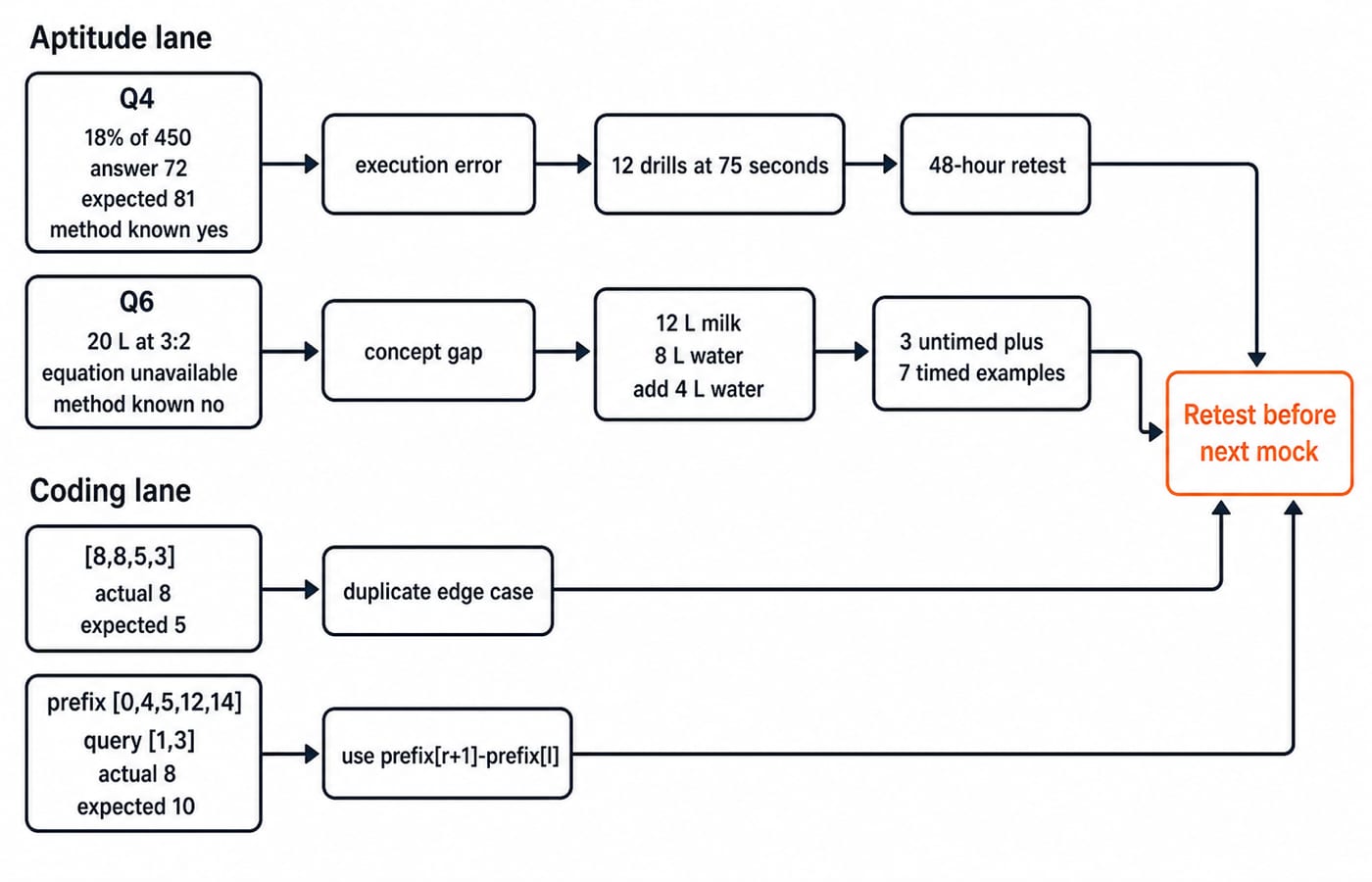
Q4 asks for 18% of 450 students. The candidate writes 72, but (18/100) x 450 = 81. Since 20% is 90, 72 deserves a recheck. This is execution, not concept, because the method was correct. Do 12 one-step calculations at 75 seconds each, including 12% of 350 = 42 and 35% of 240 = 84, then try a fresh variant after 48 hours.
Q6 gives 20 litres of milk and water in a 3:2 ratio. Milk is 20 x 3/5 = 12 litres; water is 20 x 2/5 = 8. For 1:1 after adding water, 12:(8+x) = 1:1, so x = 4 litres. Not forming this equation is a concept gap. Review it, then solve three untimed and seven timed examples.
“Careless” cannot be a final label. It does not tell you whether to fix a copied fraction, a missing sanity check, or a selection decision. Q14 lost its mark because 5/8 was copied as 3/8, so the repair is a transcription habit, not a revision of ratios.
4. Debug coding losses with the smallest failing case
Task A asks for the second-largest distinct value. For [8, 8, 5, 3], the answer is 5, but taking the second-last sorted element returns 8. This is a duplicate edge case. Track distinct values, then test [9, 9, 7, 7, 3] -> 7, [4, 2] -> 2, and [4, 4, 4] -> no second distinct value, using the required sentinel or message.
For zero-based range sums, [4, 1, 7, 2] has prefix [0, 4, 5, 12, 14]. Query [1, 3] should give 1 + 7 + 2 = 10. Buggy prefix[r] - prefix[l] gives 12 - 4 = 8; correct prefix[r+1] - prefix[l] gives 14 - 4 = 10. Label it indexing and test l = 0, r = n-1, and l = r. Then work the same two traps, duplicates and off-by-one ranges, through TCS NQT coding questions in other shapes.
5. Convert the ledger into a finite repair queue
Allocate five repair hours: 90 minutes for two concept gaps, 45 for two execution errors, 45 for pacing, 30 for selection, and 90 for two coding bugs. So 90 + 45 + 45 + 30 + 90 = 300 minutes = 5 hours. A finite queue closes; an open-ended revision list never does.
Use fixed actions. Concept gets one explanation, three untimed examples, and seven timed ones. Execution gets the wrong line, a 10-item drill, and a written check. Pacing gets a visible stop time; selection gets first-pass mark-or-skip practice; coding gets the smallest failing input, a fix, and five edge cases.
If the same concept gap survives two reviews, TCS live preparation can support a structured rebuild. Enrolment alone is not the repair. Explanation, practice, and retest still matter.
6. Run an honest 8-hour-45-minute weekly cycle
Run the week like this: Sunday, 120-minute mock plus 60-minute audit; Monday and Tuesday, 45 minutes each for concepts; Wednesday, 60 minutes for checks and pacing; Thursday, 90 minutes for coding; Friday, 60-minute mixed set; Saturday, 45-minute retest.
The total is 180 + 90 + 60 + 90 + 60 + 45 = 525 minutes = 8 hours 45 minutes. The audit sits beside the mock on Sunday because memory of the attempt decays within a day, and the retest sits on Saturday so nothing is closed on the day it was repaired.
Miss one weekday session, and move only the highest-loss bucket into Friday. Miss two, and retain the audit and retest, carry repairs forward, and skip a fresh full mock instead of protecting a streak.
7. Retest the repair, then earn the next mock
Use parallel checks, not memorised repeats:
Percentage:
16% of 625 = 100.Mixture: 30 litres at milk:water
2:3contains 12 litres milk and 18 litres water. Adding 6 litres milk gives18:18 = 1:1.Distinct value:
[9, 9, 7, 7, 3] -> 7.Prefix sum:
[3, 6, 2, 5], query[0, 2] -> 11, using prefix[0, 3, 9, 11, 16].
Close a bucket on evidence, not on a feeling of improvement. Close aptitude only after the original pattern and two variants are correct on separate attempts. Close coding after the smallest failing case and five edge cases pass. For pacing and selection, use 10 questions and obey your own skip trigger on every item, even before accuracy is perfect.
If the top two loss buckets pass their retests, take a fresh mock from the TCS NQT and Smart Hiring Test Series and create a new ledger. If they do not pass, repeat only the failed repair block.
The short version
Label, reproduce, repair, retest, then remock. A bucket closes when the original item and two variants come back correct on separate days, not when the topic starts to feel familiar. If two full cycles leave the same gap standing, change the input rather than the effort, and pick your next read from the TCS preparation hub.
Keep learning
TCS NQT Eligibility: Check Backlogs, Gaps and Degree Rules
Use a closed TCS hiring notice as a worked checklist for degree, backlog, course-duration and academic-gap rules, then verify the current drive.
Updated 2 Sep 20264 min readIT Recruitment Exams

CoCubes Preparation Plan: Six Weeks for Campus Hiring Tests
Build a practical six-week CoCubes study plan around the modules in your own test invitation, your diagnostic results, and 72 hours of focused work.
Updated 1 Sep 20266 min readIT Recruitment Exams
eLitmus Retake Decision: Read Section Percentiles Before Testing Again
Do not retake eLitmus on disappointment alone. Use your section pattern, target-job evidence, and fresh timed practice to decide whether to go, wait, or rebuild.
Updated 30 Aug 20264 min readIT Recruitment Exams
eLitmus Mock Analysis: Diagnose Knowledge Gaps and Attempt Errors
A worked mock-review method to separate concept gaps from calculation, reading and decision errors, recover marks, and plan the next four weeks.
Updated 29 Aug 20265 min readIT Recruitment Exams