AMCAT Exam Pattern: Compulsory Modules, Domain Choices and Score Use
Learn how to read the current AMCAT pattern, select role-relevant domain modules, handle adaptive questions and interpret each score without inventing a total.
KnowledgeGate Team
Exam prep & CS education
Updated 28 Jul 20265 min read
You may know that AMCAT is an employability test and still prepare the wrong mix by treating compulsory aptitude, personality and optional domain modules as interchangeable sections. They are not. The compulsory four are scored for every candidate, the optional domains are scored only if you select them, and no employer ever sees those numbers rolled into one. Your live MyAMCAT Help Center, dashboard and test invitation control the exact test you sit.
1. Read the AMCAT pattern as a core plus a role signal
The live MyAMCAT exam-pattern Help Center describes four compulsory modules and up to two optional domain modules.
Part | Current official description | Screening purpose |
|---|---|---|
English Ability | 18 questions, 16 minutes | Written communication |
Quantitative Ability | 16 questions, 18 minutes | Numerical reasoning |
Logical Ability | 14 questions, 16 minutes | Patterns and inference |
Personality | 90 questions, 20 minutes | Behavioural tendencies |
Up to two skill-specific or domain modules | Counts and timings depend on selection | Role-relevant knowledge |
MyAMCAT states that there is no negative marking, so a blank answer and a wrong one cost the same: nothing. Leave nothing unanswered. The counts and timings above are what the Help Center shows today and can be revised. Under adaptive scoring a raw correct-answer count is not a score in any case, so do not turn these totals into a target.
2. Compulsory modules answer four different employer questions
English Ability checks whether you can understand and communicate written information. Quantitative Ability checks numerical reasoning, while Logical Ability checks pattern and inference work. Personality describes behavioural tendencies, so it is not a memory paper with rehearsed right answers.
The English row gives one useful pacing calculation: 16 minutes is 16 x 60 = 960 seconds, and 960 / 18 = 53.3 seconds per question on average. Treat that as a planning average for timed practice, not a stopwatch target for every item. The Aptitude Course for Placement builds the foundation that three of the four compulsory modules draw on.
3. Choose domain modules backwards from the role
MyAMCAT says candidates may choose up to two skill-specific modules, and a relevant choice can improve visibility for particular jobs. Visibility is not an interview, so choose for evidence rather than volume: a weak score in a module you picked casually still travels with your profile.
Riya is a B.Tech CS graduate targeting backend developer and QA automation roles. She reads the live job descriptions for those roles, sees programming logic and core CS repeated across all of them, and picks Computer Programming and Computer Science where her module list offers both. The first shows she can reason through code, the second that the subjects underneath it are there. If only one appears, she takes whichever matches her target jobs rather than copying a friend's pair.
Degree is evidence, but role relevance decides. For the wider module menu, including how the Automata coding modules differ from Computer Programming, read AMCAT preparation: modules, adaptive scoring and which optional modules to pick. Confirm the domains on your own module list, then use the AMCAT Preparation Course as a structured route.
4. Adaptive testing changes the route, not careful answering
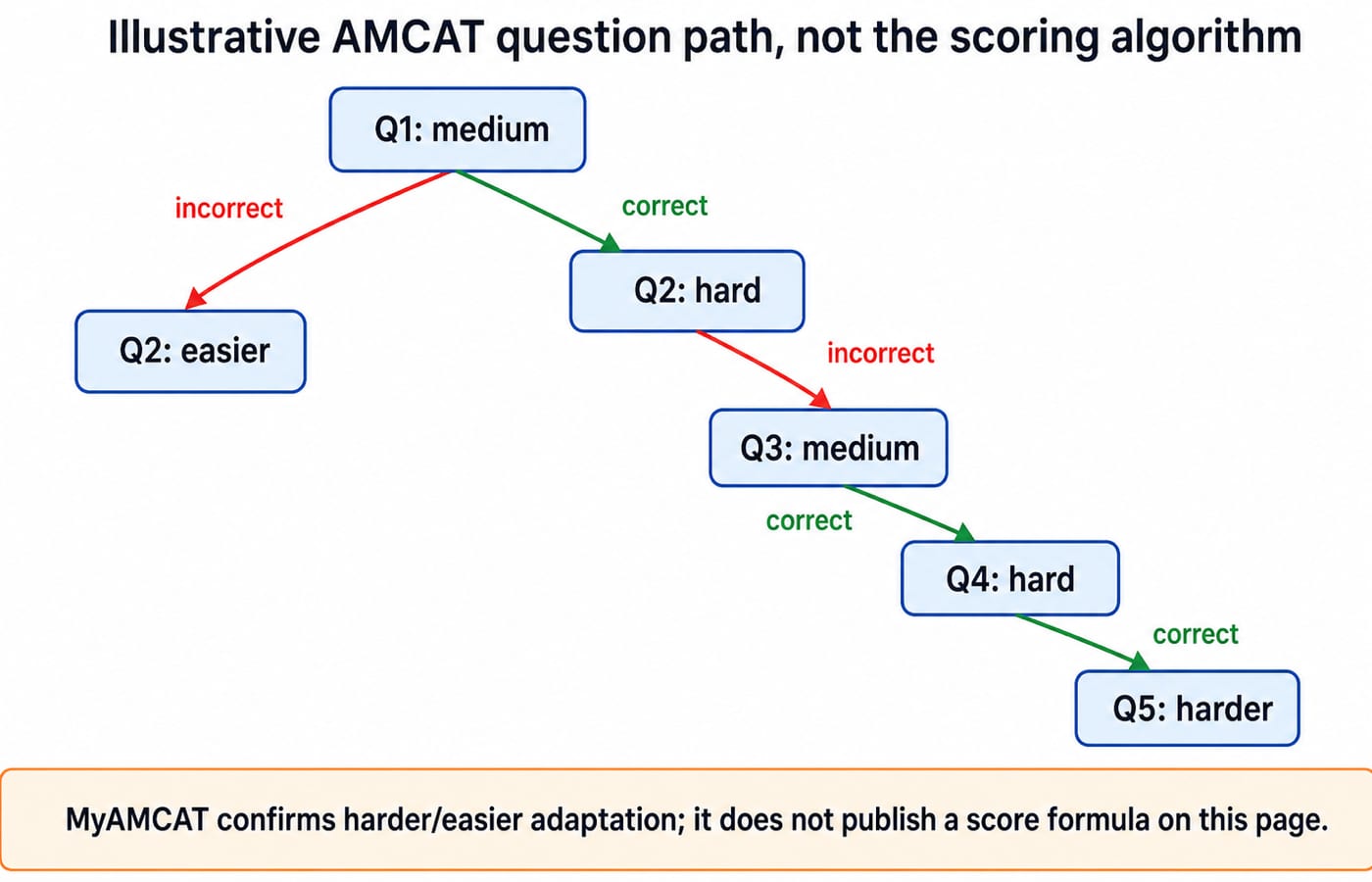
MyAMCAT explains that a correct answer can lead to a harder question, while an incorrect answer can lead to an easier one. Performance depends on the level of questions answered correctly, but the platform does not disclose a score formula on that answer.
One possible path: Q1 medium, correct -> Q2 hard, incorrect -> Q3 medium, correct -> Q4 hard, correct -> Q5 harder. Another candidate could start Q1 medium, incorrect -> Q2 easier. Two people sitting the same module face different sequences, which is why a paper that felt easy predicts nothing. Answer the item in front of you. Do not miss a hard item deliberately to steer towards easier ones, and do not panic when difficulty climbs after a strong run: that climb is the test agreeing with you.
5. Read module scores separately instead of inventing one total
MyAMCAT says there is no overall AMCAT score. Each module has its own score, and employers can apply separate criteria. An 88th percentile means 88 percent of compared test takers scored lower, not that 88 percent of questions were correct.
The numbers below are invented, because real employer cutoffs are not published. Candidate A has English 650, Quant 540, Logical 610 and Computer Programming 720. Employer X screens on English >= 600, Logical >= 600 and Programming >= 700, so A clears all three gates. Employer Y screens on Quant >= 600, so the same candidate fails on 540 < 600. One scorecard, two opposite verdicts, nothing averaged.
Adding the modules gives 650 + 540 + 610 + 720 = 2,520, and 2,520 / 4 = 630. Nobody in the hiring chain reads that 630, and it is worse than useless: it buries the Quant 540 that Employer Y screens on behind three stronger modules. Read your weakest module, not the mean.
6. Follow the score through an employer-controlled hiring funnel
MyAMCAT says candidates apply to jobs or respond to relevant invites after scores are generated. Companies may shortlist using module scores and eligibility such as degree and graduation year. The company controls interview communication and final selection.
Invented numbers, real shape: Neeraj sees 10 jobs, six match his degree and graduation year, four of those also match his location and role preferences, he applies to three, and one sends an interview call. 10 -> 6 -> 4 -> 3 -> 1. Every narrowing step is a filter someone else owns, and only one of them, the applying, is yours.
A score is not an application. An invite is not an offer. A strong module cannot waive eligibility, and there is no universal good score. Verify score or subscription validity on the live dashboard.
7. Correct four AMCAT pattern mistakes before test day
Mistake: Memorising one old timing table. Correction: Check the live Help Center and invitation.
Mistake: Choosing domains because friends chose them. Correction: Map current domains to target roles.
Mistake: Treating easy or hard questions as a score preview. Correction: Adaptive difficulty is not a visible score formula.
Mistake: Adding module scores into one total. Correction: Read each module against the employer's separate criteria.
Errors that cost placements outside the test hall, in resume work and mock interviews, sit in common placement preparation mistakes. For AMCAT itself, rank your sources: the official Help Center, then your current dashboard or invitation, then the live job eligibility text, then preparation material. Never let a coaching screenshot override the live official interface.
8. Short version and next step
Complete every compulsory module. Choose up to two available domains only after mapping them to target roles. Expect adaptive question flow without trying to reverse-engineer it. Use each module score as one input to employer-controlled shortlisting.
Use the AMCAT Preparation Course for an AMCAT-specific route, the Aptitude Course for Placement for the common core, or browse IT Recruitment Exam Preparation. Finally, open the live pattern page and your invitation again before building preparation around any count or timing.
Keep learning

TCS NQT Eligibility: Check Backlogs, Gaps and Degree Rules
Use a closed TCS hiring notice as a worked checklist for degree, backlog, course-duration and academic-gap rules, then verify the current drive.
Updated 2 Sep 20264 min readIT Recruitment Exams

CoCubes Preparation Plan: Six Weeks for Campus Hiring Tests
Build a practical six-week CoCubes study plan around the modules in your own test invitation, your diagnostic results, and 72 hours of focused work.
Updated 1 Sep 20266 min readIT Recruitment Exams

eLitmus Retake Decision: Read Section Percentiles Before Testing Again
Do not retake eLitmus on disappointment alone. Use your section pattern, target-job evidence, and fresh timed practice to decide whether to go, wait, or rebuild.
Updated 30 Aug 20264 min readIT Recruitment Exams

eLitmus Mock Analysis: Diagnose Knowledge Gaps and Attempt Errors
A worked mock-review method to separate concept gaps from calculation, reading and decision errors, recover marks, and plan the next four weeks.
Updated 29 Aug 20265 min readIT Recruitment Exams