TCS NQT Preparation: An 8-Week Aptitude and Coding Plan
Build an eight-week study system around a diagnostic, focused aptitude repair, tested coding practice, timed sets and a recovery evening each week.
KnowledgeGate Team
Exam prep & CS education
Updated 16 Aug 20267 min read
You may have only an hour on class or work days. A four-hour evening plan will collapse by Week 2. This eight-week, 80-hour system starts with a diagnostic, targets aptitude gaps and unfinished coding, and protects review and recovery. Confirm your own section list, timings and coding conditions from your TCS NQT invitation before you fix any block.
Build your TCS NQT test map and take one honest diagnostic
The NQT runs in three layers: foundation abilities (Numerical, Verbal, Reasoning), advanced abilities (Advanced Quantitative and Advanced Reasoning), and programming abilities (Programming Logic plus a hands-on Coding section). Each section carries its own clock, so a fast section cannot buy time for a slow one. Fill one table from your own invitation first: section name | time | question or task type | navigation rule | permitted coding language. Counts, durations, marks and negative marking shift between cycles and are set on the official TCS iON page (tcsion.com).
Then take a self-made 115-minute diagnostic: 12 numerical, 12 reasoning, 12 verbal, 8 programming-logic questions and 2 coding tasks. One honest record looks like this:
Numerical: 9 attempted, 6 correct, 25 minutes
Reasoning: 10 attempted, 8 correct, 20 minutes
Verbal: 11 attempted, 9 correct, 15 minutes
Programming Logic: 6 attempted, 3 correct, 15 minutes
Coding: 1 of 2 tasks passes all tests in 40 minutes
MCQ attempts are 9 + 10 + 11 + 6 = 36; correct answers are 6 + 8 + 9 + 3 = 26. Accuracy is 26 / 36 x 100 = 72.2%. The read is specific: numerical concepts need repair, programming logic needs output-prediction drill, coding needs completion practice, verbal and reasoning need maintenance only. Settle your target track in the same sitting: Digital and Prime turn on the advanced sets and on code that passes test cases, which pulls hours away from sections you already clear.
Turn eight weeks into an 80-hour TCS NQT calendar
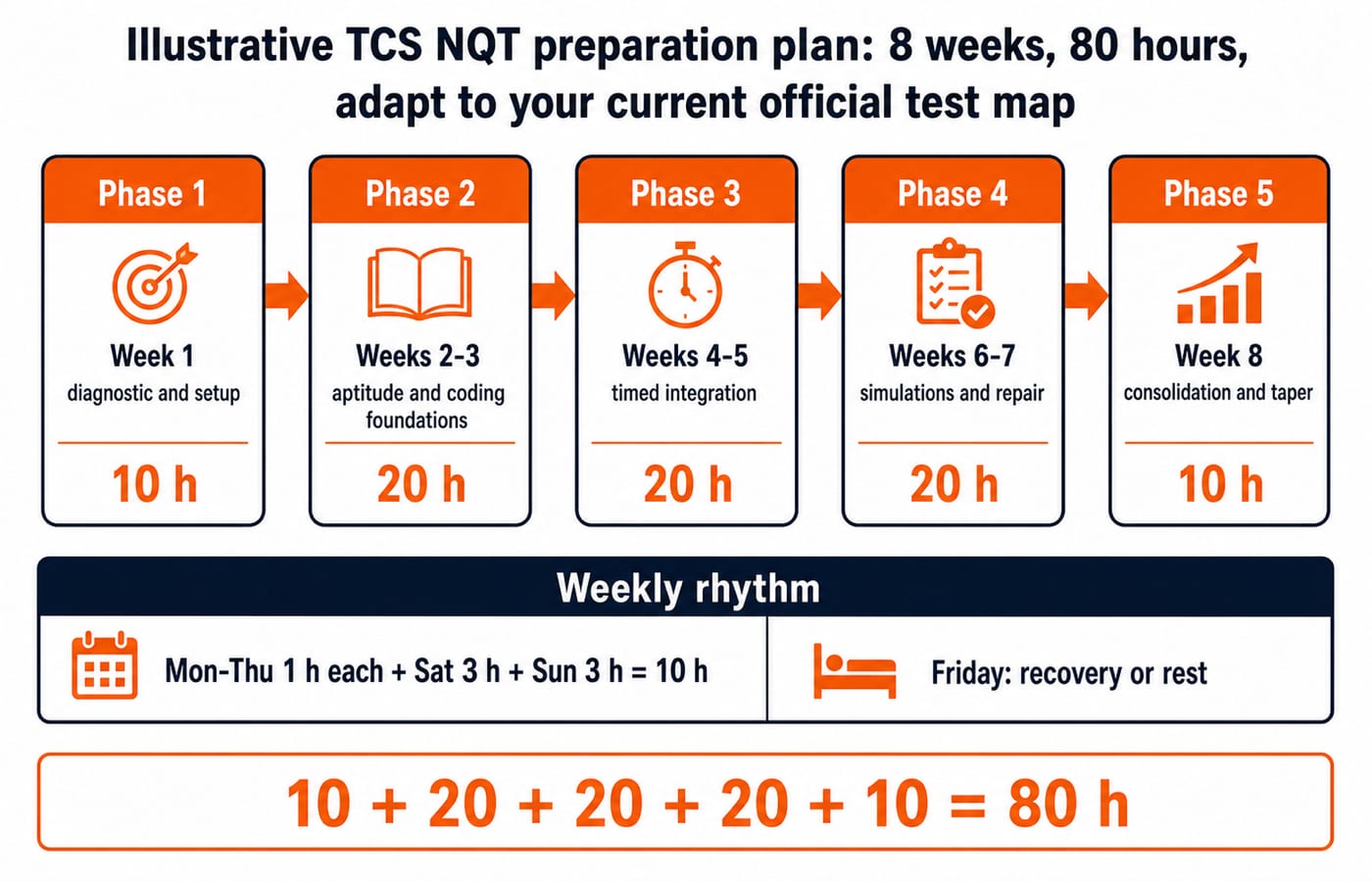
Budget 8 weeks x 10 hours = 80 hours: one hour each Monday to Thursday, three hours Saturday, three hours Sunday, and Friday left free for recovery or rest.
Phase | Time |
|---|---|
Week 1, diagnostic and setup | 10 hours |
Weeks 2-3, foundations | 20 hours |
Weeks 4-5, timed integration | 20 hours |
Weeks 6-7, simulations and repair | 20 hours |
Week 8, consolidation and taper | 10 hours |
The check is 10 + 20 + 20 + 20 + 10 = 80 hours. Ten hours a week is a floor, not an ideal: if you can genuinely give fifteen, the fuller split in our TCS NQT exam pattern, sections and study plan fits you better. This calendar is for the weeks when ten is what exists. If Tuesday is lost, move its hour to Friday. If two weekday blocks are lost, recover only one on Friday and drop a repeated easy drill. Do not turn Saturday into a five-hour punishment session. Weak-area work, coding and error review survive before optional breadth.
Weeks 2 and 3: rebuild TCS NQT aptitude with checked solutions
Weekly split: numerical 2.5 h + reasoning 1.5 h + verbal 1 h + programming logic 1 h + coding 2.5 h + review 1.5 h = 10 h. Each 30-minute aptitude block is 8 minutes recall + 17 minutes solving + 5 minutes error note.
For 180 km out at 60 km/h and 180 km back at 45 km/h, times are 180 / 60 = 3 h and 180 / 45 = 4 h. Average speed is total distance over total time, 360 / 7 = 51.43 km/h. (60 + 45) / 2 = 52.5 is wrong because the legs take different times, so the slower one carries more of the trip.
In 2, 6, 12, 20, 30, the differences are 4, 6, 8, 10; the next is 12, giving 30 + 12 = 42. In “Neither the trainer nor the candidates were ready”, the verb agrees with the nearer subject, the plural “candidates”, so “were” is correct.
Drill the foundation three on general aptitude sets rather than on anything sold as a TCS paper: the concepts are shared with almost every company test in the country, and only the interface changes. If you would rather follow a built schedule than assemble one, the TCS Preparation Live Course carries the foundation, advanced and coding tracks together.
Weeks 2 to 4: make TCS NQT coding produce tested evidence
Use a repeatable 45-minute block: 5 minutes to restate input, output and constraints, 25 minutes to implement, 10 minutes to test, and 5 minutes to log the failure. In Week 2, favour correct untimed logic. In Week 3, add edge cases. In Week 4, hold the same process under the clock. Write in one language you are fluent in and that your instructions permit, rather than sampling three.
Programming Logic is a different skill from writing code: it asks you to predict what a fragment prints. Drill it by writing the expected output down first and only then running the code. Every mismatch is the part to study.
Suppose the task is to return the second-largest distinct value in [7, 2, 7, 5, 5, 1]. Track (largest, second):
7gives(7, none).2gives(7, 2).The repeated
7changes nothing.5gives(7, 5).The repeated
5and final1change nothing.
The output is 5. Also test [4, 4], which has no distinct second value, and [-2, -5, -1], which returns -2. Sorting without defining distinctness fails on duplicates, because the top two positions of [7, 7, 5, 5, 2, 1] both hold 7. Work through the shapes in our TCS NQT coding-patterns article for more practice of this kind.
Weeks 4 and 5: convert correct methods into timed TCS NQT choices
Allocate sectionally timed sets 3 h + coding 3.5 h + full-length timed practice 2 h + review 1.5 h = 10 h. Because the NQT clocks each section separately, run sets against a section timer, never one total, or you train a pacing habit the interface will not let you use. Use three touches: timed set on Day 1, untimed error repair on Day 2, two new timed variants on Day 3.
Set 1 has 10 attempts in 18 minutes and 7 correct: 7 / 10 x 100 = 70% accuracy and 18 / 7 = 2.57 minutes per correct answer. Comparable Set 2 has 11 attempts, 9 correct and the same time: 9 / 11 x 100 = 81.8% and 18 / 9 = 2 minutes per correct answer. Minutes per correct answer is the number that moves first once accuracy settles, so track both.
Use fixed error-log fields: Q4 | average-speed concept | used arithmetic mean | redo with total distance / total time; Q9 | arithmetic slip | skipped denominator | write one intermediate line; Q16 | time loss | 4 minutes with no route | mark and revisit only if the interface permits navigation.
Weeks 6 and 7: simulate the real TCS NQT conditions and repair what breaks
Use full simulations 4 h + coding 2 h + error repair 2.5 h + light revision 1.5 h = 10 h each week. Copy order, section timing, navigation and coding conditions from your own official communication, and keep the section clocks separate even when that is inconvenient. Analyse one simulation completely before sitting another.
On a self-made 30-MCQ, 2-coding-task paper, Mock A has 27 attempts, 21 correct and 6 wrong: 21 / 27 x 100 = 77.8%, with 1 of 2 coding tasks complete. Mock B has 29 attempts, 25 correct and 4 wrong: 25 / 29 x 100 = 86.2%, with 2 of 2 complete. Two more attempts, two fewer wrong answers, one more finished coding task: the gain came from repair, not from attempting more.
If Mock A loses 9 minutes on two numerical questions that both end wrong, trial a 90-second first-pass abandon rule in later practice, and use it in the assessment only where the interface actually lets you return to a question. If building a fresh paper every week is what stops you, the TCS NQT and Smart Hiring Test Series is one source of full-length sectionally timed sets.
Week 8: consolidate, protect the buffer and finish fresh
Allocate one full simulation 3 h + targeted repair 2.5 h + coding edge cases 1.5 h + formula, grammar and error-log recall 1 h + buffer or rest 2 h = 10 h. Put the final simulation early in the week so there is time to repair it. Add no new topic after the midpoint unless your own test map shows a section you never covered.
On a disrupted day, use 25 minutes coding + 20 minutes weakest aptitude topic + 15 minutes error-log review = 60 minutes. If the whole week is disrupted, preserve the early simulation, two coding blocks and two weakest-topic blocks. Reduce breadth rather than sleep.
The short version
Copy the section list and timings from your official communication, take the diagnostic, keep Friday for recovery, and start. Let the error log decide where each hour goes. When one section stays weak after two repair cycles, reach into the TCS NQT and TCS exams preparation category rather than repeat the same drill a third time.
Keep learning

TCS NQT Eligibility: Check Backlogs, Gaps and Degree Rules
Use a closed TCS hiring notice as a worked checklist for degree, backlog, course-duration and academic-gap rules, then verify the current drive.
Updated 2 Sep 20264 min readIT Recruitment Exams

CoCubes Preparation Plan: Six Weeks for Campus Hiring Tests
Build a practical six-week CoCubes study plan around the modules in your own test invitation, your diagnostic results, and 72 hours of focused work.
Updated 1 Sep 20266 min readIT Recruitment Exams

eLitmus Retake Decision: Read Section Percentiles Before Testing Again
Do not retake eLitmus on disappointment alone. Use your section pattern, target-job evidence, and fresh timed practice to decide whether to go, wait, or rebuild.
Updated 30 Aug 20264 min readIT Recruitment Exams

eLitmus Mock Analysis: Diagnose Knowledge Gaps and Attempt Errors
A worked mock-review method to separate concept gaps from calculation, reading and decision errors, recover marks, and plan the next four weeks.
Updated 29 Aug 20265 min readIT Recruitment Exams