AMCAT Scorecard Analysis: Choose Target Roles and Set a Retake Threshold
Turn an uneven AMCAT scorecard into a practical role plan. This worked example shows how to rank roles, prioritise module repair and decide when a retake is worth considering.
KnowledgeGate Team
Exam prep & CS education
Updated 5 Aug 20266 min read

One low module can make a retake feel urgent even when viable roles are still open. AMCAT publishes no single passing score, and companies weigh sections differently, so no one total settles it. Riya's module scores are 640, 690, 510, 470 and 620, and that spread becomes a ranked role shortlist, a repair order and a readiness gate she checks herself.
1. Read the AMCAT Scorecard as Three Separate Decisions
Three separate questions hide inside one report. Module evidence says which skills are weak: the per-module score plus the report card's feedback and percentile. Role fit says which sectors your profile currently matches, which is the job-match section, not the score line. Application eligibility lives on the listing itself, in the qualification, batch and location rules it states.
AMCAT's own help centre is explicit that there is no one good score, because companies apply different criteria to different sections. Read the total as module evidence, then answer the three questions separately. The IT Recruitment Exams category maps the wider course set, and AMCAT, CoCubes and eLitmus explained covers how the three platforms differ.
2. Copy Five Scorecard Rows Before Interpreting Any of Them
Build a six-column audit and fill it only from what the report prints. Write not shown where a field is blank: an invented percentile or an imagined employer threshold will silently drive every decision after it.
Module label copied from report | Score copied from report | Report feedback | Target-role flag | Fixed-set baseline | Repair decision |
|---|---|---|---|---|---|
English Ability |
|
| None |
| Maintain |
Logical Ability |
|
| None |
| Maintain |
Quantitative Ability |
| Improve Quantitative Ability | Primary |
| Repair first |
Computer Programming |
| Improve Computer Programming | Stretch |
| Repair second |
Computer Science |
|
| None |
| Maintain |
The fixed-set baseline is separate evidence, Riya's accuracy on her own practice sets of 20 questions for the aptitude modules and 24 for Computer Programming. It is not a converted score, so the two columns are compared only for direction. Repair order comes from the target roles rather than the scores: a flagged module a target role needs goes first, and anything at 80% or better stays in maintenance.
3. Rank Target Roles With Fit, Interest, Evidence and Eligibility
Riya scores interest (1-5), evidence (2 relevant project, 1 adjacent, 0 none), eligible listings capped at 3, and fit (High = 3, Medium = 2, Low = 1).
Role priority = 2 x interest + 2 x evidence + fit points + eligible-listing count
Role | Interest | Evidence | Fit points | Eligible listings | Priority |
|---|---|---|---|---|---|
Software Engineer, IT Services |
|
|
|
|
|
Software Engineer, IT Product |
|
|
|
|
|
Business Analyst |
|
|
|
|
|
The job-match lines read: IT Services Medium, improve Quantitative Ability; IT Product Low, improve Computer Programming; Business Analyst Low, improve Quantitative Ability. Those labels only set the fit-points column. Priorities 17, 15 and 10 make IT Services primary, IT Product stretch and Business Analyst parked. AMCAT Exam Pattern: Compulsory Modules, Domain Choices and Score Use covers choosing domain modules backwards from the role and how the score then reaches employers.
4. Let the Role Shortlist Set the Module Repair Order
Give a primary-role flag 2, stretch-role flag 1, and below-75% baseline 1.
Repair priority = 2 x primary-role flag + 1 x stretch-role flag + baseline-below-75 flag
Quantitative: primary flag, 60% baseline, 2 x 1 + 1 x 0 + 1 = 3. Programming: stretch flag, 58.3% baseline, 2 x 0 + 1 x 1 + 1 = 2. English, Logical and Computer Science are unflagged at 90%, 85% and 80%; each scores 0 and stays in maintenance. The report supplies the flags and Riya supplies the arithmetic.
Her nine-hour week allocates Quantitative 3 hours, Programming 2.5, mixed maintenance 1, role evidence and applications 1, ledger review 0.5 and buffer 1. The aptitude for placements guide carries the Quantitative, Logical and English routines those blocks run on.
5. Set a Retake Threshold From Comparable Practice, Not a Company Cutoff
Official AMCAT guidance for a low score currently permits a re-attempt after 45 days and tells candidates to work from the feedback report's weak areas first. That date is when booking reopens, not when Riya is ready, so it is her earliest possible day and she rechecks the live rule before paying.
Her readiness evidence is a practice ledger: one row per wrong or shaky answer, holding the question, the concept she missed in a single phrase (that phrase is the concept tag) and a confidence mark written before she checks the key, 1 for a guess and 2 for a settled answer. A correct answer carrying 1 is a fragile correct, right today and unreliable in a month.
For each targeted module she then requires three consecutive fixed sets on one blueprint, same question count, topic mix and time cap, and all three gates:
every set scores at least
75%no concept tag repeats, so each tag appears at most once across the three sets
no single set holds more than two fragile corrects
Two non-score gates remain: current eligibility must keep the role relevant, and a retake must beat spending that time on interviews, projects or applications. If the primary role is already strong with no improvement flag, applying may be better.
6. Use a 45-Day Repair Plan That Survives Missed Days
Weeks 1-4 use 9 hours/week = 36 hours. Weeks 5 to 6 use 8 hours/week = 16 hours: Quantitative 2, Programming 2, comparable sets 2, applications 0.5, ledger review 0.5, buffer 1. Days 43 to 45 add 2 hours: ledger audit 60 minutes, rule and listing recheck 30, decision 30. Total: 36 + 16 + 2 = 54 hours.
Days 1 to 14 diagnose errors. Days 15 to 28 use changed-value questions and strengthen Riya's Java REST project with tests and complexity notes. Days 29 to 42 run comparable sets and maintain applications. Days 43 to 45 inspect evidence and decide, with no new concepts.
After a lost two-hour Programming session, use the one-hour buffer and carry one hour into the next Programming block. Preserve the retest; never create a four-hour punishment session or borrow from an interview.
7. Work the Full AMCAT Retake Go or No-Go Decision
At Day 45, Riya's Quantitative sets are 15/20 = 75%, 16/20 = 80% and 16/20 = 80%. The percentage-change tag appears 1, 0, 0 times and fragile corrects run 2, 1, 1. Quantitative clears all three gates.
Her Programming sets are 18/24 = 75%, 19/24 = 79.2% and 17/24 = 70.8%. The aggregate is (18 + 19 + 17) / 72 = 54/72 = 75%, but set three misses the every-set gate and repeats the array-index tag twice. Day 45 decision: do not retake yet. A 75% average cannot erase one unstable set.
After one repair week, fresh Programming sets are 19/24 = 79.2%, 18/24 = 75% and 20/24 = 83.3%. Tag counts of 1, 0, 0 and fragile corrects of 2, 2, 1 clear the practice gate. Riya rechecks the official rule and her role eligibility, then retakes only if the product-role stretch is worth it. Otherwise the next block goes to applications, project evidence and interviews. Either way the call rests on evidence, not on the discomfort of a 470.
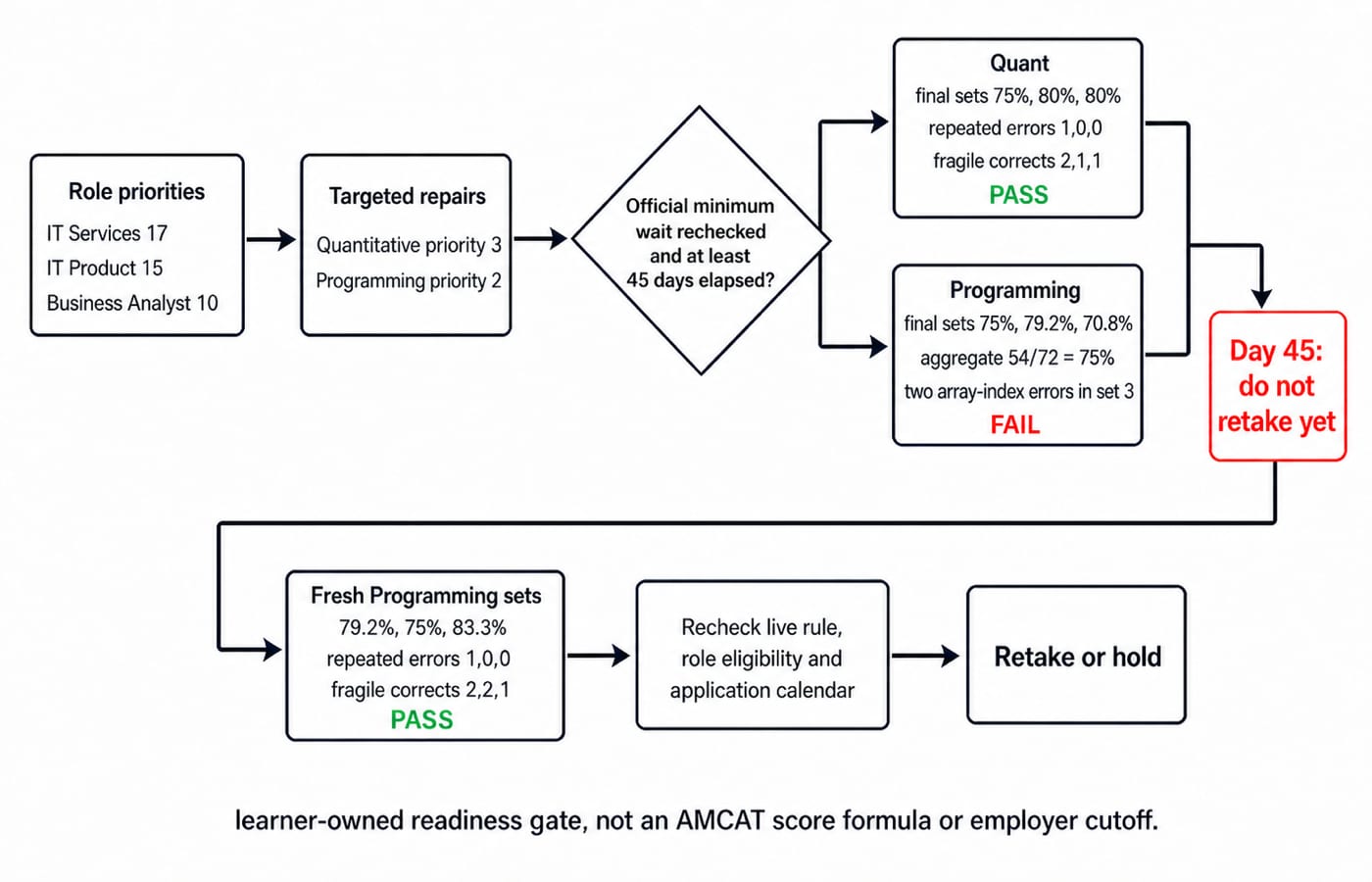
8. AMCAT Scorecard Analysis in One Short Decision Rule
Copy only what the report shows, and keep module evidence, job fit and listing eligibility apart. Rank the roles, repair what your top role needs, then require three stable fixed sets after the official wait. The rule in one line: retake when a named gap has closed on evidence you can show, not when one number feels bad. Rebuild Riya's audit with your own scores. If assembling the modules, sets and ledger yourself has no appeal, the AMCAT Preparation Course ships that structure already built; if Quantitative is your only weak module, the aptitude guide above is enough.
Keep learning

TCS NQT Eligibility: Check Backlogs, Gaps and Degree Rules
Use a closed TCS hiring notice as a worked checklist for degree, backlog, course-duration and academic-gap rules, then verify the current drive.
Updated 2 Sep 20264 min readIT Recruitment Exams

CoCubes Preparation Plan: Six Weeks for Campus Hiring Tests
Build a practical six-week CoCubes study plan around the modules in your own test invitation, your diagnostic results, and 72 hours of focused work.
Updated 1 Sep 20266 min readIT Recruitment Exams

eLitmus Retake Decision: Read Section Percentiles Before Testing Again
Do not retake eLitmus on disappointment alone. Use your section pattern, target-job evidence, and fresh timed practice to decide whether to go, wait, or rebuild.
Updated 30 Aug 20264 min readIT Recruitment Exams

eLitmus Mock Analysis: Diagnose Knowledge Gaps and Attempt Errors
A worked mock-review method to separate concept gaps from calculation, reading and decision errors, recover marks, and plan the next four weeks.
Updated 29 Aug 20265 min readIT Recruitment Exams