Coal India 2020 Previous Year Questions (PYQs) with Solutions
Real questions from the Coal India 2020 paper, solved. Every question below shows its options, the correct answer, and a full text solution — free to read, no login needed. Open any question to practice it interactively inside its course.
- Questions:
- 200
- With solutions:
- 192
- Tagged Coal India 2020 in the bank:
- 418
- Q1.COAL-INDIA 2020COAL-INDIA 2020
Who among the following has become the first Indian cricketer and second in world cricket to complete 100 T-20 Internationals?
- A.
Rohit Sharma
- B.
Virat Kohli
- C.
MS Dhoni
- D.
Ravindra Jadeja
Correct answer: A
Solution
Rohit Sharma is the first Indian cricketer and second in world cricket to complete 100 T-20 Internationals.
- A.
- Q2.COAL-INDIA 2020
Who had introduced ‘Doctrine of Lapse’ in India?
- A.
Lord Dalhousie
- B.
Lord Canning
- C.
Lord Hastings
- D.
Lord Auckland
Correct answer: A
Solution
The Doctrine of Lapse was introduced by Lord Dalhousie during his tenure as Governor-General of India. Under this policy, if a ruler of a princely state died without a natural male heir, the state could be annexed by the British East India Company, and adopted heirs were not recognized for succession.
- A.
- Q3.COAL-INDIA 2020
Who is the President of FICCI for the 2025-2026 term?
- A.
Rajesh Shah
- B.
Anant Goenka
- C.
Sandip Somany
- D.
Uday Shankar
Correct answer: B
Solution
Anant Goenka is the correct answer. He was elected President of the Federation of Indian Chambers of Commerce and Industry (FICCI) for the 2025–26 term. As Vice Chairman of the RPG Group, he succeeded Sandeep Somany and assumed leadership of one of India's leading industry bodies.
- A.
- Q4.COAL-INDIA 2020COAL-INDIA 2020
Phulkari is the famous handicraft of which state?
- A.
Sikkim
- B.
Punjab
- C.
Madhya Pradesh
- D.
Maharashtra
Correct answer: B
Solution
Phulkari is a traditional embroidery style originating from the Punjab region. It is characterized by bright colors and floral patterns, making it a famous handicraft of the state of Punjab.
- A.
- Q5.COAL-INDIA 2020COAL-INDIA 2020
Nabakalebara is the festival of which of the following state?
- A.
Kerala
- B.
Karnataka
- C.
Odisha
- D.
Andhra Pradesh
Correct answer: C
Solution
Nabakalebara is a major festival associated with the Jagannath Temple in Odisha. It is a special ritual in which the wooden idols of Lord Jagannath, Balabhadra, Subhadra, and Sudarshan are ceremonially replaced with new ones. The festival is observed at irregular intervals, usually every 12 to 19 years.
- A.
- Q6.COAL-INDIA 2020
The Amazon rainforest is spread over in ______ countries.
- A.
5
- B.
3
- C.
9
- D.
8
Correct answer: C
Solution
The Amazon rainforest is spread across nine countries in South America. These include Brazil, Peru, Colombia, Venezuela, Ecuador, Bolivia, Guyana, Suriname, and French Guiana.
- A.
- Q7.COAL-INDIA 2020COAL-INDIA 2020
Which of the following can be used as a coolant in a nuclear reactor?
- A.
Liquid Sodium
- B.
Nitrogen
- C.
Hydrogen
- D.
Carbon monoxide
Correct answer: A
Solution
Liquid sodium is used as a coolant in certain nuclear reactors, especially Fast Breeder Reactors (FBRs). Its high thermal conductivity, high boiling point, and low neutron absorption make it highly effective for transferring heat from the reactor core.
- A.
- Q8.COAL-INDIA 2020
Which of the following countries will host the 2026 Men’s Hockey World Cup?
- A.
India and Sri Lanka
- B.
Belgium and the Netherlands
- C.
New Zealand and Spain
- D.
China and Russia
Correct answer: B
Solution
The correct answer is Option B because the International Hockey Federation (FIH) officially awarded the hosting rights for the 2026 Men's Hockey World Cup to Belgium and the Netherlands. This joint bid was selected as part of a strategic partnership between two leading hockey nations in Europe to showcase the sport's growth. Option A is incorrect because India and Sri Lanka have not been announced as hosts for this specific tournament, although they are active participants in the sport. Option C is also incorrect as New Zealand and Spain were not chosen for this event; while Spain has hosted previous editions, the 2026 slot belongs to the Benelux region. Option D is incorrect because China and Russia were not selected as co-hosts for the 2026 Men's Hockey World Cup. Therefore, based on official FIH announcements, Belgium and the Netherlands are confirmed as the hosts.
- A.
- Q9.COAL-INDIA 2020COAL-INDIA 2020
Which of the following is the oldest oilseed crop in India?
- A.
Flaxseed
- B.
Mustard
- C.
Rapeseed
- D.
Sesame
Correct answer: D
Solution
Sesame is one of the earliest domesticated oilseed crops in the world and has been cultivated in India for thousands of years. It is valued for its high-quality edible oil and nutritional content.
- A.
- Q10.COAL-INDIA 2020COAL-INDIA 2020
Who among the following will only be provided with SPG cover in India?
- A.
President
- B.
Prime Minister
- C.
Home Minister
- D.
Finance Minister
Correct answer: B
Solution
The Prime Minister of India is the only individual who receives SPG (Special Protection Group) protection under the current legal framework. Following amendments to the SPG Act in 2019, SPG cover is restricted to the serving Prime Minister and immediate family members residing at the official residence.
- A.
- Q11.COAL-INDIA 2020
______ speed is measured by the Anemometer.
- A.
Cyclone
- B.
Current
- C.
Earthquake
- D.
Wind
Correct answer: D
Solution
An anemometer is a scientific instrument used to measure wind speed. It typically consists of cups or propellers that rotate in response to air movement, allowing for accurate wind velocity readings.
- A.
- Q12.COAL-INDIA 2020
Who is the current Chairman of the Airport Authority of India in 2026?
- A.
Vipin Kumar
- B.
Rajnish Kumar
- C.
Amit Khare
- D.
Arvind Singh
Correct answer: A
Solution
The correct answer is Vipin Kumar. As of 2026, Vipin Kumar serves as the Chairman and Managing Director of the Airport Authority of India (AAI). He assumed this high-ranking position following his appointment by the Government of India, bringing extensive experience in aviation management and infrastructure development to lead the nation's premier civil aviation authority. His leadership focuses on expanding airport capacity, enhancing passenger experience, and modernizing air traffic management systems across the country. Option B (Rajnish Kumar) is incorrect as he is associated with other major Indian corporations, not AAI. Option C (Amit Khare) and Option D (Arvind Singh) are also incorrect as they do not hold the position of Chairman at AAI in 2026. Students should note that key positions in public sector organizations like AAI are often appointed by the government and can change over time, making awareness of current appointments important for competitive exams.
- A.
- Q13.COAL-INDIA 2020
Which of the following countries will host the “No Money for Terror” conference in 2026?
- A.
China
- B.
India
- C.
France
- D.
Sri Lanka
Correct answer: C
Solution
France is the correct answer. The 5th "No Money For Terror" Ministerial Conference was held in Paris, France, on 19 May 2026. The conference focused on combating terrorist financing, financial crime, misuse of financial innovations, and strengthening international cooperation.
- A.
- Q14.COAL-INDIA 2020COAL-INDIA 2020
Which of the following is the first Indian Regional Satellite?
- A.
INSAT-3D
- B.
IRNSS-1A
- C.
YOUTHSAT
- D.
GSAT-7
Correct answer: B
Solution
IRNSS-1A was the first satellite of the Indian Regional Navigation Satellite System (IRNSS), now known as NavIC (Navigation with Indian Constellation). It was launched on 1 July 2013 and marked the beginning of India's indigenous regional navigation system.
- A.
- Q15.COAL-INDIA 2020COAL-INDIA 2020
For which of the following mineral India is mainly depend on imports?
- A.
Lead
- B.
Mercury
- C.
Mica
- D.
Limestone
Correct answer: B
Solution
India is mainly dependent on imports for mercury as domestic production is negligible. While lead, mica, and limestone have significant domestic availability, mercury imports are essential for various industrial applications.
- A.
- Q16.COAL-INDIA 2020
______ is the most cultivated crop of Kerala.
- A.
Wheat
- B.
Chick Pea
- C.
Mustard
- D.
Coconut
Correct answer: D
Solution
The correct answer is Option D (Coconut). Coconut is the most cultivated crop in Kerala and occupies the largest area under cultivation among the state's crops. Kerala's warm and humid tropical climate, abundant rainfall, and coastal geography provide ideal conditions for coconut cultivation. The crop is an important source of income and employment and is widely used in food, oil production, coir manufacturing, and various traditional industries. Therefore, coconut is rightly regarded as the most cultivated crop of Kerala.
- A.
- Q17.COAL-INDIA 2020
India’s two operational Satellite Launch Pads are located at which place?
- A.
Mumbai
- B.
Rajkot
- C.
Sriharikota
- D.
Jalandhar
Correct answer: C
Solution
India's two operational Satellite Launch Pads—the First Launch Pad (FLP) and Second Launch Pad (SLP)—are located at the Satish Dhawan Space Centre in Sriharikota, Andhra Pradesh. These launch pads are used by Indian Space Research Organisation for launching PSLV, GSLV, LVM3, and other missions.
- A.
- Q18.COAL-INDIA 2020
When is World Science Day for Peace and Development celebrated every year?
- A.
30th August
- B.
4th November
- C.
10th November
- D.
11th October
Correct answer: C
Solution
World Science Day for Peace and Development is officially celebrated on November 10th every year. This date was established by UNESCO in 2001 to promote the importance of science for peace and development. The correct answer is Option C (10th November) because it aligns with the globally recognized observance date set by international scientific organizations. Option A (30th August) is incorrect as it does not correspond to any major international science-related observance. Option B (4th November) is also wrong, as this date is not designated for World Science Day. Option D (11th October) is incorrect because it falls on the day after the actual celebration. Students should remember that November 10th is the fixed annual date for this important global event, making Option C the only accurate choice.
- A.
- Q19.COAL-INDIA 2020COAL-INDIA 2020
Who appoints the Vice President of India?
- A.
President
- B.
Supreme Court
- C.
The Electoral College of India
- D.
Prime Minister
Correct answer: C
Solution
The Vice President of India is not directly appointed by the President, Prime Minister, or Supreme Court. Instead, Article 66 of the Indian Constitution mandates that the Vice President is elected by an electoral college. This body comprises all members of both Houses of Parliament, including the Lok Sabha and Rajya Sabha, using proportional representation through a single transferable vote system. Although the question uses the term 'appoints', in the context of constitutional processes, this refers to the selection mechanism. Option C correctly identifies 'The Electoral College of India' as the body responsible for this election. Options A, B, and D are incorrect because the President does not appoint them (though they administer the oath), the Supreme Court adjudicates disputes but does not select officials, and the Prime Minister has no constitutional role in this specific appointment process. Therefore, Option C is the accurate answer based on India's constitutional framework.
- A.
- Q20.COAL-INDIA 2020COAL-INDIA 2020
Which of the following Company has developed Mac Operating System?
- A.
Microsoft
- B.
IBM Corp
- C.
HP
- D.
Apple
Correct answer: D
Solution
Apple Inc. developed the Mac Operating System, historically known as Mac OS. Microsoft develops Windows, while IBM and HP focus on other systems or hardware.
- A.
- Q21.COAL-INDIA 2020
Who was the founder of the Sayyid Dynasty?
- A.
Jalal-ud-din Khilji
- B.
Sikandar Lodhi
- C.
Khizar Khan
- D.
Nasir-ud-din Mahmud
Correct answer: C
Solution
The Sayyid Dynasty was the fourth dynasty to rule the Delhi Sultanate, reigning from 1414 to 1451 CE. Khizar Khan established this dynasty in 1414 after defeating the Tughlaq ruler, effectively ending the Tughlaq rule in Delhi. He was originally a governor of Multan under Timur and later seized power, claiming descent from the Prophet Muhammad (Sayyid), which gave the dynasty its name. Therefore, Option C is correct.\nJalal-ud-din Khilji (Option A) founded the Khilji Dynasty in 1290, which preceded the Tughlaqs. Sikandar Lodhi (Option B) was a ruler of the Lodi Dynasty, which came much later in 1489. Nasir-ud-din Mahmud (Option D) was actually the last ruler of the Sayyid Dynasty, not its founder. Understanding the chronological sequence of Delhi Sultanate dynasties helps eliminate these distractors and confirms Khizar Khan as the correct answer.
- A.
- Q22.COAL-INDIA 2020COAL-INDIA 2020
The average of 17 numbers is 48. The average of first 9 numbers is 45 and average of next 9 numbers is 52. If 9th number is excluded, the average of the remaining number is:
- A.
53.4375
- B.
58.5135
- C.
47.4375
- D.
49.5225
Correct answer: C
Solution
Given:
Average of 17 numbers = 48
Average of first 9 numbers = 45
Average of next 9 numbers = 52
Note:
The 9th number is common in both groups.
Step 1: Find total sum of 17 numbers
Total sum:
= 17 × 48
= 816
Step 2: Find sums of the two groups
Sum of first 9 numbers:
= 9 × 45
= 405
Sum of next 9 numbers:
= 9 × 52
= 468
Combined sum:
= 405 + 468
= 873
Step 3: Find the 9th number
The 9th number has been counted twice.
Therefore,
9th number:
= 873 − 816
= 57
Step 4: Find average after excluding 9th number
Remaining sum:
= 816 − 57
= 759
Remaining numbers:
= 16
Required average:
= 759/16
= 47.4375 - A.
- Q23.COAL-INDIA 2020COAL-INDIA 2020
Alloy A contains copper and zinc in the ratio 4 : 5 and alloy B contains copper and zinc in the ratio 7 : 2. A and B are taken in the ratio 7 : 4 and melted to form a new alloy. The percentage of copper in the new alloy is closest to:
- A.
67.5%
- B.
65.25%
- C.
56.57%
- D.
57.79%
Correct answer: C
Solution
Given:
Alloy A:
Copper : Zinc = 4 : 5Copper % in A:
= 4/(4 + 5) × 100
= 4/9 × 100
= 44.44%Alloy B:
Copper : Zinc = 7 : 2Copper % in B:
= 7/(7 + 2) × 100
= 7/9 × 100
= 77.78%A and B are mixed in the ratio 7 : 4.
Copper % in new alloy:
= (7 × 44.44 + 4 × 77.78)/(7 + 4)
= (311.08 + 311.12)/11
= 622.20/11
= 56.56%
≈ 56.57% - A.
- Q24.COAL-INDIA 2020COAL-INDIA 2020
A woman distributed her savings among her daughters A, B, C and D in the ratio 6 : 7 : 9 : 16. If A gives ₹600 from her share to C, the ratio of the resulting shares of A and C becomes 1 : 2. What was the initial sum of the shares of A, B and C?
- A.
13200
- B.
14550
- C.
15100
- D.
14750
Correct answer: A
Solution
Concept
When quantities are divided in a ratio, write each quantity as its ratio part multiplied by one common value. A transfer subtracts the amount from the giver and adds the same amount to the receiver.
The new ratio then forms an equation in the common value. Solve that equation first, and only afterward calculate the requested initial total.
Application
Let the common value be x. The initial shares follow this mapping:
Daughter
Initial share
A
6x
B
7x
C
9x
D
16x
After A transfers ₹600 to C, their shares become A = 6x − 600 and C = 9x + 600.
Use the resulting ratio A : C = 1 : 2: (6x − 600) / (9x + 600) = 1 / 2.
Cross-multiply and simplify: 2(6x − 600) = 9x + 600, so 12x − 1,200 = 9x + 600, hence 3x = 1,800 and x = 600.
The requested initial total is A + B + C = (6 + 7 + 9)x = 22 × 600 = ₹13,200.
Cross-check
With x = 600, the initial shares of A, B and C are ₹3,600, ₹4,200 and ₹5,400. After the transfer, A has ₹3,000 and C has ₹6,000, whose ratio is 1 : 2; their initial total is ₹13,200.
- A.
- Q25.COAL-INDIA 2020COAL-INDIA 2020
The sum of the first 10 terms of a GP is equal to the sum of the first 12 terms of the same GP, whose common ratio is non-zero. If the sum of the first 17 terms is 42, what is the fourth term of the GP?
- A.
0
- B.
-42
- C.
42
- D.
-21
Correct answer: B
Solution
Given:
Sum of the first 10 terms = Sum of the first 12 terms
⇒ S₁₂ − S₁₀ = 0
⇒ 11th term + 12th term = 0
Let the first term = a and the common ratio = r. Then:
11th term = ar¹⁰ and 12th term = ar¹¹
So, ar¹⁰ + ar¹¹ = 0
⇒ ar¹⁰(1 + r) = 0
The common ratio is non-zero (given), so r ≠ 0, and a ≠ 0 (otherwise every sum would be 0, contradicting S₁₇ = 42). Hence ar¹⁰ ≠ 0, which forces 1 + r = 0, so r = −1.
Now, with r = −1 the GP becomes a, −a, a, −a, …
Since 17 is odd, the terms pair off and cancel, leaving:
S₁₇ = a = 42
Fourth term: T₄ = ar³ = 42 × (−1)³ = −42. - A.
- Q26.COAL-INDIA 2020
If a six-digit number 3x9z8y is divisible by 7, 11, 13, then the average value of x, y, z is:
- A.
23/3
- B.
31/3
- C.
8
- D.
20/3
Correct answer: D
Solution
Given number:
3x9z8y
The number is divisible by 7, 11 and 13.
Since:
7 × 11 × 13 = 1001
Any number divisible by 7, 11 and 13 together must be divisible by 1001.
Now observe:
A 6-digit number of the form abcdef is divisible by 1001 if:
(abc) = (def)
Given number:
3x9z8y
So,
3x9 = z8y
Comparing digits:
z = 3
8 = x
y = 9
Therefore:
x = 8
y = 9
z = 3
Average of x, y, z:
= (8 + 9 + 3)/3
= 20/3 - A.
- Q27.COAL-INDIA 2020COAL-INDIA 2020
Twenty-five litres of 40% acid solution is mixed with 35 litres of 70% acid solution. What is the concentration of acid in the resulting solution?
- A.
57.5%
- B.
55%
- C.
60%
- D.
62.5%
Correct answer: A
Solution
Given:
25 litres of 40% acid solution
35 litres of 70% acid solutionAmount of acid in first solution:
= 40% of 25
= (40/100) × 25
= 10 litresAmount of acid in second solution:
= 70% of 35
= (70/100) × 35
= 24.5 litresTotal acid:
= 10 + 24.5
= 34.5 litresTotal solution:
= 25 + 35
= 60 litresConcentration of acid in new solution:
= (34.5/60) × 100
= 57.5% - A.
- Q28.COAL-INDIA 2020COAL-INDIA 2020
A 18 m long ladder (whose foot is on the ground) leans against a wall making an angle of 30° with the wall. What is the height (in m) of the point where the ladder touches the wall from the ground?
- A.
9√3
- B.
(9√3)/2
- C.
18
- D.
9√2
Correct answer: A
Solution
Given:
Length of ladder = 18 m
The ladder makes an angle of 30° with the wall.
We need to find the height where the ladder touches the wall.
In the right triangle formed:
Hypotenuse = 18 m
Angle with wall = 30°
Required height is adjacent to the angle.
Using:
cos 30° = Height/18
√3/2 = Height/18
Height = 18 × √3/2
= 9√3 m - A.
- Q29.COAL-INDIA 2020COAL-INDIA 2020
A person invested a sum of Rs. 9000 at r% per annum at simple interest and a sum of Rs. 13500 at (r-2)% at simple interest. If total interest earned on both the investments for 5 years is Rs. 9337.50, then the rate of interest on the first investment is:
- A.
8%
- B.
10%
- C.
7.5%
- D.
9.5%
Correct answer: D
Solution
Given:
First investment = Rs. 9000 at r%
Second investment = Rs. 13500 at (r − 2)%
Time = 5 years
Total simple interest = Rs. 9337.50Using SI formula:
SI = (P × R × T)/100Interest from first investment:
= (9000 × r × 5)/100
= 450rInterest from second investment:
= (13500 × (r − 2) × 5)/100
= 675(r − 2)Total interest:
450r + 675(r − 2) = 9337.50
450r + 675r − 1350 = 9337.50
1125r = 10687.50
r = 10687.50/1125
r = 9.5% - A.
- Q30.COAL-INDIA 2020COAL-INDIA 2020
From the top of a pole house A in a street, the angles of elevation and depression of the top and foot of house B on the opposite side of the street are 60° and 30°, respectively. If the height of pole house A is 21 m, then what is the height (in m) of house B? (correct to one decimal place)
- A.
84
- B.
57.5
- C.
47.8
- D.
49.8
Correct answer: A
Solution
Given:
Height of pole house A = 21 m
Angle of depression from top of A to foot of B = 30°
Angle of elevation from top of A to top of B = 60°
Let the distance between the houses be x m.
From the angle of depression:
tan 30° = 21/x
1/√3 = 21/x
x = 21√3
Now, let the height of house B be h m.
Difference in heights:
= h − 21
Using angle of elevation:
tan 60° = (h − 21)/(21√3)
√3 = (h − 21)/(21√3)
Cross multiply:
h − 21 = 21 × 3
h − 21 = 63
h = 84 m
Since the obtained answer does not match the options, let us verify carefully.
Using:
Distance = 21√3 ≈ 36.37
Now,
tan 60° = (h − 21)/36.37
√3 = (h − 21)/36.37
h − 21 = 36.37 × 1.732
≈ 63
h ≈ 84 m
The options provided do not contain the correct value. - A.
- Q31.COAL-INDIA 2020COAL-INDIA 2020
A woman saves 18% of her income. If her income increases by 15% and her expenditure increases by 21.6%, then what is the percent decrease in her savings (correct to one decimal place)?
- A.
16.8
- B.
15.1
- C.
13.7
- D.
17.2
Correct answer: B
Solution
Concept
Savings = Income − Expenditure, so a change in savings depends on how income and expenditure move together. Any ‘percent decrease’ is found as (decrease ÷ the ORIGINAL value) × 100, using the original savings as the base — never the new income, new expenditure, or new savings. When a problem gives only percentages (no rupee figures), assume a convenient base income, such as 100, to convert the percentages into workable numbers.
Application
Let the initial income = 100. Since she saves 18% of her income, original savings = 18% of 100 = 18, and original expenditure = 100 − 18 = 82.
Income rises by 15%, so new income = 100 × 1.15 = 115.
Expenditure rises by 21.6%, so new expenditure = 82 × 1.216 = 99.712.
New savings = new income − new expenditure = 115 − 99.712 = 15.288.
Decrease in savings = original savings − new savings = 18 − 15.288 = 2.712.
Percent decrease in savings = (decrease ÷ original savings) × 100 = (2.712 ÷ 18) × 100 ≈ 15.1%.
Cross-check
Cross-check with a different base to confirm the percentage does not depend on the assumed income: with income = 1000, original savings = 180, new income = 1150, new expenditure = 820 × 1.216 = 997.12, new savings = 152.88, decrease = 27.12, and (27.12 ÷ 180) × 100 ≈ 15.1% — the same result, matching 15.1.
- A.
- Q32.COAL-INDIA 2020
If A’s income is 60% more than B’s income and B’s income is 40% less than C’s income, then by what percent is C’s income more than A’s income? (Correct to one decimal place)
- A.
4.2
- B.
2.4
- C.
6.8
- D.
7.6
Correct answer: A
Solution
Let C's income be 100 units. Since B is 40% less than C, B equals 60 units.
A is 60% more than B, so A equals 1.6 times 60, which is 96 units.
To find how much more C is than A, calculate (100 - 96) / 96 * 100. This equals approximately 4.2%.
- A.
- Q33.COAL-INDIA 2020COAL-INDIA 2020
A person sold two articles for Rs. 1836 each. On one he gained 20% and on other he lost 20%. What is his overall gain or loss percent, correct to one decimal place?
- A.
5% gain
- B.
6% gain
- C.
7% loss
- D.
4% loss
Correct answer: D
Solution
Selling price of each article = Rs. 1836
For first article:
Gain = 20%
Let cost price be x.
120% of x = 1836
x = 1836 × 100/120
x = 1530
For second article:
Loss = 20%
Let cost price be y.
80% of y = 1836
y = 1836 × 100/80
y = 2295
Total cost price:
= 1530 + 2295
= 3825
Total selling price:
= 1836 + 1836
= 3672
Loss:
= 3825 − 3672
= 153
Loss percentage:
= (153/3825) × 100
= 4% - A.
- Q34.COAL-INDIA 2020COAL-INDIA 2020
A train while going slower by 15 km reaches late by 45 hours, if it travels faster by 60 km it reaches 72 hours earlier. The total distance (in km) travelled is:
- A.
8250
- B.
8775
- C.
7500
- D.
9750
Correct answer: D
Solution
Let the original speed of the train be x km/hr.
Then:
Reduced speed = (x − 15) km/hr
Increased speed = (x + 60) km/hr
Let the total distance be D km.
Step 1: Form equations using time difference
According to the question:
When speed is reduced by 15 km/hr, the train becomes late by 45 hours.
So,
D/(x − 15) − D/x = 45
Taking LCM:
D[x − (x − 15)] / x(x − 15) = 45
15D / x(x − 15) = 45
D = 3x(x − 15) —— (1)
When speed is increased by 60 km/hr, the train arrives 72 hours earlier.
So,
D/x − D/(x + 60) = 72
Taking LCM:
D[(x + 60) − x] / x(x + 60) = 72
60D / x(x + 60) = 72
5D = 6x(x + 60) —— (2)Step 2: Solve equations
From (1):
D = 3x(x − 15)
Substitute into (2):
5[3x(x − 15)] = 6x(x + 60)
15x(x − 15) = 6x(x + 60)
Divide by 3x:
5(x − 15) = 2(x + 60)
5x − 75 = 2x + 120
3x = 195
x = 65Step 3: Find distance
Using equation (1):
D = 3 × 65 × (65 − 15)
= 3 × 65 × 50
= 9750 km - A.
- Q35.COAL-INDIA 2020
If x = (√7 − √5) / (√5 + √7) and y is reciprocal of x, then what is the value of √(x³ + y³)?
- A.
3√47
- B.
√47
- C.
6√47
- D.
5√47
Correct answer: C
Solution
Given:
x = (√7 − √5)/(√5 + √7)
y is reciprocal of x.
So,
y = (√5 + √7)/(√7 − √5)
Now simplify x:
x = (√7 − √5)/(√5 + √7)
Multiply numerator and denominator by (√7 − √5):
x = (√7 − √5)²/(7 − 5)
= (7 + 5 − 2√35)/2
= (12 − 2√35)/2
= 6 − √35
Similarly,
y = 1/x = 6 + √35
Now,
x + y = 12
xy = 1
Using identity:
x³ + y³ = (x + y)³ − 3xy(x + y)
= 12³ − 3(1)(12)
= 1728 − 36
= 1692
Therefore,
√(x³ + y³)
= √1692
= √(36 × 47)
= 6√47
- A.
- Q36.COAL-INDIA 2020COAL-INDIA 2020
In a class of 60 students, 60% are girls. The average weight of the boys is 62 kg and that of the girls is 58 kg. What is the average weight (in kg) of the whole class?
- A.
61.5
- B.
60
- C.
59.6
- D.
61.4
Correct answer: C
Solution
Given:
Total students = 60
Girls = 60% of the class
Boys = the remaining students
Average weight of boys = 62 kg
Average weight of girls = 58 kg
Step 1: Find the number of boys and girls
Girls = 60% of 60
= (60/100) × 60
= 36
Boys = 60 − 36
= 24Step 2: Find the total weight of boys and girls
Total weight of boys = 24 × 62 = 1488 kg
Total weight of girls = 36 × 58 = 2088 kgStep 3: Find the average weight of the whole class
Total weight of the class = 1488 + 2088 = 3576 kg
Average weight = Total weight ÷ Total students
= 3576 ÷ 60
= 59.6 kgHence, the average weight of the whole class is 59.6 kg.
- A.
- Q37.COAL-INDIA 2020COAL-INDIA 2020
A loan has to be returned in two equal yearly instalments of Rs. 42135 each. If the rate of interest is 6% p.a. compounded annually, then the total interest paid (in Rs.) is:
- A.
7700
- B.
7020
- C.
7550
- D.
8000
Correct answer: B
Solution
Given
Each equal yearly instalment = Rs. 42135
Rate of interest = 6% p.a., compounded annually
Number of instalments = 2
Idea: The loan amount today equals the present value (PV) of all future instalments, discounted at the compound rate. Total interest = (sum of instalments paid) − (loan amount).
Step 1 — Present value of each instalment
First instalment (paid after 1 year):
PV₁ = 42135 ÷ 1.06 = Rs. 39750Second instalment (paid after 2 years):
PV₂ = 42135 ÷ (1.06)² = 42135 ÷ 1.1236 = Rs. 37500Step 2 — Loan amount (sum of present values)
Loan amount = PV₁ + PV₂ = 39750 + 37500 = Rs. 77250
Step 3 — Total amount repaid
Total repayment = 2 × 42135 = Rs. 84270
Step 4 — Total interest paid
Total interest = Total repayment − Loan amount = 84270 − 77250 = Rs. 7020
Hence, the total interest paid is Rs. 7020.
- A.
- Q38.COAL-INDIA 2020
A and B can do a work in 21 days. A is 7/4 times as efficient as B. In how many days, A alone can complete the 200/3 % of the work?
- A.
22
- B.
33
- C.
36
- D.
27
Correct answer: A
Solution
Given:
A and B together complete the work in 21 days.
Efficiency ratio:
A : B = 7 : 4
Let efficiencies be:
7x and 4x
Combined efficiency:
= 11x
Since total work is completed in 21 days:
11x = 1/21
x = 1/231
Efficiency of A:
= 7x
= 7/231
= 1/33
So, A alone completes 1 unit of work in 33 days.
Now,
Required work = 200/3 %
= 200/3 × 1/100
= 2/3 of the work
Time taken by A to complete 2/3 work:
= 33 × 2/3
= 22 days - A.
- Q39.COAL-INDIA 2020
The value of

is (8 + k), where k = ?
- A.
0.656
- B.
0.388
- C.
0.721
- D.
0.129
Correct answer: C
Solution
Let a = 5.169 and b = 4 × 0.888 = 3.552.
The numerator becomes a³ + b³ and the denominator is a² - ab + b².
Using the identity a³ + b³ = (a+b)(a² - ab + b²), the expression simplifies to a + b.
Substituting values: 5.169 + 3.552 = 8.721.
Since the value is 8 + k, we have 8.721 = 8 + k, so k = 0.721.
- A.
- Q40.COAL-INDIA 2020

where a and b are positive integers, then the value of ab is closest to:
- A.
8
- B.
12
- C.
21
- D.
35
Correct answer: C
Solution
Given:
√(12 − 2√35) + √(8 + 2√15) = √a + √b
We simplify each surd separately.
Step 1: Simplify √(12 − 2√35)
Assume:
√(12 − 2√35) = √m − √n
Squaring both sides:
12 − 2√35 = m + n − 2√mn
Comparing terms:
m + n = 12
mn = 35
The numbers satisfying these conditions are:
m = 7 and n = 5
Therefore,
√(12 − 2√35) = √7 − √5
Step 2: Simplify √(8 + 2√15)
Assume:
√(8 + 2√15) = √p + √q
Squaring both sides:
8 + 2√15 = p + q + 2√pq
Comparing terms:
p + q = 8
pq = 15
The numbers are:
p = 5 and q = 3
Therefore,
√(8 + 2√15) = √5 + √3
Step 3: Add the expressions
(√7 − √5) + (√5 + √3)
= √7 + √3
So,
a = 7 and b = 3
Therefore,
ab = 7 × 3 = 21 - A.
- Q41.COAL-INDIA 2020COAL-INDIA 2020
The third term of an arithmetic progression is 6. Then the sum of first five terms is:
- A.
15
- B.
25
- C.
30
- D.
35
Correct answer: C
Solution
Given:
Third term of an Arithmetic Progression (AP) = 6
Let the AP be:
a − 2d, a − d, a, a + d, a + 2d
Here, the third term is:
a = 6
So the first five terms become:
6 − 2d, 6 − d, 6, 6 + d, 6 + 2d
Sum of first five terms:
= (6 − 2d) + (6 − d) + 6 + (6 + d) + (6 + 2d)
The d terms cancel out:
= 6 + 6 + 6 + 6 + 6
= 30 - A.
- Q42.COAL-INDIA 2020COAL-INDIA 2020
A can do a certain work in 12 days, and B alone can do the same work in 16 days. A and B undertook to complete it for Rs. 8000. With the help of C, they completed the work in 6 days. How much money (in Rs.) should be paid to C?
- A.
1000
- B.
2000
- C.
3000
- D.
4000
Correct answer: A
Solution
Given:
A can complete the work in 12 days
B can complete the work in 16 days
Total payment = Rs. 8000
With the help of C, the work is completed in 6 days
Step 1: Find efficiencies of A and B
Efficiency of A:
= 1/12 work per day
Efficiency of B:
= 1/16 work per day
Combined efficiency of A and B:
1/12 + 1/16
Taking LCM = 48
= 4/48 + 3/48
= 7/48Step 2: Find total efficiency with C
Since the work is completed in 6 days:
Total efficiency of A + B + C
= 1/6
Efficiency of C:
= 1/6 − 7/48
Taking LCM = 48
= 8/48 − 7/48
= 1/48Step 3: Find C’s share of money
Total work is divided according to efficiencies.
Ratio of efficiencies:
A : B : C
= 1/12 : 1/16 : 1/48
Multiplying by 48:
= 4 : 3 : 1
Total ratio:
4 + 3 + 1 = 8
C’s share:
= (1/8) × 8000
= 1000 - A.
- Q43.COAL-INDIA 2020
If x⁴ + x²y² + y⁴ = 29 and x² − xy + y² = 5, then what is the value of 5xy?
- A.
0
- B.
2
- C.
-2
- D.
-1
Correct answer: B
Solution
First, factor the expression x⁴ + x²y² + y⁴ as (x² - xy + y²)(x² + xy + y²).
Substitute the given value 5 for (x² - xy + y²) to get 5(x² + xy + y²) = 29. Solve for x² + xy + y² to find it equals 5.8.
Subtract the original equation x² - xy + y² = 5 from this result to isolate 2xy. This gives 2xy = 0.8, so xy = 0.4.
Finally, multiply xy by 5 to find the value of 5xy is 2.
- A.
- Q44.COAL-INDIA 2020
A person marks his goods 40% above the cost price. He sold 30% of goods at marked price, 60% of the remaining at a discount of 20% and remaining at 40% discount. What is his overall gain percent?
- A.
15.8%
- B.
12.56%
- C.
23.5%
- D.
27.4%
Correct answer: B
Solution
Assume total Cost Price (CP) of all goods = Rs. 100
Marked 40% above CP:
Marked Price (MP) = 140Step 1: 30% goods sold at MP
Profit = 40%
Contribution to SP:
30% of 140
= 42Step 2: 60% of remaining goods sold at 20% discount
Remaining goods after first sale:
100% − 30% = 70%
60% of remaining:
= 60% of 70%
= 42% of total goods
Selling price after 20% discount:
140 × 80/100 = 112
Contribution:
42% of 112
= 47.04Step 3: Remaining goods sold at 40% discount
Remaining quantity:
100% − 30% − 42%
= 28%
Selling price after 40% discount:
140 × 60/100 = 84
Contribution:
28% of 84
= 23.52Step 4: Total Selling Price
Total SP:
42 + 47.04 + 23.52
= 112.56
Total CP = 100
Profit:
112.56 − 100 = 12.56
Overall gain %:
12.56% - A.
- Q45.COAL-INDIA 2020
A covers a certain distance at a certain speed. If he covers half of the distance in three times the time, then the ratio of this speed to the original speed is:
- A.
1:4
- B.
1:6
- C.
4:5
- D.
6:1
Correct answer: B
Solution
Let:
Original distance = d
Original speed = s
Original time = t
Using the formula:
Speed = Distance / Time
So,
s = d/t
Now, according to the question:New distance = d/2
New time = 3t
Let the new speed be s₁.
Then,
s₁ = (d/2)/(3t)
= d/6t
But,
s = d/t
Therefore,
s₁/s = (d/6t)/(d/t)
= 1/6So,
s₁ : s = 1 : 6 - A.
- Q46.COAL-INDIA 2020
If x⁴ − 79x² + 1 = 0, then a value of x³ + x⁻³ can be:
- A.
702
- B.
720
- C.
789
- D.
798
Correct answer: A
Solution
Given:
x⁴ − 79x² + 1 = 0
We need to find the value of:
x³ + x⁻³
Step 1: Divide the equation by x²
x⁴/x² − 79x²/x² + 1/x² = 0
x² + 1/x² = 79
Step 2: Use identity
(x + 1/x)² = x² + 1/x² + 2
Substitute:
(x + 1/x)² = 79 + 2
= 81
x + 1/x = 9
Step 3: Use another identity
x³ + 1/x³ = (x + 1/x)³ − 3(x + 1/x)
Substitute:
= 9³ − 3 × 9
= 729 − 27
= 702 - A.
- Q47.COAL-INDIA 2020
Sukanya is Ayushman’s wife. Lekha is Sukanya’s sister. Nisha is Lekha’s mother. Mukesh is Nisha’s husband. Piyush is Nisha’s son. How is Ayushman related to Mukesh?
- A.
Brother in law
- B.
Son
- C.
Brother
- D.
Son in law
Correct answer: D
Solution
Concept: In blood-relation puzzles, a person who marries into a family takes an “in-law” relationship to their spouse’s parents: the husband of a couple’s daughter is their son-in-law. To find how any two people relate, first turn every sentence in the stem into a parent-child or marriage link, build one family tree from those links, then read the relationship straight off the tree.
Application:
Sukanya is Ayushman's wife, so Ayushman and Sukanya are married.
Lekha is Sukanya's sister, so Lekha and Sukanya share the same mother and father.
Nisha is Lekha's mother, and since Sukanya is Lekha's sister, Nisha is Sukanya's mother too.
Mukesh is Nisha's husband, which makes Mukesh Sukanya's father.
Piyush is Nisha's son, so Piyush is Sukanya's brother — Mukesh and Nisha's three children are Piyush, Lekha, and Sukanya.
Ayushman is married to Mukesh's daughter Sukanya, so Ayushman is Mukesh's son-in-law.
Cross-check: Viewed from Mukesh's side: his son Piyush's wife would be his daughter-in-law, while the husbands of his daughters Lekha and Sukanya are his sons-in-law. Ayushman, as Sukanya's husband, falls in that second group, confirming the relationship independently of the step-by-step trace.
Ayushman is Mukesh's son-in-law.
- A.
- Q48.COAL-INDIA 2020COAL-INDIA 2020
Select the pair of words from the given options that shares a similar relationship as the given pair.
Shark : Fish
- A.
Bat : Bird
- B.
Dolphin : Fish
- C.
Whale : Mammal
- D.
Iguana : Amphibian
Correct answer: C
Solution
Identify the relationship in the given pair, Shark : Fish.
A shark is biologically classified as a type of fish (specifically, a cartilaginous fish). So the relationship is "member : its biological class".
Now test each option against this same "member : its biological class" pattern:
Bat : Bird → A bat is a mammal, not a bird. (Wrong class)
Dolphin : Fish → A dolphin is a mammal, not a fish. (Wrong class)
Whale : Mammal → A whale is biologically classified as a mammal. (Correct class)
Iguana : Amphibian → An iguana is a reptile, not an amphibian. (Wrong class)
Hence Whale : Mammal is the only pair that mirrors the logic of Shark : Fish. - A.
- Q49.COAL-INDIA 2020
In a certain language, if PERSIST is written as 7591912, then how is ANCESTOR coded in the same language?
- A.
14351259
- B.
15351059
- C.
15351269
- D.
14351268
Correct answer: C
Solution
- Write down the positional values of letters in PERSIST: P=16, E=5, R=18, S=19, I=9, S=19, T=20.
- Find the single-digit sum of the positional values (digital root) for each letter:
P -> 1 + 6 = 7
E -> 5
R -> 1 + 8 = 9
S -> 1 + 9 = 10 -> 1 + 0 = 1
I -> 9
S -> 1 + 9 = 10 -> 1 + 0 = 1
T -> 2 + 0 = 2
- Combining these digits gives 75911912, but the question states it is written as 7591912. Notice that the consecutive 'S' and 'I' positions are condensed, or the absolute values are written by grouping S(1), I(9), S(1) as 191. Let's apply the single-digit logic to ANCESTOR.
- Write down the positional values of letters in ANCESTOR: A=1, N=14, C=3, E=5, S=19, T=20, O=15, R=18.
- Convert each positional value to a single digit by adding its digits: A -> 1 N -> 1 + 4 = 5 C -> 3 E -> 5 S -> 1 + 9 = 10 -> 1 + 0 = 1 T -> 2 + 0 = 2 O -> 1 + 5 = 6 R -> 1 + 8 = 9
- Combining the resulting digits sequentially gives: 15351269. - A.
- Q50.COAL-INDIA 2020COAL-INDIA 2020
A reputed educational institution is to select meritorious graduates, for the award of scholarships for higher studies abroad at a premium University, who fulfill the following criteria:
The candidate must -
(i) have Minimum 85% marks in the final year examination of the institute.
(ii) have secured at least 90% marks in the selection test of the University abroad.
(iii) not be less than 21 years and not more than 25 years of age as on 01.01.2020In case of a candidate who satisfies all other criteria except:
(a) At (i) above but has won at least one major prize/award in Debate/ Sports/ Cultural event, the case may be referred to the Director of the Institution.
(b) At (ii) above but is from the reserved category, there is relaxation of age by 2 years.Based on the above criteria and conditions, analyze and decide which of the following course of action should be taken for the candidate whose description is provided below. Please note that you are not to assume anything other than the information given.
Deepinder Bhalla, born on 17th December, 1997 secured 79% marks in final year. She got 92% marks in selection test and has won 3 Inter-University debate competitions.
- A.
The candidate is to be selected.
- B.
The case is to be referred to the Director of the Institute.
- C.
The candidate is not to be selected.
- D.
The candidate is to be selected under the relaxed criterion.
Correct answer: B
Solution
Eligibility criteria (a candidate must satisfy all three):
Minimum 85% marks in the final-year examination.
At least 90% marks in the University's selection test.
Age between 21 and 25 years as on 01.01.2020.
Special relaxations:
Fails (i) but has won at least one major Debate / Sports / Cultural prize -> refer the case to the Director.
Fails (ii) and is from the reserved category -> a 2-year age relaxation is allowed.
Checking Deepinder Bhalla:
Final-year marks = 79% -> below the required 85% (fails (i))
Selection-test marks = 92% -> at least 90% (meets (ii))
Born 17 Dec 1997 -> age on 01.01.2020 = 22 years, within 21-25 (meets (iii))
Won 3 inter-university debate competitions -> a major Debate prize (satisfied)
She satisfies (ii) and (iii) and falls short only on (i). The reserved-category age relaxation does not apply, because she clears (ii) and no reserved-category status is given. However, having won a major Debate award, she fits the first special relaxation, so her case must be referred to the Director.
Correct answer: The case is to be referred to the Director of the Institute.
- A.
- Q51.COAL-INDIA 2020COAL-INDIA 2020
Rearrange the given letters to form meaningful words and select the option which is different from the other three words.
- A.
PLEAP
- B.
SEHCWA
- C.
RPOATIC
- D.
EOGARN
Correct answer: B
Solution
PLEAP → APPLE (Fruit)
SEHCWA → CASHEW (Nut)
RPOATIC → APRICOT (Fruit)
EOGARN → ORANGE (Fruit)Only CASHEW is not a fruit.
- A.
- Q52.COAL-INDIA 2020COAL-INDIA 2020
A cube with each edge of 4 cm is painted on all faces. How many of 1 cm cubes, cut out of the larger cube, will not have paint on any of its sides?
- A.
3
- B.
4
- C.
6
- D.
8
Correct answer: D
Solution
Concept: When a large painted cube is cut into smaller unit cubes, only the cubes lying strictly inside (not touching any outer face) stay unpainted. These inner cubes form a smaller cube called the core.
Formula: Number of unpainted cubes = (n - 2)^3, where n is the number of unit cubes along one edge (Edge of large cube / Edge of small cube).
Given: Edge of the large cube = 4 cm, edge of each small cube = 1 cm.
Step 1 - Find n: n = 4 cm / 1 cm = 4.
Step 2 - Apply the formula: Unpainted cubes = (4 - 2)^3 = 2^3 = 2 x 2 x 2 = 8.
Therefore, exactly 8 of the smaller cubes have no paint on any face. The answer is 8.
- A.
- Q53.COAL-INDIA 2020COAL-INDIA 2020
Which answer figure is the exact mirror image of the given sequence when a vertical mirror is held on the right side?
pR4GTF7Dq
Solution
Concept. A vertical plane mirror held to the right of a horizontal string produces a reflection in which two changes happen together: (1) the order of the characters is reversed end-for-end, and (2) every individual character is inverted left-to-right (laterally flipped). A figure is the exact mirror image only if BOTH changes are present.
Application to pR4GTF7Dq.
Reverse the order. Reading pR4GTF7Dq from right to left gives the character sequence q, D, 7, F, T, G, 4, R, p.
Laterally flip each glyph. q becomes p; D becomes a back-to-front D (bowl on the left); 7 becomes a reversed 7; F becomes a reversed F; T stays T (it is symmetric about a vertical axis); G becomes a reversed G; 4 becomes a reversed 4; R becomes a reversed R; and the final p becomes q.
Read off the result. The exact mirror image therefore begins with an upright p, ends with an upright q, and in between shows a reversed-D, reversed-7, reversed-F, upright T, reversed-G, reversed-4 and reversed-R. This is the figure whose first character is p and last character is q with every interior glyph turned back-to-front.
Cross-check. Confirm both conditions on the end characters, which are the easiest to verify: the original starts with p, so the reflection must END with q (a true reflection swaps p and q). A figure that ends in an upright D and d, or that begins with q and ends with p, has reversed the order but failed to flip one or more glyphs, so it is not the exact mirror image.
- Q54.COAL-INDIA 2020COAL-INDIA 2020
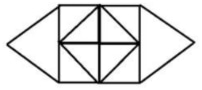
How many triangles are there in the given figure?
- A.
12
- B.
14
- C.
15
- D.
16
Correct answer: B
Solution
Concept
A triangle is any closed three-sided region whose three sides each run entirely along lines that are actually drawn. To count every triangle without missing or repeating any, work by SIZE: first count the smallest atomic triangles, then count the larger triangles that are built by joining two or more adjacent smaller ones along a shared line.
Applying it to this figure
The figure is a central square split into a 2×2 grid (one horizontal and one vertical midline) with a diamond inscribed by joining the four side-midpoints, plus one triangular wing attached on the left and one on the right. Count level by level:
Smallest triangles: inside the square, each of the 4 grid cells is cut by one diamond edge into 2 triangles, giving 4 × 2 = 8 smallest triangles.
Half-diamond triangles: joining two adjacent smallest triangles that share a diamond diagonal gives the four half-diamond triangles — top half, bottom half, left half and right half of the diamond. That is 4 triangles.
Wing triangles: the left wing is one triangle and the right wing is one triangle, giving 2 more.
Total = 8 + 4 + 2 = 14 triangles.
Cross-check
No larger composite triangle is created where a wing meets the square: a wing's slanted edge and the square's side do not continue into one straight line, so they cannot serve as a single side of a bigger triangle. Inside the square the only slanted lines are the four diamond edges, and the square has no corner-to-corner diagonals, so there are no half-square triangles. Re-counting by size confirms 8 + 4 + 2 with nothing left over, so the figure contains exactly 14 triangles.
- A.
- Q55.COAL-INDIA 2020
A group of 74 students of Class XI went on picnic. The number of students who went on picnic by each section is as follows:
Section A = 15
Section B = 24
Section C = 15
Section D = 205 students from Section A spent as much as 4 students from Section B.
12 students from Section B spent as much as 9 students from Section C and 6 students from Section C spent as much as 8 students from Section D.If every student of a particular section spent the same amount and all the students spent Rs 23,370 altogether, find the amount spent by each student of Section D.
- A.
Rs 307.50
- B.
Rs 410
- C.
Rs 369
- D.
Rs 246.50
Correct answer: A
Solution
- Let the expenditure of a single student in sections A, B, C, and D be a, b, c, and d respectively.
- Step 1: Establish the relational equations from the problem statement: 5a = 4b -> a = (4/5)b 12b = 9c -> c = (12/9)b = (4/3)b 6c = 8d -> d = (6/8)c = (3/4)c
- Step 2: Convert all variables into terms of 'b' to create a unified ratio: a = 0.8b c = 1.333b d = (3/4) (4/3)b = b
- Step 3: Set up the total expenditure equation using the student counts (A=15, B=24, C=15, D=20):
Total Expense = 15a + 24b + 15c + 20d = 23,370
Substitute the values: 15(4/5)b + 24b + 15(4/3)b + 20(b) = 23,370
Simplify: 12b + 24b + 20b + 20b = 23,370 76b = 23,370 b = 23,370 ÷ 76 = 307.50
- Step 4: Find the expenditure for Section D: * Since d = b, a student of Section D spent exactly Rs 307.50. - A.
- Q56.COAL-INDIA 2020COAL-INDIA 2020
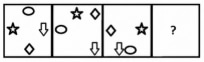
Select the figure that will come next in the following figure series.
Solution
Concept
In a figure-series, treat the 8 marked cells of the box — the four corners and the four edge-midpoints — as points on a ring. Each shape advances by its own fixed number of these cells, in its own fixed direction, every frame; once that step size is confirmed from two consecutive frames, applying it once more predicts the next frame exactly.
Application
Track each shape across the three given boxes (positions named by where they sit inside the box):
Star: middle-left → top-centre → middle-right. It advances two cells clockwise every frame, so next it lands at bottom-centre.
Oval: top-centre → middle-left → bottom-centre. It moves two cells anticlockwise every frame, so next it lands at middle-right.
Diamond: bottom-centre → top-right → middle-left. It advances a fixed step every frame (three cells anticlockwise), so next it lands at the bottom-right corner.
Down-arrow: middle-right → bottom-right → bottom-centre (sharing the bottom edge with the oval in this frame). It advances one cell clockwise every frame, so next it lands at bottom-left.
Cross-check
The first two boxes alone fix every shape's step unambiguously, since no two shapes share a cell there: the star's middle-left-to-top-centre move and the down-arrow's middle-right-to-bottom-right move each cover exactly one named cell, and the oval's and diamond's moves are equally clear. Applying each shape's confirmed step a second time reproduces the third box exactly — including the down-arrow and oval both arriving at bottom-centre together, which is why that box shows them side by side. Applying the same steps once more, independently for each shape, is what fixes the fourth figure.
Result
Combining every shape's own fixed step gives one figure that satisfies all four simultaneously: the down-arrow at bottom-left, the oval at middle-right, the star at bottom-centre, and the diamond at the bottom-right corner. Every other figure breaks exactly one of these — either the diamond fails to advance at all, the diamond reverses to an earlier cell, or the down-arrow advances one cell too many.
- Q57.COAL-INDIA 2020COAL-INDIA 2020
Choose the Venn diagram from the given options which represents the correct relationship amongst the following classes:
Pen, Chair, Stationery
Solution
Concept
These are class-relationship (syllogism) diagrams. The link between any two named groups is one of three kinds: one group is wholly a sub-type of the other (one circle drawn entirely inside the other), the groups partly share members (two circles that overlap), or the groups have nothing in common (two circles drawn fully apart). The correct diagram is the one whose circle arrangement matches the real-world relationship of every pair.
Application
Test each pair among Pen, Chair and Stationery:
Pen and Stationery: a pen is a kind of stationery, so the whole Pen group sits within the Stationery group — the Pen circle must lie completely inside the Stationery circle.
Chair and Stationery: a chair is furniture, not stationery, so they share no members — the Chair circle must stay completely apart from the Stationery circle.
Pen and Chair: a pen is not a chair and a chair is not a pen, so these two also share no members — their circles must stay apart.
The arrangement that satisfies all three at once is: one smaller circle fully enclosed by a larger circle, plus a third circle standing entirely on its own, separate from both.
Cross-check
Reject any diagram with overlap (overlap would wrongly claim a chair is partly a pen or partly stationery) and reject any diagram that places two circles inside one outer circle (that would wrongly make a chair a type of stationery). Only the enclosed-circle-plus-one-detached-circle layout keeps Pen inside Stationery while leaving Chair unrelated to both.
- Q58.COAL-INDIA 2020COAL-INDIA 2020
Six participants — U, V, W, X, Y and Z — are sitting in two rows of three, with each person facing someone in the other row. X is second to the right of Z. W, who is a neighbour of Y, is sitting diagonally opposite X. V is a neighbour of Z. Y is not at the end of any row. If V and U interchange their positions, who would be the neighbours of U in the new position?
- A.
W and X
- B.
X and Y
- C.
Z and Y
- D.
Z and X
Correct answer: D
Solution
Step 1 — Build one row. "X is second to the right of Z" places Z and X at the two ends of the same row, with one seat between them. Since "V is a neighbour of Z", V takes that middle seat. So this row reads: Z – V – X.
Step 2 — Build the other row. "Y is not at the end of any row", so Y sits in the middle of the opposite row. "W is the neighbour of Y" and W is diagonally opposite X, so W takes the end of that row that lies diagonally across from X. The only person left, U, takes the remaining end. So this row reads: U – Y – W (or W – Y – U), with U opposite Z.
Step 3 — Apply the interchange. V and U swap seats. U moves into V's old middle seat, which sits between Z and X.
Therefore, after the swap, U's neighbours are Z and X, which is option 4.
- A.
- Q59.COAL-INDIA 2020
A + B means ‘A is the father of B’, A − B means ‘A is the wife of B’, A × B means ‘A is brother of B’, A ÷ B means ‘A is the daughter of B’. If R − V × T ÷ W, then how is R related to W?
- A.
Son in law
- B.
Mother
- C.
Daughter in law
- D.
Mother in law
Correct answer: C
Solution
- Given relation string: R - V × T ÷ W
- Breakdown of relationships from left to right:
- R - V: 'R is the wife of V' (R is female, V is male, and they are a married couple: R(-) ⇔ V(+))
- V × T: 'V is brother of T' (V and T are siblings, sharing the same generation: V(+) — T)
- T ÷ W: 'T is the daughter of W' (T is female, and W is the parent of T: W is one generation above T)
- Generation and family tree tracking: Since V and T are siblings, W is the parent of both V and T. R is married to V, which means R is the wife of W's son.
- Therefore, R is the daughter-in-law of W. - A.
- Q60.COAL-INDIA 2020COAL-INDIA 2020
Ravi is shorter than Kartik but taller than Gagan and Tarun, who are taller than Saksham. Sunil is taller than Aarav but shorter than Saksham. Who is the tallest of all?
- A.
Aarav
- B.
Tarun
- C.
Kartik
- D.
Gagan
Correct answer: C
Solution
Convert each statement into a height comparison (taller > shorter) and merge them into a single chain.
Statement 1: "Ravi is shorter than Kartik but taller than Gagan and Tarun" → Kartik > Ravi > Gagan, Tarun.
Statement 1 (continued): "…Gagan and Tarun, who are taller than Saksham" → Gagan, Tarun > Saksham.
Statement 2: "Sunil is taller than Aarav but shorter than Saksham" → Saksham > Sunil > Aarav.
Combined chain (tallest → shortest): Kartik > Ravi > Gagan/Tarun > Saksham > Sunil > Aarav.
Kartik sits at the top of the chain, so Kartik is the tallest of all.
- A.
- Q61.COAL-INDIA 2020
Select the option that is related to the fourth term in the same way as the first term is related to the second term.
Quarrel : War :: Error : ?
- A.
Carelessness
- B.
Anger
- C.
Omission
- D.
Blunder
Correct answer: D
Solution
The relationship between the words is based on intensity/degree.
- A 'Quarrel' is a minor argument, which escalates in intensity to a 'War'.
- Similarly, an 'Error' is a minor mistake, which escalates in intensity to a 'Blunder' (a massive, serious mistake). - A.
- Q62.COAL-INDIA 2020COAL-INDIA 2020
Select the option that is related to the fourth term in the same way as the first term is related to the second term.
REQUEST : QGNYZYM :: ______ : OTBHDIM
- A.
RESTFIT
- B.
PRECICT
- C.
PREDICT
- D.
RESTICT
Correct answer: C
Solution
The Logic: Each letter of the word is shifted by an alternating add/subtract pattern of consecutive natural numbers: -1, +2, -3, +4, -5, +6, -7.
Verifying the given pair REQUEST -> QGNYZYM:
R - 1 = Q
E + 2 = G
Q - 3 = N
U + 4 = Y
E - 5 = Z
S + 6 = Y
T - 7 = M
So REQUEST is coded as QGNYZYM. The fourth term OTBHDIM is therefore the code of the missing word, so we reverse the shifts (+1, -2, +3, -4, +5, -6, +7) on OTBHDIM:
O + 1 = P
T - 2 = R
B + 3 = E
H - 4 = D
D + 5 = I
I - 6 = C
M + 7 = T
The missing word is PREDICT. (Check: applying -1, +2, -3, +4, -5, +6, -7 to PREDICT gives back OTBHDIM.)
- A.
- Q63.COAL-INDIA 2020COAL-INDIA 2020
Which word CANNOT be formed using the letters of the given word, using each letter only as many times as it appears in the given word?
DOCUMENTARY
- A.
AERODUCT
- B.
EDUCATOR
- C.
DEMOCRACY
- D.
MONETARY
Correct answer: C
Solution
Given word: DOCUMENTARY — its letters are D, O, C, U, M, E, N, T, A, R, Y, each appearing exactly once.
Rule: a word can be formed only if every letter it needs is available in DOCUMENTARY, and no letter is used more times than it appears there.
AERODUCT (A, E, R, O, D, U, C, T): every letter is available — can be formed.
EDUCATOR (E, D, U, C, A, T, O, R): every letter is available — can be formed.
DEMOCRACY (D, E, M, O, C, R, A, C, Y): it needs the letter 'C' twice, but DOCUMENTARY contains 'C' only once — cannot be formed.
MONETARY (M, O, N, E, T, A, R, Y): every letter is available — can be formed.
Hence DEMOCRACY is the word that cannot be formed from the letters of DOCUMENTARY.
- A.
- Q64.COAL-INDIA 2020COAL-INDIA 2020COAL-INDIA 2020
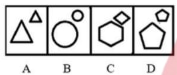
Select the figure which is different from the other three alternatives.
- A.
A
- B.
B
- C.
C
- D.
D
Correct answer: C
Solution
Concept: In this non-verbal "classification / odd-one-out" item, each figure pairs one outer polygon with one smaller inner polygon. The figures that belong together follow a consistent rule linking the pair — here, the outer and inner shapes always have the same number of sides. The one figure that breaks this side-count match is the odd one out.
Application — checking each figure:
Figure
Outer shape
Inner shape
Side count matches?
A
Triangle (3 sides)
Triangle (3 sides)
Yes
B
Circle (no straight sides)
Circle (no straight sides)
Yes
C
Hexagon (6 sides)
Diamond / Rhombus (4 sides)
No
D
Pentagon (5 sides)
Pentagon (5 sides)
Yes
Cross-check: Figures A, B and D each keep the outer and inner shape's side count identical (3-3, round-round, 5-5), confirming they follow the pairing rule. Figure C pairs a 6-sided hexagon with a 4-sided diamond — the side counts do not match, so Figure C alone violates the pattern the other three follow.
Hence, Figure C is the figure that is different from the other three alternatives.
- A.
- Q65.COAL-INDIA 2020
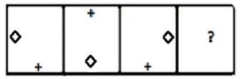
Select the image that will come next in the following figure series.
Solution
- The Logic: Track the movement of the two symbols (Diamond '✧' and Plus '+') across the boxes dynamically.
- Movement of Diamond (✧):
- Box 1: Left-middle position
- Box 2: Bottom-middle position
- Box 3: Right-middle position
- Pattern: It moves clockwise along the sides (Left -> Bottom -> Right). Therefore, in Box 4, it must move to the Top-middle position.
- Movement of Plus (+):
- Box 1: Bottom-middle position
- Box 2: Top-middle position
- Box 3: Bottom-middle position
- Pattern: It alternates back and forth between Bottom and Top positions. Therefore, in Box 4, it must move to the Top-middle position.
- Final Combined Figure: Both the Diamond (✧) and the Plus (+) will sit at the top-middle area together, with the '+' symbol positioned slightly above/beside the diamond. This matches Option 3. - Q66.COAL-INDIA 2020
Three statements are given followed by four conclusions I, II, III and IV. You have to consider these statements to be true, even if they seem at variance from commonly known facts. Decide which of the given conclusions logically follows from the given statement.
Statements:All beetroots are carrots.
All carrots are radishes.
All radishes are white.Conclusions:
I. All beetroots are white.
II. All white are carrots.
III. All radishes are beetroots.
IV. All carrots are white.- A.
Only conclusions I and II follow.
- B.
Only conclusions I and IV follow.
- C.
Only conclusions II and III follow.
- D.
All the conclusions follow.
Correct answer: B
Solution
- The Logic: The statements describe nested relationships (concentric circles): Beetroots inside Carrots, Carrots inside Radishes, and Radishes inside White.
- Checking Conclusion I: Since all beetroots are inside carrots, all carrots are inside radishes, and all radishes are inside white, all beetroots are automatically inside white. (Follows)
- Checking Conclusion II: "All white are carrots" moves from the outermost circle to an inner circle, which is incorrect. Only "some white are carrots" is true. (Does not follow)
- Checking Conclusion III: "All radishes are beetroots" moves from an outer circle to an inner circle, which is incorrect. Only "some radishes are beetroots" is true. (Does not follow)
- Checking Conclusion IV: Since all carrots are inside radishes, and all radishes are inside white, all carrots are automatically inside white. (Follows)
- Therefore, only conclusions I and IV follow. - A.
- Q67.COAL-INDIA 2020COAL-INDIA 2020
A statement is given followed by two courses of action I and II. You have to assume everything in the statement to be true, then decide which of the given courses of action logically follows.
Statement: It is estimated that in this year's International Trade Fair 25 lakh people will visit Pragati Maidan, Delhi.
Courses of action:
I. The Delhi Police should be on high alert and discourage people from visiting the fair.
II. The fair management should have enough ticket booths and shuttle services to avoid long queues.- A.
Only II follows.
- B.
Both I and II follow.
- C.
Neither I nor II follows.
- D.
Only I follows.
Correct answer: A
Solution
Concept
In a Statement–Courses of Action item, a proposed course of action follows only if it is a practical, feasible administrative step that a responsible authority would reasonably take in response to the stated situation, and if it does not work against the underlying purpose implied by the statement. A course of action that is impractical, merely restates the problem, or conflicts with that purpose does not follow, even if it appears superficially related to the situation.
Application to This Item
Statement:
It is estimated that 25 lakh people will visit the International Trade Fair at Pragati Maidan, Delhi.We need to determine which course of action logically follows.
Analysis of Course of Action I:
“The Delhi Police should be on high alert and discourage people from visiting the fair.”
Being on high alert may be reasonable for crowd management.
However, discouraging people from visiting the fair is not logical because trade fairs are organized to attract visitors, not prevent them.
Therefore, Course of Action I does not logically follow.
Analysis of Course of Action II:
“The management of the fair should have enough ticket booths and shuttle services to avoid long queues.”
A very large crowd is expected.
Additional ticket booths and shuttle services would help manage the crowd efficiently.
Therefore, Course of Action II logically follows.
Why the Other Options Don't Hold
Both I and II follow — this fails because course of action I's instruction to discourage attendance conflicts with the very purpose of holding a trade fair; grouping it with the genuinely sound course of action II is not justified.
Neither I nor II follows — this fails because the ticket-booth and shuttle-service measure genuinely responds to the anticipated 25-lakh crowd and does not conflict with the fair's purpose, so ruling out every course of action is too sweeping a conclusion.
Only I follows — this fails because approving the whole of course of action I overlooks that its discourage-attendance clause conflicts with the fair's purpose, even though the high-alert part alone would be reasonable.
Correct Option:
Only II follows - A.
- Q68.COAL-INDIA 2020COAL-INDIA 2020
In a certain code, ARDENT is coded as 13 and CANOE is coded as 11. What is the code for REPRESENT?
- A.
17
- B.
18
- C.
19
- D.
20
Correct answer: C
Solution
Step 1 — Spot the pattern. Count the letters in each word and compare with its code.
ARDENT has 6 letters and is coded 13.
CANOE has 5 letters and is coded 11.Step 2 — Find the rule. In both cases, (number of letters × 2) + 1 gives the code:
ARDENT: (6 × 2) + 1 = 12 + 1 = 13 ✓
CANOE: (5 × 2) + 1 = 10 + 1 = 11 ✓Step 3 — Apply to REPRESENT. REPRESENT has 9 letters.
Code = (9 × 2) + 1 = 18 + 1 = 19.
Hence, the code for REPRESENT is 19.
- A.
- Q69.COAL-INDIA 2020COAL-INDIA 2020
Four groups of numbers are given, out of which the numbers in three groups bear a certain common relationship. Choose the group in which the numbers are differently related.
- A.
28 - 195
- B.
18 - 81
- C.
22 - 121
- D.
38 - 361
Correct answer: A
Solution
Pattern: in each group, divide the first number by 2 and square the result to get the second number, i.e. (First ÷ 2)² = Second.
18 → (18 ÷ 2)² = 9² = 81 ✓
22 → (22 ÷ 2)² = 11² = 121 ✓
38 → (38 ÷ 2)² = 19² = 361 ✓
28 → (28 ÷ 2)² = 14² = 196, but the group shows 195, so this group does not follow the rule.
Hence the group 28 - 195 is differently related from the other three.
- A.
- Q70.COAL-INDIA 2020COAL-INDIA 2020
Some equations are solved on the basis of a certain system. Find the correct answer for the given unsolved equation on that basis.
94 × 18 = 44
89 × 23 = 78
75 × 36 = ?- A.
21
- B.
43
- C.
56
- D.
53
Correct answer: D
Solution
The pattern works on the four digits of the two numbers: multiply the two digits of the first number, multiply the two digits of the second number, then add the two products.
Rule: (tens digit of 1st number × units digit of 1st number) + (tens digit of 2nd number × units digit of 2nd number) = ResultVerify with the given equations:
94 × 18 = 44 → (9 × 4) + (1 × 8) = 36 + 8 = 44 ✓
89 × 23 = 78 → (8 × 9) + (2 × 3) = 72 + 6 = 78 ✓Apply the same rule to the unsolved equation:
75 × 36 = ? → (7 × 5) + (3 × 6) = 35 + 18 = 53So 75 × 36 = 53.
- A.
- Q71.COAL-INDIA 2020COAL-INDIA 2020
Which number will replace the question mark (?) in the following series?
2, 7, 14, 23, ?, 47
- A.
37
- B.
32
- C.
30
- D.
34
Correct answer: D
Solution
Find the differences between consecutive terms of the series:
7 − 2 = 5
14 − 7 = 7
23 − 14 = 9
? − 23 = 11 → ? = 23 + 11 = 34
47 − 34 = 13The differences are consecutive odd numbers: +5, +7, +9, +11, +13. Adding 11 to 23 gives the missing term, 34.
- A.
- Q72.COAL-INDIA 2020COAL-INDIA 2020
Identify the part of the sentence which contains an error.
India and Sri Lanka / have / many large number of / educated workers than Brazil.
- A.
many large number of
- B.
have
- C.
educated workers than Brazil
- D.
India and Sri Lanka
Correct answer: A
Solution
Correct answer: the segment 'many large number of'.
The sentence compares the number of educated workers in two groups (India and Sri Lanka vs Brazil) using 'than'. A comparison with 'than' must be supported by a comparative form. The phrase 'many large number of' provides no comparative and is itself ill-formed: it wrongly stacks 'many' (which goes straight before a plural noun, e.g. 'many workers') on top of the quantifier 'a large number of'. English uses one or the other, never both together.
The corrected sentence reads: 'India and Sri Lanka have a larger number of educated workers than Brazil' (or 'India and Sri Lanka have more educated workers than Brazil').
The remaining segments are fine: 'India and Sri Lanka' is a valid compound subject, the plural verb 'have' agrees with it, and 'educated workers than Brazil' is well-formed once the comparative is restored. Hence the error lies only in 'many large number of'.
- A.
- Q73.COAL-INDIA 2020
Choose the correct words to fill in the blanks.
The prize money was shared ______ all the members ______ the football team.
- A.
by; among
- B.
between; in
- C.
among; of
- D.
by; from
Correct answer: C
Solution
The sentence is:
“The prize money was shared ______ all the members ______ the football team.”We use “among” when something is distributed within a group of more than two people.
We use “of” with “members of the football team.”
So the correct sentence is:
“The prize money was shared among all the members of the football team.”
Correct Answer:
(c) among; of - A.
- Q74.COAL-INDIA 2020COAL-INDIA 2020
Choose the word that best replaces the words highlighted in the sentence.
Our teacher has the art of explaining something clearly.
- A.
exposition
- B.
argumentation
- C.
narration
- D.
description
Correct answer: A
Solution
The word that best replaces 'explaining something clearly' is 'exposition'. This noun refers to a comprehensive explanation or presentation of information, aligning with the teacher's skill in communication.
- A.
- Q75.COAL-INDIA 2020COAL-INDIA 2020
Choose the word that best replaces the words highlighted in the sentence.
Rahim has the power to see what would or might happen in the future.
- A.
astrology
- B.
imagination
- C.
prediction
- D.
foresight
Correct answer: D
Solution
Astrology → The study or belief that the movements and positions of stars and planets influence human life and events.
Example: She believes in astrology and reads her horoscope daily.Imagination → The ability to form ideas, pictures, or concepts in the mind.
Example: Children have a very active imagination.Prediction → A statement or forecast about what may happen in the future.
Example: The weather prediction says it will rain tomorrow.Foresight → The ability to anticipate or think wisely about future events and consequences.
Example: Her foresight helped the company avoid losses
- A.
- Q76.COAL-INDIA 2020COAL-INDIA 2020
Choose the correct meaning of the expression highlighted in the sentence.
The amended law is a watered down version of the earlier law.
- A.
weaker or diluted
- B.
difficult to implement
- C.
stronger
- D.
submerged in water
Correct answer: A
Solution
The idiom 'watered down' means made weaker, milder, or less effective — just as a drink loses its strength when water is added to it.
In the sentence, the amended law is described as a 'watered down' version of the earlier law. This means the new law is weaker and less strict or forceful than the original — its strength has been diluted, not that it is hard to apply, made stronger, or literally placed in water.
Hence, the correct meaning of 'watered down' here is 'weaker or diluted'.
- A.
- Q77.COAL-INDIA 2020COAL-INDIA 2020
Complete the sentence with the appropriate word.
Tarun’s father bought him a motorbike but ______ him to ride it safely.
- A.
cautioned
- B.
taught
- C.
pleased
- D.
helped
Correct answer: A
Solution
“Cautioned” means warned or advised carefully, which fits the context best.
The sentence requires a word indicating warning about safety. 'Cautioned' fits context of advising safe riding, while other options lack this meaning. - A.
- Q78.COAL-INDIA 2020COAL-INDIA 2020
Choose the correct spelling from the options given.
- A.
accomodate
- B.
accomadete
- C.
accommodate
- D.
accomadate
Correct answer: C
Solution
The correct spelling is accommodate, which has a double “c” and a double “m”: a-cc-o-mm-o-d-a-t-e.
Meaning: to provide space or lodging for someone, or to adjust or adapt to someone’s needs.
To provide space or lodging for someone
Example: The hotel can accommodate 200 guests.To adjust or adapt to someone’s needs or requests
Example: The teacher accommodated the students by extending the deadline.To fit in or make room for something
Example: This bag can accommodate all your books.
Tip: Like “committee” and “occurrence”, this word doubles its consonants — keep both the double “c” and the double “m”.
- A.
- Q79.COAL-INDIA 2020COAL-INDIA 2020
Choose the correct word(s) to fill in the blank.
Mohan Lal ______ asleep while watching TV last night.
- A.
has fallen
- B.
had fallen
- C.
fell
- D.
falls
Correct answer: C
Solution
The correct answer is c. fell
Correct sentence:
“Mohan Lal fell asleep while watching TV last night.”
Reason:
The phrase “last night” indicates a completed action in the past, so the simple past tense is required. - A.
- Q80.COAL-INDIA 2020COAL-INDIA 2020
Choose the word that means the opposite of the highlighted word in the sentence.
It is difficult to find any indication of humility in that person.
- A.
submission
- B.
pride
- C.
concern
- D.
compassion
Correct answer: B
Solution
The highlighted word is "humility", which means modesty and a low or unassuming view of one's own importance.
The antonym we need is a word expressing the opposite quality – excessive self-importance. "Pride" fits exactly: it denotes a high or inflated opinion of one's own worth, the direct opposite of humility. ("Arrogance" and "conceit" are close synonyms of pride.)
"Submission" sits on the humble side of the scale rather than opposing it, while "concern" and "compassion" relate to care for others and are unrelated to the pride–humility contrast. Hence "pride" is the correct answer.
- A.
- Q81.COAL-INDIA 2020COAL-INDIA 2020
Choose the word that roughly means the same as the word highlighted in the sentence.
The excavation yielded priceless treasures from the earliest civilization.
- A.
memorable
- B.
cheap
- C.
prized
- D.
valuable
Correct answer: D
Solution
The word 'priceless' in the sentence describes treasures that are so valuable they cannot be assigned a monetary cost.
Therefore, we need to find the option with the closest meaning.\nOption D 'valuable' is the correct choice because it directly relates to high worth or importance, capturing the essence of 'priceless' in this context.
While 'memorable' (Option A) means worth remembering, it does not necessarily imply high monetary or intrinsic value.
'Cheap' (Option B) is an antonym, meaning low in cost.
'Prized' (Option C) means highly valued or cherished, which is close, but 'valuable' is the more direct synonym for something that has immense worth or price.
Thus, 'valuable' best replaces the highlighted word while maintaining the sentence's meaning. - A.
- Q82.COAL-INDIA 2020
Choose the correct conjunction to complete the sentence.
I want to tell you what happened ______ you will understand it better.
- A.
so that
- B.
because
- C.
but
- D.
although
Correct answer: A
Solution
The correct conjunction is 'so that' because it introduces a purpose clause explaining why you want to tell the story. This structure shows the relationship between telling something and achieving understanding.
- A.
- Q83.COAL-INDIA 2020
Choose the word that roughly means the same as the word highlighted in the sentence.
Students who prepare for their board exams shouldn’t neglect the languages.
- A.
abandon
- B.
fail
- C.
ignore
- D.
decline
Correct answer: C
Solution
The correct answer is 'ignore' (Option 2) as it is the synonym for 'neglect'.
Sentences with ignore
You should not ignore your teacher’s advice.
He ignored the warning signs and continued driving.
Sentences with neglect
Parents should never neglect their children’s education.
The garden dried up because it was neglected for many weeks.
- A.
- Q84.COAL-INDIA 2020COAL-INDIA 2020
Put the jumbled words in the correct order to form a meaningful sentence.
can / walk / every / take / day / a / if / try / you / should / to / you
- A.
If you can, you should try to take a walk every day.
- B.
If you can try to, you should take a walk every day.
- C.
If you should, you can try every day to take a walk.
- D.
If you should take a walk every day, you can try to.
Correct answer: A
Solution
The correct sentence order is: 'If you can, you should try to take a walk every day.'
This arrangement places the subject first, followed by the modal verb and main action, with the conditional clause at the end. - A.
- Q85.COAL-INDIA 2020COAL-INDIA 2020
Choose the word that means the opposite of the highlighted word in the sentence.
If you are selected, you must proceed with the following conditions.
- A.
proceeding
- B.
receding
- C.
succeeding
- D.
preceding
Correct answer: B
Solution
Antonym questions test whether you know a word's core sense precisely enough to state its exact opposite — not just any word that looks or sounds related. Many English words cluster in families sharing a root (here, “-ceed” and “-cede”), so distractors are often built from that root while expressing a different relationship (such as sequence/order) instead of the one actually being tested (direction of movement).
The highlighted word “proceed” means to move forward or carry on in a course of action. Reversing this specific sense of forward movement gives “to move backward, withdraw, or go away” — exactly what “receding” expresses.
proceeding — carries the same forward-moving sense as the highlighted word, so it is a near-synonym, not an opposite.
succeeding — means coming after in sequence or achieving a goal; this concerns order, not direction of movement.
preceding — means coming before in sequence; again an order relationship, not the movement-direction opposite required here.
Because “receding” is the only option that reverses the specific sense of forward movement carried by “proceed,” it is the correct antonym.
- A.
- Q86.COAL-INDIA 2020
Choose the correct structure to complete the sentence.
_______ on his own, they would have been forced to dismiss him from service.
- A.
Had he not resigned
- B.
He had not resigned
- C.
He had resigned
- D.
Unless he had not resigned
Correct answer: A
Solution
The sentence expresses a third conditional situation (an unreal past condition).
Correct structure:
Had + subject + past participle, ... would have ...
So the sentence becomes:
“Had he not resigned on his own, they would have been forced to dismiss him from service.”
Correct Answer:
(a) Had he not resigned - A.
- Q87.COAL-INDIA 2020COAL-INDIA 2020
Choose the correct spelling from the options given.
- A.
enaugarate
- B.
innagarate
- C.
inaugurate
- D.
inagurate
Correct answer: C
Solution
We need to identify the correctly spelled word.
enaugarate → incorrect
innagarate → incorrect
inaugurate → correct
inagurate → incorrect
The correct spelling is “inaugurate.”
Correct Answer:
(c) inaugurate - A.
- Q88.COAL-INDIA 2020COAL-INDIA 2020
Identify the part of the sentence which contains an error.
The coin collector was willing to pay / a huge sum for the rare coin / because it was / one kind.
- A.
because it was
- B.
one kind
- C.
The coin collector was willing to pay
- D.
a huge sum for the rare coin
Correct answer: B
Solution
The error lies in the phrase “one kind.”
The intended expression is the idiom “one of a kind,” which means unique or the only one of its type. Omitting “of a” leaves the phrase incomplete and changes its meaning, so “one kind” is grammatically wrong here.
Corrected sentence: The coin collector was willing to pay a huge sum for the rare coin because it was one of a kind.
- A.
- Q89.COAL-INDIA 2020
Complete the sentence with the appropriate word.
It is claimed that ______ in the telecom industry will bring the charges down for people.
- A.
finance
- B.
decrease
- C.
competition
- D.
increase
Correct answer: C
Solution
The sentence is:
“It is claimed that ______ in the telecom industry will bring the charges down for people.”
The word that best fits the context is “competition.”
More competition among telecom companies usually leads to lower prices for consumers.
Correct Answer:
(c) competition - A.
- Q90.COAL-INDIA 2020COAL-INDIA 2020
Choose the correct meaning of the expression highlighted in the sentence.
An unknown politician tried to whip up the crowd through his speech.
- A.
beat up
- B.
stir emotionally
- C.
drive away
- D.
scolded
Correct answer: B
Solution
The expression “whip up” means to excite, provoke, or stir up emotions in people.
In the sentence, the politician is trying to emotionally excite the crowd through his speech.
Correct Answer:
(b) stir emotionally - A.
- Q91.COAL-INDIA 2020COAL-INDIA 2020
Choose the correct order of sentences to form a meaningful paragraph.
- A.
Movies depict cruelty and violence as heroic rather than vicious.
Every day we read and hear about the crimes committed by younger people.
The result is that juvenile crime has become a major problem in our country.
In addition, many parents often avoid their responsibilities or are unable to exercise them. - B.
The result is that juvenile crime has become a major problem in our country.
In addition, many parents often avoid their responsibilities or are unable to exercise them.
Movies depict cruelty and violence as heroic rather than vicious.
Every day we read and hear about the crimes committed by younger people. - C.
Every day we read and hear about the crimes committed by younger people.
Movies depict cruelty and violence as heroic rather than vicious.
In addition, many parents often avoid their responsibilities or are unable to exercise them.
The result is that juvenile crime has become a major problem in our country. - D.
In addition, many parents often avoid their responsibilities or are unable to exercise them.
Movies depict cruelty and violence as heroic rather than vicious. Every day we read and hear about the crimes committed by younger people.
The result is that juvenile crime has become a major problem in our country.
Correct answer: C
Solution
The correct sequence is Option C.
The paragraph begins by stating the observable phenomenon: 'Every day we read and hear about the crimes committed by younger people.' This sets the context.
Next, it introduces contributing factors, starting with media influence: 'Movies depict cruelty and violence as heroic rather than vicious.'
The third sentence adds another cause using the transition 'In addition,' linking parental neglect to the previous point.
Finally, the sentence starting with 'The result is that...' logically concludes the paragraph by summarizing the outcome of these combined factors.
Options A, B, and D fail because they either place the conclusion ('The result...') too early or disrupt the logical flow between causes and effects.
Specifically, Option A starts with movies but jumps to crime statistics before explaining the parental factor, creating a disjointed narrative.
Option B places the conclusion immediately after mentioning parents, which is premature since the media influence hasn't been introduced yet.
Therefore, Option C provides the most coherent cause-and-effect structure. - A.
- Q92.COAL-INDIA 2020COAL-INDIA 2020
Read the passage carefully and answer the questions that follow.
The Postmaster, a native of Calcutta, took up his duties in the remote village of Ulapur. He felt very lonely and homesick. At times he wrote verses. Ratan was his only companion. She was an orphan girl. She did odd jobs for him. He talked to Ratan about his mother, brother and sister. That gave him much comfort. Ratan got very much attached to him.
One day the Postmaster fell ill. Ratan nursed him like his mother. Afterwards the Postmaster applied for a transfer. It was rejected. So he resigned his job. Ratan expected him to take her with him. The Postmaster simply laughed at her idea. The laughter haunted her throughout the night.
The Postmaster promised to ask his successor to take care of her. It offended her more. Ratan burst out weeping and said there was no need for that. Before his departure he gave her some money. She refused to accept it. While crossing the river in a boat he felt an impulse to go back and bring the girl. It was too late. Meetings and partings are numberless in human life. He consoled himself with this philosophy. Ratan had no such philosophy to console her. She was wandering about the post office with tears in her eyes, fondly hoping that her Postmaster would return.
Q. Which of the following did NOT give comfort to the postmaster when he felt homesick?
- A.
He wrote verses at times.
- B.
He talked to Ratan about his family.
- C.
When Ratan asked him to take her with him, he laughed at the idea.
- D.
Ratan nursed him like his mother when he fell ill.
Correct answer: C
Solution
The correct answer is c. When Ratan asked him to take her with him, he laughed at the idea.
This incident does not provide comfort to the Postmaster. In fact, it relates to Ratan’s expectations and emotional hurt. The Postmaster’s laughter is directed at Ratan’s assumption, not something that relieved his homesickness. The comforting elements in the passage are his writing verses and talking to Ratan about his family, which eased his loneliness.
- A.
- Q93.COAL-INDIA 2020COAL-INDIA 2020
Read the passage carefully and answer the questions that follow.
The Postmaster, a native of Calcutta, took up his duties in the remote village of Ulapur. He felt very lonely and homesick. At times he wrote verses. Ratan was his only companion. She was an orphan girl. She did odd jobs for him. He talked to Ratan about his mother, brother and sister. That gave him much comfort. Ratan got very much attached to him.
One day the Postmaster fell ill. Ratan nursed him like his mother. Afterwards the Postmaster applied for a transfer. It was rejected. So he resigned his job. Ratan expected him to take her with him. The Postmaster simply laughed at her idea. The laughter haunted her throughout the night.
The Postmaster promised to ask his successor to take care of her. It offended her more. Ratan burst out weeping and said there was no need for that. Before his departure he gave her some money. She refused to accept it. While crossing the river in a boat he felt an impulse to go back and bring the girl. It was too late. Meetings and partings are numberless in human life. He consoled himself with this philosophy. Ratan had no such philosophy to console her. She was wandering about the post office with tears in her eyes, fondly hoping that her Postmaster would return.
Q. “At times he wrote verses.” The phrase “at times” means ______.
- A.
often
- B.
sometimes
- C.
rarely
- D.
always
Correct answer: B
Solution
The correct answer is b. sometimes
The phrase “at times” means that something happens on some occasions but not regularly. In the sentence, it indicates that the Postmaster wrote verses occasionally when he felt like it, not frequently or habitually.
- A.
- Q94.COAL-INDIA 2020COAL-INDIA 2020
Read the passage carefully and answer the questions that follow.
The Postmaster, a native of Calcutta, took up his duties in the remote village of Ulapur. He felt very lonely and homesick. At times he wrote verses. Ratan was his only companion. She was an orphan girl. She did odd jobs for him. He talked to Ratan about his mother, brother and sister. That gave him much comfort. Ratan got very much attached to him.
One day the Postmaster fell ill. Ratan nursed him like his mother. Afterwards the Postmaster applied for a transfer. It was rejected. So he resigned his job. Ratan expected him to take her with him. The Postmaster simply laughed at her idea. The laughter haunted her throughout the night.
The Postmaster promised to ask his successor to take care of her. It offended her more. Ratan burst out weeping and said there was no need for that. Before his departure he gave her some money. She refused to accept it. While crossing the river in a boat he felt an impulse to go back and bring the girl. It was too late. Meetings and partings are numberless in human life. He consoled himself with this philosophy. Ratan had no such philosophy to console her. She was wandering about the post office with tears in her eyes, fondly hoping that her Postmaster would return.
Q. What is the theme (or main idea) of the passage?
- A.
We meet so many people in our lives and we cannot remember all of them.
- B.
We should appreciate those who help us in life.
- C.
Human relationships have no monetary value.
- D.
We should not care for the people who help us.
Correct answer: C
Solution
The correct answer is c. Human relationships have no monetary value.
The passage highlights emotional bonds between the Postmaster and Ratan, showing attachment, care, separation, and regret. The final lines especially emphasize that relationships cannot be measured or replaced materially (he gives money, but it has no emotional value for Ratan). The central idea is the emotional depth and non-material nature of human relationships.
- A.
- Q95.COAL-INDIA 2020COAL-INDIA 2020
Read the passage carefully and answer the questions that follow.
The Postmaster, a native of Calcutta, took up his duties in the remote village of Ulapur. He felt very lonely and homesick. At times he wrote verses. Ratan was his only companion. She was an orphan girl. She did odd jobs for him. He talked to Ratan about his mother, brother and sister. That gave him much comfort. Ratan got very much attached to him.
One day the Postmaster fell ill. Ratan nursed him like his mother. Afterwards the Postmaster applied for a transfer. It was rejected. So he resigned his job. Ratan expected him to take her with him. The Postmaster simply laughed at her idea. The laughter haunted her throughout the night.
The Postmaster promised to ask his successor to take care of her. It offended her more. Ratan burst out weeping and said there was no need for that. Before his departure he gave her some money. She refused to accept it. While crossing the river in a boat he felt an impulse to go back and bring the girl. It was too late. Meetings and partings are numberless in human life. He consoled himself with this philosophy. Ratan had no such philosophy to console her. She was wandering about the post office with tears in her eyes, fondly hoping that her Postmaster would return.
Q. Choose the best option that expresses the tone of the passage.
- A.
sentimental
- B.
casual
- C.
dismissive
- D.
serious
Correct answer: A
Solution
The correct answer is a. sentimental
The passage focuses on emotional experiences—loneliness, attachment, care, separation, regret, and hope. Both the Postmaster and Ratan go through deep emotional conflict, and the ending highlights longing and unresolved feelings. This strongly reflects a sentimental tone.
- A.
- Q96.COAL-INDIA 2020COAL-INDIA 2020
Read the passage carefully and answer the questions that follow.
The Postmaster, a native of Calcutta, took up his duties in the remote village of Ulapur. He felt very lonely and homesick. At times he wrote verses. Ratan was his only companion. She was an orphan girl. She did odd jobs for him. He talked to Ratan about his mother, brother and sister. That gave him much comfort. Ratan got very much attached to him.
One day the Postmaster fell ill. Ratan nursed him like his mother. Afterwards the Postmaster applied for a transfer. It was rejected. So he resigned his job. Ratan expected him to take her with him. The Postmaster simply laughed at her idea. The laughter haunted her throughout the night.
The Postmaster promised to ask his successor to take care of her. It offended her more. Ratan burst out weeping and said there was no need for that. Before his departure he gave her some money. She refused to accept it. While crossing the river in a boat he felt an impulse to go back and bring the girl. It was too late. Meetings and partings are numberless in human life. He consoled himself with this philosophy. Ratan had no such philosophy to console her. She was wandering about the post office with tears in her eyes, fondly hoping that her Postmaster would return
Q. What do you infer about Ratan from the words “She ______ fondly hoping that the Postmaster would return”?
Choose the best option, according to the passage.- A.
The Postmaster did not like Ratan, so he left her.
- B.
Ratan was very much attached to the postmaster.
- C.
The Postmaster did not at all want to take Ratan with him.
- D.
The Postmaster treated Ratan only as a servant.
Correct answer: B
Solution
The correct answer is b. Ratan was very much attached to the postmaster.
Ratan’s behaviour at the end of the passage shows that she continues to wander around the post office and still “fondly hopes” that the Postmaster will return. This clearly reflects her emotional attachment and deep affection for him, even after his departure and rejection of her expectations.
- A.
- Q97.COAL-INDIA 2020
A ______ is a pictorial depiction of the schema of a database that shows the relations in the database, the attributes, and primary keys and foreign keys.
- A.
relational query languages
- B.
relational algebra
- C.
flow diagram
- D.
schema diagram
Correct answer: D
Solution
A schema diagram is a pictorial or graphical representation of a database structure. It visually maps out the entire organization of the database by displaying the relation names (tables), their attributes (columns), primary keys, and the foreign key relationships that link different tables together.
- A.
- Q98.COAL-INDIA 2020
Consider the following table of arrival time and burst time for three processes P₀, P₁, P₂.
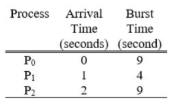
The preemptive shortest job first scheduling algorithm is used. Scheduling is carried out only at arrival or completion of process. The average waiting time for the three process is ______.
- A.
7 seconds
- B.
4.8 seconds
- C.
6 seconds
- D.
5 seconds
Correct answer: D
Solution
To solve this Preemptive Shortest Job First (SRTF) problem, we track the execution step-by-step using a Gantt chart based on the processes' remaining burst times:
At t = 0: Only P0 arrives (Remaining Burst Time, RBT = 9). It executes.
At t = 1: P1 arrives (RBT = 4). Since P1's burst time (4) is shorter than P0's remaining time (8), P0 is preempted. P1 runs until completion at t = 5 (since no other shorter job arrives at t=2, where P2 arrives with RBT = 9).
At t = 5: Ready processes are P0 (RBT = 8) and P2 (RBT = 9). P0 executes next from t = 5 to t = 13.
At t = 13: Finally, P2 executes from t = 13 to t = 22.
Waiting Time (WT = Turnaround Time - Burst Time):
P0: (13 - 0) - 9 = 4 seconds
P1: (5 - 1) - 4 = 0 seconds
P2: (22 - 2) - 9 = 11 seconds
Average Waiting Time ={4 + 0 + 11}/3 = 15/3 = 5 seconds
Thus, the correct option is D.
- A.
- Q99.COAL-INDIA 2020
According to Boolean law:
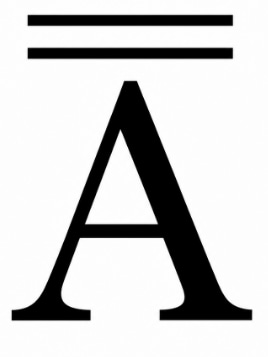
is equivalent to?
- A.
0
- B.
A
- C.
A̅
- D.
1
Correct answer: B
Solution
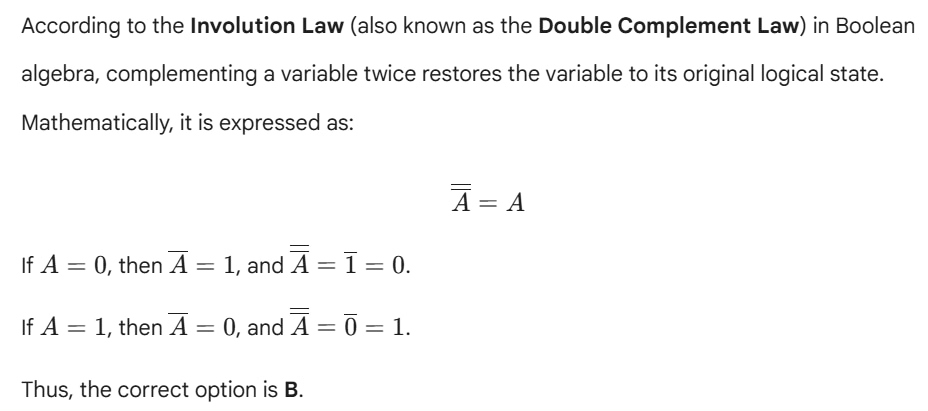
- A.
- Q100.COAL-INDIA 2020
Consider the following recursive function.
int function (int x, int y) {
if (y <= 0) return x;
return function (y, x % y);
}The above recursive function computes ______.
- A.
GCD of x and y
- B.
yˣ
- C.
x × y
- D.
LCM of x and y
Correct answer: A
Solution
The given code implements Euclid's algorithm. It repeatedly calls function(y, x % y) until y <= 0. When the remainder becomes 0, the current x is the greatest common divisor of the two numbers. Therefore, the function computes the GCD, also called HCF.
Correct option: A
- A.
- Q101.COAL-INDIA 2020
The working set model is used in memory management to implement the concept of:
- A.
Principle of locality
- B.
Thrashing
- C.
Paging
- D.
Segmentation
Correct answer: A
Solution
The working set model is explicitly based on the principle of locality. This principle states that as a process executes, it moves from one locality (a set of pages that are actively used together) to another. By tracking and keeping the active pages (the working set) of a process in main memory, the operating system effectively minimizes page faults and prevents thrashing.
Thus, the correct option is A.
- A.
- Q102.COAL-INDIA 2020
Depth First Search graph search algorithm uses ______ data structure for its implementation.
- A.
Stack
- B.
tree
- C.
Dequeue
- D.
Queue
Correct answer: A
Solution
The correct answer is A: Stack. Depth First Search (DFS) explores a graph by going as deep as possible along each branch before backtracking. This Last-In, First-Out (LIFO) behavior is inherently managed using a Stack data structure (either explicitly or implicitly via recursion).
- A.
- Q103.COAL-INDIA 2020
In RSA
p and q are chosen as very large prime numbers
Compute n = p q and ϕ(n) = (p−1) (q−1)
Later e encryption key is chosen. How is this encryption key selected?
- A.
e is chosen as a relative prime to q
- B.
e is chosen as a relative prime to p
- C.
e is chosen as a relative prime to ϕ(n)
- D.
e is chosen as a relative prime to n
Correct answer: C
Solution
The encryption key e is selected such that 1 < e < φ(n) and gcd(e, φ(n)) = 1. This ensures e is coprime to φ(n), allowing a valid decryption key d to exist.
- Q104.COAL-INDIA 2020
Consider the following problem X
“Given a Turing Machine M over the input alphabet Σ any state q of M and word Σ*, does the computation of M on w visit the state q”
Which of the following X is correct?
- A.
X is undecidable but partially decidable
- B.
X is not a decision problem
- C.
X is decidable
- D.
X is undecidable but not even partially decidable
Correct answer: A
Solution
The State-Entry Problem X asks if a Turing Machine M ever visits a specific state q on input w. It is undecidable because solving it would easily solve the Halting Problem (by making the halting state q). However, it is partially decidable (recursively enumerable) because we can simulate M on w; if it ever enters state q, we can halt and answer "yes". Thus, Option A is correct.
- A.
- Q105.COAL-INDIA 2020
The expression for commutative law is given by:
- A.
A + AB = A
- B.
AB + AA′ = A
- C.
A + B = B + A
- D.
A + AB = B
Correct answer: C
Solution
The Commutative Law states that changing the sequence of variables in a logical operation does not affect the final output. In Boolean algebra, this applies to both OR (addition) and AND (multiplication) gates:
OR operation: A + B = B + A
AND operation: A . B = B . A
Thus, the correct expression matching the law is given in Option C.
- A.
- Q106.COAL-INDIA 2020
Consider the following grammar
S → m | mn | mno
Choose correct statement from the following:
- A.
The grammar is LL(4)
- B.
The grammar is LL(3)
- C.
The grammar is LL(2)
- D.
The grammar is LL(1)
Correct answer: B
Solution
To determine if the grammar S → m | mn | mno is LL(k), we find the minimum lookahead k to distinguish productions.
FIRST3(m) = {m}
FIRST3(mn) = {mn}
FIRST3(mno) = {mno}
Since all three lookahead sets of length 3 are completely disjoint, a parser needs exactly 3 symbols of lookahead to make a unique decision. Thus, it is LL(3).
Correct Answer:
The grammar is LL(3)(Option B). - A.
- Q107.COAL-INDIA 2020
Consider the classful addressing, the IP address 128.252.144.84 denotes:
- A.
0.0.0.0 as network ID and 128.252.252.84 as node ID
- B.
128.0.0.0 as network ID and 128.252.127.84 as node ID
- C.
128.252.144.0 as network ID and 128.252.144.84 as node ID
- D.
128.252.0.0 as network ID and 128.252.144.84 as node ID
Correct answer: D
Solution
To solve this, we must identify the Class of the IP address based on its first octet.
1. Identify the Class: The IP address is 128.252.144.84.
Class A: 1 – 126
Class B: 128 – 191
Class C: 192 – 223
Since the first octet is 128, this is a Class B address.
2. Determine Network and Host ID: In Classful addressing, Class B uses a specific format for the 32-bit address:
Network ID: The first 2 octets (16 bits).
Host (Node) ID: The remaining 2 octets (16 bits).
3. Apply to the given IP:
Network ID: 128.252.0.0 (The first two octets are kept, and the rest are set to zero).
Node ID: While the "Node ID" can refer to the host portion (0.0.144.84), in many examination contexts, it is represented by showing the full IP to denote which specific node belongs to that network. Option D follows the standard convention of identifying the Network portion clearly.
- A.
- Q108.COAL-INDIA 2020
Consider the following statement.
I. Packet Filter Firewall analyze network traffic at transport layer.
II. Circuit Level Firewall operate at transport and session layer of OSI Model.From the above statement which statement/s is/are True
- A.
Only I
- B.
Only II
- C.
None
- D.
I and II
Correct answer: B
Solution
Statement I is false because Packet Filter Firewalls primarily operate at the Network Layer (Layer 3), inspecting IP addresses and ports. Statement II is true; Circuit-Level Gateways operate at the Session Layer (Layer 5) to monitor TCP handshakes and session validity.
- A.
- Q109.COAL-INDIA 2020
______ is not a public key cryptosystem.
- A.
El Gamal
- B.
Rabin
- C.
AES
- D.
RSA
Correct answer: C
Solution
The correct option is C. AES (Advanced Encryption Standard) is a symmetric key symmetric cipher that uses the same secret key for both encryption and decryption. In contrast, El Gamal, Rabin, and RSA are all asymmetric (public key) cryptosystems that utilize a mathematically related public-private key pair.
- A.
- Q110.COAL-INDIA 2020
Consider the FA shown in fig below which language is accepted by the FA:
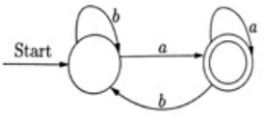
- A.
(b + a + b)*a
- B.
b + (a + b)*b
- C.
b + a*b*
- D.
b + a*b
Correct answer: A
Solution
The correct option is A. Let the initial state be q0 and the final state be q1. To reach the final state q1 and stay there, any sequence of inputs can be processed as long as the last symbol processed is 'a'. Every path ending at q1 must end with an 'a' transition from q0 or a self-loop 'a' on q1. Thus, the language consists of all strings over {a, b} ending with 'a', represented by (b + a + b)*a or simply (a+b)*a.
- A.
- Q111.COAL-INDIA 2020
Generation of intermediate code based on an abstract machine model is useful in compilers because:
- A.
It makes implementation of lexical and syntax analysis easier
- B.
It is difficult to generate executable code from high level language program.
- C.
Syntax translations are easier for intermediate code generation
- D.
It enhances the portability of the compiler system program
Correct answer: D
Solution
Intermediate Code Generation (ICG) acts as a machine-independent bridge between the front-end (source language) and back-end (target architecture) of a compiler. By targeting a standard abstract machine model, the front-end remains unchanged when porting the compiler to a new architecture. Only a new back-end needs to be written, significantly increasing compiler portability.
Correct Answer:
It enhances the portability of the compiler system program(Option D). - A.
- Q112.COAL-INDIA 2020
The maximum height of a binary tree with ‘n’ nodes is ______.
- A.
(n + n)
- B.
(n + 1)
- C.
n
- D.
(n − 1)
Correct answer: D
Solution
The correct answer depends on the height definition used. If height is the number of edges on the longest path, the maximum height of a skewed binary tree with n nodes is (n - 1). If height is measured by nodes (levels), it is n. Based on Option D being marked correct, this platform defines height by edges, making Option D the intended correct choice, despite the conflicting feedback text in Option C.
- A.
- Q113.COAL-INDIA 2020
In hashing, collision resolution is carried out by close addressing. Which of the following is close addressing technique -
I. Buckets (for contiguous storage)
II. Chains (for linked storage)- A.
Only I
- B.
Only II
- C.
I and II
- D.
None
Correct answer: B
Solution
Hash-table collision resolution splits into two families based on WHERE a colliding key ends up being stored. Open addressing (also called closed hashing) keeps every colliding key inside the hash table's own array, relocating it to another slot within that same array via a probe sequence (linear probing, quadratic probing, double hashing) — no extra memory is created. Close addressing (also called closed addressing, or chaining / open hashing) instead creates a separate auxiliary structure for each slot specifically to hold colliding keys — most commonly a linked list — so a colliding key is stored outside the table's own array, in memory allocated only when a collision happens.
Applying that test to the two named techniques: the technique described as contiguous storage places a colliding key into another position within the hash table's own array — no separate collision-handling memory is created for it, matching the open-addressing pattern. The technique described as linked storage creates a new node in a structure attached to the slot specifically to hold the colliding key, outside the table's own array — matching the close-addressing pattern exactly.
This lines up with how the two terms are traditionally split: close addressing (also called closed addressing) names the array-external, per-slot chaining approach, while open addressing (occasionally also called closed hashing — a separate point of terminology overlap) names the in-place, same-array approach. A technique that keeps every key inside the table's own array — however that array is organised — sits in the open-addressing family rather than close addressing.
So the linked-storage technique (Chains) is the close-addressing technique among the two listed here; the contiguous-storage technique (Buckets) belongs to the open-addressing family instead.
- A.
- Q114.COAL-INDIA 2020
The main memory of a computer has 2cm blocks while the cache has 2c blocks. If the cache uses the set-associative mapping scheme with two blocks per set, then block k of the main memory maps to the set:
- A.
(k mod m) of the cache
- B.
(k mod c) of the cache
- C.
(k mod 2c) of the cache
- D.
(k mod 2cm) of the cache
Correct answer: B
Solution
In set-associative mapping, a cache is partitioned into equal-size sets and each main-memory block is assigned to exactly one set. The governing rule is: set index = (block number) mod (number of cache sets). The modulus is the number of sets, not the number of cache blocks.
Applying the rule to this item:
Notation check: 2c and 2cm in the source are ordinary products, 2 × c and 2 × c × m; they are not powers of 2.
Cache size: the cache contains 2c blocks.
Associativity: two blocks are stored in each set.
Number of sets: S = (2c cache blocks) / (2 blocks per set) = c.
Mapping: block k is assigned to set k mod c.
Therefore, block k of main memory maps to set (k mod c) of the cache.
Contrast with the other values:
(k mod m) uses the main-memory multiplier m rather than the cache-set count.
(k mod 2c) uses the total number of cache blocks before grouping them two per set.
(k mod 2cm) uses the total number of main-memory blocks rather than the cache-set count.
Cross-check: 2cm main-memory blocks distributed across c sets give 2cm / c = 2m candidate blocks per set, which is consistent with c cache sets.
- A.
- Q115.COAL-INDIA 2020
Consider the following two statements.
A binary tree T is full if each node is either a leaf or possesses exactly two child nodes.
A binary tree T with n levels is complete if all levels except possibly the last are completely full, and the last level has all its nodes to the left side.
Which statements is/are TRUE
- A.
Only 2
- B.
Only 1
- C.
1 and 2
- D.
Neither 1 nor 2
Correct answer: C
Solution
Both statements are correct. A Full Binary Tree strictly restricts internal nodes to exactly two children (0 or 2 children total per node). A Complete Binary Tree ensures all levels are packed full sequentially from top-to-bottom, and the final level fills strictly from left-to-right without gaps.
- Q116.COAL-INDIA 2020
Consider the Unix i-node which uses 12 direct DBAs, 1 single indirect, 1 double indirect, 1 triple indirect. The disk block address requires 32 bits and disk block size is 1 KB. What is the maximum file size?
- A.
32 GB
- B.
64 GB
- C.
16 GB
- D.
8 GB
Correct answer: C
Solution
Disk Block Size (DBS): 1 KB = 210 bytes
Disk Block Address (DBA) size: 32 bits = 4 bytes
Number of entries per index block (N): DBS / DBA size = 1 KB / 4 bytes = 1024/4 = 256 = 28
Maximum File Size Formula:
Max File Size =(Direct DBAs + 1 x N + 1 x N2 + 1 x N3 x DBS)
The highest-order term (N3) dominant value determines the maximum approximate size:
Max File Size = N3 x DBS = (28)3 x 1 KB} = 224 x 210 bytes = 234 bytes = 16 GB
Thus, the exact maximum size is just slightly over 16 GB. The correct option is C.
- A.
- Q117.COAL-INDIA 2020
A trigger has three parts.
The ______ describes the change that activates the trigger.
The ______ is a query that is run whenever the trigger is activated.
The ______ is the procedure that is executed if the trigger is activated and the condition is true.- A.
event, condition, actor
- B.
entity, condition, action
- C.
event, question, action
- D.
event, condition, action
Correct answer: D
Solution
A trigger follows the Event-Condition-Action framework:
Event: The change (like INSERT or UPDATE) that triggers the process.
Condition: A test or query to check if the action should proceed.
Action: The actual procedure executed. The correct option is D.
- A.
- Q118.COAL-INDIA 2020
Which layer is associated with log in and log out from the network?
- A.
Presentation
- B.
Transport
- C.
Data Link
- D.
Session
Correct answer: D
Solution
The Session Layer (Layer 5) establishes, manages, maintains, and terminates connections (sessions) between local and remote applications. This directly includes authentication and authorization steps like logging in and logging out.
- A.
- Q119.COAL-INDIA 2020
Digital Certificates are described using ______ format.
- A.
X.509
- B.
X.510
- C.
X.508
- D.
X.409
Correct answer: A
Solution
The correct option is A. X.509 is a standard ITU-T format used to define the structure of digital certificates. It binds a public key to an identity using a digital signature from a trusted Certificate Authority (CA) and is widely used in TLS/SSL security protocols.
- A.
- Q120.COAL-INDIA 2020
______ Command is used to enable, disable, modify, or drop a constraint in SQL.
- A.
MODIFY Table
- B.
DEFINE Table
- C.
ADD Column
- D.
ALTER Table
Correct answer: D
Solution
The ALTER TABLE command is used to change the structure of an existing table. It allows you to add, delete, or modify columns and constraints (like UNIQUE, CHECK, or FOREIGN KEY) without recreating the entire table. The correct option is D.
- A.
- Q121.COAL-INDIA 2020
Which is equivalent CFG without useless symbols for the given grammar:
S → PQ | p , P → p
- A.
S → PQ
- B.
S → p
- C.
S → P , P → p
- D.
S → P | p , P → p
Correct answer: B
Solution
A symbol is useful if it is both generating and reachable.
Generating Symbols:
SandPderive terminals (S → p, P → p).Qhas no production rule, so it is non-generating.Elimination: Since
Qis useless, the production S → PQ is eliminated.
This leaves S → p and P → p. Now,
Pcannot be reached from the start symbolS, makingPunreachable. RemovingPleaves only S→ p.Correct Answer: S → p (Option B).
- A.
- Q122.COAL-INDIA 2020
Which of the following derivation does a top-down parser use while parsing a input string? The input is assumed to be scanned in left to right order.
- A.
Topmost derivation
- B.
Leftmost derivation traced out in reverse
- C.
Leftmost derivation
- D.
Rightmost derivation
Correct answer: C
Solution
The correct option is C (Leftmost derivation).
A top-down parser constructs the parse tree from the root (start symbol) down to the leaves (input tokens). When scanning the input string from left to right, it always expands the leftmost non-terminal symbol first at each step. This process corresponds exactly to finding a Leftmost Derivation (LMD) for the input string.
- A.
- Q123.COAL-INDIA 2020
Polynomial addition is implemented using ______ data structure.
- A.
Trees
- B.
Stack
- C.
Linked list
- D.
Queue
Correct answer: C
Solution
A Linked List is the most efficient data structure for polynomial addition. Each node represents a term containing a coefficient, an exponent, and a pointer to the next term. It dynamically handles any number of non-zero terms sorted by exponent order without wasting contiguous memory space. The correct option is C.
- A.
- Q124.COAL-INDIA 2020
A ______ of a relation is a set of one or more attributes whose values are guaranteed to identify tuples in the relation uniquely.
- A.
foreign key
- B.
super key
- C.
key
- D.
scheme
Correct answer: B
Solution
A super key is any set of one or more attributes whose values uniquely identify each tuple in a relation. A candidate key is only a minimal super key, and a primary key is a chosen candidate key. Since the question does not require minimality, the correct term is super key. Therefore, Option B is correct.
- A.
- Q125.COAL-INDIA 2020
For implementation of recursion system uses ______ data structure.
- A.
Linked List
- B.
Deque
- C.
Stack
- D.
Queue
Correct answer: C
Solution
When a function calls itself recursively, the system needs to remember the execution state of the previous call. It uses a Stack data structure (called the system call stack) operating on a LIFO (Last-In, First-Out) basis to push active activation records and pop them when returning.
- A.
- Q126.COAL-INDIA 2020
Which of the following statement is true?
- A.
The parsers canonical LR and LALR have the same power
- B.
LALR parser is more important than canonical LR parser
- C.
SLR parser is more powerful than LALR parser
- D.
Canonical LR parser is more powerful than LALR parser
Correct answer: D
Solution
The capability of LR parsers to handle languages follows a strict hierarchy. A Canonical LR (CLR) parser is the most powerful bottom-up parser because it maintains distinct lookaheads for every state. LALR reduces the states by merging those with identical core items, which can introduce reduce-reduce conflicts, making CLR strictly more powerful than LALR.
Correct Answer:
Canonical LR parser is more powerful than LALR parser(Option D). - A.
- Q127.COAL-INDIA 2020
Page fault occurs when ______.
- A.
The page is in main memory
- B.
The page has an address, which cannot be loaded
- C.
The page is not in main memory
- D.
The page is not in cache memory
Correct answer: C
Solution
A page fault is a hardware interrupt triggered when a running program references a virtual memory page that is not currently loaded into the physical main memory (RAM). The operating system must then fetch the required page from secondary storage (hard disk/SSD).
Thus, a page fault occurs when the page is not in main memory. Correct option is C.
- A.
- Q128.COAL-INDIA 2020
Queue structure is used in ______.
- A.
Polynomial addition
- B.
Recursion
- C.
Depth First Search algorithm
- D.
Breadth First Search algorithm
Correct answer: D
Solution
A Queue follows the FIFO (First-In, First-Out) principle. Breadth First Search (BFS) explores a graph level-by-level, requiring nodes of the current level to be processed completely before moving to the next. A queue is uniquely suited to keep track of these nodes in the exact order they are discovered.
- A.
- Q129.COAL-INDIA 2020
In RSA algorithm if p = 7, q = 11 and e = 13 then what will be the value of d?
- A.
23
- B.
13
- C.
37
- D.
40
Correct answer: C
Solution
- A.
- Q130.COAL-INDIA 2020
Consider the following statements:
Arithmetic Logic Unit (ALU)
Performs arithmetic operations
Performs comparisons
Communicates with I/O devices
Keeps watch on the system
Which of these statements are correct?
- A.
1 only
- B.
1 and 2 only
- C.
1 and 4
- D.
2 and 3
Correct answer: B
Solution
An Arithmetic Logic Unit (ALU) is a fundamental component of the CPU that handles calculations and logical decision-making.
Statement 1 is correct: The ALU performs arithmetic operations such as addition (+), subtraction (-), multiplication (X), and division (/).
Statement 2 is correct: It performs logical comparisons like "greater than" (>), "less than" (<), and "equal to" (=).
Statement 3 is incorrect: Communicating with I/O devices is the responsibility of the Control Unit (CU) and the Bus system, not the ALU.
Statement 4 is incorrect: Monitoring or managing the system is handled by the Control Unit and the Operating System.
- Q131.COAL-INDIA 2020
The term cycle stealing is used in context of:
- A.
Interrupt based data transfer
- B.
Polling Mode Data Transfer
- C.
DMA based data Transfer
- D.
Clock cycle overriding
Correct answer: C
Solution
Cycle Stealing is a method used in Direct Memory Access (DMA) data transfer. In this mode, the DMA controller "steals" or borrows a bus cycle from the CPU to transfer a single word of data.
Since the CPU and DMA controller share the same system bus, the DMA controller requests the CPU to pause its bus activity for one clock cycle.
The CPU suspends its operation for that specific cycle, allowing the DMA to transfer data directly between the I/O device and memory.
This is highly efficient because the CPU doesn't stop entirely; it just slows down slightly while data is transferred in the background.
- A.
- Q132.COAL-INDIA 2020
For following logic diagram which expression is true?
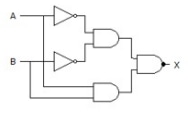
Solution
- Q133.COAL-INDIA 2020
Excess-3 code of decimal number 2 is:
- A.
0101
- B.
1010
- C.
1100
- D.
0011
Correct answer: A
Solution
To find the Excess-3 code of a decimal number, add 3 to the given decimal number and then convert the resulting sum into its 4-bit binary equivalent:
Add 3 to the decimal digit:
2 + 3 = 5
Convert the sum (5) to 4-bit binary:
(5)10 = 01012
Thus, the Excess-3 code for decimal 2 is 0101. The correct option is A.
- A.
- Q134.COAL-INDIA 2020
Consider a system with page fault service time (S) = 100 ns, main memory access time (M) = 20 ns, and page fault rate (P) = 65%. Calculate the effective memory access time.
- A.
62 ns
- B.
82 ns
- C.
80 ns
- D.
72 ns
Correct answer: D
Solution
Concept
Under demand paging, a memory reference either finds its page already resident in main memory or it misses and must wait for the page to be brought in from secondary storage. The page-fault rate P is the probability of a miss. The Effective Memory Access Time (EMAT) is the probability-weighted average of the fast in-memory access and the slow fault-handling path:
EMAT = (1 - P) x M + P x S
Here M is the time for a normal main-memory access and S is the full page-fault service time (the complete cost of fetching the page and restarting the reference). The weights (1 - P) and P sum to 1, so EMAT always lies between M and S, moving toward S as the fault rate rises.
Application
Identify the given values: page-fault rate P = 0.65, main-memory access M = 20 ns, page-fault service time S = 100 ns.
Compute the no-fault contribution: (1 - P) x M = (1 - 0.65) x 20 = 0.35 x 20 = 7 ns.
Compute the fault contribution: P x S = 0.65 x 100 = 65 ns.
Add the two weighted terms: EMAT = 7 + 65 = 72 ns.
Cross-check
Sanity bound: EMAT must fall between M = 20 ns and S = 100 ns, and 72 ns does. Because the fault rate is high (0.65), the result should sit well above the midpoint of M and S and lean toward S, which 72 ns does, confirming the weighting is applied in the right direction.
- A.
- Q135.COAL-INDIA 2020
Solve the following recurrence relation:
T(n) = 4T(n/2) + n²
- A.
θ(n³)
- B.
θ(n² log n)
- C.
θ(n²/2)
- D.
θ(n²)
Correct answer: B
Solution
- A.
- Q136.COAL-INDIA 2020
In ______ balance factor of a node is the difference between left subtree and right subtree.
- A.
Red Black Tree
- B.
B+ Tree
- C.
AVL tree
- D.
2-3 Tree
Correct answer: C
Solution
The balance factor of a node is the difference between left subtree and right subtree.
- A.
- Q137.COAL-INDIA 2020
The language generated by following grammar is:
S → aSa | bSb | ε
- A.
Even length palindrome
- B.
aⁿbⁿ n > 0, m ≥ 0
- C.
Odd length palindrome
- D.
aⁿbᵐ n > 1, m ≥ 1
Correct answer: A
Solution
- A.
- Q138.COAL-INDIA 2020
The language {aᵐbⁿcᵐ⁺ⁿ | m, n ≥ 1} is:
- A.
regular
- B.
type 0 but not context sensitive
- C.
context free but not regular
- D.
context sensitive but not context free
Correct answer: C
Solution
- A.
- Q139.COAL-INDIA 2020
Which of the following affects the processing power of CPU?
I. Data bus width
II. Clock speed
III. Address Bus width- A.
I and III
- B.
I, II and III
- C.
Only I
- D.
Only II
Correct answer: B
Solution
The processing power of a CPU is not just about how fast it "thinks," but also how much data it can handle at once and how much memory it can access.
Data Bus Width: This determines how many bits of data the CPU can move in a single cycle. A 64-bit data bus can move twice as much data as a 32-bit bus, directly increasing throughput.
Clock Speed: This is the frequency at which a processor executes instructions. A higher clock speed (measured in GHz) means the CPU can perform more operations per second.
Address Bus Width: This determines the maximum amount of RAM the CPU can address (use). If the address bus is too narrow, the CPU is limited in the amount of memory it can utilize, which can create a bottleneck for data-heavy processing tasks.
- A.
- Q140.COAL-INDIA 2020
In a D flip flop the out-put state Q is related with D input in what way?
- A.
Q is dependent of D
- B.
Q is same as D
- C.
Q is independent of D
- D.
Q is complement of D
Correct answer: B
Solution
A D flip-flop (Data or Delay flip-flop) transfers its input directly to the output after a clock trigger. The characteristic equation is Qnext = D. This means whatever logic level is present at the D input will appear exactly at the output state Q on the next active clock edge.
Thus, the correct option is B.
- A.
- Q141.COAL-INDIA 2020
______ includes a query language and commands to insert tuples into, delete tuples from, and modify tuples in the database.
- A.
Query Language
- B.
Data-manipulation language
- C.
Data-definition language
- D.
Data-calculation language
Correct answer: B
Solution
Data-manipulation language (DML) provides the functional capability to query data and perform modifications like inserting, deleting, or updating records (tuples) within the table structure. Unlike DDL, which defines the schema, DML interacts directly with the data itself. The correct option is B.
- A.
- Q142.COAL-INDIA 2020
Which grammar rules violate the requirement of the operator grammar? A, B, C are variables and a, b, c are terminals.
i. A → BC
ii. A → CcBb
iii. A → BaC
iv. A → ε- A.
i only
- B.
i and ii
- C.
i and iii
- D.
i and iv
Correct answer: D
Solution
An Operator Grammar must satisfy two strict conditions:
No production can have an ε (null) on the right-hand side.
No two non-terminals (variables) can appear adjacently on the right-hand side.
Rule i (A → BC): Violates condition 2 because B and C are adjacent variables.
Rule ii (A → CcBb): Valid. Variables are separated by terminal c.
Rule iii (A → BaC): Valid. Variables are separated by terminal a.
Rule iv (A → ε): Violates condition 1 due to the null production.
Thus, i and iv violate the requirements.
Correct Answer:
i and iv(Option D). - A.
- Q143.COAL-INDIA 2020
Principle of locality is used in ______.
- A.
Registers
- B.
DMA
- C.
Cache Memory
- D.
Interrupt
Correct answer: C
Solution
The Principle of Locality (or Locality of Reference) is the tendency of a processor to access the same set of memory locations repetitively over a short period of time. This principle is the fundamental reason why Cache Memory works effectively.
There are two main types:
Temporal Locality: If a memory location is accessed once, it is likely to be accessed again soon (e.g., loops).
Spatial Locality: If a memory location is accessed, nearby memory locations are likely to be accessed soon (e.g., arrays).
- A.
- Q144.COAL-INDIA 2020
In ______ authentication, the claimant proves that she knows the secret without sending it to the verifier.
- A.
asymmetric
- B.
zero knowledge
- C.
symmetric
- D.
challenge response
Correct answer: D
Solution
The correct option is D. In challenge-response authentication, the verifier sends a challenge (like a random nonce). The claimant processes it using their secret key and returns the response. This proves possession of the secret without ever sending the secret itself over the network.
- A.
- Q145.COAL-INDIA 2020
The following is the insertion sequence for a Binary Search Tree (BST):
45, 65, 35, 40, 33, 70, 60, 75, 69
How many nodes are present in the Left Sub Tree (LST) and Right Sub Tree (RST) of the root node?
- A.
LST – 6, RST – 2
- B.
LST – 5, RST – 3
- C.
LST – 3, RST – 5
- D.
LST – 2, RST – 6
Correct answer: C
Solution
In a Binary Search Tree, the first inserted element becomes the root. Here the root is 45.
LST (elements < 45): 35, 40, 33 -> 3 nodes
RST (elements > 45): 65, 70, 60, 75, 69 -> 5 nodesThus, LST = 3 and RST = 5. The correct option is C.
- A.
- Q146.COAL-INDIA 2020
Find the output of the following
#include<stdio.h>
int main()
{
int x = 5, y = 9;
x = (x = x + y) - (y = x - y);
printf("%d %d", x, y);
return 0;
}- A.
5 14
- B.
5 9
- C.
14 5
- D.
9 5
Correct answer: D
Solution
The core of this problem lies in the expression:
x = (x = x + y) - (y = x - y);. This is an example of an expression that technically results in undefined behavior in standard C because it modifies the same variable multiple times without a sequence point. However, most modern compilers (and competitive exam environments) evaluate it using a specific mathematical sequence.Initial Values:
x = 5,y = 9.Evaluating the Parentheses:
First sub-expression
(x = x + y):xbecomes 5 + 9 = 14. The value of this sub-expression is 14.Second sub-expression
(y = x - y): Now,xis 14. So,ybecomes 14 - 9 = 5. The value of this sub-expression is 5.
Final Assignment for x:
x = (14) - (5) = 9.
Final Result:
x = 9,y = 5.
- A.
- Q147.COAL-INDIA 2020
Solve the following recurrence relation
T(n) = 4T(n/2) + n
- A.
O(n²)
- B.
O(n /2)
- C.
O(n)
- D.
O(log n
Correct answer: A
Solution
- A.
- Q148.COAL-INDIA 2020
A ______ is the candidate key selected as the main unique identifier for each row in a table. It must contain unique values and cannot contain NULL values.
- A.
foreign key
- B.
natural key
- C.
candidate key
- D.
primary key
Correct answer: D
Solution
A candidate key is any minimal attribute or set of attributes that can uniquely identify a row.
A primary key is the candidate key selected as the main unique identifier for the table. It must be unique and cannot contain NULL values.
Since the question asks for the selected main unique identifier, the correct answer is primary key.
Correct option: D
- A.
- Q149.COAL-INDIA 2020
Write true (T) / false (F) for each of the following statements:
A. Symbol table is used only in first phase of a compiler.
B. A pretty printer analyses a program and prints it in such a way that the structure of the program becomes clearly visible.
C. YACC build up LALR parsing table.
D. If a grammar is LALR(1), it is not necessarily SLR(1).- A.
TTFT
- B.
FTTT
- C.
TTTF
- D.
FTTF
Correct answer: B
Solution
The correct option is B (FTTT). Statement A is false because the symbol table is accessed by all phases of a compiler. Statements B, C, and D are true: pretty printers format code structurally, YACC generates LALR(1) parsing tables, and the LALR(1) class of grammars is strictly larger than SLR(1).
- A.
- Q150.COAL-INDIA 2020
The following grammar is:
S → Aa | bAc | Bc | bBa
A → d
B → d- A.
Not LR(1) but LALR(1)
- B.
Neither LR(1) nor LALR(1)
- C.
LR(1) and LALR(1)
- D.
LR(1) but not LALR(1)
Correct answer: D
Solution
- A.
- Q151.COAL-INDIA 2020
Let L be the set of all binary strings whose last two symbols are the same. The number of states in the minimum state deterministic finite state automaton accepting language is ______.
- A.
2
- B.
5
- C.
8
- D.
3
Correct answer: B
Solution
The language requires strings to have a length >= 2 ending in 00 or 11. The minimal DFA needs 5 states:
Initial state (empty string)
Read a 0 (ends in 0)
Read a 1 (ends in 1)
Read 00 (Final state for 00)
Read 11 (Final state for 11)
- A.
- Q152.COAL-INDIA 2020
______ is First in Last Out kind of data structure.
- A.
Stack
- B.
Queue
- C.
Array
- D.
Deque
Correct answer: A
Solution
A Stack follows the LIFO (Last In First Out) or FILO (First In Last Out) principle. The element inserted first is placed at the bottom, so it can only be removed after all subsequent elements above it are popped out. Thus, Option A is correct.
- A.
- Q153.COAL-INDIA 2020
What is mean by stable sorting algorithm?
- A.
A sorting algorithm is stable if it preserves the order of all keys
- B.
A sorting algorithm is stable if it preserves the order of non-duplicate keys
- C.
A sorting algorithm is stable if it preserves the order of duplicate keys
- D.
A sorting algorithm is stable if it doesn’t preserve the order of duplicate keys
Correct answer: C
Solution
A sorting algorithm is defined as stable if it preserves the relative order of records with equal keys (identical values) as they appeared in the original input. If two items have identical keys, their initial positional sequence remains completely unchanged after the sorting process finishes.
- A.
- Q154.COAL-INDIA 2020
Consider the following Inorder and Preorder traversal of a tree
Inorder – D B E F A G H C
Preorder – A B D E F C G HWhat is the Postorder Traversal of the same tree?
- A.
D F E B H C G A
- B.
D F E B H G C A
- C.
D F E H B G C A
- D.
D E F B H G C A
Correct answer: B
Solution
Solution:
Given,
Inorder: D B E F A G H C
Preorder: A B D E F C G H
From the preorder traversal, the first node is the root.
Root = A
Splitting the inorder traversal about A:
Left subtree: D B E F
Right subtree: G H C
Left Subtree
Preorder: B D E F
Root = B
Inorder left of B = D
Inorder right of B = E F
Thus:
Left child of B = D
Right child of B = E
Right child of E = F
Right Subtree
Preorder: C G H
Root = C
Inorder left of C = G H
Thus:
Left child of C = G
Right child of G = H
The tree is:
        A
      /   \
     B     C
    / \   /
   D   E G
        \  \
         F  H
Now perform Postorder Traversal (Left → Right → Root):
Left subtree of A: D F E B
Right subtree of A: H G C
Root: A
Therefore, the Postorder Traversal is:
D F E B H G C A
Answer: D F E B H G C A
- A.
- Q155.COAL-INDIA 2020
In SQL – the function - avg, min, max, sum, count are called as ______.
- A.
aggregate function
- B.
adjunct function
- C.
scalar operation
- D.
set operation
Correct answer: A
Solution
The correct option is A. In SQL, functions like avg, min, max, sum, and count are called aggregate functions. They process a collection of multiple values across rows within a column and collapse them to return a single, summarized mathematical value.
- A.
- Q156.COAL-INDIA 2020
What is the output/behavior of the following C program?
#include<stdio.h>
int main()
{
int i = 5;
printf("%d %d %d", i++, i, ++i);
return 0;
}- A.
7 6 6
- B.
6 7 8
- C.
Undefined behavior
- D.
5 6 7
Correct answer: C
Solution
Concept: In C, a sequence point marks a place where all side effects of prior evaluations are guaranteed complete before evaluation continues. Between two sequence points, modifying the same scalar object more than once, or modifying it while also reading its value for something other than computing the new stored value, is undefined behavior. The C standard also leaves the order in which a function call’s arguments are evaluated unspecified — a compiler may evaluate them left-to-right, right-to-left, or in any other order, and may schedule the associated side effects at different points.
The call is printf("%d %d %d", i++, i, ++i); with i initialized to 5.
All three arguments — i++, i, and ++i — are evaluated as part of setting up the same function call; the only sequence point here occurs right before the actual call, after every argument has been evaluated.
i++ modifies i (post-increment), ++i also modifies i (pre-increment), and the middle argument reads i directly — that is two modifications and one plain read of the same object across the three argument evaluations, with no sequence point separating them from each other.
Because no sequence point separates these evaluations, the compiler is free to choose any order among the three arguments and to apply the two increments at any point relative to the plain read — the standard places no obligation on what value the plain i sees or in which order the increments occur.
Cross-check: Different compilers, and even the same compiler under different optimization settings, are free to print different values for this exact program without violating the standard, because the standard simply does not define an outcome here. Assuming one specific evaluation order — say, strict left-to-right with each side effect applied immediately — only reproduces ONE of the many results a conforming compiler could legally produce; it does not establish what "the" output is.
Therefore, the only defensible classification for this program is undefined behavior — not any specific triplet of printed numbers.
- A.
- Q157.COAL-INDIA 2020
What is number of page faults by least recently used page replacement for a memory with 4 frames for the page reference string
2, 0, 1, 2, 4, 0, 5, 1, 4, 6, 4, 2, 1, 3, 0 ?- A.
7
- B.
8
- C.
9
- D.
10
Correct answer: D
Solution
Concept
LRU (Least Recently Used) replacement: on a page reference, if the page is already resident it is a hit; otherwise it is a page fault. When all frames are full and a fault occurs, the page that was used farthest back in time (the least recently used) is evicted to make room. The key discipline is to track the recency of each resident page, because that alone decides who is evicted — and an eviction can force a later re-reference of that same page to fault again.
Application — trace with 4 frames
Reference string =
2, 0, 1, 2, 4, 0, 5, 1, 4, 6, 4, 2, 1, 3, 0(frames = 4). The bracket shows the resident set after each access.2: [2] → Fault (1)
0: [2, 0] → Fault (2)
1: [2, 0, 1] → Fault (3)
2: [2, 0, 1] → Hit
4: [2, 0, 1, 4] → Fault (4)
0: [2, 0, 1, 4] → Hit
5: [2, 0, 4, 5] — evict 1 (least recently used) → Fault (5)
1: [0, 4, 5, 1] — evict 2 (least recently used) → Fault (6)
4: [0, 4, 5, 1] → Hit
6: [4, 5, 1, 6] — evict 0 → Fault (7)
4: [4, 5, 1, 6] → Hit
2: [4, 1, 6, 2] — evict 5 → Fault (8)
1: [4, 1, 6, 2] → Hit
3: [4, 1, 2, 3] — evict 6 → Fault (9)
0: [1, 2, 3, 0] — evict 4 → Fault (10)
Why the count is 10, not 9: at the access to 5, the four resident pages are {2, 0, 1, 4} and their last-use times make 1 the least recently used, so 1 is evicted. The very next access is to 1, which is therefore no longer resident — it faults. Evicting any other page here (for example 2, which was used more recently) would be an LRU violation and is the usual source of the undercount.
Cross-check
Counting the fault markers above: faults occur at references 2, 0, 1, 4, 5, 1, 6, 2, 3, 0 — ten of the fifteen accesses miss, leaving five hits (at 2, 0, 4, 4, 1). Total page faults = 10.
- A.
- Q158.COAL-INDIA 2020
Relations and fields can be renamed in relational algebra using the renaming operator ______.
- A.
ρ
- B.
σ
- C.
θ
- D.
⋈
Correct answer: A
Solution
The Rename operator is denoted by the Greek letter rho (ρ). It is used to rename either the relation (table) itself or the attributes (fields) within a relation. This is particularly useful in self-joins or to avoid ambiguity. The correct option is A.
- A.
- Q159.COAL-INDIA 2020
For a balanced binary search tree with
nelements, the time required to search a given element is:- A.
O(log n)
- B.
O(n log n)
- C.
O(n² log n)
- D.
O(n²)
Correct answer: A
Solution
Key idea: search time in a BST is proportional to the tree height,
h.Balanced/average case: the height is
O(log n), so search time isO(log n).Skewed worst case: the height can become
O(n), so search can degrade to linear time. That is why the balanced-case qualifier is important.
Answer:
O(log n) - A.
- Q160.COAL-INDIA 2020
Database management system ACID property refers to:
- A.
Authenticity, Consistency, Isolation, and Durability
- B.
Atomicity, Confidentiality, Isolation, and Durability
- C.
Atomicity, Consistency, Isolation, and Durability
- D.
Atomicity, Consistency, Integrity, and Durability
Correct answer: C
Solution
ACID properties ensure reliable database transactions. They stand for:
Atomicity: All or nothing.
Consistency: Database remains in a valid state.
Isolation: Concurrent transactions don't interfere.
Durability: Changes are permanent after commit. The correct option is C.
- A.
- Q161.COAL-INDIA 2020
Which of the following statement is true?
- A.
Any logic expression can be implemented using only NAND gates
- B.
Any logic expression can be implemented using only EXNOR gates
- C.
Any logic expression can be implemented using only NOT gates
- D.
Any logic expression can be implemented using only XOR gates
Correct answer: A
Solution
The correct option is A. NAND gates (along with NOR gates) are functionally complete, universal logic gates. This means any fundamental boolean operation (AND, OR, NOT) and consequently any complex logic expression can be implemented entirely using only NAND gates.
- A.
- Q162.COAL-INDIA 2020
Mutual Exclusion Problem occurs ________.
- A.
between two processes that uses different resources of different machines
- B.
between two disjoint processes that do not interact
- C.
among processes that share resources
- D.
among processes that do not use the same resource
Correct answer: C
Solution
The mutual exclusion problem arises when multiple concurrent processes access shared, non-shareable resources (like a shared variable, file, or printer) simultaneously. To prevent data inconsistency and race conditions, only one process must be allowed to execute its critical section at any given time.
Thus, the mutual exclusion problem occurs among processes that share resources. Correct option is C.
- A.
- Q163.COAL-INDIA 2020
The time complexity of searching an element in linked list of length n will be:
- A.
O(n log n)
- B.
O(log n)
- C.
O(n)
- D.
O(n²)
Correct answer: C
Solution
To search for an element in a singly or doubly linked list of length n, you must traverse it sequentially starting from the head node. In the worst case (if the element is at the end or not present), you have to check all n nodes. Therefore, the time complexity is O(n). Thus, Option C is correct.
- A.
- Q164.COAL-INDIA 2020
Consider the disk which has average seek time of 32 ns and rotational rate of 360 rpm (round per minute). Each track of the disk has 512 sectors, each of size 512 bytes.
What is the time taken to read four continuous sectors? And What is the data transfer rate?
- A.
0.0443 s and 936 KBps
- B.
0.0843 s and 1536 KBps
- C.
0.1043 s and 1736 KBps
- D.
0.0943 s and 1636 KBps
Correct answer: B
Solution
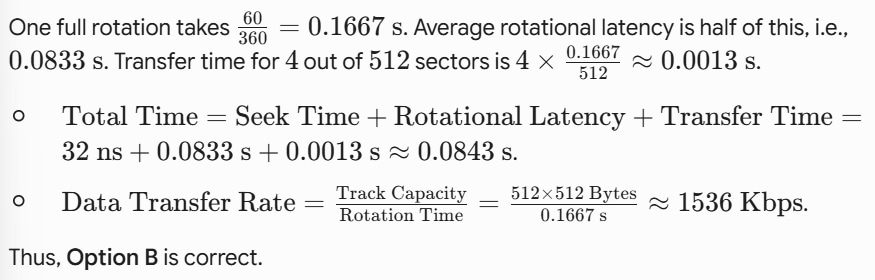
Correct answer: Option B (0.0843 s and 1536 KBps)
Important unit note:
KBps means kilobytes per second. Kbps means kilobits per second. Since each sector size is given in bytes, the computed transfer rate is in KBps. If converted to bits, 1536 KBps = 1536 × 8 = 12288 Kbps.Given:
Average seek time = 32 ns ≈ 0 s
Rotational speed = 360 rpm = 6 rotations/second
Sectors per track = 512
Sector size = 512 bytesTrack size:
512 sectors × 512 bytes = 262144 bytes = 256 KBAverage rotational latency:
One rotation takes 1/6 s.
Average rotational latency = (1/2) × (1/6) = 1/12 = 0.0833 sTransfer time for 4 continuous sectors:
Data to read = 4 × 512 bytes = 2048 bytes = 2 KB
Transfer rate = 6 × 256 KB/s = 1536 KBps
Transfer time = 2/1536 s ≈ 0.00130 sTotal time:
Seek time + average rotational latency + transfer time
≈ 0 + 0.0833 + 0.00130
≈ 0.0846 s, represented by the closest option 0.0843 s.Therefore, the intended answer is 0.0843 s and 1536 KBps.
- A.
- Q165.COAL-INDIA 2020
MSB stands for:
- A.
Middle significant bit
- B.
Measured significant bit
- C.
Maximum significant bit
- D.
Most significant bit
Correct answer: D
Solution
The correct option is D. MSB stands for Most Significant Bit. In a binary number, it is the leftmost bit that carries the highest positional weight (2n-1). It determines the largest value component and often indicates the sign in signed number representations.
- A.
- Q166.COAL-INDIA 2020
Which scheduling algorithm gives a minimum average waiting time?
- A.
RR
- B.
Priority
- C.
SJF
- D.
FCFS
Correct answer: C
Solution
Shortest Job First (SJF) scheduling algorithm is provably optimal because it minimizes the average waiting time for a given set of processes. By scheduling the process with the shortest CPU burst time first, the waiting times of subsequent longer processes are reduced, moving the overall mathematical average to its minimum possible value.
Thus, the correct option is C.
- A.
- Q167.COAL-INDIA 2020
Consider the following statements
1. Insertion Sort and Merge Sort are stable.
2. Heap Sort is inherently unstable.
3. Selection Sort is not inherently stable, but may be coded in such a way that it is stable.- A.
Only statement 1 is correct
- B.
All statements are correct
- C.
Statement 3 is not correct
- D.
Only statement 1 and 2 is correct
Correct answer: B
Solution
Statement 1 is correct: Insertion Sort and Merge Sort preserve the relative order of equal elements, making them inherently stable.
Statement 2 is correct: Heap Sort uses a heap tree structure where non-adjacent elements are swapped, making it inherently unstable.
Statement 3 is correct: Standard Selection Sort is unstable due to long-distance swaps, but it can be made stable by changing the swapping mechanism to an insertion-like shift.
Therefore, all statements are correct. The correct option is B.
- A.
- Q168.COAL-INDIA 2020
Which of the following statement is false?
- A.
Every regular language is also a context free language
- B.
Every non deterministic Turing machine can be converted to an equivalent deterministic Turing machine
- C.
Every subset of recursively enumerable set is recursive
- D.
Every NFA can be converted into equivalent DFA
Correct answer: C
Solution
The correct option is C. Statement C is false because a subset of a recursively enumerable (RE) language is not necessarily recursive, or even RE. Since the set of all languages is uncountable but RE languages are countable, an RE language can have uncountably many subsets, most of which are non-RE.
- A.
- Q169.COAL-INDIA 2020
Tuple Relational Calculus query is expressed as ______.
- A.
{ T | p(T) }
- B.
{ P() | T }
- C.
{ p(T) | T }
- D.
{ T | P() | T }
Correct answer: A
Solution
In Tuple Relational Calculus (TRC), a query is expressed as { T | p(T) }. Here, T represents the tuple variable and p(T) is a formula (predicate) that describes the condition the tuple must satisfy. It non-procedurally describes "what" data is needed. The correct option is A.
- A.
- Q170.COAL-INDIA 2020
Consider the grammar
S → AbBaCc | ε
A → aAb | ba
B → BBC | cb
C → cCa | acFind the First () of S.
- A.
{a, b, ε}
- B.
{ε}
- C.
{a, ε}
- D.
{a, b, c, ε}
Correct answer: A
Solution
Given Grammar:
S → AbBaCc | ε
A → aAb | ba
B → BBC | cb
C → cCa | acFIRST(A) = { a, b }
Since:
S → AbBaCc | εand A does not derive ε,
FIRST(S) = FIRST(A) ∪ { ε }
Therefore,
FIRST(S) = { a, b, ε }
- A.
- Q171.COAL-INDIA 2020
Calculate the link utilization (efficiency) for the stop-and-wait flow control mechanism if the frame size is 4800 bits, bit rate is 9600 bps, and the distance between the devices is 2000 km. Given propagation speed is 200000 km/s.
- A.
0.92
- B.
0.82
- C.
0.96
- D.
0.86
Correct answer: C
Solution
Concept: In stop-and-wait flow control, the sender transmits one frame and then waits idle for its acknowledgement before sending the next. Link utilization (also called efficiency) is the fraction of time the link actually carries data, given by Tt / (Tt + 2Tp), where Tt is the transmission time and Tp is the one-way propagation time. The factor 2Tp accounts for the round trip the frame and its acknowledgement travel. This is a pure dimensionless ratio between 0 and 1 — it is not the throughput in bits per second.
Application: Substitute the given values step by step.
Transmission time Tt = frame size / bit rate = 4800 / 9600 = 0.5 s.
Propagation time Tp = distance / propagation speed = 2000 / 200000 = 0.01 s.
Efficiency = Tt / (Tt + 2Tp) = 0.5 / (0.5 + 2 × 0.01) = 0.5 / 0.52 = 0.9615.
Cross-check: Because the transmission time (0.5 s) is much larger than the round-trip propagation overhead (2 × 0.01 = 0.02 s), the sender stays busy almost the whole time, so the efficiency must be close to 1 — and 0.9615 ≈ 0.96 confirms this. (For reference, the actual data throughput would be 0.96 × 9600 ≈ 9231 bps; the utilization asked here is the ratio 0.96, not this bps value.)
Result: The link utilization is approximately 0.96.
- A.
- Q172.COAL-INDIA 2020
Which is the correct method to obtained 10's compliment of a decimal number?
- A.
The minuend is added to the 10’s complement of the subtrahend and carry is dropped
- B.
The 10’s complement of a decimal number is equal to 9’s complement of given number minus one
- C.
The subtrahend is added to the 10’s complement of the minuend and carry is dropped
- D.
The 10’s complement of a decimal number is equal to 9’s complement of given number plus one
Correct answer: D
Solution
The correct option is D (The 10's complement of a decimal number is equal to 9's complement of given number plus one).
Mathematically, for a base-r number system, the r's complement is calculated by adding 1 to the least significant digit of its (r-1)'s complement. For decimal numbers (base r=10), the 10's complement is obtained by finding the 9's complement first and then adding 1 to it (10's Complement = 9's Complement + 1).
- A.
- Q173.COAL-INDIA 2020
Maximum throughput of slotted ALOHA network is:
- A.
18.4%
- B.
36.8%
- C.
50%
- D.
35.8%
Correct answer: B
Solution
The maximum throughput (S) of Slotted ALOHA is achieved when the load G = 1, given by S = G . e-G. For G = 1, S = 1/e = 0.368 or 36.8%. This is exactly double the efficiency of Pure ALOHA (18.4%).
- A.
- Q174.COAL-INDIA 2020
Which one of the following is true?
- A.
Every regular grammar is LL(1) and every regular set does not have an LR(1) grammar
- B.
Every regular grammar is not LL(1) and every regular set does not have an LR(1) grammar
- C.
Every regular grammar is LL(1) and every regular set has an LR(1) grammar
- D.
Every regular grammar is not LL(1) and every regular set has an LR(1) grammar
Correct answer: D
Solution
The correct option is D. Not every regular grammar is LL(1) because left-recursion or common prefixes can cause conflicts. However, every regular set (language) can be represented by at least one deterministic, conflict-free LR(1) grammar because regular languages are a strict subset of deterministic context-free languages (DCFLs). - A.
- Q175.COAL-INDIA 2020
A computer uses RAM chips of 1024 × 1 capacity.
How many chips are needed to provide memory capacity of 16K bytes?
- A.
8
- B.
1024
- C.
16
- D.
128
Correct answer: D
Solution
Given: Each RAM chip has capacity 1024 × 1, which means 1024 bits = 1K bit.
Required memory: 16K bytes = 16K × 8 bits = 128K bits.
Capacity of one chip: 1K bit.
Number of chips: 128K bits ÷ 1K bit = 128.
Answer: 128 chips
- A.
- Q176.COAL-INDIA 2020
Number of states in DFA accepting the following language
L = { aⁿ b²ᵐ | n, m ≥ 1 }
- A.
m
- B.
n
- C.
5
- D.
2
Correct answer: C
Solution
The language L = {an b2m | n, m >= 1} requires at least one a, followed by an even, non-zero number of b's (minimum string is abb). Constructing the minimal DFA requires: an initial state, a state tracking the first a, a state for the first b, an accepting state for the second b, and a dead state for invalid structures. Total states = 5. Thus, Option C is correct.
- A.
- Q177.COAL-INDIA 2020
Which of the following has lowest access time?
- A.
Main Memory
- B.
Optical disk
- C.
Cache
- D.
Registers
Correct answer: D
Solution
In computer architecture, the access time refers to the time it takes for the CPU to retrieve data from a storage location. The memory hierarchy is designed such that the closer a storage unit is to the CPU's execution unit, the faster (lower access time) it is.
Registers are located directly inside the CPU. They are the smallest and fastest storage elements in a computer system, operating at the same speed as the processor itself.
- A.
- Q178.COAL-INDIA 2020
Which of the following is equivalent of the Boolean expression given below?
A + Ā.B + A.B̅
- A.
A + B
- B.
A + B̅
- C.
B + Ā
- D.
B̅ + Ā
Correct answer: A
Solution
The correct option is A: A + B. Using the redundancy law (A + ĀB = A + B), the first two terms simplify to A + B. Adding the third term gives (A + B) + AB̅. Applying the distributive law, A(1 + B̅) + B = A + B.
- A.
- Q179.COAL-INDIA 2020
Which of the following is / are correct
I. A language is context free if and only if it is accepted by PDA
II. PDA is a finite automata with push down stack- A.
Only II is true
- B.
Both I and II are false
- C.
Both I and II are true
- D.
Only I is true
Correct answer: C
Solution
Correct Answer: C (Both I and II are true)
Statement I is true: By definition, a language is context-free (CFL) if and only if there exists a Pushdown Automaton (PDA) that accepts it, establishing a perfect equivalence.
Statement II is true: Structurally, a PDA is formally defined as a finite automaton enhanced with an external, infinite memory storage known as a pushdown stack.
- A.
- Q180.COAL-INDIA 2020
With respect to deque which of the following is true?
- A.
Insertion is done only from front end
- B.
Insertion and deletion can be done at front and rear ends
- C.
Deletion is done only from rear end
- D.
Insertion is done only from rear end
Correct answer: B
Solution
A Deque (Double-Ended Queue) is a linear data structure that generalizes a queue. It permits the flexibility of inserting and deleting elements from both structural endpoints: the front and the rear. Unlike standard queues (FIFO) or stacks (LIFO), it does not restrict access to a single side. The correct option is B.
- A.
- Q181.COAL-INDIA 2020
A negative edge triggered flip flop transfers data from input to output on the:
- A.
LOW to HIGH transition of clock pulse
- B.
BEFORE transition of clock pulse
- C.
HIGH to LOW transition of clock pulse
- D.
WITHOUT transition of clock pulse
Correct answer: C
Solution
An edge-triggered flip-flop changes states only during specific clock transitions. A negative edge-triggered flip-flop responds when the clock pulse drops from a logic high state (1) to a logic low state (0). This falling edge initiates the data transfer from input to output.
Thus, the correct option is C.
- A.
- Q182.COAL-INDIA 2020
Consider the following relational schema
Sailors(sid, sname, rating, age)
Reserves(sid, bid, day)
Boats(bid, bname, color)What is the equivalent of following relational algebra query in SQL query
πsname((σcolor = 'red'(Boats)) ⋈ Reserves ⋈ Sailors)
- A.
SELECT S.sname, S.rating
FROM Sailors S, Reserves R
WHERE S.sid = R.sid AND R.bid = B.bid AND B.color = 'red'
- B.
SELECT S.sname
FROM Sailors S, Reserves R, Boats B
WHERE S.sid = R.sid AND R.bid = B.bid AND B.color = 'red'
- C.
SELECT S.sname
FROM Sailors S, Reserves R, Boats B
WHERE S.sid = R.sid AND B.color = 'red' - D.
SELECT S.sname
FROM Sailors S, Reserves R, Boats B
WHERE R.bid = B.bid AND B.color = 'red'
Correct answer: B
Solution
The given relational algebra expression selects boats with
color = 'red', performs a natural join (⋈) acrossBoats,Reserves, andSailors, and projects (π) onlysname. In SQL, a natural join is achieved via cross-product in theFROMclause combined with matching primary/foreign key equality predicates (S.sid = R.sid AND R.bid = B.bid) in theWHEREclause alongside the filter condition. - A.
- Q183.COAL-INDIA 2020
What is the complexity of Merge Sort?
- A.
O(n)
- B.
O(n² log n)
- C.
O(n log n)
- D.
O(n²)
Correct answer: C
Solution
Merge Sort follows the Divide and Conquer paradigm. The recurrence relation is T(n) = 2T(n/2) + θ(n). Solving this using Master's Theorem or a recursion tree gives a consistent time complexity of O(n.log n) for best, average, and worst cases. The correct option is C.
- A.
- Q184.COAL-INDIA 2020
______ of graph is a vertex whose removal disconnects graph.
- A.
Start vertex
- B.
Middle point
- C.
Terminal Vertex
- D.
Articulation point / Cut vertex
Correct answer: D
Solution
The correct answer is Option D (Articulation point / Cut vertex). In graph theory, an articulation point (or cut vertex) is any vertex whose removal increases the number of connected components in the graph, thereby disconnecting a previously connected graph.
- A.
- Q185.COAL-INDIA 2020
Canonical SOP form of logic expression consists of only ______.
- A.
Maxterms
- B.
Literals
- C.
Cell
- D.
Minterms
Correct answer: D
Solution
SOP stands for Sum of Products. A Canonical SOP form is a logic expression where every individual product term contains all the variables of the function (either in complemented or uncomplemented form). These individual product terms are called Minterms. Therefore, a canonical SOP expression consists entirely of a sum of minterms.
Thus, the correct option is D.
- A.
- Q186.COAL-INDIA 2020
The following grammar is:
S → Aa | bAc | dc | bda
A → a- A.
Neither LALR(1) nor SLR(1)
- B.
LALR(1) but not SLR(1)
- C.
Not LALR(1) but SLR(1)
- D.
LALR(1) and SLR(1)
Correct answer: D
Solution
CONCEPT: A state in the canonical LR(0) automaton carries a shift-reduce or reduce-reduce conflict only when TWO DIFFERENT items in that SAME state compete for the same lookahead symbol. SLR(1) restricts each reduce action to the lookaheads in FOLLOW of the reduced nonterminal — one GLOBAL, context-blind set covering every place that nonterminal ever appears in the grammar. LALR(1) instead computes, per state, the precise lookaheads a valid derivation can actually deliver there, which is never broader than FOLLOW (FOLLOW is the union across every context, not just the ones reaching this one state) — so wherever SLR(1)'s coarser FOLLOW-based check already avoids a clash in a state, LALR(1)'s narrower, state-specific lookaheads cannot manufacture a new clash there. So if a state in this grammar's LR(0) automaton never holds more than one completed item, and never holds a completed item alongside a shift action on the same symbol, there is only ONE production's item present to begin with — no amount of lookahead splitting can introduce a second, competing item into that state, so both SLR(1) and LALR(1) succeed there.
APPLICATION:
FOLLOW(A): A occurs in S → Aa (followed by 'a') and S → bAc (followed by 'c'), so FOLLOW(A) = {a, c}.
Build the canonical LR(0) item sets. The start state contains S′→•S, S→•Aa, S→•bAc, S→•dc, S→•bda, A→•a.
On symbol 'a' from the start state, the automaton moves to the state {A→a•} — a single completed item with no other item sharing that state.
After prefix 'b', the state {S→b•Ac, S→b•da, A→•a} also transitions on 'a' to that SAME state {A→a•} (identical item set), so the two paths converge on one state instead of colliding inside it.
Every other position that completes a handle — {S→Aa•}, {S→dc•}, {S→bAc•}, {S→bda•} — is likewise reached as a state containing exactly that one completed item, with no shift action or second reduce competing for any symbol in that same state.
So no state in the LR(0) automaton ever holds two competing actions on the same input symbol — the construction has zero shift-reduce or reduce-reduce conflicts even before any lookahead restriction is applied.
CROSS-CHECK: Every reduce-bearing state found above — {A→a•}, {S→Aa•}, {S→dc•}, {S→bAc•}, {S→bda•} — carries exactly one item, so there is never a second, competing item for LALR(1)'s finer per-state lookaheads to clash with. The FOLLOW(A) = {a, c} overlap only matters when it forces two DIFFERENT items into the same state, which never happens here. So the grammar succeeds under SLR(1) (the coarser check), and therefore also under LALR(1), whose lookaheads are never broader than SLR(1)'s.
Result: the grammar is parsable by both SLR(1) and LALR(1).
- A.
- Q187.COAL-INDIA 2020
A relation is in ______ form if every field contains only atomic values, that is, not lists or sets.
- A.
First normal
- B.
Third normal
- C.
Second normal
- D.
Fourth normal
Correct answer: A
Solution
The correct option is A (First normal).
By definition, a relation is in the First Normal Form (1NF) if and only if the domain of each attribute contains only atomic (indivisible) values. It strictly prohibits multi-valued attributes, composite attributes, or non-atomic collections like lists and sets within a single field.
- A.
- Q188.COAL-INDIA 2020
In hashing, collision results when ______.
- A.
an attempt is made to delete a record at full primary bucket
- B.
an attempt is made to insert a record at full primary bucket
- C.
an attempt is made to insert a record anywhere in primary bucket
- D.
an attempt is made to insert a record at empty primary bucket
Correct answer: B
Solution
A collision occurs when two or more distinct keys are mapped to the same hash value or "bucket" by a hash function. If that primary bucket is already full (occupied), the new record cannot be stored there, resulting in a collision. The correct option is B.
- A.
- Q189.COAL-INDIA 2020
In SQL, the ______ command is used to recompile view.
- A.
ALTER VIEW
- B.
DEFINE VIEW
- C.
CREATE VIEW
- D.
COMPILE VIEW
Correct answer: A
Solution
The correct option is A (ALTER VIEW).
In database dialects that support explicit view recompilation (such as Oracle SQL), the
ALTER VIEW view_name COMPILE;statement is used to manually recompile an invalid or outdated view. This occurs when underlying base tables are modified, ensuring dependencies are verified without recreating the view definition. - A.
- Q190.COAL-INDIA 2020
The multiplicand register and multiplier register of a hardware circuit implementing Booth's algorithm hold (11101) and (1100) respectively. The result shall be:
- A.
81210
- B.
-81210
- C.
-1210
- D.
1210
Correct answer: D
Solution
Concept
Booth's algorithm multiplies two signed numbers held in two's-complement form. Each register is interpreted as a signed two's-complement value (a leading 1 marks a negative number), and the algorithm produces the ordinary signed product of those two values. So the first step is always to decode each register into its signed decimal value, then multiply.
Application
Decode the multiplicand register (11101). It has 5 bits and the leading bit is 1, so it is negative. Taking the two's complement: invert 11101 -> 00010, then add 1 -> 00011 = 3. Hence the multiplicand = -3.
Decode the multiplier register (1100). It has 4 bits and the leading bit is 1, so it is negative. Two's complement: invert 1100 -> 0011, then add 1 -> 0100 = 4. Hence the multiplier = -4.
Multiply the decoded signed values: (-3) x (-4). A negative times a negative is positive, with magnitude 3 x 4 = 12.
Therefore the product produced by Booth's algorithm is 1210.
Cross-check
Range sanity check: a 5-bit value lies in [-16, 15] and a 4-bit value in [-8, 7], so any product is bounded by 16 x 8 = 128 in magnitude. A magnitude of 12 sits comfortably inside this range, while values such as 812 are far outside it and cannot be a valid product of these registers - confirming that 1210 is the result.
- A.
- Q191.COAL-INDIA 2020
The ______ defines a set of operations on relations, paralleling the usual algebraic operations such as addition, subtraction or multiplication, which operate on numbers.
- A.
relational calculus
- B.
referential integrity
- C.
relational algebra
- D.
relations
Correct answer: C
Solution
The question describes operations on relations that parallel algebraic operations on numbers, making Option C (relational algebra) the correct concept. However, the platform has incorrectly marked Option A as correct. Relational algebra is a procedural query language containing formal operators like selection, projection, and join to manipulate relations.
- A.
- Q192.COAL-INDIA 2020
The class of Context-free grammar is not closed under ______ operations.
- A.
Concatenation
- B.
Union
- C.
Star
- D.
Intersection
Correct answer: D
Solution
The correct option is D (Intersection). The class of Context-Free Languages (CFLs) generated by Context-Free Grammars is closed under union, concatenation, and Kleene star operations. However, it is not closed under intersection (and complementation).
- A.
- Q193.COAL-INDIA 2020
Which of the following is a unary operation?
- A.
Intersection
- B.
Projection
- C.
Join
- D.
Cartesian Product
Correct answer: B
Solution
A unary operation is an operation that is performed on a single relation. In Relational Algebra, Projection (𝝅) and Selection (σ) are primary unary operations. Intersection, Join, and Cartesian Product are binary operations because they require two relations to operate. The correct option is B.
- A.
- Q194.COAL-INDIA 2020
Which of the following statement is false about Prim’s algorithm?
- A.
Initially the root's key is initialized to 0 and all other nodes to infinity
- B.
It may use binomial max heap to represent the priority queue
- C.
The complexity is O(E log V) using binary heap
- D.
The time complexity is O(E + V log V) using Fibonacci Heap
Correct answer: B
Solution
Concept: Prim's algorithm grows a Minimum Spanning Tree from a start vertex by repeatedly adding the cheapest edge that crosses from the tree to a vertex outside it (the cut property). To pick that cheapest crossing edge fast, every vertex keeps a key = the smallest edge weight connecting it to the current tree, and these keys are stored in a min-priority queue so that extract-min always returns the next vertex to attach.
Initialization: every vertex starts with key = infinity, then the start (root) vertex's key is set to 0 so it is the first one extracted. So the root's key is 0 while all other vertices begin at infinity and are lowered as cheaper edges are discovered.
Application — checking each statement against this method:
"binomial max heap for the priority queue" — Prim's needs the MINIMUM-weight vertex each step, which a min-priority queue (min-heap) provides. A max-heap returns the largest key, so it cannot drive Prim's; this claim does not hold.
"root key initialized to 0" — consistent with the initialization above: the start vertex's key is set to 0 (others are infinity), so this holds.
"O(E log V) using a binary heap" — with a binary heap each of the O(E) decrease-key and O(V) extract-min operations costs O(log V), giving O(E log V); this holds.
"O(E + V log V) using a Fibonacci heap" — a Fibonacci heap does decrease-key in O(1) amortized and extract-min in O(log V) amortized, giving O(E + V log V); this holds.
Cross-check: three statements match standard Prim's behaviour, so the single statement that is false about Prim's algorithm is the one claiming a binomial max heap can represent the priority queue.
- A.
- Q195.COAL-INDIA 2020
Which of following problems are undecidable?
I. Membership problem in context-free languages
II. Whether a given context-free language is regular
III. Whether a finite state automaton halts on all inputs
IV. Membership problem for type 0 languages- A.
III and IV
- B.
I and IV
- C.
I and II
- D.
II and IV
Correct answer: D
Solution
Correct Answer: D (II and IV)
II is Undecidable: Checking if a context-free language is regular is a well-known undecidable problem (proven via Rice's Theorem or reduction from the Post Correspondence Problem).
IV is Undecidable: Type 0 languages are Recursively Enumerable (RE). The membership problem for $RE$ languages is equivalent to the Halting Problem, which is undecidable.
I & III are Decidable: Membership for CFLs is decidable (CYK algorithm). A Finite State Automaton (DFA/NFA) always halts on all inputs because it processes exactly one input symbol per transition and has no infinite loops without consuming input; hence, its halting problem is trivially decidable.
- A.
- Q196.COAL-INDIA 2020
During DMA transfer, DMA controller transfers data ______.
- A.
directly from CPU to Memory
- B.
directly from memory to CPU
- C.
directly between memory and registers
- D.
directly between the I/O module and main memory
Correct answer: D
Solution
DMA (Direct Memory Access) allows data transfer directly between I/O devices and memory without CPU intervention. This mechanism improves system efficiency by freeing the processor from managing data transfers manually.
- A.
- Q197.COAL-INDIA 2020COAL-INDIA 2020
Who is the first Indian to be nominated as the General Vice President of International Organisation Development Association (IODA)?
- A.
Sangita Reddy
- B.
Vinaya Shetty
- C.
Uday Shankar
- D.
Arvind Singh
Correct answer: B
Solution
Dr. Vinaya Shetty became the first Indian and Asian to be elected as the General Vice President (GVP) of the International Organisation Development Association (IODA) since its inception in 1986. She is a management consultant from Mumbai and has been associated with IODA's organizational development initiatives since 2009
- A.
- Q198.COAL-INDIA 2020COAL-INDIA 2020
Which of the following IT initiatives have been launched by the Ministry of Finance for improving monitoring and pace of Customs clearance of imported goods and facilitating arriving international passengers?
- A.
ICAM
- B.
Cyber security
- C.
DCOI
- D.
ICEDASH and ATITHI
Correct answer: D
Solution
The Ministry of Finance launched ICEDASH and ATITHI initiatives to improve monitoring, pace of Customs clearance, and facilitate arriving international passengers.
- A.
- Q199.COAL-INDIA 2020
Which of the following General Insurance Company has launched “Farmitra” a mobile app for farmers?
- A.
United India Insurance
- B.
The Oriental Insurance
- C.
Tata AIG Insurance
- D.
Bajaj Allianz General Insurance
Correct answer: D
Solution
The solution must explain that Bajaj Allianz General Insurance launched the 'Farmitra' mobile app to assist farmers.
- A.
- Q200.COAL-INDIA 2020
Which country has opted out itself from the (Regional Comprehensive Economic Partnership) RCEP agreement?
- A.
India
- B.
Thailand
- C.
Malaysia
- D.
Laos
Correct answer: A
Solution
India decided not to join the Regional Comprehensive Economic Partnership agreement. Hence India is the correct answer.
- A.