Types of Education and NEP 2020 for Teaching Exams: Complete Higher Education Notes
Learn a reliable way to classify learning situations, then connect NEP 2020 higher education provisions with multiple entry, exit and credit recognition.
KnowledgeGate Team
Exam prep & CS education
Updated 25 Aug 20265 min read

Aspirants often recite formal, non-formal and informal education correctly, then misclassify an online university course or assume every flexible NEP pathway is non-formal. The deciding evidence is not the device, classroom or timetable. Formal, non-formal and informal education are distinguished by how learning is organised; NEP 2020 higher education provisions include multidisciplinary study, flexible curricular combinations, multiple entry and exit, the Academic Bank of Credit, and access, equity and inclusion. Exam syllabi and weightage vary across CTET, State TET, UGC NET and teaching-recruitment examinations, so use the applicable notification for the tested units and weightage.
Related reading: NEP education policy and national curriculum framework.
1. Types of education: formal, non-formal and informal
Formal education is planned learning within a recognised institutional system, normally with an organised curriculum, assessment and progression towards a recognised qualification.
Non-formal education is organised, purposeful learning outside the regular school or degree ladder, usually flexible in entry, timing or duration. Informal education emerges through daily life, observation, work, family, media or interaction, without prescribed curriculum or assessment.
Type | Planning and structure | Institutional relationship | Assessment or credential | Exact example |
|---|---|---|---|---|
Formal | Planned curriculum | Recognised institutional system | Assessment and recognised progression | University B.Ed semester |
Non-formal | Organised, purposeful and flexible | Outside the regular school or degree ladder | May use progress checks or a completion certificate | NGO adult-literacy programme |
Informal | No designed programme | Arises through life or interaction | No prescribed assessment system | Learning classroom management from a colleague |
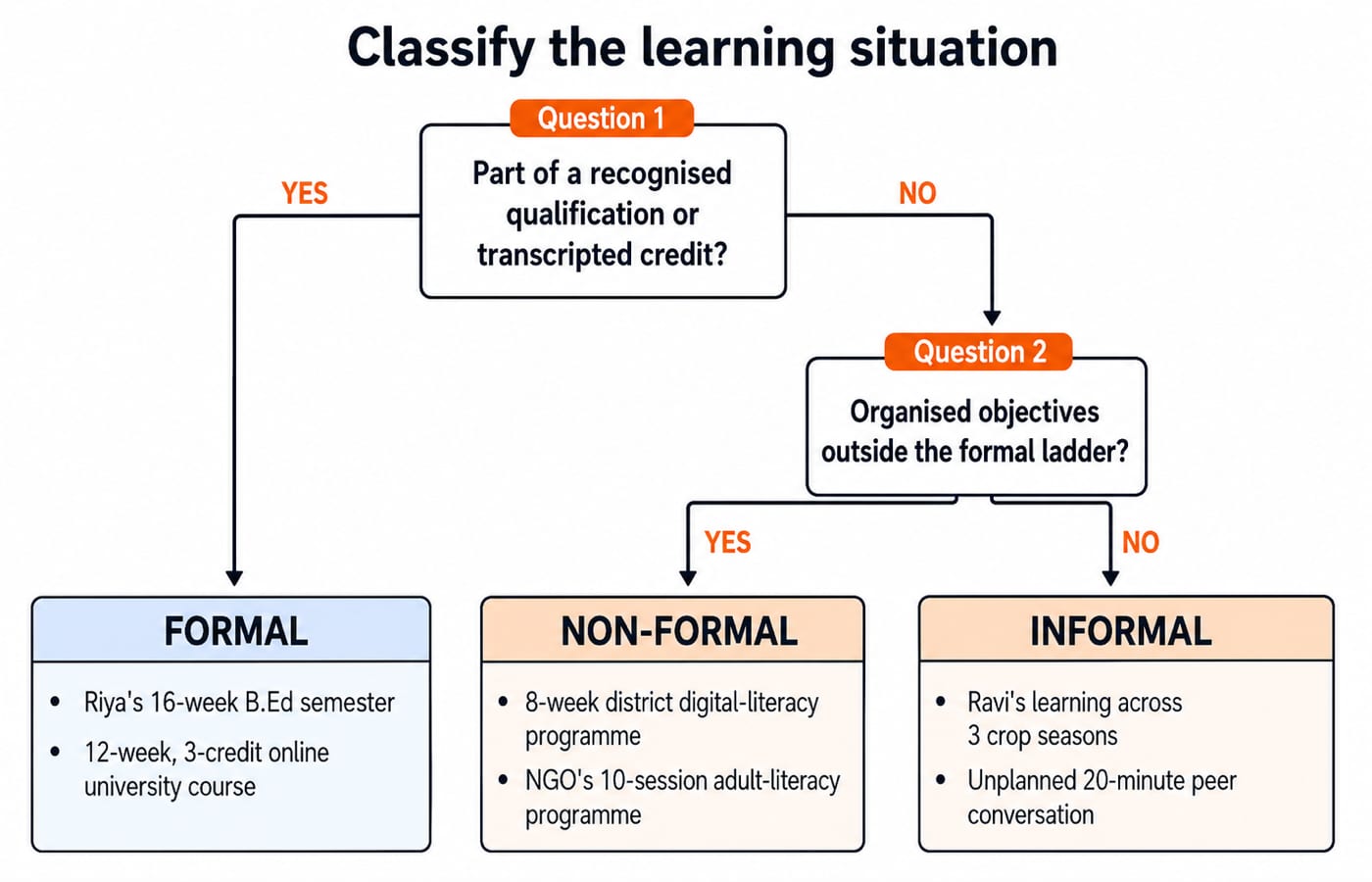
Technology and location do not determine type. Ask whether learning belongs to a recognised formal programme, then whether it is organised outside that ladder. If neither fits, it is informal.
2. Types of education worked example: classify six learning situations
Case | Evidence | Answer |
|---|---|---|
A | Riya attends a 16-week B.Ed semester with a prescribed syllabus, internal assessment, final assessment and a university award. | Formal |
B | A district centre runs an 8-week evening digital-literacy programme with fixed objectives and progress checks, outside any school or degree ladder. | Non-formal |
C | Ravi learns crop rotation by observing his family across 3 crop seasons, with no syllabus, assessment or certificate. | Informal |
D | A learner takes a 12-week online university course carrying 3 transcripted credits. | Formal, despite being online |
E | An NGO conducts 10 planned adult-literacy sessions with modules and progress checks, but no degree progression. | Non-formal |
F | A teacher improves classroom management through an unplanned 20-minute conversation with a colleague after school. | Informal |
Run this check sequence exactly: recognised qualification or transcripted credit? Formal. Organised objectives outside the formal ladder? Non-formal. Learning through ordinary experience without a designed programme? Informal.
A certificate is not decisive; non-formal programmes may issue completion certificates.
3. NEP 2020 higher education: the policy map and official targets
The Ministry of Education's National Education Policy 2020 gives this five-part map:
Multidisciplinary institutions and curricula: learning crosses subject boundaries.
Flexible curricular combinations: students combine disciplines and courses.
Multiple entry and exit: undergraduate stages map to awards.
Academic Bank of Credit (ABC): credits from recognised higher education institutions are digitally stored for recognition.
Access, equity and inclusion: opportunities widen for learners and underserved regions.
Section 10.8 says the policy aims to raise higher education Gross Enrolment Ratio, including vocational education, from 26.3% in 2018 to 50% by 2035. It also aims for at least one large multidisciplinary higher education institution in or near every district by 2030. These are aims, not present achievements.
Place these ideas in the wider Paper 1 context with UGC NET Paper 1 vs Paper 2. CTET and recruitment examinations need not use the same unit name.
4. NEP 2020 multiple entry and exit: a four-learner worked example
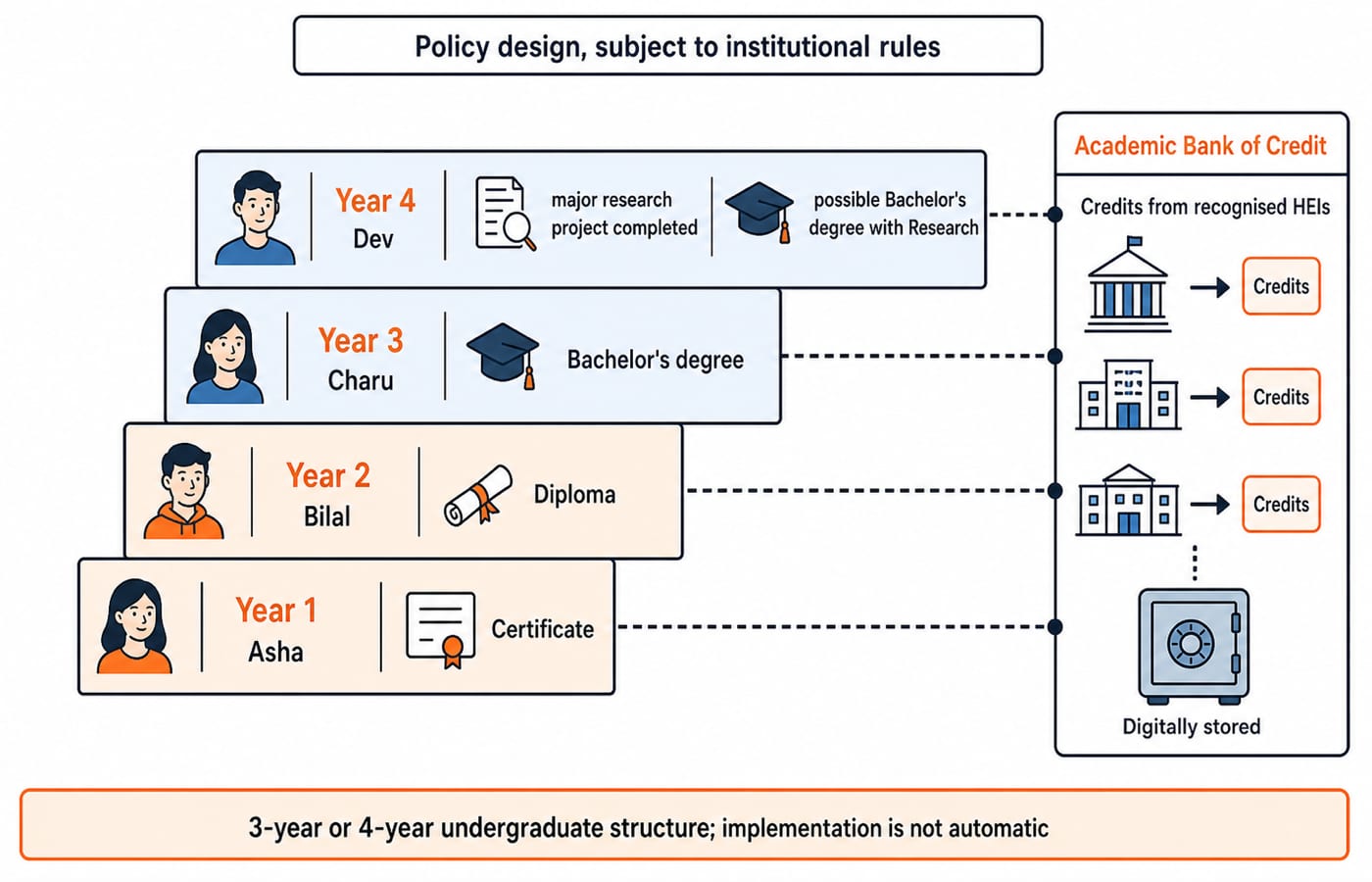
Section 11.9 envisages an undergraduate degree of 3 or 4 years: an appropriate certificate after 1 year, a diploma after 2 years and Bachelor's degree after 3 years. The preferred 4-year multidisciplinary Bachelor's may lead to a degree with Research only after the institution-specified rigorous major-area research project.
Learner | Completed stage | Policy mapping |
|---|---|---|
Asha | Year 1 | Appropriate certificate |
Bilal | Year 2 | Diploma |
Charu | Year 3 | Bachelor's degree |
Dev | Year 4 plus the institution-specified major research project | Possible Bachelor's degree with Research |
ABC is envisaged to store recognised higher-education credits digitally for recognition.
Policy and institutional rules: NEP 2020 envisages these pathways, but exit awards, re-entry and credit transfer depend on the applicable university, regulator and programme rules.
5. Types of education and NEP 2020: keep category, mode and policy mechanism separate
Term | What it describes | What it does not prove |
|---|---|---|
Formal, non-formal, informal | Organisation of learning | Delivery mode or study load |
Face-to-face, online, blended | Delivery mode | Type of education |
Full-time, part-time | Study load | Formal status |
Multiple entry-exit, ABC | Policy mechanisms | Automatic implementation |
Multidisciplinary | Curricular breadth | Delivery mode or exit award |
A 3-credit online university course remains formal because it belongs to a recognised programme. A 10-session face-to-face NGO literacy programme can be non-formal. An informal conversation can improve practice without becoming a formal teacher-education qualification.
Computer Science Pedagogy for Teacher Exams concerns how a subject is taught and learned. Classification concerns how learning is organised.
6. Types of education and NEP 2020 traps that cost marks
Wrong shortcut | Correction |
|---|---|
Online means non-formal. | Delivery mode is not the deciding cue. |
Non-formal means unplanned. | It is organised but outside the regular formal ladder. |
Informal means ineffective. | The term describes the absence of a designed curriculum, not the value of learning. |
Every certificate proves formal education. | Non-formal programmes may also certify completion. |
Four years always means with Research. | NEP 2020 makes it conditional on a rigorous major-area project. |
ABC is itself a university. | It is a credit-storage and recognition mechanism. |
The 50% GER is already achieved. | NEP 2020 states it as a 2035 aim. |
Multiple exit makes a degree non-formal. | The pathway remains inside formal higher education. |
Write “NEP 2020 envisages” for policy design. Use “the institution currently offers” only after verifying its rule. Never interchange aim, implementation and achievement.
7. How teaching exams test types of education and NEP 2020
Four formats are identifying a type, matching terms and features, judging two statements, and matching NEP provisions with 1, 2, 3 and 4 years. Use clues such as recognised programme, outside the ladder, daily experience, transcripted credits and research-project condition.
A 12-week online course carries 3 university credits. Which type? Formal, because recognised credit matters more than online mode.
“A planned 8-week literacy course outside a school or degree ladder is informal.” False. It is non-formal because it is organised and purposeful.
Match the learners under NEP 2020 section 11.9. Asha, Year 1: certificate. Bilal, Year 2: diploma. Charu, Year 3: Bachelor's degree. Dev, Year 4 plus research project: possible Bachelor's degree with Research.
For school-level learner theory, continue with CTET CDP high-yield concepts, or use UGC NET CS exam preparation for the NET route. Check your examining body's current notification or syllabus, not another exam's pattern.
8. The short version and the next step
Formal belongs to a recognised learning ladder.
Non-formal is organised outside that ladder.
Informal grows from daily experience.
Online is a mode, not a type.
NEP 2020's flexible pathways remain part of formal higher education.
Reclassify all six cases and reproduce the 1-year to 4-year map without notes. For structured compulsory-paper preparation, continue with the NTA UGC NET Paper 1 course.
Keep learning

Guidance, Counselling and Mental Health for Teaching Exams: Concepts, Cases and Exam Traps
Learn to separate guidance, counselling and mental-health support, then apply the distinctions to learner cases without crossing a teacher's professional boundaries.
Updated 23 Oct 20266 min readCTET & UPTET

Classroom Management and Communication for Teaching Exams: Complete Notes and Worked Scenarios
Connect classroom management, communication, feedback, discipline, and teacher immediacy, then practise an exam-style vignette with a step-by-step solution.
Updated 19 Oct 20266 min readCTET & UPTET

Teaching-Learning Aids and ICT Integration for Teaching Exams: Notes with Worked Classroom Examples
Learn how to select and sequence teaching-learning aids, recognise genuine ICT integration, and solve classroom scenarios with worked calculations.
Updated 15 Oct 20265 min readCTET & UPTET

Nature, Objectives and Characteristics of Teaching: Concept Notes for Teaching Exams
Learn to separate what teaching is, what change it seeks and how an effective teaching process operates. A worked fraction lesson connects every concept.
Updated 10 Oct 20265 min readCTET & UPTET