CTET CDP: the high-yield concepts and theorists you must know
A CTET Child Development and Pedagogy guide to the high-yield ideas: Piaget, Vygotsky, Kohlberg, constructivism, inclusive education and how CDP is tested.
KnowledgeGate Team
Exam prep & CS education
Updated 25 Jul 20266 min read

Child Development and Pedagogy carries its own section in both CTET Paper 1 and Paper 2, so it is the part of the syllabus that pays off whichever paper you sit. It also rewards understanding over memory: its questions are usually classroom scenarios, a described child or a teacher facing a choice, rather than dry definitions. An aspirant who owns four theorists and the principles of development will out-answer one who has memorised twenty definitions, because the scenario never asks for the definition.
The number of CDP questions, the marks they carry and the marking scheme are stated in the official notification at ctet.nic.in. Check them there before you decide how many hours CDP deserves against your other sections.
How children develop: the core principles
Development is the spine of CDP. These five principles recur across almost every cycle.
Development is continuous, sequential, and proceeds from general to specific. A child gains gross motor control before fine motor control, and broad responses before precise ones.
It follows a cephalocaudal and proximodistal direction, that is, head to toe and centre outward.
Heredity and environment both shape development. The nature-versus-nurture framing is a favourite, and the accepted answer is that the two interact rather than one dominating.
Development proceeds at an individual rate. Two children of the same age can sit at different points on the same sequence, which is why the expected CDP answer treats a slower child as a child needing different support, never as a deficient one.
Development is integrated. Physical, cognitive, emotional and social growth move together, so a difficulty that looks cognitive (a child who will not attempt sums) often shows up first as an emotional or social one.
Understand each principle as one line you could say to a colleague. The exam tests whether you can apply it to a described child, not whether you can recite it.
The theorists you cannot skip
Four names carry a large share of CDP questions. Learn what each is known for and one keyword that triggers it.
Jean Piaget, cognitive development. Learning happens through stages, sensorimotor, preoperational, concrete operational, and formal operational, driven by assimilation and accommodation. Keyword triggers: schema, stages, conservation.
Lev Vygotsky, social constructivism. Learning is social first and individual second. The Zone of Proximal Development, the gap between what a child can do alone and with guidance, and scaffolding are his signature ideas.
Lawrence Kohlberg, moral development. Moral reasoning grows through pre-conventional, conventional, and post-conventional levels. Any question about how children reason about right and wrong points here.
Jerome Bruner, discovery learning. Knowledge is built actively through enactive, iconic, and symbolic modes of representation.
A reliable exam trick is to attach a strategy to a theorist. If a scenario describes a teacher guiding a child just beyond their current ability, that is Vygotsky's ZPD; if it describes a child unable to grasp conservation of volume, that is Piaget's preoperational stage.
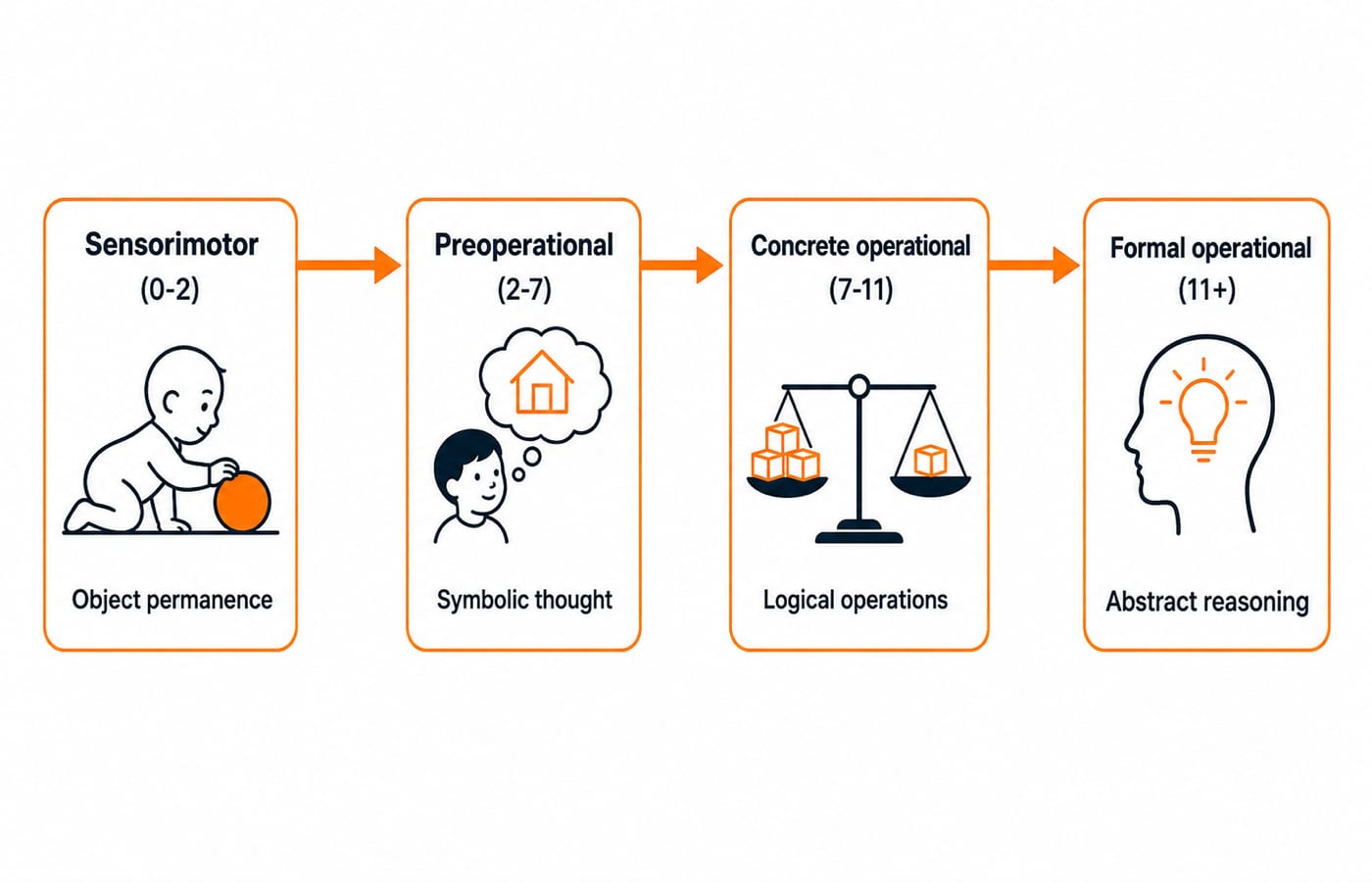
Piaget's stages are worth holding as a picture rather than a list, because scenario questions usually describe a behaviour and expect you to place the child at the right stage. A child who cannot yet reason about hypothetical situations, only about concrete objects in front of them, sits in the concrete operational stage, not the formal operational one, and the wrong stage is the trap answer.
A worked scenario, reasoned step by step
Take a question in the form CTET actually uses. A teacher notices that a child can solve a subtraction problem when using counters on the desk but fails the same problem when asked to do it mentally. What does this indicate, and what should the teacher do?
Work through it the way the section rewards. First, identify the principle: the child understands the operation concretely but has not yet moved to the abstract representation, which is the concrete-to-abstract progression Piaget and later constructivists describe. Second, rule out the wrong readings: this is not a lack of ability or a discipline issue, and re-teaching the same abstract method will not help. Third, choose the response that matches the principle: the teacher should let the child continue with concrete materials and gradually fade them, bridging to pictorial and then mental methods. The correct option is almost always the one that meets the child at their current stage and scaffolds forward, which is exactly the value system CDP tests.
Learning, motivation, and constructivism
The pedagogy half of CDP builds on how learning actually happens in a classroom.
Constructivism holds that learners build knowledge on top of what they already know, rather than receiving it passively. This is the theoretical basis for activity-based and child-centred teaching, and it underlies a large number of "what should a good teacher do" questions.
Motivation splits into intrinsic, driven by interest, and extrinsic, driven by rewards. CDP consistently favours intrinsic motivation as the more durable driver of learning.
Factors affecting learning include maturation, readiness, attention, and the emotional climate of the classroom.
The through-line is that the "correct" pedagogical answer almost always favours the child as an active constructor of meaning over the teacher as a transmitter of facts.
Inclusive education and assessment
Two modern themes are reliably present and reliably scoring.
Inclusive education and the diverse learner. This covers children with special needs, learners from varied linguistic and socio-economic backgrounds, and the gifted child. The expected stance is accommodation and inclusion, never segregation.
Assessment. The shift the exam wants you to internalise is from marks-based, one-shot testing toward continuous and comprehensive evaluation, assessment for learning rather than only of learning. Formative assessment, feedback, and the idea that errors are information rather than failures are all high-yield.
How CDP is actually tested
CDP questions are overwhelmingly application, not recall. A typical item describes a classroom situation, a child who behaves a certain way or a teacher facing a choice, and asks for the best response or the principle underneath it. The theory is the tool; the scenario is the test. Four item forms cover most of what you will meet.
Place the child. A behaviour is described and you choose the stage or level it belongs to. The adjacent stage is almost always the distractor, so decide what the child cannot yet do before you pick.
Choose the teacher's response. Several plausible actions are offered. The credited one meets the child at their current stage and scaffolds forward; the wrong ones repeat the same instruction, move the child out of the group, or postpone the work to the parents.
Name the principle. A scenario is given and the options are theorists or terms. A trigger word in the stem does the work: guidance just beyond current ability points to Vygotsky, failing conservation points to Piaget, reasoning about right and wrong points to Kohlberg.
Spot the statement that does not belong. A list of claims about development, motivation or assessment carries one that contradicts the child-centred stance, and the stem is often phrased negatively. Read the stem twice; under time pressure the negative is what candidates miss.
Because of this, cramming definitions is the wrong strategy. Once your CDP revision is done you should be able to read a scenario and answer it without first retrieving a definition, because you understand the principle well enough to apply it directly.
The same scenario style runs through UPTET and the other state teaching-eligibility papers, so the work transfers rather than having to be repeated, and you can see which of those papers we teach for on the CTET category page. For the evidence behind the pattern, the theorist-by-theorist breakdown of recent cycles is in our CTET previous year analysis of CDP theorists and pedagogy patterns.
Your next step
CDP carries into both papers and rewards principle over memory, so it deserves your first and heaviest block of study. Learn the principles of development, own the four theorists, internalise constructivism, and take inclusive education and continuous assessment seriously.
Our structured CDP teaching sits inside the CTET 2026 (Paper 1 and 2) bundle, and because CDP is common to both papers it maps equally to the CTET Paper 1 and CTET Paper 2 courses. Whichever paper you sit, confirm the exact CDP weightage on the official CTET notification before you finalise how much time to give it.
Keep learning

Guidance, Counselling and Mental Health for Teaching Exams: Concepts, Cases and Exam Traps
Learn to separate guidance, counselling and mental-health support, then apply the distinctions to learner cases without crossing a teacher's professional boundaries.
Updated 23 Oct 20266 min readCTET & UPTET

Classroom Management and Communication for Teaching Exams: Complete Notes and Worked Scenarios
Connect classroom management, communication, feedback, discipline, and teacher immediacy, then practise an exam-style vignette with a step-by-step solution.
Updated 19 Oct 20266 min readCTET & UPTET

Teaching-Learning Aids and ICT Integration for Teaching Exams: Notes with Worked Classroom Examples
Learn how to select and sequence teaching-learning aids, recognise genuine ICT integration, and solve classroom scenarios with worked calculations.
Updated 15 Oct 20265 min readCTET & UPTET

Nature, Objectives and Characteristics of Teaching: Concept Notes for Teaching Exams
Learn to separate what teaching is, what change it seeks and how an effective teaching process operates. A worked fraction lesson connects every concept.
Updated 10 Oct 20265 min readCTET & UPTET