MDG and SDG Notes for Teaching Exams: Complete Comparison with Worked Examples
Learn the MDG and SDG goal lists, chronology, five Ps and key differences, then apply them to a fully worked district programme and exam-style checks.
KnowledgeGate Team
Exam prep & CS education
Updated 23 Aug 20265 min read
Aspirants remember that MDGs came before SDGs, but often mix up 8 versus 17, 2015 versus 2030, MDG 7 versus SDG 6, and MDG 8 versus SDG 17. MDGs and SDGs separate cleanly once you track their numbered goals, timelines and direct outcomes. The current Paper 1 curriculum places MDG and SDG in Unit 9, People Development and Environment. Candidates for other teaching papers should confirm their current official syllabus while exploring UGC NET preparation courses.
1. MDG and SDG at a glance: the 8, 17, 2015, 2030 frame
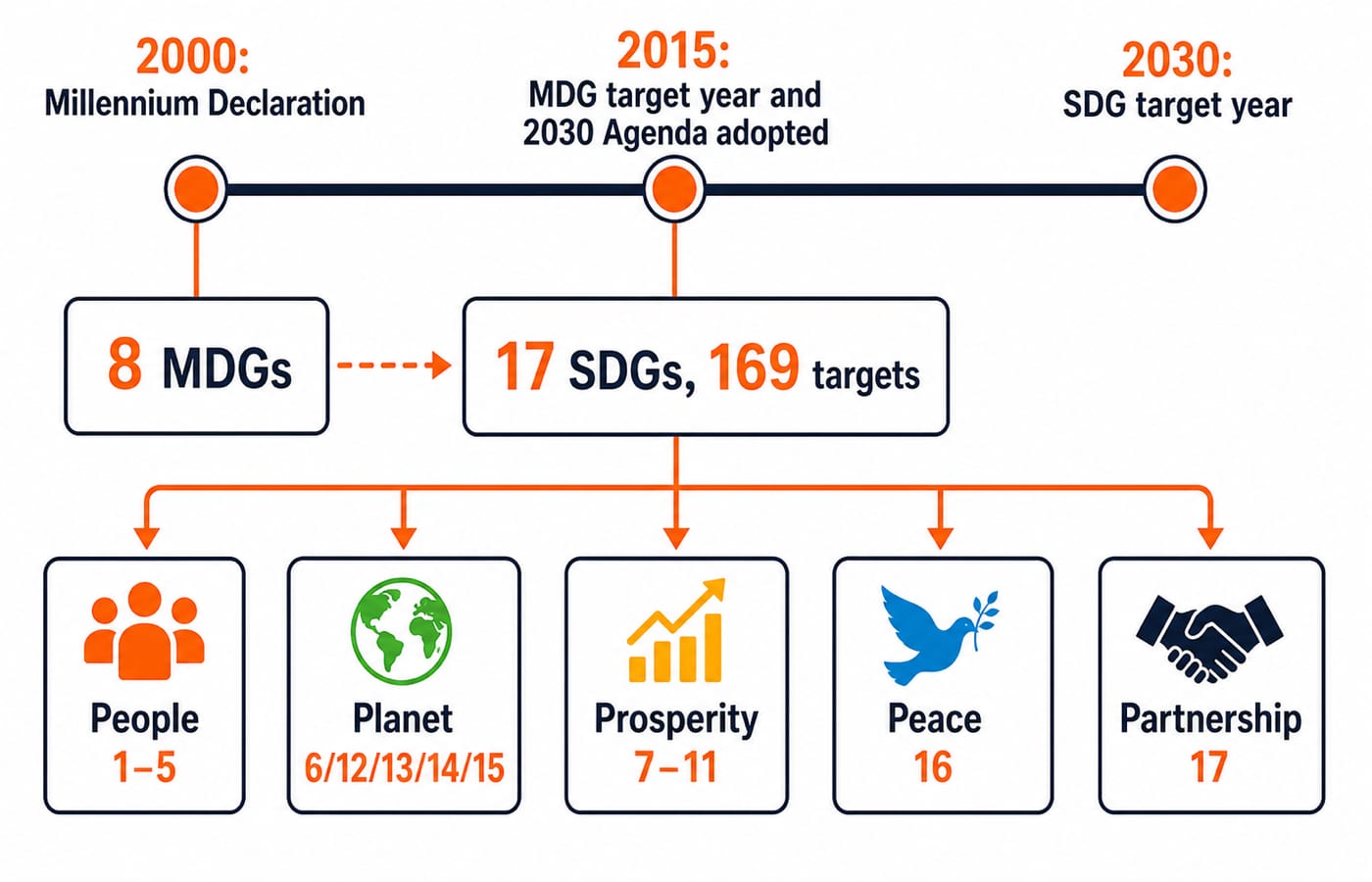
The Millennium Development Goals (MDGs) followed the United Nations Millennium Declaration of 2000 and had a 2015 target date. The UN adopted the official 2030 Agenda in 2015, setting 17 Sustainable Development Goals (SDGs) and 169 targets for the 2030 horizon.
MDG: 8 goals, target year 2015. SDG: 17 goals, target year 2030.
The year 2015 has two roles: the MDG target year and the SDG Agenda adoption year. This is why chronology questions cause confusion.
2. The eight Millennium Development Goals, in exam-ready order
Eradicate Extreme Poverty and Hunger
Achieve Universal Primary Education
Promote Gender Equality and Empower Women
Reduce Child Mortality
Improve Maternal Health
Combat HIV/AIDS, Malaria and Other Diseases
Ensure Environmental Sustainability
Develop a Global Partnership for Development
Group Goals 1 to 6 under people and human development, Goal 7 under environment, and Goal 8 under partnership. Fix four common matches: MDG 2 is primary education, MDG 3 gender equality, MDG 7 environmental sustainability, and MDG 8 global partnership.
Safe drinking water sat inside the broad MDG 7 framework, not under a standalone water goal. That distinction matters when you compare it with SDG 6.
3. The 17 Sustainable Development Goals through the five Ps
No Poverty
Zero Hunger
Good Health and Well-being
Quality Education
Gender Equality
Clean Water and Sanitation
Affordable and Clean Energy
Decent Work and Economic Growth
Industry, Innovation and Infrastructure
Reduced Inequalities
Sustainable Cities and Communities
Responsible Consumption and Production
Climate Action
Life Below Water
Life on Land
Peace, Justice and Strong Institutions
Partnerships for the Goals
Use the Agenda's five Ps for revision, not instead of the numbered list: People is Goals 1 to 5; Planet is 6, 12, 13, 14 and 15; Prosperity is 7 to 11; Peace is 16; and Partnership is 17.
The Agenda describes the goals as integrated and indivisible, so one intervention can affect several goals. Education may also affect health, gender equality and decent work. In a case, identify the direct goal before its co-benefits.
4. MDG versus SDG: what changed and what continued
Feature | MDG | SDG | Exam takeaway |
|---|---|---|---|
Framework size | 8 goals | 17 goals | Do not transfer goal numbers across frameworks |
Time horizon | 2015 target | 2030 target | 2015 also marks SDG adoption |
Coverage | Strong focus on basic human-development deficits and developing-country outcomes | Universal agenda for all countries | Avoid saying SDGs apply only to developing countries |
Design | Broad sector goals | Integrated social, economic and environmental framework | One programme may support several goals |
These MDG-SDG links are study connections, not official equivalences: MDG 1 connects to SDGs 1 and 2; MDG 2 to SDG 4; MDG 3 to SDGs 5 and 10; MDGs 4, 5 and 6 chiefly to SDG 3; MDG 7 across SDGs 6, 7, 11, 12, 13, 14 and 15; and MDG 8 chiefly to SDG 17.
The Agenda says the SDGs build on the MDGs and seek to finish incomplete work, while adding interconnected priorities such as inequality, energy, cities, climate, ecosystems and institutions.
5. Worked example: map one district programme to the correct goals
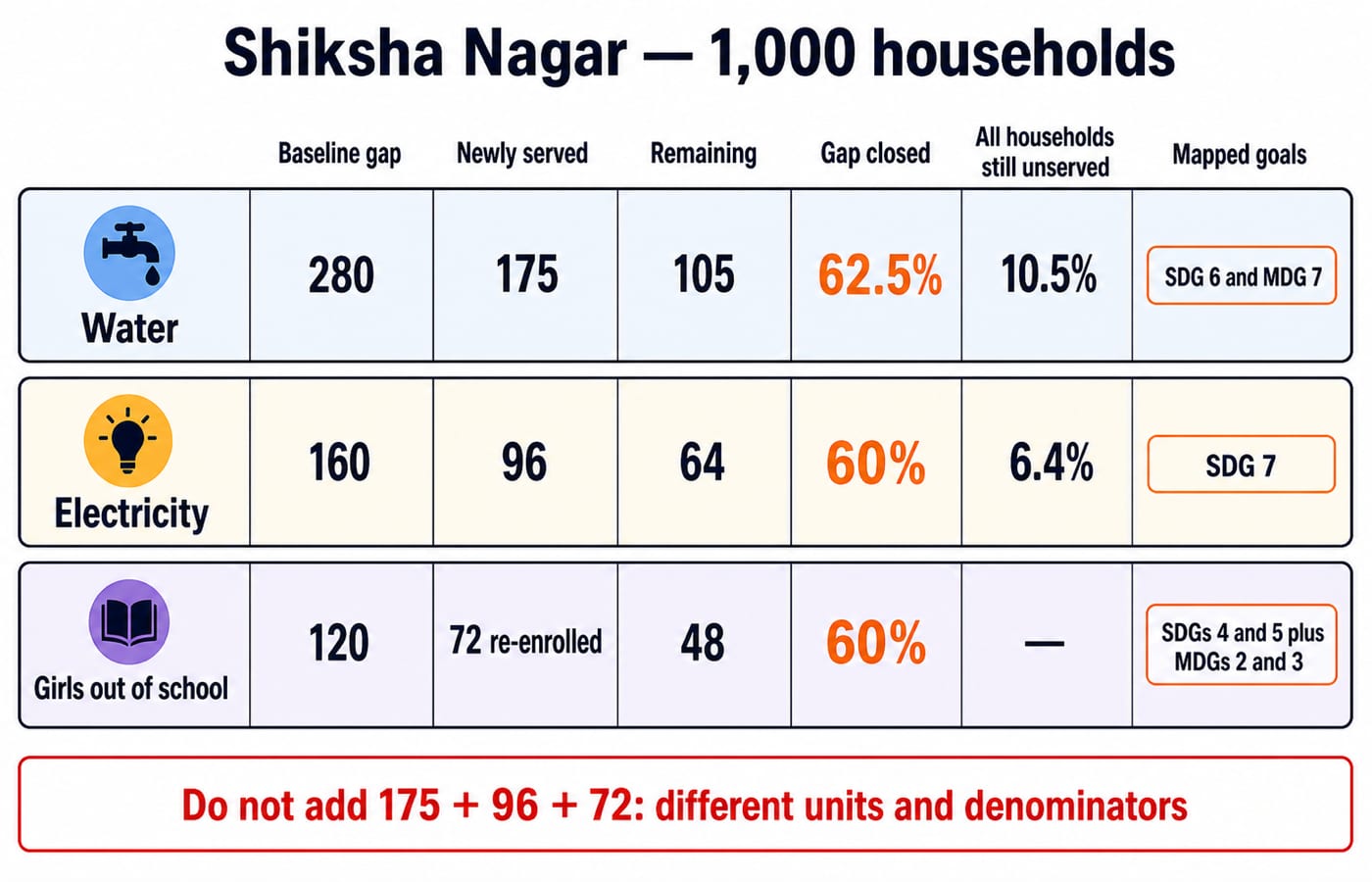
Shiksha Nagar has 1,000 households. At baseline, 280 lack reliable safe water, 160 lack electricity, and 120 girls aged 12 to 16 are out of school. A programme serves 175 of the 280 households, gives electricity to 96 of the 160, and re-enrols 72 of the 120 girls.
Water: Remaining gap = 280 − 175 = 105 households. Gap closed = 175 ÷ 280 × 100 = 62.5%. Households still unserved = 105 ÷ 1,000 × 100 = 10.5%. The direct classification is SDG 6, with a connection to the older broad MDG 7.
Electricity: Remaining gap = 160 − 96 = 64 households. Gap closed = 96 ÷ 160 × 100 = 60%. Households still unserved = 64 ÷ 1,000 × 100 = 6.4%. The direct classification is SDG 7, an area with no standalone MDG counterpart.
Girls' education: Remaining gap = 120 − 72 = 48 girls. Gap closed = 72 ÷ 120 × 100 = 60%. The direct classification is SDG 4, with a strong SDG 5 link, and continuity with MDGs 2 and 3.
Do not call 175 + 96 + 72 = 343 a composite achievement score. The units and denominators differ.
6. How teaching exams test MDG and SDG
Expect chronology, number-to-label matching, MDG versus SDG classification, statements about scope, and case mapping. For UGC NET, this is Paper 1 material, not the Computer Science-specific block explained in UGC NET Paper 1 vs Paper 2.
Use these checks:
Which SDG directly covers clean water and sanitation? SDG 6.
“The SDGs are universal” is true. “The SDGs apply only to developing countries” is false, based on the official Agenda.
A school reduces out-of-school learners from 65 of 500 to 26 of 500. The rate falls from 65 ÷ 500 × 100 = 13% to 26 ÷ 500 × 100 = 5.2%. The reduction is 39 learners, and 39 ÷ 65 × 100 = 60% of the original gap. Classify it directly under SDG 4. Do not add SDG 5 unless sex-disaggregated evidence is given.
Learn the labels, practise matching, then solve statement and case items from more than 20 MDG and SDG questions in KnowledgeGate's practice bank.
7. Traps that cost easy marks
Wrong shortcut | Correction |
|---|---|
2015 means only SDG adoption | It is also the MDG target year |
MDG 7 equals SDG 7 | Numbers changed; water moved to SDG 6 and energy became SDG 7 |
MDG 8 and SDG 8 both mean partnership | Partnership is MDG 8 but SDG 17 |
Every benefit is the direct goal | Identify the primary outcome, then add supported co-benefits |
Targets and indicators are the same | A target states the result sought; an indicator measures progress |
Do not say MDGs were only for poor countries. They focused strongly on developing-country outcomes, with richer countries carrying partnership responsibilities, while SDGs are explicitly universal.
Content knowledge also differs from pedagogy. Goal labels are not the same as how primary learners explore environmental themes, the focus of CTET EVS pedagogy.
8. The short version and the next step
Recall four shifts: 8 goals to 17, 2015 to 2030, broad MDG sectors to integrated SDG goals, and MDG 8 partnership to SDG 17 partnership. Now reproduce the eight MDGs, the 17 numbered SDGs, and the Shiksha Nagar classification once without notes.
NTA UGC NET Paper 1 course includes MDG and SDG in Unit 9, People Development and Environment.
Keep learning

Guidance, Counselling and Mental Health for Teaching Exams: Concepts, Cases and Exam Traps
Learn to separate guidance, counselling and mental-health support, then apply the distinctions to learner cases without crossing a teacher's professional boundaries.
Updated 23 Oct 20266 min readCTET & UPTET

Classroom Management and Communication for Teaching Exams: Complete Notes and Worked Scenarios
Connect classroom management, communication, feedback, discipline, and teacher immediacy, then practise an exam-style vignette with a step-by-step solution.
Updated 19 Oct 20266 min readCTET & UPTET

Teaching-Learning Aids and ICT Integration for Teaching Exams: Notes with Worked Classroom Examples
Learn how to select and sequence teaching-learning aids, recognise genuine ICT integration, and solve classroom scenarios with worked calculations.
Updated 15 Oct 20265 min readCTET & UPTET
Nature, Objectives and Characteristics of Teaching: Concept Notes for Teaching Exams
Learn to separate what teaching is, what change it seeks and how an effective teaching process operates. A worked fraction lesson connects every concept.
Updated 10 Oct 20265 min readCTET & UPTET