Classroom Management and Communication for Teaching Exams: Complete Notes and Worked Scenarios
Connect classroom management, communication, feedback, discipline, and teacher immediacy, then practise an exam-style vignette with a step-by-step solution.
KnowledgeGate Team
Exam prep & CS education
Updated 19 Oct 20266 min read

Communication, discipline, feedback, and teacher immediacy may look separate. Teaching-exam questions combine them in situations and ask for the soundest response. For CTET, TET, NET, and recruitment papers, the soundest responses account for communication, discipline, feedback, and teacher immediacy. Check each exam's current syllabus and pattern on its official portal.
Classroom management means designing learning conditions
Classroom management plans time, space, routines, relationships, instruction, monitoring, and responses so learning continues. Preventive management prepares before difficulty; supportive redirection guides while learning continues; corrective or restorative action responds after disruption.
Keep four terms separate. A rule says "Speak one at a time." A procedure says "Submit the exit slip in the blue tray." A routine has all 40 learners take out notebooks and write the date within 60 seconds of the bell. A logical consequence asks a learner who misuses shared material to restore it rather than receive unrelated punishment.
Authoritarian management stresses control; permissive management lacks dependable limits. Democratic management combines consistent boundaries, dignity, suitable participation, and self-discipline. For broader CTET and UPTET preparation, see the Govt Teaching Eligibility Tests category.
The classroom communication loop and its forms
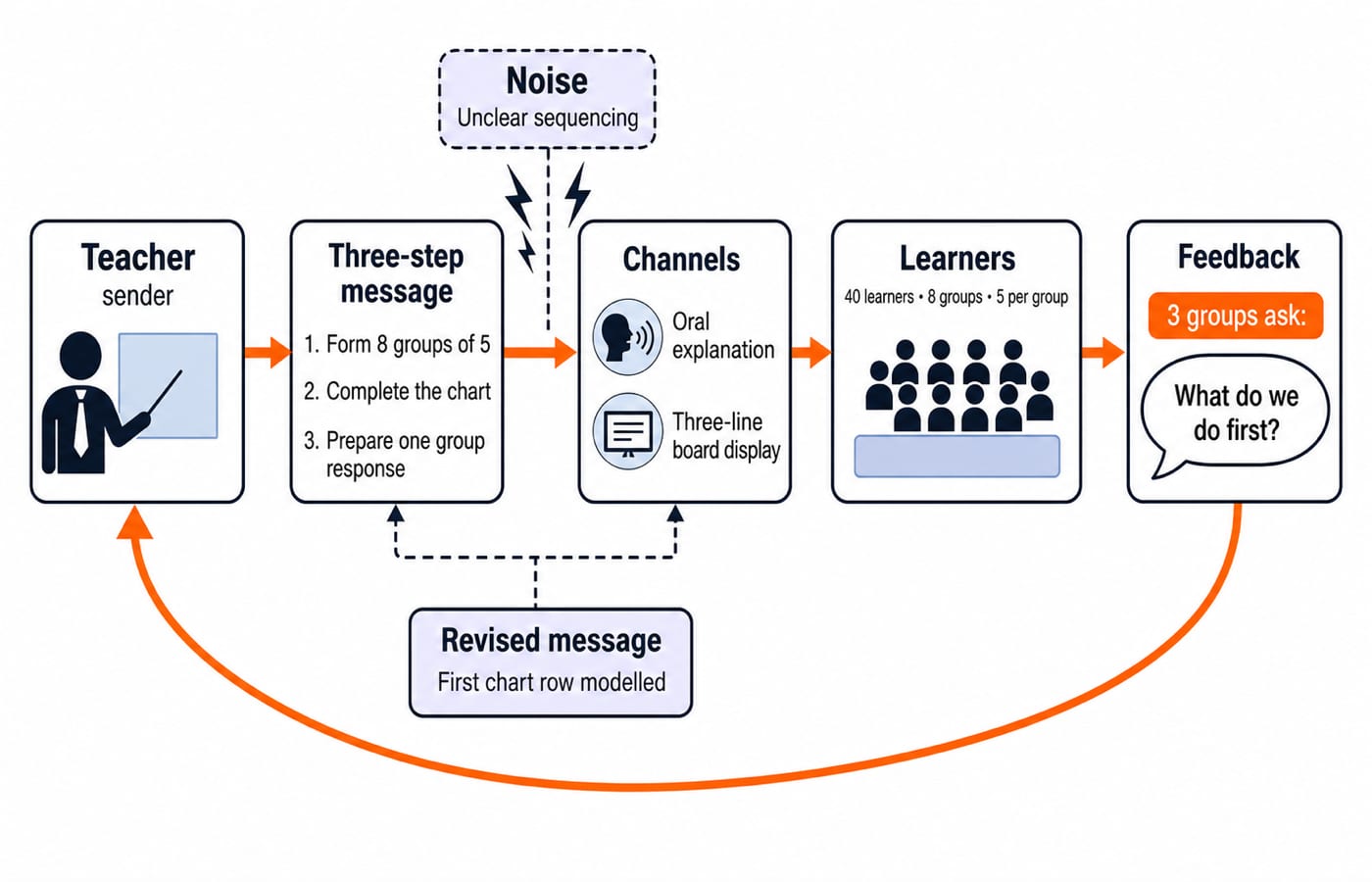
The loop is sender or source -> encoding -> message -> channel -> receiver -> decoding -> feedback, within context and noise. Speaking does not complete it; checking meaning does. Berlo's SMCR highlights source, message, channel, and receiver. Shannon-Weaver helps identify noise. Treat both as recognition points.
Communication can be verbal (spoken or written), non-verbal (expression, gesture, posture, eye contact, distance), or visual (board, chart, diagram, symbol). Paraverbal pace, pause, pitch, and volume can make one sentence encourage or threaten.
Replace "Settle down and finish it quickly" with: "For the next 6 minutes, solve Questions 1 to 3 independently, underline the keyword in each stem, and place your pencil down when finished." A learner repeats the task to check clarity. Apply the 7 Cs: clear, concise, concrete, correct, coherent, complete, courteous.
Interaction, questioning, feedback, and teacher immediacy
Closed questions check facts, open questions seek explanations, probing questions uncover reasoning, and redirecting questions extend an answer through another learner. A useful routine is: ask, wait 3 seconds, take a response, allow a 20-second pair check, then invite another response. The wait and pair-check timings are practice choices, not universal rules.
"Good" gives no direction. "Your claim is clear; now add one classroom example to justify it" names success and the next action. Feedback should be timely, specific, respectful, and about work or behaviour, not identity.
Teacher immediacy reduces distance through respectful names, attentive posture, suitable eye contact, accessible movement, and responses to ideas. FIACS classifies classroom interaction into these categories:
Categories | Interaction type | Categories named |
|---|---|---|
1-4 | Indirect teacher talk | Accepts feeling, praises or encourages, accepts or uses ideas, asks questions |
5-7 | Direct teacher talk | Lectures, gives directions, criticises or justifies authority |
8-9 | Pupil talk | Response, initiation |
10 | Neither | Silence or confusion |
A fully worked classroom scenario
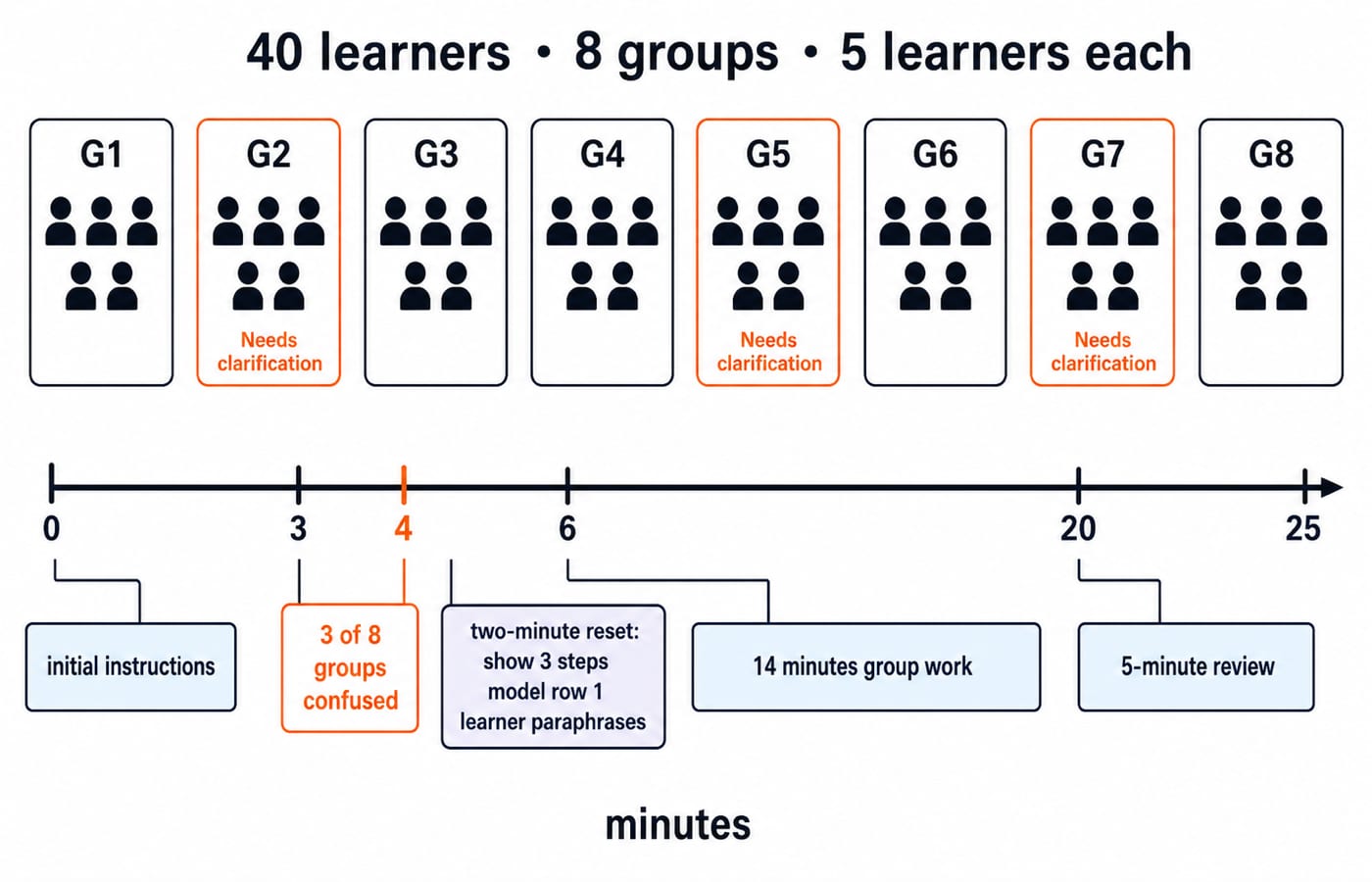
Stem: "A teacher has 40 learners in 8 groups of 5 for a 25-minute activity. Minutes 0-3 are for instructions, minutes 3-20 for group work, and minutes 20-25 for review. At minute 4, 3 groups are still asking what to do first. What should the teacher do?"
A. Announce loss of marks for the 15 learners.
B. Pause the class for 2 minutes, display the three steps "assign five roles, complete the four-row chart, select one presenter", model the first chart row, ask one learner to paraphrase, and restart at minute 6 with 14 work minutes left.
C. Ignore the questions until the review.
D. Complete the chart on the board while learners copy it.
Answer: B. Three questioning groups show unreliable decoding. A mistakes communication failure for indiscipline, C spreads confusion, and D removes participation. B combines oral, visual, and modelled channels, checks understanding, and preserves the 5-minute review.
Check the arithmetic. 8 groups x 5 learners = 40. Minutes 4 to 6 give a 2-minute reset. Minutes 6 to 20 give 20 - 6 = 14 work minutes. The full timeline is 3 minutes' instruction + 1 attempted-work minute + 2 reset minutes + 14 resumed-work minutes + 5 review minutes = 25 minutes.
The 40 learners are receivers; 8 groups of 5 organise participation. Three steps improve encoding, 3 confused groups provide feedback, the modelled first row adds visual support, and a learner paraphrase checks comprehension. Minutes 4-6 correct communication; minutes 6-20 preserve 14 work minutes.
Discipline, self-discipline, conflict, and proportionate response
Discipline supports safe participation. Self-discipline is regulation without constant external control. Check for unclear or inaccessible instructions, task difficulty, unmet needs, peer conflict, or boundary testing. Cause guides response without excusing harm.
For ordinary disruption, use: non-verbal cue -> proximity or pause -> private reminder -> bounded choice or logical consequence -> restorative follow-up. Threats, harassment, or serious harm require immediate action under institutional policy.
Say: "When side conversations continue during instructions, others miss Step 2. Please stop now and tell me the first task. If the instruction is unclear, ask me after the class begins work." Unlike "You are always disruptive", this addresses behaviour. Use plain language, visual or repeated instructions, private correction where possible, and no humiliation or sarcasm.
Worked discipline scenario: During group work, two learners argue over a shared pair of scissors, and one pulls it from the other. First secure the scissors and separate the immediate risk without a public accusation. Next, hear each account briefly, restate the turn-taking rule, return the material with assigned roles, and ask both learners to confirm the routine. A collective punishment is unrelated, while ignoring the grab leaves a safety risk. This sequence protects safety first, uses a proportionate correction, restores participation, and checks whether the routine is understood.
How teaching exams test these ideas
Expect communication sequences, verbal, non-verbal, or visual identification, noise, model matching, FIACS categories, discipline versus self-discipline, feedback, interaction, and best-first-response scenarios.
Use five questions to eliminate weak scenario options:
Does the option protect immediate safety?
Does it address the likely cause or communication gap?
Does it preserve dignity?
Does it restore feedback and participation?
Is it proportionate and less intrusive than the alternatives?
If two options sound positive, prefer one that checks understanding and builds agency. For a model-by-model treatment of noise, feedback, field of experience, and the roles inside 10 communication models, use Communication Models Explained: All 10 for Teaching Exams. That earlier post owns model identification; this one uses communication evidence to diagnose a classroom-management breakdown and choose the least intrusive response that restores participation. For current sections, marks, dates, counts, eligibility, or patterns, consult the conducting body. CTET aspirants should use the CBSE CTET site.
Common traps and their corrections
Trap: silence proves success. Silence does not prove understanding, inclusion, or self-regulation. Check whether learners can paraphrase, begin, ask relevant questions, and follow routines with fewer prompts.
Trap: strictest means best. Public punishment, sarcasm, collective penalties, and unrelated loss of marks may damage trust. Prefer a reminder, specific feedback, logical consequence, and private restoration unless safety demands escalation.
Trap: every problem is misconduct. Vague encoding, overload, poor visibility, language difficulty, or missing feedback may be the barrier. Diagnose the loop first. The same correction-first approach applies to these common CTET mistakes to avoid.
Key principles and practice
Plan routines before problems.
Communicate one clear sequence.
Combine words with useful visual and non-verbal cues.
Seek feedback instead of assuming understanding.
Respond proportionately while preserving dignity.
Aim for self-discipline and learning, not obedience alone.
Try a 15-minute drill: 5 minutes redrawing the loop, 5 applying the checklist to two scenarios, and 5 explaining why a punitive distractor loses to feedback. Label each error concept, communication barrier, or response selection.
For primary preparation, use the CTET Paper 1 Course 2026 - Knowledge Gate AI. For upper-primary preparation, use the CTET Paper 2 Course 2026 - Knowledge Gate AI. Check which paper matches your goal and current official eligibility rules.
Keep learning

Teaching-Learning Aids and ICT Integration for Teaching Exams: Notes with Worked Classroom Examples
Learn how to select and sequence teaching-learning aids, recognise genuine ICT integration, and solve classroom scenarios with worked calculations.
Updated 15 Oct 20265 min readCTET & UPTET

Nature, Objectives and Characteristics of Teaching: Concept Notes for Teaching Exams
Learn to separate what teaching is, what change it seeks and how an effective teaching process operates. A worked fraction lesson connects every concept.
Updated 10 Oct 20265 min readCTET & UPTET

सामान्य अशुद्धियाँ (Samanya Ashuddhiyaan): Complete Hindi Grammar Notes for CTET and TET Exams
Learn to identify and correct Hindi word-form, agreement, pronoun and redundancy errors through exact examples, a worked MCQ and a scored diagnostic.
Updated 6 Oct 20266 min readCTET & UPTET

Universities and Learning Programmes for Teaching Exams: Types, Modes and Solved Examples
Separate university status, delivery mode and programme purpose with a repeatable method, then test it on five UGC NET-style classification cases.
Updated 2 Oct 20265 min readCTET & UPTET