Curriculum Framework and Reforms for Teaching Exams: NCF 2005, NEP 2020 and NCF-SE 2023 Notes
Learn how policy, curriculum frameworks, syllabi, pedagogy and assessment fit together. Use one worked Class VI lesson to revise reform concepts for teaching exams.
KnowledgeGate Team
Exam prep & CS education
Updated 18 Sep 20265 min read
Teaching-exam options often mix up policy, curriculum framework, syllabus, textbook, pedagogy and assessment, even though each belongs at a different level. A curriculum framework connects national policy to classroom planning; pedagogy and assessment then turn that direction into learner evidence. Use these distinctions within your wider CTET and UPTET preparation.
Curriculum, syllabus and framework: learn the hierarchy first
A curriculum covers the whole planned learning experience: aims, content, pedagogy and assessment. A syllabus specifies content, while a textbook is one learning resource. Pedagogy facilitates learning, and assessment supplies evidence. A curriculum framework gives the principles and structure for developing curricula and syllabi.
Remember the chain:
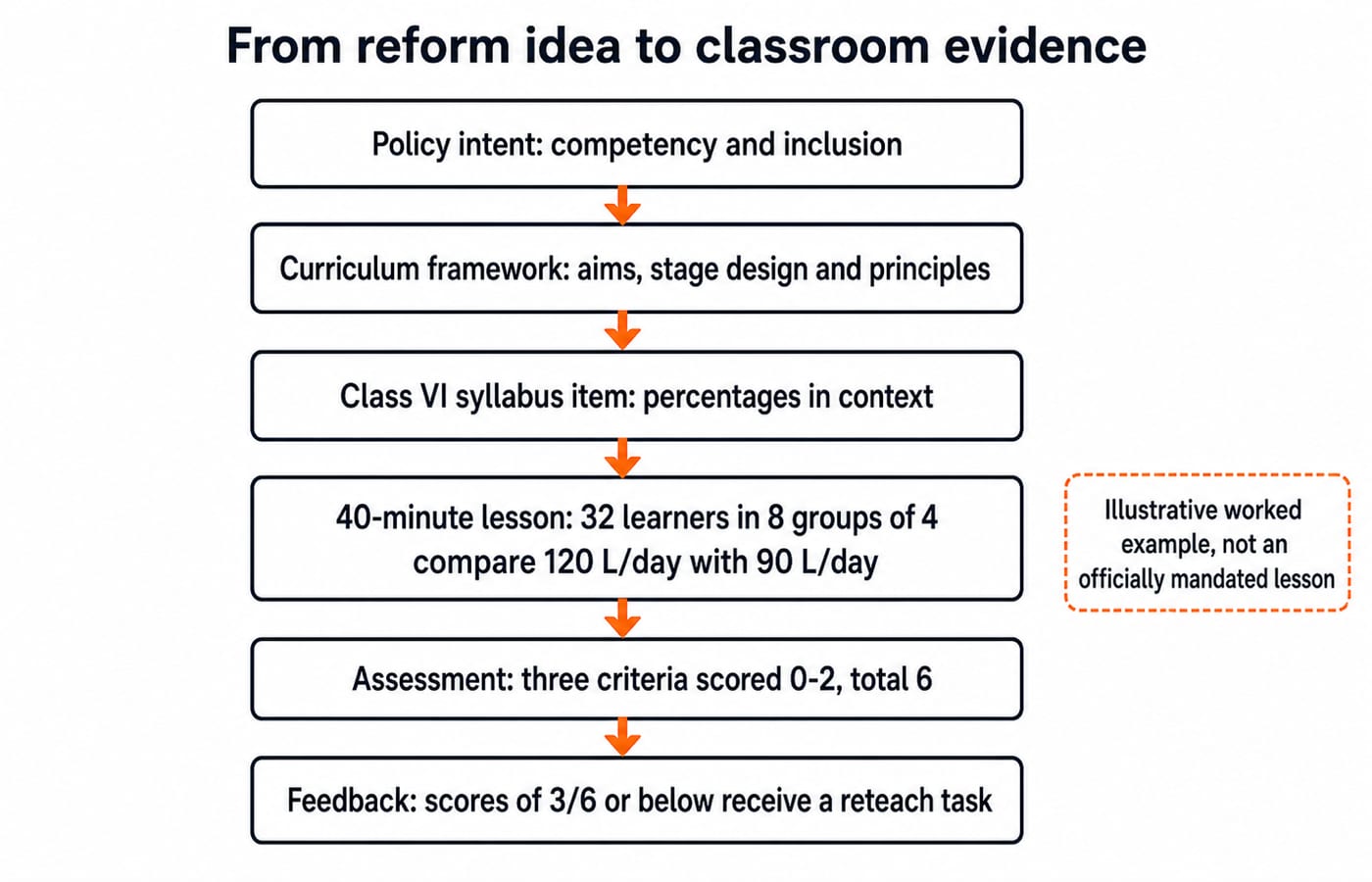
policy intent -> curriculum framework -> curriculum or syllabus -> learning resource and lesson -> assessment evidence -> feedback
These are connected levels, not interchangeable labels.
Classroom statement | Correct level |
|---|---|
Fractions are listed for Class VI | Syllabus |
Students investigate household water use | Pedagogy |
A 0-2 rubric covers calculation, evidence and explanation | Assessment |
Competency, inclusion and local context guide the unit | Framework-level direction |
What changed across NCF 2005, NEP 2020 and NCF-SE 2023
Document and issuing body | Main emphasis | What it adds to the reform path |
|---|---|---|
NCF 2005, issued by NCERT | Connect knowledge with life outside school, reduce rote learning, enrich learning beyond textbooks and support child-centred knowledge construction | Establishes a clear move away from recall-only teaching |
NEP 2020, issued by the Ministry of Education | A 5+3+3+4 curricular and pedagogical structure, reduced content load, experiential and competency-based learning, and more formative assessment | States the national policy direction and gives stage design greater prominence |
NCF-SE 2023, issued by NCERT | Curricular aims, competencies, content, pedagogy and assessment guidance organised by stage | Translates NEP principles into a more explicit school-education framework |
The continuity is movement away from recall-only teaching. The later layer makes stage design, competencies and alignment among standards, classroom work and assessment more explicit.
NCF is not the same as NEP. Child-centred does not mean teacher-absent, and reduced content does not mean reduced learning. NCERT issued NCF 2005 and NCF-SE 2023; the Ministry of Education issued NEP 2020. The current CBSE information bulletin controls CTET syllabus, pattern and eligibility, while each issuing body's official page controls its own role wording.
Fully worked example: turn a reform principle into a teachable lesson
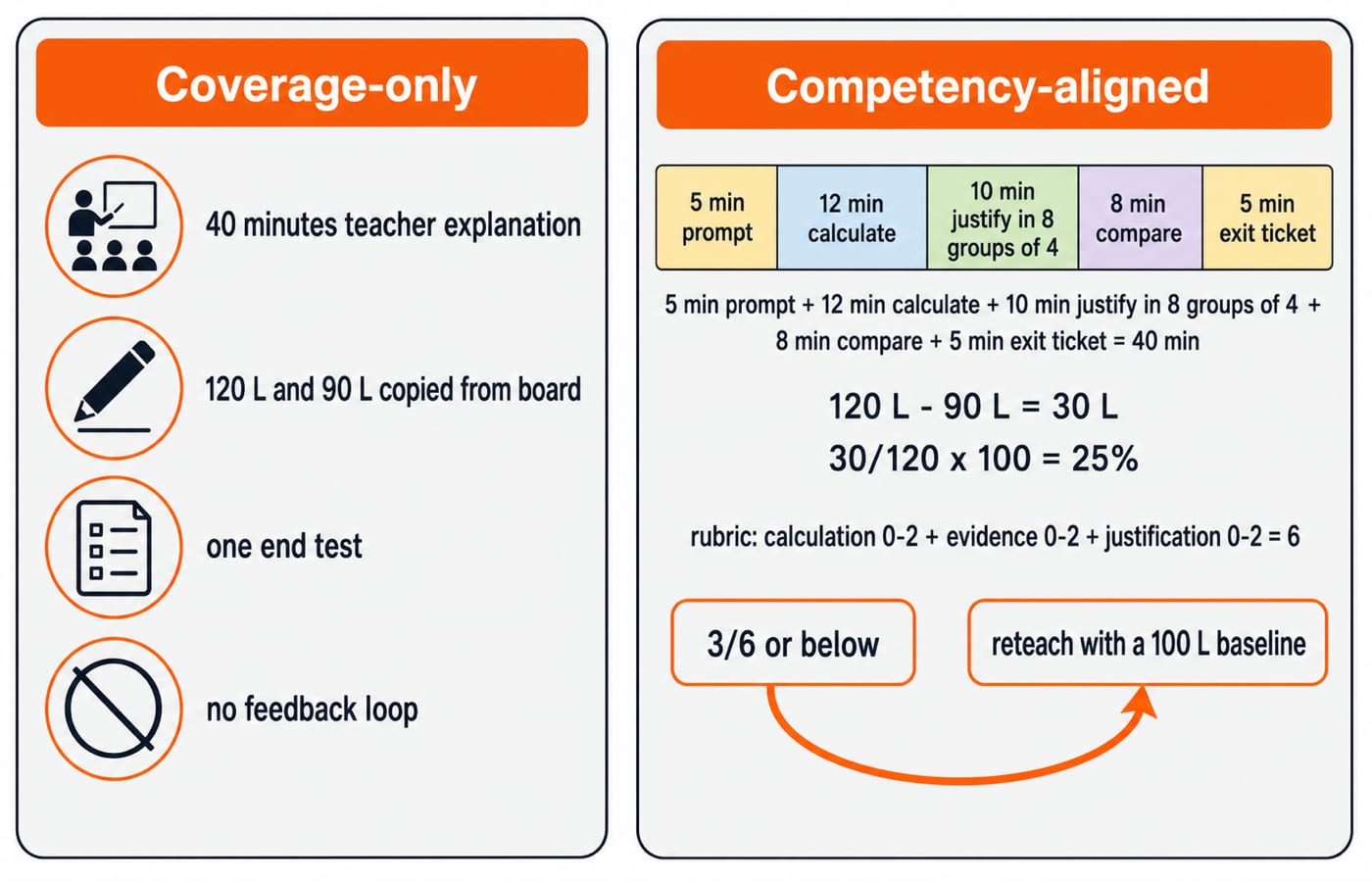
Consider a 40-minute Class VI lesson with 32 learners in 8 groups of 4. The learning outcome is: “Given a household-use table, calculate percentage reduction and justify which change contributes most.” This local-context approach is also useful when revising CTET EVS pedagogy.
Baseline use is bathing 48 L, washing 42 L, and kitchen plus drinking 30 L: 48 + 42 + 30 = 120 L/day. The revised values are 36 L, 24 L and 30 L: 36 + 24 + 30 = 90 L/day.
Now work through the evidence:
Total saving is
120 - 90 = 30 L/day.Percentage saving is
(30 / 120) x 100 = 25%.Bathing saves
48 - 36 = 12 L.Washing saves
42 - 24 = 18 L.Washing therefore contributes the larger saving by
18 - 12 = 6 L.
The timetable is a 5-minute prompt, 12-minute calculation, 10-minute group justification, 8-minute comparison and 5-minute exit ticket: 5 + 12 + 10 + 8 + 5 = 40 minutes. The percentage reasoning tests mathematics pedagogy, while the task also requires evidence and a defended choice.
Use an illustrative rubric with 0, 1 or 2 points each for correct calculation, table evidence and clear justification. The maximum is 2 + 2 + 2 = 6. A learner scoring 2 + 2 + 1 = 5/6 proceeds to an extension task. One scoring 1 + 1 + 1 = 3/6 receives a reteach task using a 100 L baseline. These thresholds are instructional choices, not official cut-offs.
The reform concept set that exam questions compress into one option
Four linked clusters appear repeatedly:
Learner-centred or constructivist learning: learners connect ideas and build meaning. Group seating alone is not collaborative learning.
Experiential and inquiry learning: learners investigate, use evidence and reflect. An activity without a learning outcome is not competency-based.
Inclusive and multilingual practice: teaching provides access without lowering the learning goal. Local context does not replace disciplinary accuracy.
Competency-based learning: learners apply knowledge and produce observable evidence. A final score is assessment of learning; evidence used to change teaching is assessment for learning.
For the origin of pedagogy, teaching maxims and named theorists, use Concept of Pedagogy: Meaning, Types, Maxims and How Teaching Exams Test It. Curriculum-reform questions have a narrower target: trace policy and framework principles into a classroom task, assessment evidence and feedback.
Who does what: NCERT, SCERT, NCTE and CBSE
Body | Document or role | Common trap |
|---|---|---|
NCERT | National curriculum frameworks and model curricular resources | It does not conduct CTET |
Relevant SCERT | State-level curricular contextualisation and resources | States need not use an identical classroom sequence |
NCTE | Teacher-education norms and standards | It is not the CTET test administrator |
CBSE | Current CTET information bulletin and test administration | It does not prepare every national curriculum framework |
“CBSE prepares every national curriculum framework” is false, and “NCERT conducts CTET” is false.
How teaching exams test curriculum reform
Expect four recurring item forms:
Statement pair: “Curriculum is broader than syllabus” is true; “textbook equals curriculum” is false.
Matching:
NCF -> NCERT,state curricular resource -> SCERT,teacher-education norms -> NCTE, andCTET bulletin -> CBSE.Classroom vignette: the water task, rubric and reteaching show competency-based learning with assessment for learning.
Chronology:
NCF 2005 -> NEP 2020 -> NCF-SE 2023is the correct order.
For elimination, underline the agency, level and learner evidence. Reject options that swap policy with framework, content list with curriculum, or end-score with formative feedback. In the 32-learner vignette, group seating is not decisive. The calculation, justification, rubric and feedback loop are.
Practise by classifying each prompt as a document, issuing body, curriculum level, classroom method or assessment purpose. The label should follow from the wording, not from a memorised keyword.
Traps, one-minute revision and the next step
Fix six traps before you revise: curriculum is not merely a syllabus; NCF is not NEP; child-centred is not teacher-free; activity is not automatically experiential learning; competency-based learning does not make factual knowledge irrelevant; formative assessment needs feedback or instructional adjustment, not just frequent tests.
Use this five-line recall ladder:
Policy sets direction.
Framework organises principles and stages.
Curriculum plans the whole learning experience.
Syllabus scopes content.
Pedagogy and assessment create and measure learning evidence.
Replay the move from 120 L to 90 L. The 25% calculation is necessary, but insufficient without table evidence, justification and feedback. Aspirants targeting primary classes can review the CTET Paper 1 course. Those targeting upper-primary classes can review the CTET Paper 2 course.
Keep learning
सामान्य अशुद्धियाँ (Samanya Ashuddhiyaan): Complete Hindi Grammar Notes for CTET and TET Exams
Learn to identify and correct Hindi word-form, agreement, pronoun and redundancy errors through exact examples, a worked MCQ and a scored diagnostic.
Updated 6 Oct 20266 min readCTET & UPTET
Universities and Learning Programmes for Teaching Exams: Types, Modes and Solved Examples
Separate university status, delivery mode and programme purpose with a repeatable method, then test it on five UGC NET-style classification cases.
Updated 2 Oct 20265 min readCTET & UPTET

National Education Policy (NEP) 2020 Notes for Teaching Exams: 5+3+3+4, Reforms and MCQ Traps
Build an exam-ready map of NEP 2020, from the age-stage structure to pedagogy, language, PARAKH, B.Ed. routes and reliable distractor elimination.
Updated 26 Sep 20265 min readCTET & UPTET
Miscellaneous Pedagogy Topics for Teaching Exams: Complete Notes and Worked Examples
Turn a loose syllabus label into a five-part concept map, then use classroom evidence to distinguish sound pedagogy from attractive but incomplete options.
Updated 25 Sep 20266 min readCTET & UPTET