Learners and Learning Process for Teaching Exams: Concepts, Examples and Traps
Learn how learner characteristics, theories, motivation, feedback and transfer fit together, then apply the model to classroom scenarios and original practice items.
KnowledgeGate Team
Exam prep & CS education
Updated 26 Aug 20265 min read

Aspirants often recall a theorist yet miss the answer when an exam turns the idea into a classroom situation. Connect learner characteristics, theories, motivation, feedback and transfer in one model. Use it across teaching-aptitude questions without assuming a universal pattern.
Learner and learning process: the exam-ready distinction
A learner actively brings prior knowledge, language, motivation, emotions and social experience to a task. Learning is a relatively durable change in knowledge, skill, strategy or understanding, shown by evidence rather than attendance or exposure.
Do not confuse learning with three lookalikes:
Maturation: developmental change, such as coordination improving with growth.
Temporary performance: success that lasts only while a prompt is present.
Memorisation without transfer: recalling a rule but failing on a changed problem.
Can the learner retrieve, explain and apply it later? CTET CDP high-yield concepts places this distinction inside child development and pedagogy.
Read the whole learner, not a single score
Dimension | Evidence to notice |
|---|---|
Academic | Prerequisites, earlier work and strategies |
Cognitive | Attention, working-memory load and misconceptions |
Social | Language, peer interaction and participation |
Emotional | Confidence, anxiety and sense of belonging |
Readiness is task-specific. The same 2/5 can have different causes. Ask a focused question, give a diagnostic task, observe the attempt and hear the learner's explanation before choosing support.
Do not fix a child as visual, auditory, weak or gifted from one response. Match support to current evidence, then check independent work.
Four theory lenses and what each changes in class
Lens | What learning means | Useful teacher move | Common trap |
|---|---|---|---|
Behaviourist | Consequences shape observable responses | Give a clear cue and timely reinforcement | Reducing learning to reward |
Cognitive | Attention and encoding organise retrievable knowledge | Chunk and connect to prior knowledge | Treating the mind as passive storage |
Constructivist | Learners reconstruct meaning from experience and prior ideas | Elicit and challenge a misconception | Calling any activity constructivist |
Social-constructivist | Language and guided participation support learning | Prompt within reach, then fade help | Giving the answer and calling it scaffolding |
Attach cues: reinforcement to Skinner; cognitive development and active construction to Piaget; guided learning and the zone of proximal development to Vygotsky; observation and modelling to Bandura. Avoid biographies, rigid age claims and one-theory explanations.
Let the scenario decide: consequence suggests reinforcement, prior-conception conflict suggests constructivism, a faded prompt suggests scaffolding, and watching a model suggests observational learning.
Worked example: one fraction goal, four learner needs
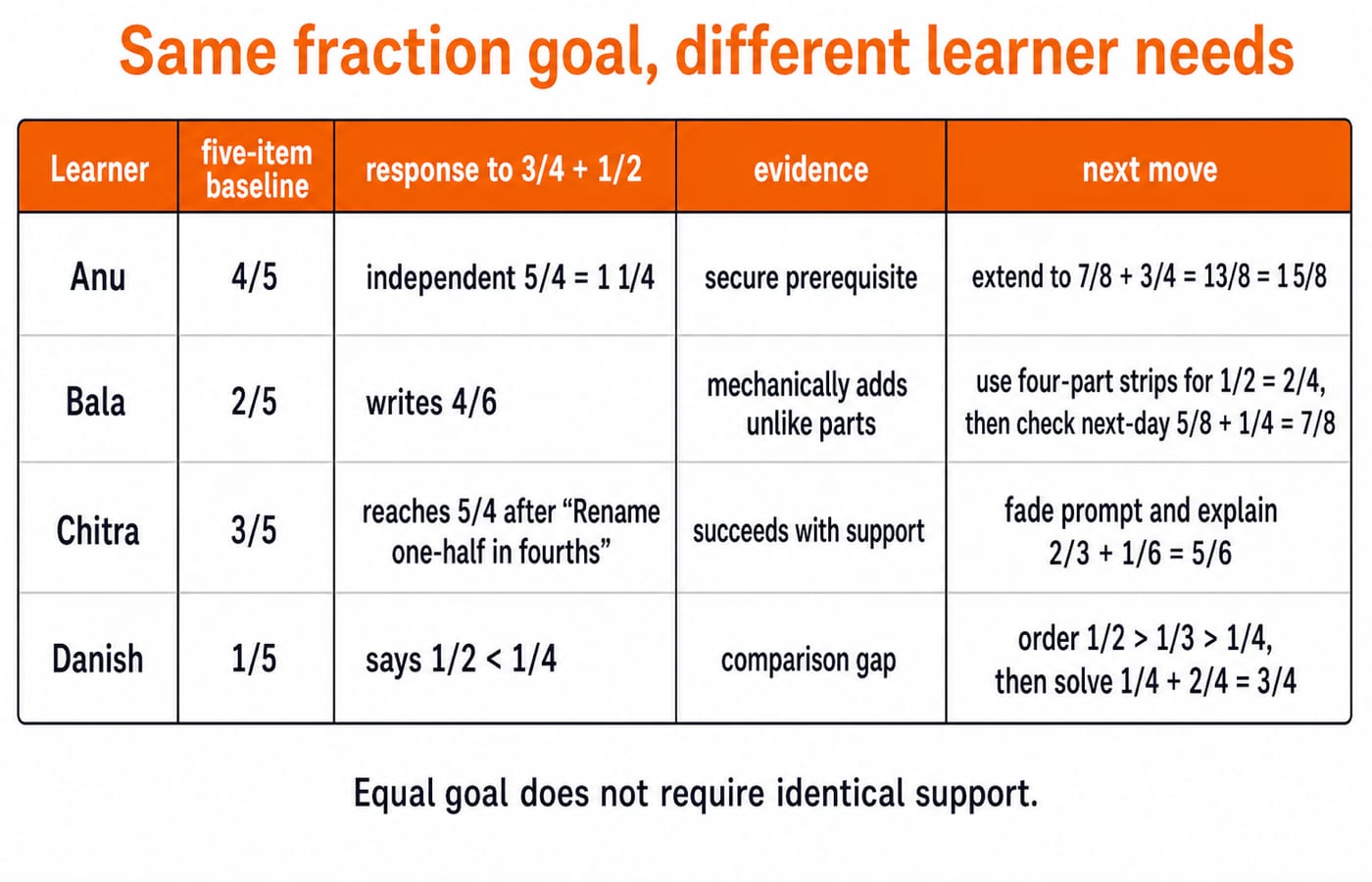
The objective is: “The learner will represent and add unlike fractions and explain why only equal-sized parts can be combined.” A five-item prerequisite check gives Anu 4/5, Bala 2/5, Chitra 3/5 and Danish 1/5.
Anu independently writes
3/4 + 1/2 = 5/4 = 1 1/4. Extend her:7/8 + 3/4 = 7/8 + 6/8 = 13/8 = 1 5/8.Bala writes
4/6, adding unlike parts mechanically. Use four-part strips to rename1/2 = 2/4, then complete3/4 + 2/4 = 5/4. Next day, check5/8 + 1/4 = 5/8 + 2/8 = 7/8independently.Chitra reaches
5/4only after “Rename one-half in fourths.” Fade the prompt and have her explain2/3 + 1/6 = 4/6 + 1/6 = 5/6.Danish says
1/2 < 1/4because 2 is smaller. Rebuild comparison with1/2 > 1/3 > 1/4, then solve1/4 + 2/4 = 3/4before unlike denominators.
The diagnostic exposes prior conceptions. Chitra's prompt counts as scaffolding only when removed. Bala's strip supports reconstruction, while the next-day item checks retention and transfer. Equal goals need not mean identical support. See CTET mathematics pedagogy for the wider application.
The learning cycle: readiness, action, feedback and transfer
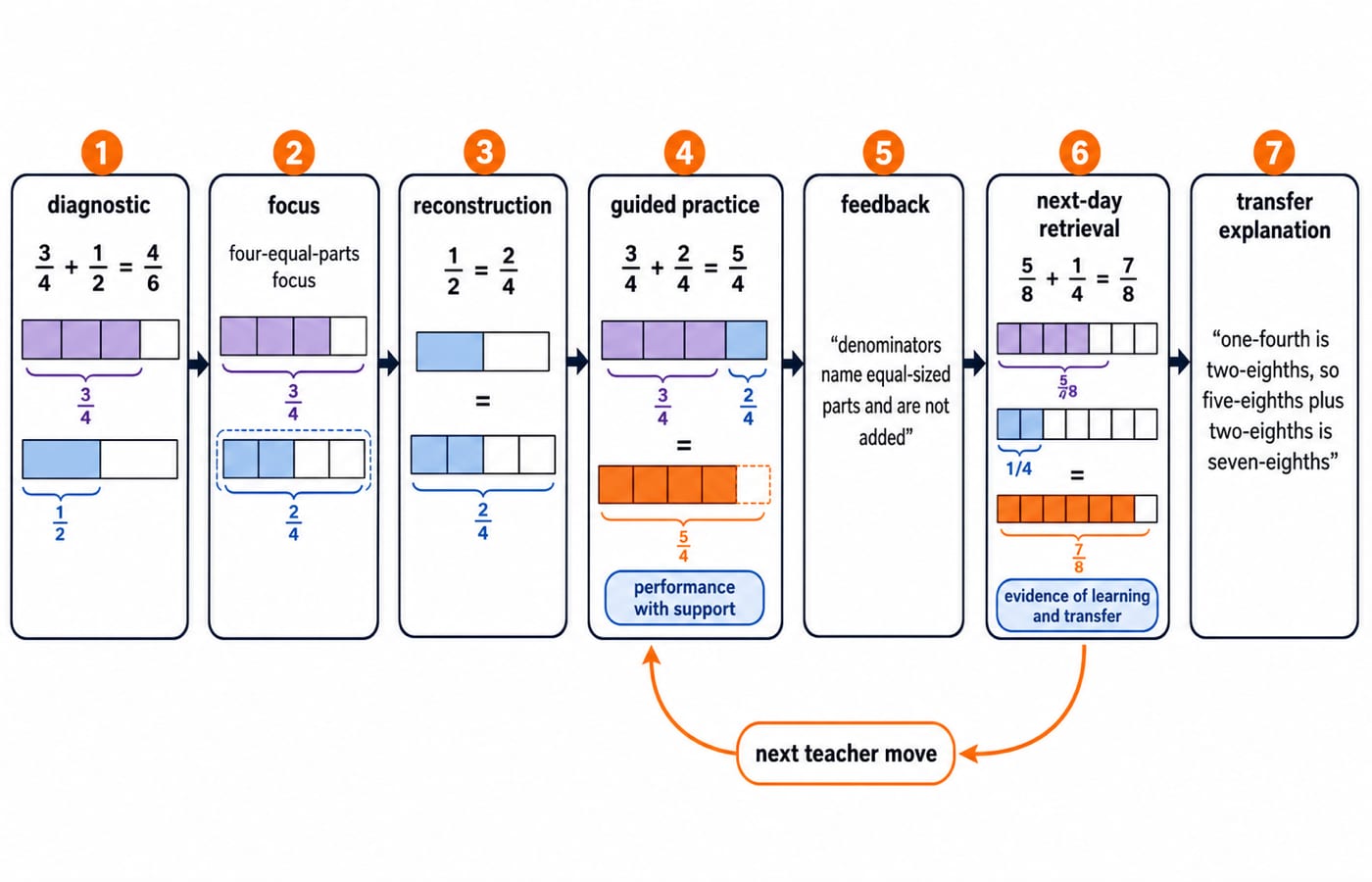
The cycle is: activate prior knowledge, focus on a goal, process actively, practise with a scaffold, receive specific feedback, retrieve later, apply in a changed situation, and reflect. Motivation affects persistence. Feedback must say what to revise, not just praise or mark.
For Bala, 5/4 with strips is supported performance. Independently reaching 7/8 the next day is stronger evidence of learning; explaining that one-fourth is two-eighths shows understanding.
Assessment for learning changes the next teaching move; assessment of learning records attainment. A five-item quiz is formative when errors determine support, but summative when only the score is reported.
How teaching exams turn the concept into questions
Questions ask you to identify a principle, choose a diagnostic or learner-centred response, or separate durable change from temporary performance. CTET, State TETs, UGC NET and recruitment papers differ. Check the relevant body's latest official bulletin for marks, counts, dates, cut-offs and syllabus wording.
Original practice item A: A learner writes 2/5 + 1/5 = 3/10. What should the teacher do first?
(a) Repeat the rule louder.
(b) Deduct marks.
(c) Ask the learner to model three fifths and explain what the denominator names.
(d) Assign ten more sums.
Answer: (c). It diagnoses and reconstructs the misconception.
Original practice item B: After copying a worked solution, a learner solves the identical item but fails when the numbers and context change. What is the best conclusion?
(a) Learning is complete.
(b) Maturation has occurred.
(c) Performance has not yet transferred.
(d) Intelligence is fixed.
Answer: (c). Identical repetition shows performance, not transfer.
High-frequency traps and their corrections
Trap | Why it happens | What goes wrong | Do this instead |
|---|---|---|---|
Equating learning with an immediate correct answer | Visible performance feels sufficient | Retention is ignored | Test unaided retrieval later |
Labelling a learner from one score | Categories feel efficient | The cause of error stays hidden | Diagnose the task-specific gap |
Treating reinforcement as bribery | Both follow behaviour | Purpose and contingency are ignored | Ask whether the consequence strengthens the target response |
Giving a full solution and calling it scaffolding | Help is confused with replacement | Independent control does not develop | Give the least sufficient prompt and fade it |
Assuming activity alone is constructivist | Movement looks like engagement | Prior misconceptions may remain | Require explanation and conceptual change |
Punishing an error first | Control seems quicker than diagnosis | Participation falls while the misunderstanding remains | Examine the reasoning and give corrective feedback |
Option wording is a cue, not a hack. Question absolutes such as “all learners”, “only rewards” or “never use peers” unless required. Prefer responses that generate evidence and build independence.
The short version and the next study move
Learners bring prior knowledge and context.
Learning must outlast the prompt.
Individual differences require evidence, not labels.
Theories are lenses tied to scenario cues.
Feedback should change the next move.
Retrieval and transfer provide strong checks of learning.
For school teaching eligibility preparation, begin with the CTET and UPTET category, then use the CTET Paper 1 course. For UGC NET teaching aptitude, use the NTA UGC NET Paper 1 course.
Now explain the four-learner fraction example aloud. Then solve ten mixed scenario questions and write one line of evidence for every answer.
Keep learning

Guidance, Counselling and Mental Health for Teaching Exams: Concepts, Cases and Exam Traps
Learn to separate guidance, counselling and mental-health support, then apply the distinctions to learner cases without crossing a teacher's professional boundaries.
Updated 23 Oct 20266 min readCTET & UPTET

Classroom Management and Communication for Teaching Exams: Complete Notes and Worked Scenarios
Connect classroom management, communication, feedback, discipline, and teacher immediacy, then practise an exam-style vignette with a step-by-step solution.
Updated 19 Oct 20266 min readCTET & UPTET

Teaching-Learning Aids and ICT Integration for Teaching Exams: Notes with Worked Classroom Examples
Learn how to select and sequence teaching-learning aids, recognise genuine ICT integration, and solve classroom scenarios with worked calculations.
Updated 15 Oct 20265 min readCTET & UPTET

Nature, Objectives and Characteristics of Teaching: Concept Notes for Teaching Exams
Learn to separate what teaching is, what change it seeks and how an effective teaching process operates. A worked fraction lesson connects every concept.
Updated 10 Oct 20265 min readCTET & UPTET