Computer Science pedagogy for teacher recruitment exams: what it tests and how to score it
Computer Science pedagogy for teacher exams: how students learn programming, teaching methods, classroom assessment, CS misconceptions, and how it is tested.
KnowledgeGate Team
Exam prep & CS education
Updated 14 Jul 20265 min read
Most Computer Science graduates preparing for a teaching post study the subject and quietly skip the pedagogy, assuming it is soft, vague, and unscoreable. It is none of those things. Pedagogy is a real, testable body of knowledge about how people learn to program and think computationally, and in almost every teaching exam it carries marks that are easier to earn than the subject questions beside them.
Pedagogy has its own vocabulary and the papers use it precisely. A question will name a method, sketch a classroom situation, or quote a student's error, and expect you to reason from principle rather than recall a definition. DSSSB, KVS, NVS, EMRS, RSSB and the state PGT and TGT computer posts all draw on it, because it sits inside the shared Computer Science core those bodies recruit on (the field is laid out in Teaching jobs for Computer Science graduates compared).
How students learn Computer Science
Learning to program is not learning facts. It is building a mental model of a machine that executes instructions exactly and literally, and most beginner difficulty comes from a weak or wrong model of that machine.
Two ideas anchor the modern understanding:
The notional machine. A learner needs an accurate mental picture of what the computer does when it runs each line: what a variable is, how assignment changes state, how control flows. A wrong notional machine (for example, believing the computer "knows" what you meant) produces bugs the learner cannot even see.
Constructivism. Learners build new understanding on top of existing knowledge. Piaget's constructivism and Papert's constructionism (learning by building shareable artifacts, the root idea behind Logo and block languages) explain why students learn programming far better by writing and debugging real programs than by watching syntax explained.
Novices climb a fixed ladder of skills, and the order is what matters:
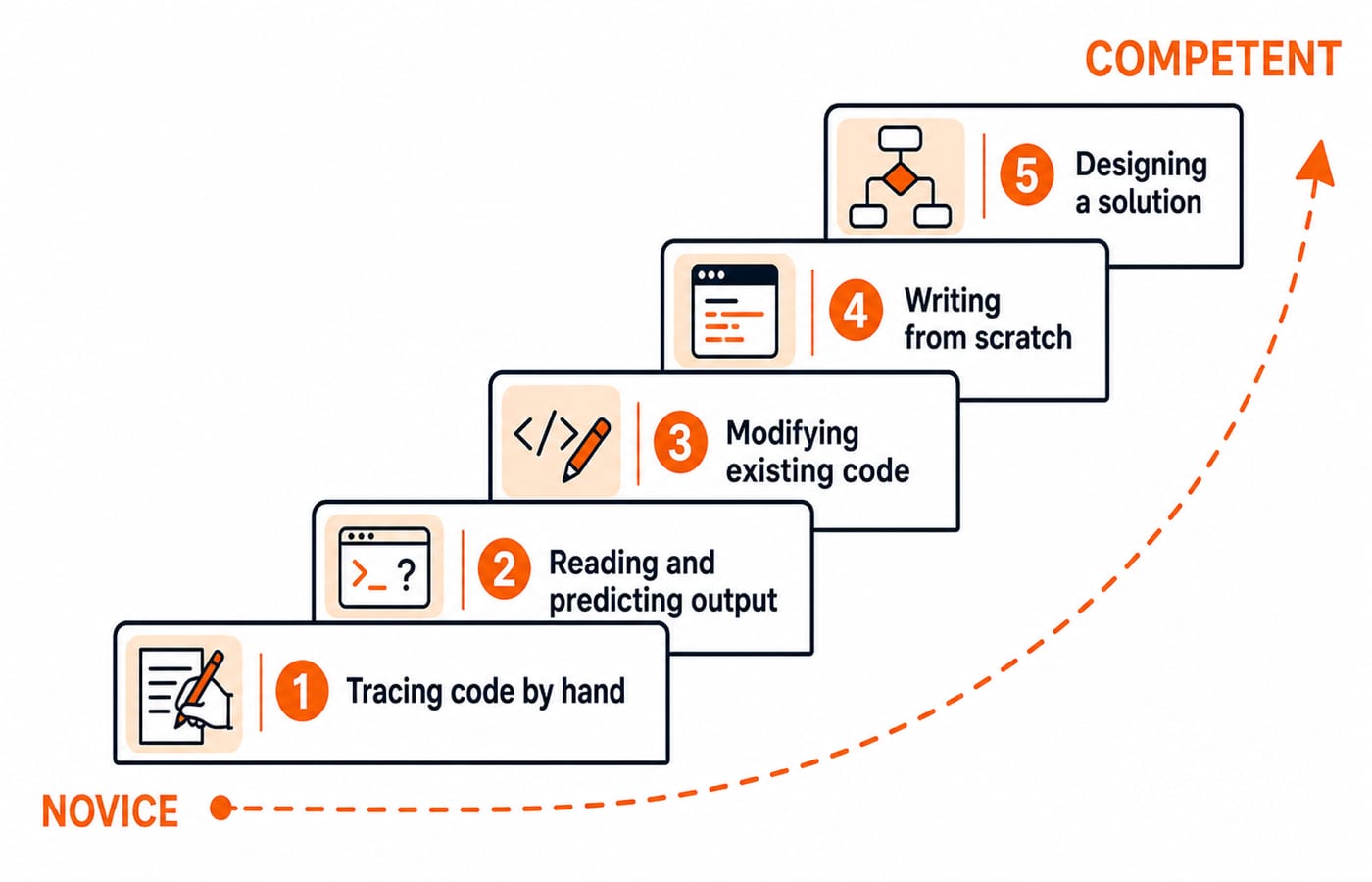
Beginners must be able to trace and read code before they can reliably write it. Teaching that jumps straight to "now write a program" skips the rungs that make writing possible.
Teaching methods that work in Computer Science
The pedagogy portion of these exams rewards knowing named, defensible methods, not adjectives. The high-value ones:
Worked examples and faded guidance. Show a fully solved problem, then gradually remove steps so the learner completes more each time. This manages the heavy cognitive load of early programming.
Pair programming. Two learners, one keyboard, rotating driver and navigator. It surfaces reasoning as talk and catches misconceptions early.
PRIMM (Predict, Run, Investigate, Modify, Make). Learners first predict what code does, run it to check, investigate why, modify it, and only then make their own. It builds reading before writing, exactly the ladder above.
Unplugged activities. Teaching concepts like sorting, searching, or binary representation with no computer at all, using cards, movement, or diagrams, so the concept lands before the syntax.
Live coding. The teacher writes and debugs in front of the class, thinking aloud, so learners see that errors are normal and debugging is a process.
Knowing when each method fits is the scoring skill. Worked examples for a brand-new concept; PRIMM to move from reading to writing; pair programming to expose reasoning; unplugged to separate concept from syntax.
Classroom assessment in Computer Science
Assessment is not only the end-of-term test. The distinctions the exam wants:
Formative vs summative. Formative assessment happens during learning to guide it (a quick trace exercise, a debugging task, questioning). Summative assessment measures learning at the end (a project, a written test). Good CS teaching is heavy on formative checks because misconceptions compound fast.
Assessment of, for, and as learning. Of learning grades it; for learning informs teaching; as learning builds the student's own self-monitoring (for example, testing their own code).
Authentic assessment. Judging a real program the student built and can explain is more valid than a syntax-recall quiz.
A practical rule to carry in: assess the mental model, not just the output. A program that happens to work can still hide a broken understanding, so ask the learner to predict, explain, and modify.
Common Computer Science misconceptions to teach around
Exam questions frequently describe a student error and ask for the misconception behind it or the fix. The classic ones:
Believing a variable holds a history of values rather than only its current one.
Thinking assignment (
a = b) is symmetric or that it links the two variables permanently.Expecting the computer to infer intent rather than execute instructions literally.
Confusing the condition of a loop with a promise the computer keeps watching continuously.
Treating
=(assignment) and==(comparison) as the same thing.
The teaching response is almost always the same shape: expose the misconception with a prediction task, then let the learner see the machine's actual behaviour, then reconcile the two. You cannot correct a mental model the learner cannot see.
Designing a Computer Science lesson
A defensible lesson structure the exam rewards:
Objective. One clear, observable learning outcome ("the learner can trace a for-loop and predict its output").
Hook and prior knowledge. Connect to what the learner already knows; surface misconceptions early.
Input with worked examples. Model the concept, thinking aloud.
Guided practice with faded support. Learners do progressively more, often in pairs, using PRIMM.
Independent practice. Learners apply it themselves.
Formative check and close. A quick trace, predict, or debug task that tells you whether the objective was met.
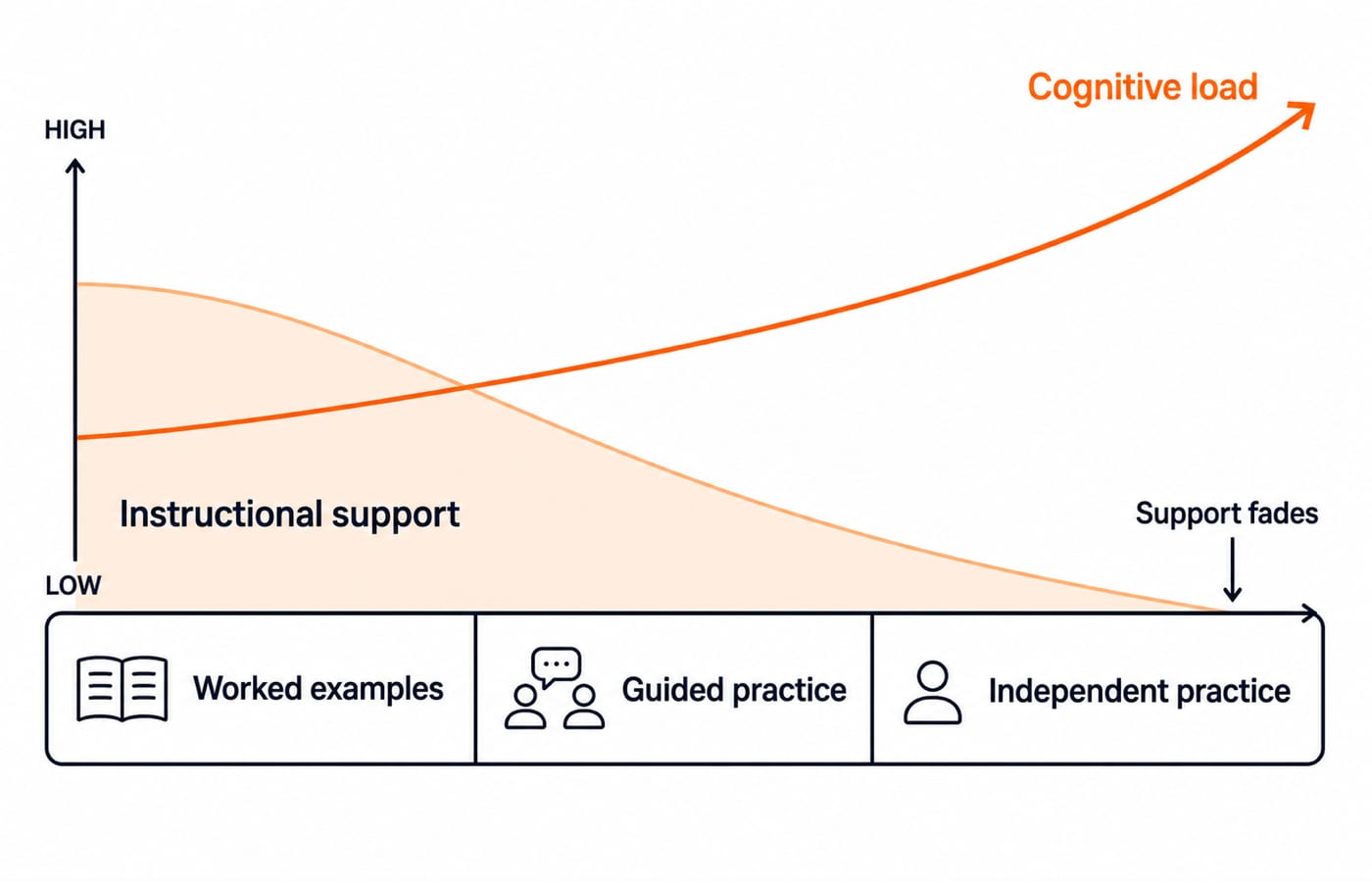
That arc is the gradual release of responsibility, I do, we do, you do, with the fading placed exactly where the cognitive load of programming is heaviest.
How Computer Science pedagogy is tested
Knowing the content is half of it; recognising how the paper asks about it is the other half.
Scenario questions. A short classroom situation ("students keep confusing
=and==") and you choose the best teaching response. These reward method knowledge, not definitions.Method-matching. Naming or selecting the right method (PRIMM, pair programming, unplugged) for a given aim.
Assessment questions. Distinguishing formative from summative, or picking an appropriate assessment for an objective.
Misconception questions. Identifying the underlying error behind a described student mistake.
Lesson-design questions. Sequencing activities correctly, usually rewarding reading-before-writing and worked-examples-before-independent-work.
Prepare by reasoning from the principles above, not by rote. If you understand the notional machine, the reading-before-writing ladder, and formative assessment, you can answer scenario questions you have never seen. The exact placement and weight of the pedagogy portion is set in your target exam's official notification, so confirm it there. Pedagogy sits on the same paper as the subject questions, and that side of the core is covered in our coding and CS fundamentals hub.
Computer Science pedagogy: the short version
CS pedagogy is teachable, testable knowledge: build the learner's notional machine, teach reading before writing, use worked examples and PRIMM, assess formatively, and correct misconceptions by making the machine's behaviour visible. It is often the most scoreable part of a teaching paper.
Prepare the shared teaching core, pedagogy included, with the Teaching Recruitment Exams bundle, and see the government teaching jobs category for the posts it prepares you for.
Keep learning

Guidance, Counselling and Mental Health for Teaching Exams: Concepts, Cases and Exam Traps
Learn to separate guidance, counselling and mental-health support, then apply the distinctions to learner cases without crossing a teacher's professional boundaries.
Updated 23 Oct 20266 min readCTET & UPTET
Classroom Management and Communication for Teaching Exams: Complete Notes and Worked Scenarios
Connect classroom management, communication, feedback, discipline, and teacher immediacy, then practise an exam-style vignette with a step-by-step solution.
Updated 19 Oct 20266 min readCTET & UPTET

Teaching-Learning Aids and ICT Integration for Teaching Exams: Notes with Worked Classroom Examples
Learn how to select and sequence teaching-learning aids, recognise genuine ICT integration, and solve classroom scenarios with worked calculations.
Updated 15 Oct 20265 min readCTET & UPTET
Nature, Objectives and Characteristics of Teaching: Concept Notes for Teaching Exams
Learn to separate what teaching is, what change it seeks and how an effective teaching process operates. A worked fraction lesson connects every concept.
Updated 10 Oct 20265 min readCTET & UPTET