National Education Policy (NEP) 2020 Notes for Teaching Exams: 5+3+3+4, Reforms and MCQ Traps
Build an exam-ready map of NEP 2020, from the age-stage structure to pedagogy, language, PARAKH, B.Ed. routes and reliable distractor elimination.
KnowledgeGate Team
Exam prep & CS education
Updated 26 Sep 20265 min read
NEP 2020 options often change one age band, remove "wherever possible", or present a policy proposal as an implemented rule. For CTET and UPTET Teaching Eligibility Test Prep, map school structure, pedagogy, language, assessment and teacher education together. An age path and elimination rules expose traps.
NEP 2020: the exam-ready frame and source rule
NEP 2020 is India's reform policy for school and higher education. It is not an Act, examination or curriculum framework, nor proof of uniform implementation in every State.
The Ministry of Education's NEP 2020 page and policy text emphasise holistic learning, flexibility, choice, equity, inclusion, foundational and competency-based learning, less rote recall, and no hard separation among arts, sciences and vocational study.
Policy statement | Time-bound target in the 2020 text | Current implementation claim |
|---|---|---|
Universal foundational literacy and numeracy | The policy set 2025 as its target | Do not call it achieved without a separate official implementation source |
Apply that rule to 2030 and 2035 targets too: check a current official source before claiming implementation.
NEP 2020 5+3+3+4 structure, from age 3 to 18
Stage | Years, grades and broad ages |
|---|---|
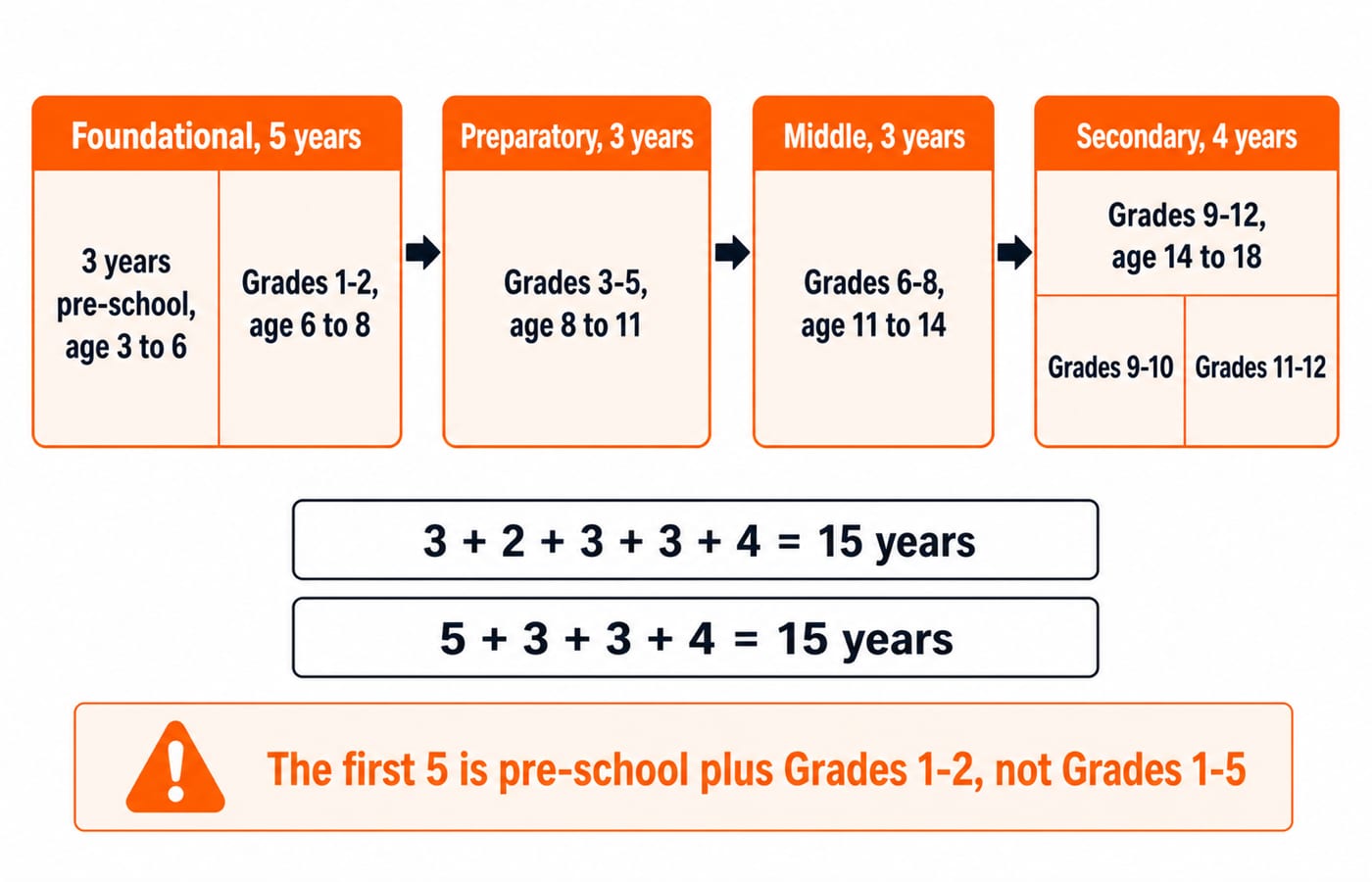
Foundational | 5 years: 3 years of Anganwadi or pre-school plus Grades 1-2, ages 3-8 |
Preparatory | 3 years: Grades 3-5, ages 8-11 |
Middle | 3 years: Grades 6-8, ages 11-14 |
Secondary | 4 years: Grades 9-12, split into Grades 9-10 and 11-12, ages 14-18 |
Work one path. Entry at age 3 plus 3 pre-school years reaches age 6. Grades 1-2 add 2 years, completing the Foundational Stage at about 8. Grades 3-5 reach about 11, Grades 6-8 about 14, and Grades 9-12 about 18.
Both checks agree: 3 + 2 + 3 + 3 + 4 = 15 years, and 5 + 3 + 3 + 4 = 15 years. The first 5 is not Grades 1-5. ECCE ages 3-6 is within the wider Foundational Stage. Secondary is Grades 9-12, not only 11-12.
NEP 2020 pedagogy: ECCE, FLN and competency
ECCE centres the early years on play, activity, discovery and flexible multilevel learning. FLN means foundational literacy and numeracy, expected by Grade 3. The policy set 2025 as its universal FLN target, not a proven outcome.
Reducing mandated content to core concepts makes space for inquiry, discussion, problem-solving, storytelling and integrated learning. It means depth around essentials, not reduced rigour.
Dictating a definition is recall-led; comparing observations and justifying a conclusion is competency-led. Role-play without reflection gives incomplete evidence. Curriculum Framework and Reforms for Teaching Exams: NCF 2005, NEP 2020 and NCF-SE 2023 Notes follows the policy-to-framework-to-classroom chain. NEP-specific questions require precise pedagogy terms and qualifiers.
NEP 2020 language and vocational exposure: retain qualifiers
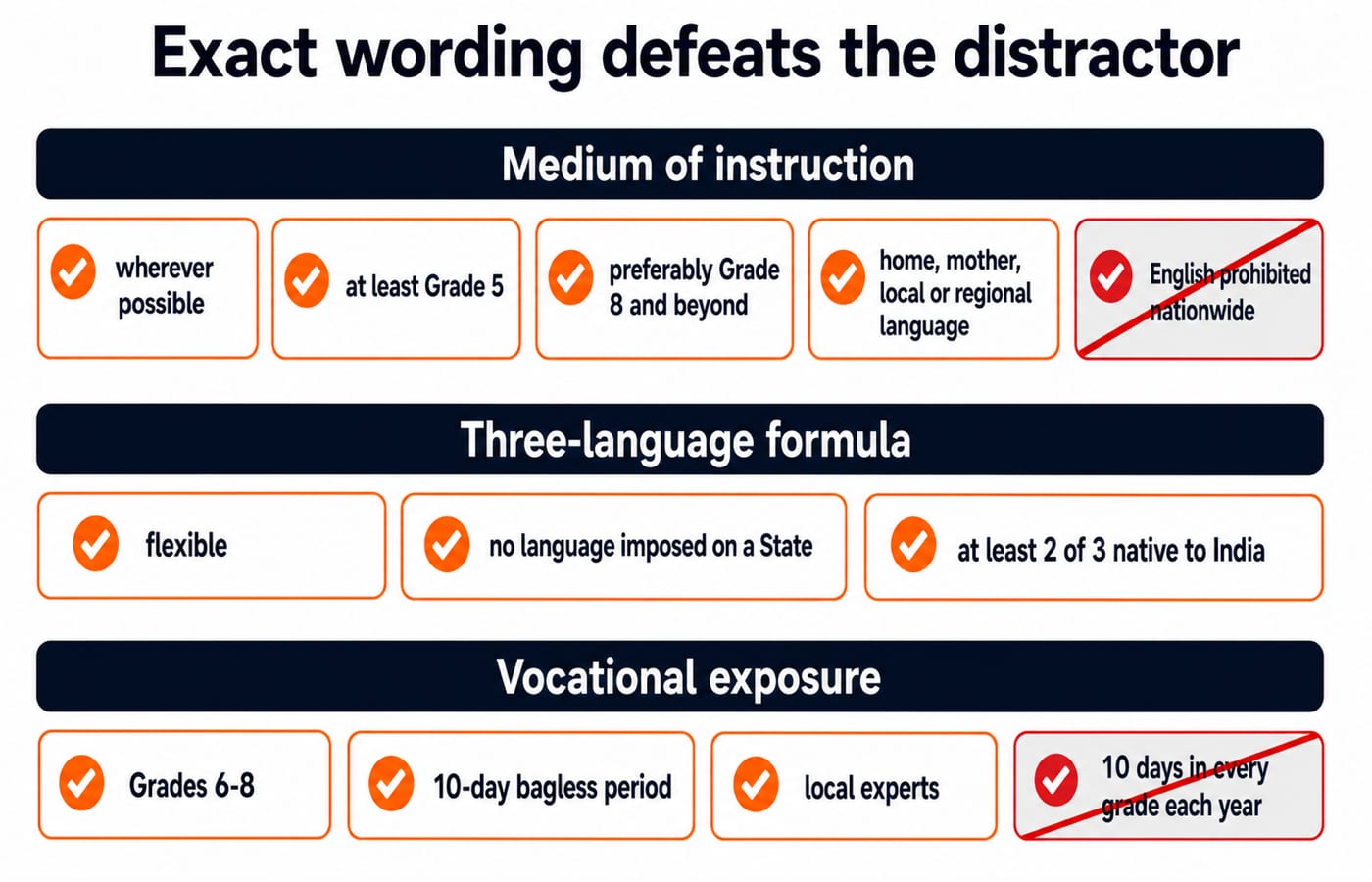
NEP 2020 says that, wherever possible, the medium until at least Grade 5, preferably till Grade 8 and beyond, will be the home, mother, local or regional language. This is not a ban on another medium. The three-language formula is flexible, imposes no language on a State, and keeps at least two languages native to India.
No hard separation permits Physics, Music and a vocational subject together, but does not guarantee every school offers them. The policy envisages a hands-on vocational course and a 10-day bagless period sometime during Grades 6-8, with local experts, not ten days in every grade each year.
NEP 2020 assessment reform, progress cards and PARAKH
The policy shifts from recall-heavy summative testing towards formative, competency-based assessment. Its proposed holistic progress card covers cognitive, affective and psychomotor domains, drawing on self, peer and teacher assessment without a percentage formula.
Compare "Define inclusion" with a classroom case: a learner understands the concept but cannot yet follow the language of instruction. Asking candidates to identify the barrier, preserve the learning goal and justify support tests application. Feedback on the missing element turns the rubric into a formative tool.
PARAKH is Performance Assessment, Review, and Analysis of Knowledge for Holistic Development. The proposed standard-setting body sets assessment norms and guidelines, guides State Achievement Surveys and undertakes the National Achievement Survey. It is not a school board.
NEP 2020 teacher education and higher education reforms
Policy route | What the 2020 text says |
|---|---|
4-year integrated B.Ed. | Set as the minimum degree qualification for school teachers by 2030 |
2-year B.Ed. | Route for those with a Bachelor's degree in another specialised subject |
1-year B.Ed. | May be offered after an appropriate 4-year Bachelor's degree or Master's degree |
Current NCTE, university and recruitment rules still govern. NEP 2020 also envisages multidisciplinary study, an Academic Bank of Credit, multiple entry and exit, linked Master's routes and discontinuing M.Phil. For the year-by-year exit-award map, use Types of Education and NEP 2020 for Teaching Exams: Complete Higher Education Notes. The linked note classifies higher-education pathways. NEP teacher-education questions instead distinguish qualification routes from the wider reform map.
For HECI, remember four proposed verticals: NHERC for regulation, NAC for accreditation, HEGC for funding and GEC for academic standard setting.
Teaching-exam NEP 2020 traps and one solved MCQ
Questions may match stages to ages, remove qualifiers, classify classroom activity, expand an institution, separate school from higher-education reform, or turn a target into a current rule. Check the exam authority's current official syllabus for inclusion.
Which statement matches the NEP 2020 policy text?
A. The Foundational Stage means Grades 1-5.
B. The Middle Stage covers Grades 6-8 and broadly ages 11-14.
C. The home language is compulsory as the medium in every school through Grade 12.
D. The 10-day bagless period is specified for Grades 9-12.
Answer: B. A omits three pre-school years plus Grades 1-2. C removes "wherever possible" and changes the grade guidance. D moves a Grades 6-8 provision.
Tempting option | Exact repair |
|---|---|
10+2 is simply renamed | It is pedagogically and curricularly restructured |
Foundational means Grades 1-5 | It is 3 pre-school years plus Grades 1-2 |
FLN by 2025 is a proven result | It was a target in the 2020 text |
Mother tongue is an absolute mandate | Retain "wherever possible" |
PARAKH is a school board | It is proposed as a standard-setting body |
4-year B.Ed. is today's only route | Check current rules, the policy describes multiple routes |
NEP 2020 in eight lines and the next revision step
5+3+3+4.
Ages 3-8, 8-11, 11-14 and 14-18.
FLN by Grade 3.
Core concepts over rote overload.
Language guidance keeps "wherever possible".
The 10-day bagless period sits in Grades 6-8.
Holistic progress card plus PARAKH.
Teacher-education and higher-education reforms are policy provisions, so verify current rules officially.
Primary-level aspirants can use the CTET Paper 1 Course 2026, while upper-primary aspirants can use the CTET Paper 2 Course 2026.
Redraw 5+3+3+4 without looking, then restore every age, grade and qualifier.
Keep learning
सामान्य अशुद्धियाँ (Samanya Ashuddhiyaan): Complete Hindi Grammar Notes for CTET and TET Exams
Learn to identify and correct Hindi word-form, agreement, pronoun and redundancy errors through exact examples, a worked MCQ and a scored diagnostic.
Updated 6 Oct 20266 min readCTET & UPTET
Universities and Learning Programmes for Teaching Exams: Types, Modes and Solved Examples
Separate university status, delivery mode and programme purpose with a repeatable method, then test it on five UGC NET-style classification cases.
Updated 2 Oct 20265 min readCTET & UPTET

Miscellaneous Pedagogy Topics for Teaching Exams: Complete Notes and Worked Examples
Turn a loose syllabus label into a five-part concept map, then use classroom evidence to distinguish sound pedagogy from attractive but incomplete options.
Updated 25 Sep 20266 min readCTET & UPTET
Mental Health and Life Skills for Teaching Exams: Complete Notes, Examples and Traps
Revise mental health, ten life skills and counselling approaches through clear contrasts, classroom examples and fast option-elimination rules.
Updated 23 Sep 20265 min readCTET & UPTET