Theory of Computation for GATE: Syllabus Map, Weightage Audit and Preparation Order
Map the official Theory of Computation syllabus, audit its completed GATE 2026 paper weightage, and revise finite automata, PDA and Turing machines in dependency order.
KnowledgeGate Team
Exam prep & CS education
Updated 19 Aug 20265 min read
Theory of Computation looks like one subject, but its models, language classes and proof methods overlap. The official GATE syllabus fixes its scope in four blocks and assigns no permanent weightage to any of them, so a remembered percentage is worth less than a count taken off the completed papers. The order in which you learn the four blocks matters just as much: a pumping argument is unusable until you can already name the language class you are arguing about.
1. Theory of Computation for GATE: What the Official Syllabus Covers
IIT Guwahati's official GATE 2026 test papers and syllabus page fixes the CS scope in four blocks:
Official syllabus block | Skill the learner must demonstrate | What you must practise |
|---|---|---|
(1) Regular expressions and finite automata | Construct, trace and convert automata | Regular-model construction and conversion |
(2) Context-free grammars and push-down automata | Derive strings and reason with a stack | Grammar and stack-memory study |
(3) Regular and context-free languages, pumping lemma | Classify languages and use pumping arguments | Language proofs |
(4) Turing machines and undecidability | Distinguish recognition, decision and undecidability | Computability study |
KnowledgeGate's GATE Guidance course carries all four blocks in a single Theory of Computation module, and the official syllabus page stays the authority on scope. For the wider catalogue, see GATE CS Exam Preparation Courses and Test Series.
2. Theory of Computation Syllabus Areas Form a Dependency Map
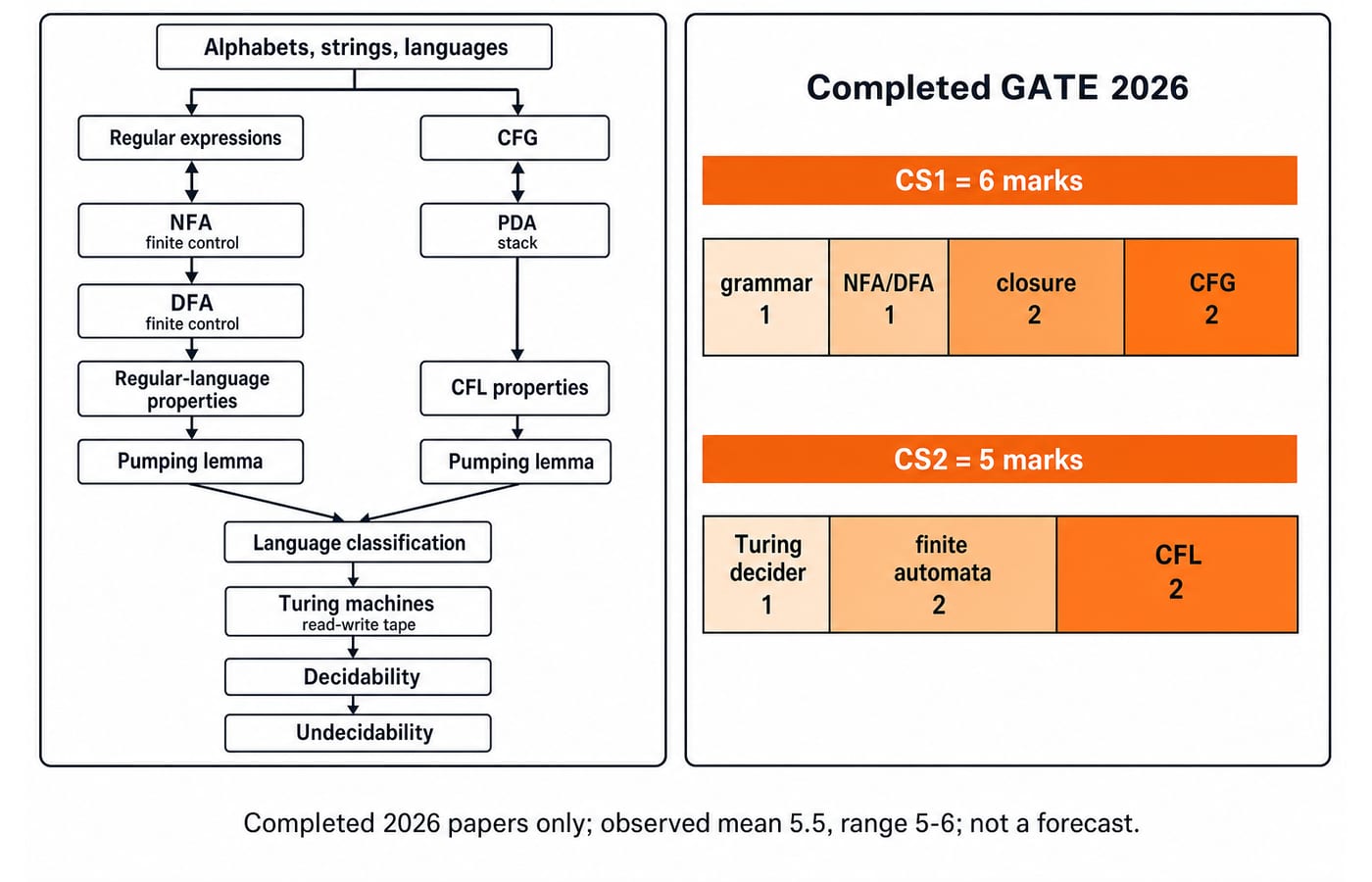
Begin with alphabets, strings and languages. Then study regular expressions, NFA and DFA through Finite Automata: DFA vs NFA Explained, followed by regular-language closure and pumping arguments. Next come CFG derivations and PDA stack behaviour in Context-Free Grammars and Pushdown Automata, then CFL properties and pumping arguments. Finish with Turing Machines and Decidability Explained.
A pumping lemma is mainly a non-membership proof tool, not a machine-construction recipe, so this order stops you attempting a proof before you can name the model and the closure property it needs. The memory progression is the spine: finite automata have finite control, a PDA adds an unbounded stack, and a Turing machine has read-write tape memory.
3. Theory of Computation Weightage: Audit the Completed 2026 Papers
Both GATE 2026 CS master papers are complete and public, so the marks here are counted, not estimated.
Paper | Classified Theory of Computation questions | Total |
|---|---|---|
CS1 | Q25 grammar, 1 mark; Q26 NFA to minimal-DFA state count, 1 mark; Q51 regular/CFL closure, 2 marks; Q52 CFG language counts, 2 marks | 1 + 1 + 2 + 2 = 6 marks |
CS2 | Q13 meaning of a Turing machine deciding a language, 1 mark; Q47 finite-automata language comparison, 2 marks; Q48 context-free-language constraints, 2 marks | 1 + 2 + 2 = 5 marks |
Per-paper totals are 6 and 5, a mean of (6 + 5) / 2 = 5.5 and an observed range of 5 to 6. Each candidate sat one paper only, so nobody faced all 11 marks. Two papers is a sample of two: 5.5 is what happened in 2026, not a percentage you can carry into the next paper.
4. Worked Theory of Computation Examples Across the Three Machine Levels
For finite control, define a DFA for binary strings with an even number of 1s. Let E be start and accept, and O the other state. Input 0 keeps the state; 1 toggles it. On 101101, trace E -> O -> O -> E -> O -> O -> E. Four 1s end in E, so the DFA accepts.
For stack memory, use S -> 0S1 | epsilon for L = {0^n1^n | n >= 0}. Derive 0011 as S => 0S1 => 00S11 => 0011. The second expansion creates another pending 1, showing why unbounded matching needs a PDA stack.
For tape memory, a decider for L = {w in {0,1}* | w contains at least one 1} scans right, accepts on the first 1, and rejects on blank. Thus 000 reaches blank and rejects, while 00100 accepts on its third symbol. Both paths halt, so it is a decider.
5. How GATE Tests Theory of Computation
Four actions cover almost every ToC question in the paper.
Trace or compare automata, and convert an NFA to a DFA while reasoning about the resulting state bound.
Inspect a derivation for ambiguity, for the strings it generates, or for how many of them there are.
Classify a language using closure properties, a pumping argument or the power of the machine that accepts it.
Separate Turing recognition from decision, and both from undecidability.
The 2026 papers exercised all four: both shifts mixed one-mark and two-mark questions across different blocks, and neither shift concentrated on one action. KnowledgeGate's bank carries over 1,000 published Theory of Computation questions, which is enough practice for every block, though the number of questions available on a topic says nothing about how heavily GATE weights it.
6. Theory of Computation Preparation Order: An 18-Hour Diagnostic Cycle
This cycle is built for revision and error diagnosis, so each phase assumes you have met the material at least once.
Phase | Work | Total |
|---|---|---|
1. Regular foundations | Two 90-minute concept/problem sessions plus one 60-minute timed set | 4 hours |
2. CFG and PDA | Two 90-minute concept/problem sessions plus one 60-minute timed set | 4 hours |
3. Language properties and pumping | Two 60-minute sessions plus one 60-minute error redo | 3 hours |
4. Turing machines and undecidability | Two 60-minute sessions plus one 60-minute error redo | 3 hours |
5. Mixed audit practice | Two 75-minute timed sets plus two 45-minute reviews | 4 hours |
The sum is 4 + 4 + 3 + 3 + 4 = 18 hours. During review, tag each miss as model choice, construction, trace, proof or definition. If you miss a study day, continue the unfinished phase instead of doubling the next day's load. Beginners should slow the phases down, not skip prerequisites.
7. Theory of Computation Mistakes That Distort Weightage and Revision
Mistake | What goes wrong | Better move |
|---|---|---|
Treating CS1 | One cycle becomes a false forecast | Re-audit completed official papers |
Studying by descending question-bank count | Volume replaces the syllabus boundary | Follow the official boundary and dependency map |
Memorising DFA or PDA diagrams without tracing | Recognition replaces executable understanding | Reproduce |
Invoking pumping lemma too early | Class and goal stay unclear | Write the target class, closure tools and proof goal first |
Grammar appears under compiler design as well. Before filing a grammar question under ToC in an audit, decide which skill it tests: parsing, precedence and parse-table construction belong to compiler design, while language classification, ambiguity and closure belong here.
8. Theory of Computation for GATE: The Short Version
Keep four points: study the official four-block scope; move from finite control to stack to tape; treat 6 and 5 as a count from the completed 2026 papers and nothing more; tag every miss before you move on. Take GATE Guidance by Sanchit Sir as the structured route, or redraw the dependency map, reproduce the 101101 trace, the 0011 derivation and the tape decider from blank paper, and run the 18-hour cycle yourself.
Keep learning
Linear Bounded Automata: Tape Limits, a Worked LBA Trace and Exam Traps
See exactly what an LBA bounds, where it sits in the language hierarchy, and how a six-cell marking machine accepts aabbcc while rejecting three near misses.
Updated 4 Oct 20266 min readTheory of Computation
Decision Properties in Theory of Computation: DFA Tests, CFG Boundaries and Turing Machine Undecidability
Learn an algorithm-first way to classify membership, emptiness, finiteness, inclusion, equivalence and universality for DFAs, CFGs and Turing machines.
Updated 29 Sep 20266 min readTheory of Computation
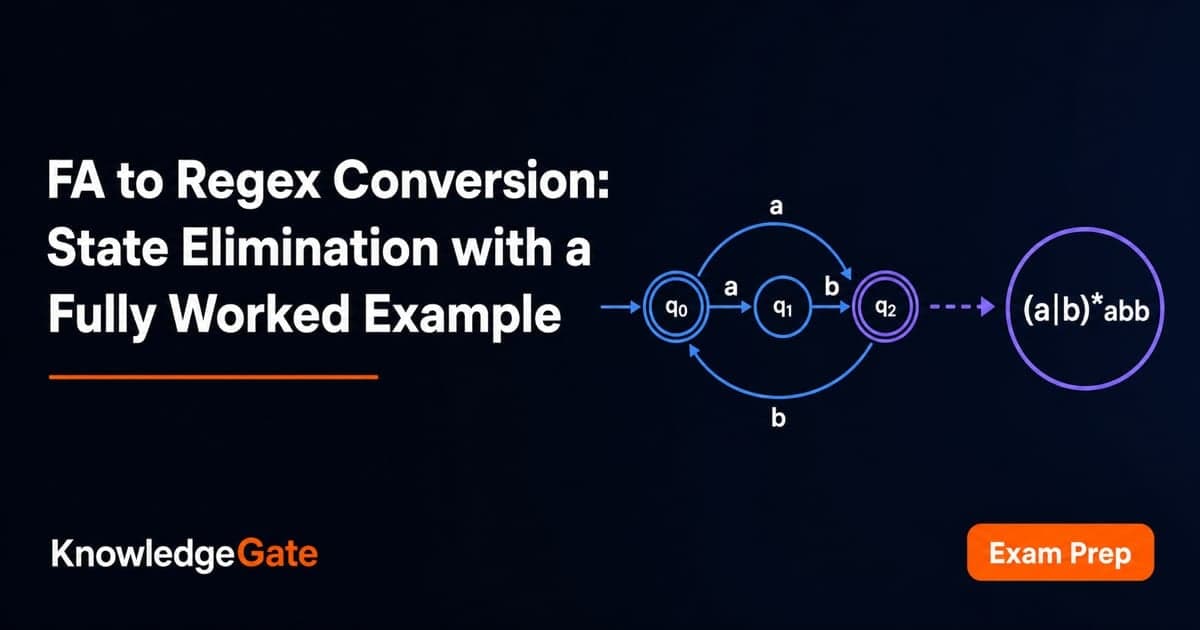
FA to Regex Conversion: State Elimination with a Fully Worked Example
Learn a mechanical state-elimination method for converting a finite automaton to a regular expression, then verify the result with a second order and short strings.
Updated 25 Sep 20265 min readTheory of Computation
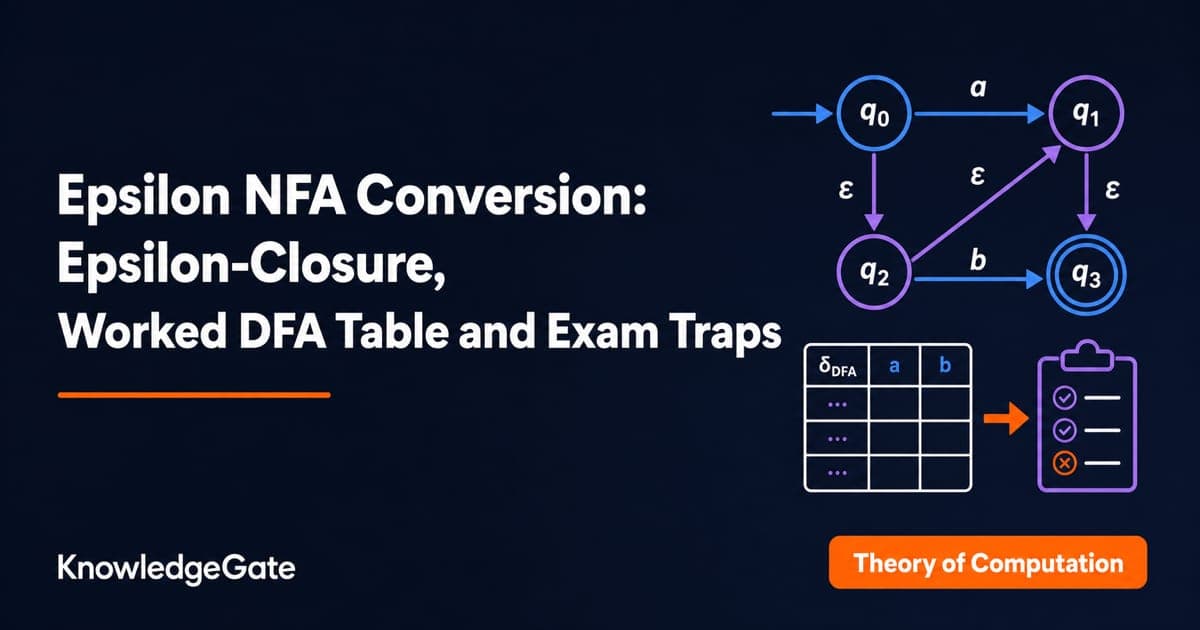
Epsilon NFA Conversion: Epsilon-Closure, Worked DFA Table and Exam Traps
Learn a mechanical epsilon-NFA conversion method through one four-state machine, complete set traces, a reachable-subset DFA table, and epsilon elimination.
Updated 24 Sep 20266 min readTheory of Computation