Non-Deterministic Finite Automata (NFA): Design, Epsilon Closures and NFA-to-DFA Conversion
Learn to follow every branch of an NFA without guesswork. Two worked machines connect active-state sets, epsilon closure and a complete eight-state DFA conversion.
KnowledgeGate Team
Exam prep & CS education
Updated 17 Aug 20266 min read
An NFA can be in several possible states after one input prefix. That feels like guesswork until you remember the acceptance rule: only one complete path needs to finish in a final state. Tracking the whole set of active states turns that rule into ordinary bookkeeping. The four-state NFA below, for the language whose third symbol from the right is 1, reaches exactly eight distinct active sets, and those eight sets are the states of an equivalent DFA.
Related reading: NFA to DFA conversion and epsilon NFA conversion.
What makes a finite automaton non-deterministic
An NFA without epsilon moves is N = (Q, Sigma, delta, q0, F), where delta: Q x Sigma -> P(Q). Its transition function returns a set, unlike a DFA transition function, which returns exactly one state. Thus delta(q,a) may contain no state, one state, or several states. A missing NFA transition need not be drawn as an explicit dead state.
For w = a1a2...ak, acceptance means that at least one path starts at q0, consumes all k symbols in order, and ends in F. To simulate all paths together, take S0 = {q0} and compute each Si as the union of delta(q,ai) over every q in S(i-1). Accept exactly when Sk intersects F.
This is mathematical branching, not randomness. The machine gives the same answer every time. See Finite Automata: DFA vs NFA and Subset Construction for the side-by-side comparison and a smaller three-state conversion.
Worked NFA design: the third symbol from the right is 1
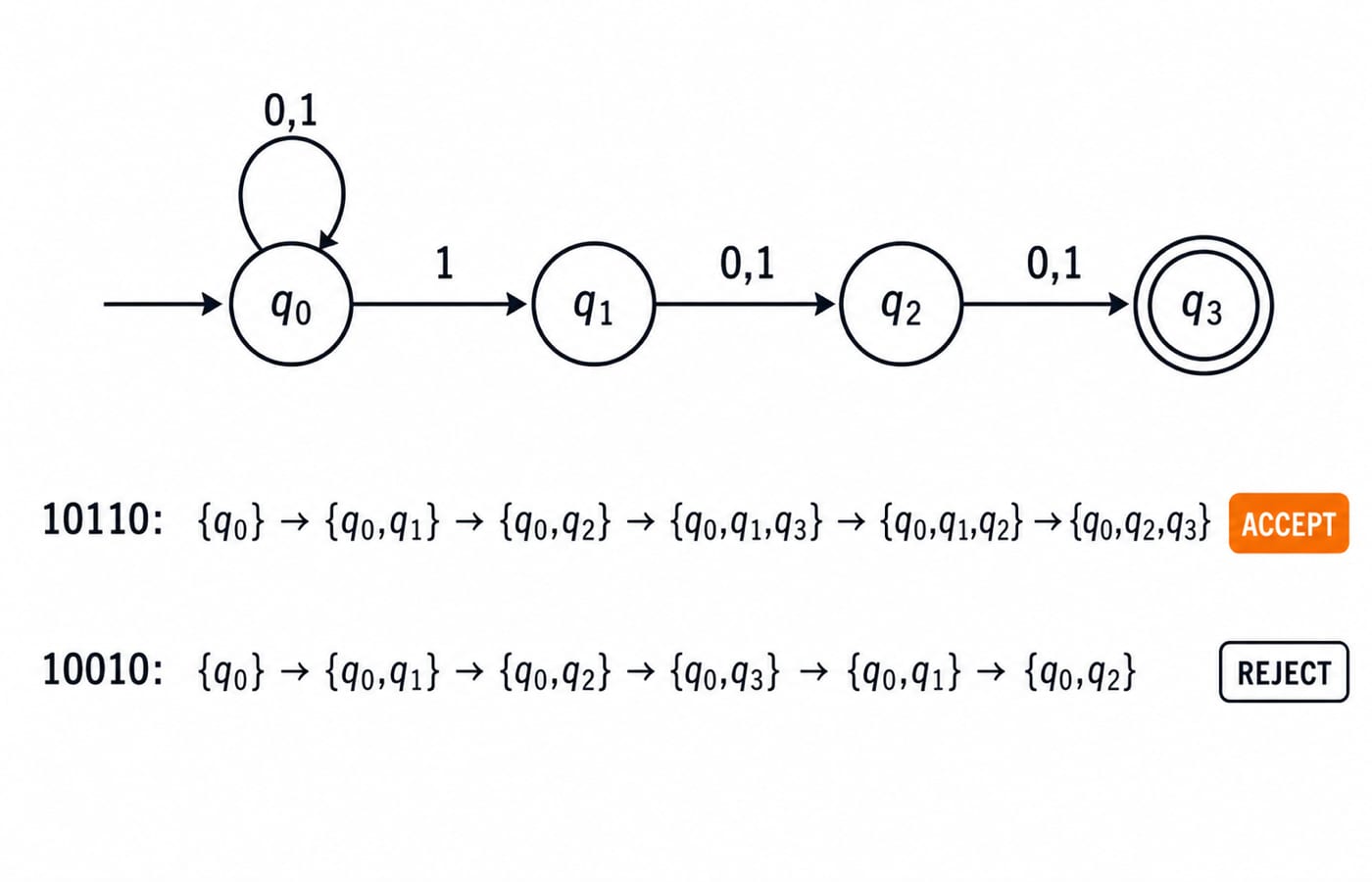
Consider L = {w in {0,1}* | |w| >= 3 and the third symbol from the right is 1}. Use start state q0, checkpoints q1 and q2, and final state q3:
State | On | On |
|---|---|---|
|
|
|
|
|
|
|
|
|
| empty | empty |
The loop at q0 scans any prefix. On a 1, a second branch may enter q1, guessing that this symbol is third from the end. Exactly two more symbols carry it through q2 to q3. Extra input kills that branch because q3 has no outgoing transition, but a later guess may survive.
Trace 10110:
{q0} -> {q0,q1} -> {q0,q2} -> {q0,q1,q3} -> {q0,q1,q2} -> {q0,q2,q3}
The final set contains q3, so accept. For 10010:
{q0} -> {q0,q1} -> {q0,q2} -> {q0,q3} -> {q0,q1} -> {q0,q2}
The earlier visit to q3 is not enough because input remained. The final set excludes q3, so reject.
Epsilon-NFAs and the epsilon-closure routine
An epsilon-NFA uses delta: Q x (Sigma union {epsilon}) -> P(Q). An epsilon edge changes state without consuming a character. The epsilon-closure(S) contains S itself and every state reachable from it through zero or more epsilon moves.
For L = 0* union 1*, make non-final start s, add s --epsilon--> a and s --epsilon--> b, make a and b final, give a only a 0 loop and b only a 1 loop. The start closure is {s,a,b}, so epsilon is accepted. The traces are:
000: {s,a,b} -> {a} -> {a} -> {a}111: {s,a,b} -> {b} -> {b} -> {b}001: {s,a,b} -> {a} -> {a} -> empty, so reject
Always apply S0 = epsilon-closure({s}), then Si = epsilon-closure(move(S(i-1),x)). Epsilon moves can be eliminated and do not create languages beyond the regular languages.
Convert the worked NFA to a DFA by subset construction
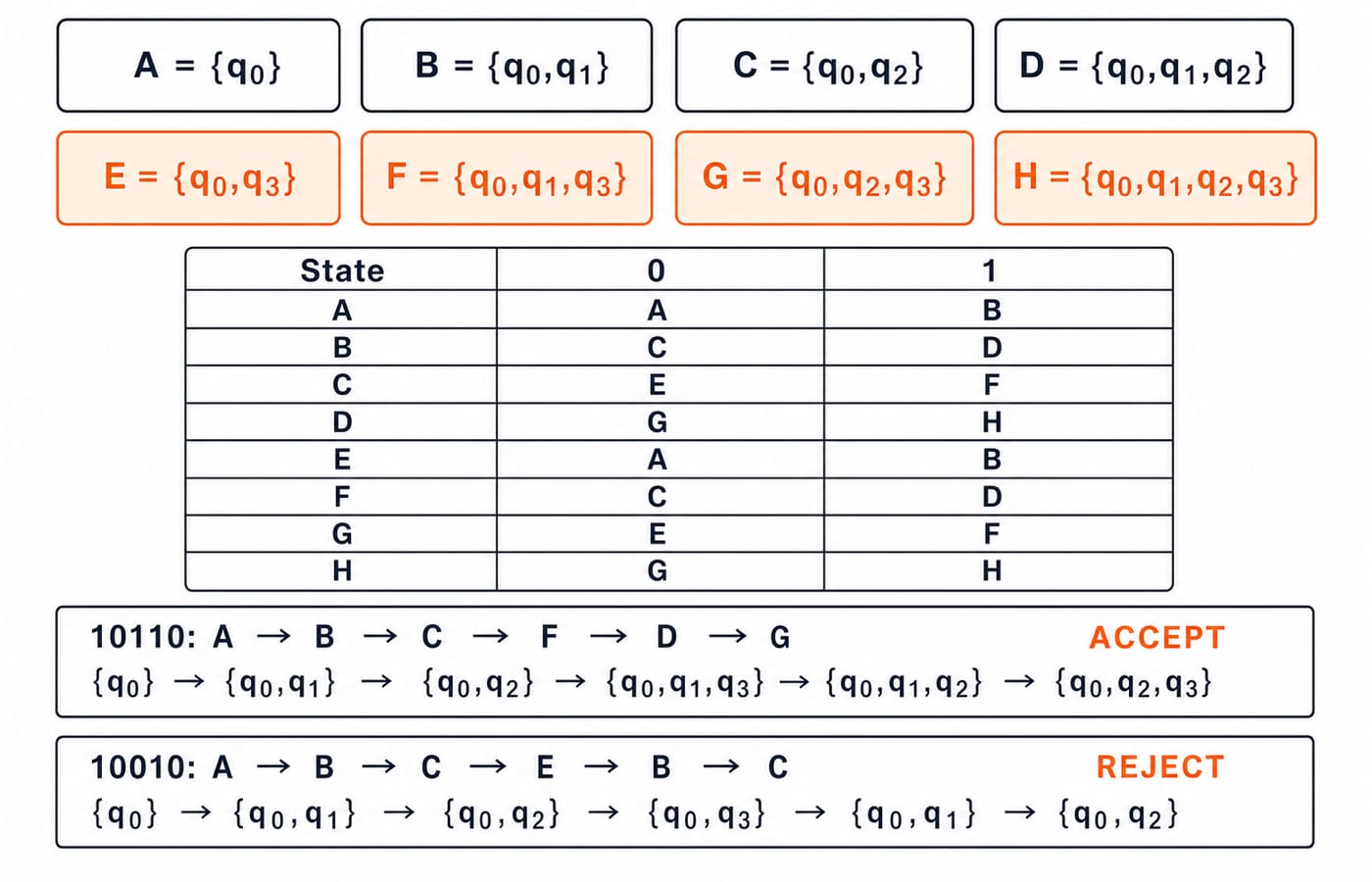
Each DFA state is one reachable NFA active set:
DFA state | NFA subset |
|
|
|---|---|---|---|
|
|
|
|
|
|
|
|
|
|
|
|
|
|
|
|
|
|
|
|
|
|
|
|
|
|
|
|
|
|
|
|
The starred subsets are accepting. For example, delta_DFA(C,1) = delta(q0,1) union delta(q2,1) = {q0,q1} union {q3} = F. Also, delta_DFA(D,0) = {q0} union {q2} union {q3} = G.
The DFA gives 10110: A -> B -> C -> F -> D -> G, so it accepts. It gives 10010: A -> B -> C -> E -> B -> C, so it rejects. Audit every row with one rule: the DFA subset must equal the active NFA set after the same prefix.
Why NFAs help even though DFAs recognise the same languages
Every DFA is already an NFA with one destination per transition. In the other direction, subset construction converts every NFA or epsilon-NFA to a DFA. The saving is countable here: the NFA above needs four states, while the smallest DFA for the same language needs eight, because a DFA has to remember the last three symbols outright. Both machines still recognise exactly the regular languages.
An n-state NFA has at most 2^n subsets, including empty. Here, 2^4 = 16, but only the eight listed subsets are reachable. Empty is unreachable because q0 survives every prefix. If empty is reached in another conversion, it becomes a DFA dead state with a loop on every symbol.
NFAs also make operations neat. To unite machines for strings ending in 00 and strings ending in 11, add a new start with epsilon edges to both old starts. For concatenation, add epsilon edges from the first machine's final states to the second start. For star, add a new accepting start and epsilon routes for zero or further repetitions. None of this lets an NFA recognise {0^n1^n | n >= 0}.
Common NFA traps and how to repair them
All paths: one complete accepting path is enough. In
{q0,q2,q3}, non-final states do not cancelq3.Early final: reaching
q3after prefix100does not accept10010. Attach an input position to each set.Epsilon: an epsilon edge consumes no symbol. Include the initial closure,
{s,a,b}here.Subsets:
{q0,q2}equals{q2,q0}. Canonicalise sets, remove unreachable ones, and mark a subset final if any member is final.Diagram mismatch: the NFA relation has two destinations from
q0on1; the eight-state DFA function has8 * 2 = 16transition cells.
How GATE-style questions test NFA reasoning
Common tasks ask you to find an active set, evaluate an epsilon closure, design for a suffix condition, determinise an NFA, identify final subsets, count reachable subsets, or compare languages. Test yourself:
What is
delta(q0,1)above?Which active set follows
101?What is the epsilon-NFA start closure?
Where does DFA state
Cgo on1?How many subsets are possible and reachable here?
Key: {q0,q1}; {q0,q1,q3}, which accepts 101; {s,a,b}; accepting F={q0,q1,q3}; 16 possible and 8 reachable.
KnowledgeGate has more than 90 Non-Deterministic FA practice questions across NFA design, epsilon conversion, NFA-to-DFA conversion, and regularity identification. Use the Finite Automata MCQ collection for focused practice, and the GATE CS category as a broader preparation route.
Short version and next step
An NFA transition returns a set, one complete accepting path is sufficient, epsilon closure adds states without consuming input, and subset construction makes each reachable set one DFA state. NFAs can be more compact than DFAs, not more expressive.
Now rebuild the four-state machine for "the third symbol from the right is 1". Check 01000:
{q0} -> {q0} -> {q0,q1} -> {q0,q2} -> {q0,q3} -> {q0}
It rejects because the final set excludes q3. The DFA trace A -> A -> B -> C -> E -> A confirms it.
For structured subject-wise learning, continue with GATE Guidance by Sanchit Sir. Use the GATE Test Series later for mock-based mixed practice.
Keep learning
Linear Bounded Automata: Tape Limits, a Worked LBA Trace and Exam Traps
See exactly what an LBA bounds, where it sits in the language hierarchy, and how a six-cell marking machine accepts aabbcc while rejecting three near misses.
Updated 4 Oct 20266 min readTheory of Computation
Decision Properties in Theory of Computation: DFA Tests, CFG Boundaries and Turing Machine Undecidability
Learn an algorithm-first way to classify membership, emptiness, finiteness, inclusion, equivalence and universality for DFAs, CFGs and Turing machines.
Updated 29 Sep 20266 min readTheory of Computation
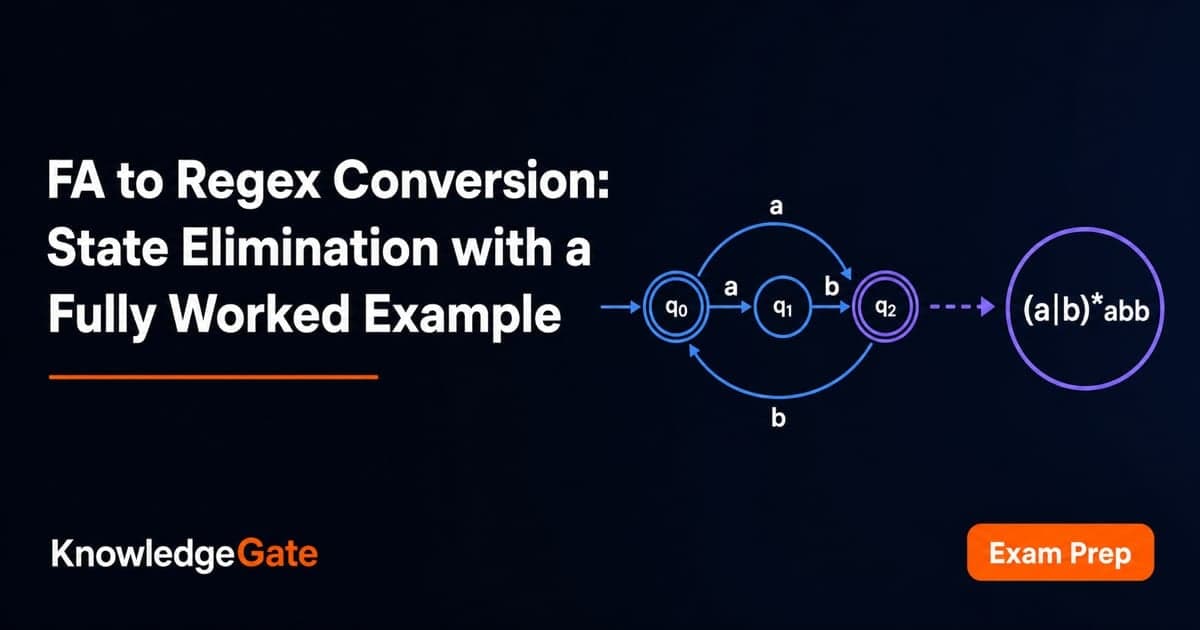
FA to Regex Conversion: State Elimination with a Fully Worked Example
Learn a mechanical state-elimination method for converting a finite automaton to a regular expression, then verify the result with a second order and short strings.
Updated 25 Sep 20265 min readTheory of Computation
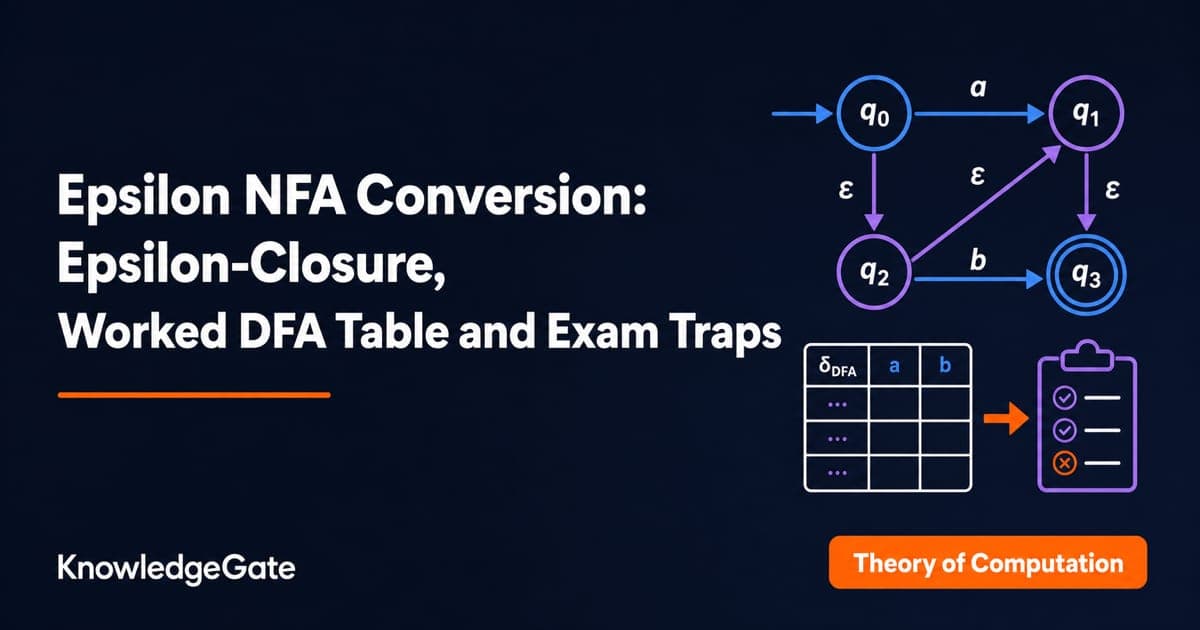
Epsilon NFA Conversion: Epsilon-Closure, Worked DFA Table and Exam Traps
Learn a mechanical epsilon-NFA conversion method through one four-state machine, complete set traces, a reachable-subset DFA table, and epsilon elimination.
Updated 24 Sep 20266 min readTheory of Computation