Pushdown Automata and CFG: Construction, Stack Traces and CFL Tests
Build a CFG and PDA for one language, trace both, convert the grammar, and settle the main CFL property traps with proofs.
KnowledgeGate Team
Exam prep & CS education
Updated 21 Aug 20266 min read
A CFG production, a PDA transition and a language description often look like three separate questions. They are three views of the same computation. The usual loss happens when you know the definitions but cannot keep the input, state and stack aligned through one trace. One language settles all of it. L = {w c w^R} yields 011c110 in a four-step derivation, a three-state PDA accepts it in nine instantaneous descriptions, and its CFL family is closed under union but not under intersection.
Pushdown automata and CFG: two views of one language class
A context-free grammar is G = (V, Sigma, P, S): variables, terminals, productions and start symbol. A PDA is M = (Q, Sigma, Gamma, delta, q0, Z0, F): states, input and stack alphabets, transition relation, start state, bottom marker and final states.
A CFG generates strings. A PDA reads them with a LIFO stack. A language is context-free exactly when some nondeterministic PDA recognises it. Final-state and empty-stack acceptance describe the same CFL family after conversion, but trace the condition stated for the machine.
Below, the leftmost stack symbol is the top, epsilon consumes no input, and (state, unread input, stack) is an instantaneous description. For derivations, ambiguity and normal forms, see Context-Free Grammars and PDAs: CNF, GNF, Pumping Lemma.
CFG construction for 011c110
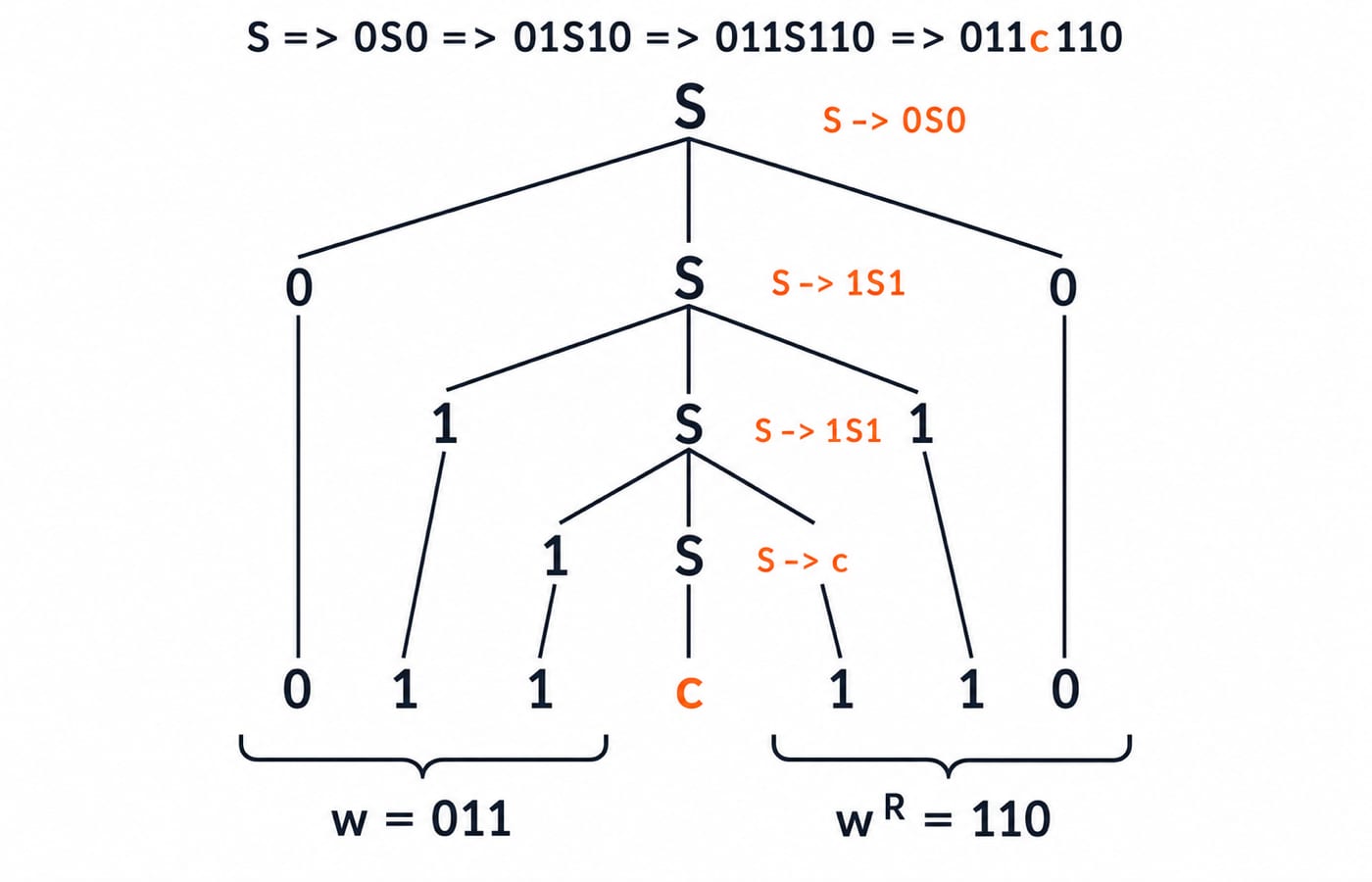
Fix L = {w c w^R | w belongs to {0,1}*}. The part after the single c reverses the part before it. Use
S -> 0S0 | 1S1 | c
Here V = {S} and the terminals are {0,1,c}. Each recursive production adds matching outer symbols; S -> c fixes the centre.
For w = 011, we have w^R = 110. The complete leftmost derivation is:
S => 0S0, usingS -> 0S0.0S0 => 01S10, usingS -> 1S1.01S10 => 011S110, usingS -> 1S1.011S110 => 011c110, usingS -> c.
The leaves read 0, 1, 1, c, 1, 1, 0. The grammar cannot generate 011c101 because 101 is not the reverse of 011; no production changes only one side of c.
PDA construction: push before c, pop after c
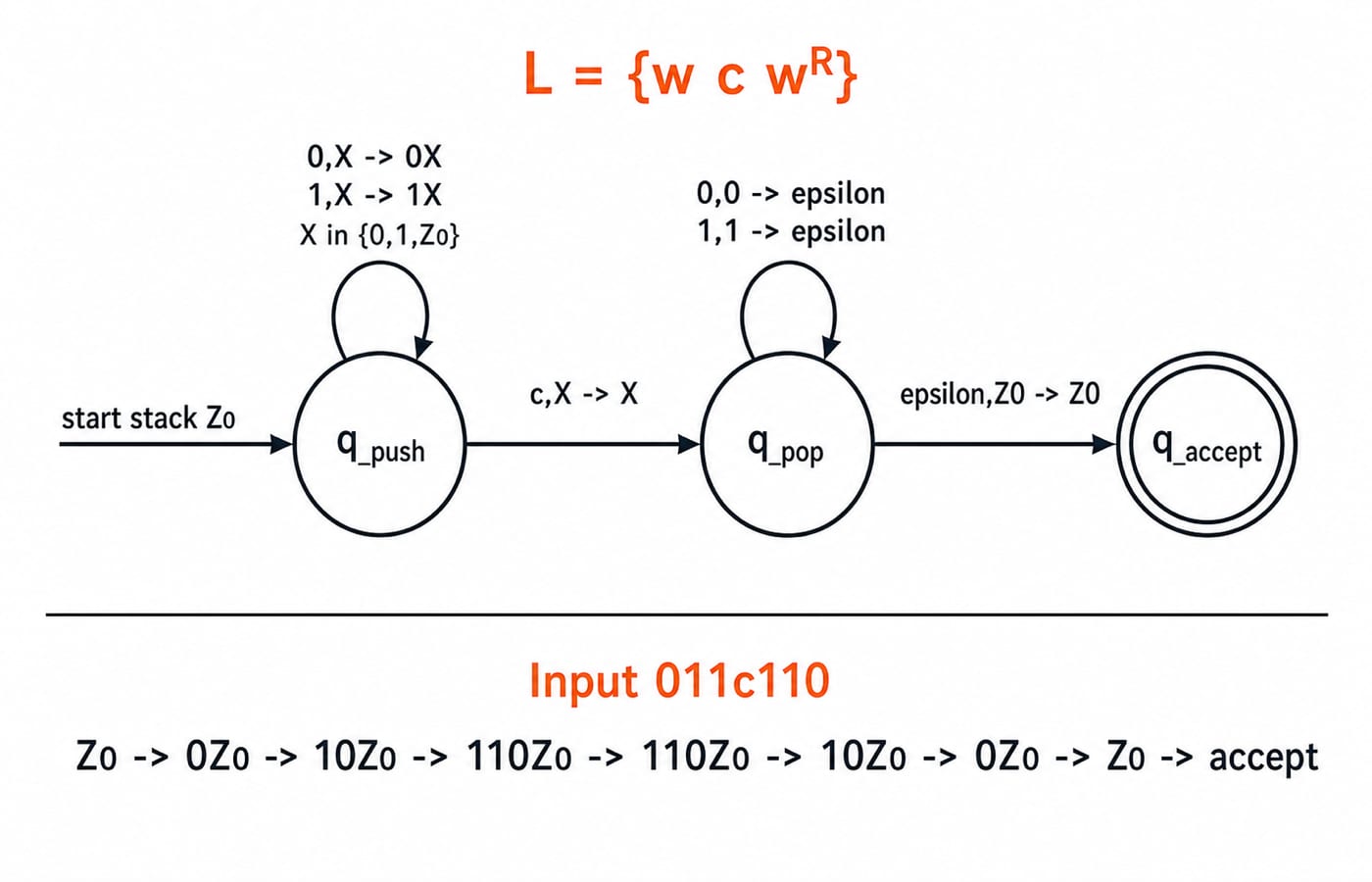
Use a final-state PDA with Q = {q_push, q_pop, q_accept}, input alphabet {0,1,c}, stack alphabet {0,1,Z0}, start q_push, bottom marker Z0, and final state q_accept.
For every stack symbol X, use delta(q_push,0,X) = (q_push,0X), delta(q_push,1,X) = (q_push,1X), and delta(q_push,c,X) = (q_pop,X). Then use delta(q_pop,0,0) = (q_pop,epsilon), delta(q_pop,1,1) = (q_pop,epsilon), and delta(q_pop,epsilon,Z0) = (q_accept,Z0).
Now trace the accepted string completely:
(q_push,011c110,Z0)
-> (q_push,11c110,0Z0)
-> (q_push,1c110,10Z0)
-> (q_push,c110,110Z0)
-> (q_pop,110,110Z0)
-> (q_pop,10,10Z0)
-> (q_pop,0,0Z0)
-> (q_pop,epsilon,Z0)
-> (q_accept,epsilon,Z0)
At c, stack 110Z0 matches the unread suffix. For 011c101, reading c and the first 1 leaves unread 01 and stack 10Z0. Input 0 does not match stack top 1, so no transition applies.
CFG-to-PDA conversion by stack simulation
The standard one-state construction accepts by empty stack. Start with S. Each production A -> alpha gives an epsilon transition replacing top A with alpha. A terminal transition consumes input a when top is a, then pops it. Production choice is nondeterministic.
Trace the stack simulation for input 011c110:
Start with stack
S.Apply
S -> 0S0, resulting in stack0S0.Match input symbol
0, resulting in stackS0.Apply
S -> 1S1, resulting in stack1S10.Match input symbol
1, resulting in stackS10.Apply
S -> 1S1, resulting in stack1S110.Match input symbol
1, resulting in stackS110.Apply
S -> c, resulting in stackc110.Match input symbol
c, resulting in stack110.Match input symbol
1, resulting in stack10.Match input symbol
1, resulting in stack0.Match input symbol
0, resulting in stackepsilon, so the machine accepts by empty stack.
The invariant is that unread input matches the exposed terminal prefix, while the stack records the unfinished sentential form. In the reverse PDA-to-CFG construction, a triple variable [pXq] represents the strings the PDA can read while moving from state p to state q and net removing one stack symbol X. The grammar's start symbol seeds this correspondence with a production to [q0 Z0 q] for the relevant states, so the grammar and the machine describe the same language.
DPDA versus NPDA and the bounded-stack trap
For {w c w^R}, c announces the push-to-pop switch, so the machine can be deterministic. For {w w^R | w belongs to {0,1}*}, an NPDA can guess the midpoint, but no marker reveals it. This language is not deterministic context-free.
Comparison | Exact boundary |
|---|---|
DFA vs PDA | A DFA has finite-state memory; a PDA adds an unbounded LIFO stack. |
DPDA vs NPDA | Every DCFL is a CFL, but not every CFL is a DCFL. |
Final state vs empty stack | For general PDAs, both acceptance modes define the CFLs. |
A bounded stack is still finite memory. With 3 states, stack alphabet {0,1,Z0}, and height capped at 10, the number of state-stack configurations is at most
3 x (1 + 3 + 3^2 + ... + 3^10) = 3 x 88,573 = 265,719.
The finite configuration set means this PDA recognises only a regular language. A large bound is not an unbounded stack.
CFL closure and decision properties
Property | Result | Reason or witness |
|---|---|---|
Union, concatenation, Kleene star, reversal | Closed | Combine CFG productions. |
Homomorphism, inverse homomorphism | Closed | Apply the map to each terminal inside the productions; invert it by pairing the PDA with a finite buffer. |
Intersection with a regular language | Closed | Combine a PDA with a finite automaton. |
General intersection | Not closed | The witness below produces a non-CFL. |
Complement, general difference | Not closed | General closure would contradict the intersection boundary. |
Let L1 = {a^i b^i c^j | i,j >= 0} and L2 = {a^i b^j c^j | i,j >= 0}. Each is context-free, but
L1 intersection L2 = {a^n b^n c^n | n >= 0},
which is not context-free. This proves non-closure under intersection. If CFLs were closed under complement, closure under union and De Morgan's law would force closure under intersection, contradicting this witness.
Problem for arbitrary CFGs or CFLs | Result |
|---|---|
Membership, emptiness, finiteness | Decidable |
Equivalence, inclusion, universality | Undecidable in general |
Grammar ambiguity | Undecidable in general |
How GATE tests pushdown automata and CFG
The official GATE 2026 Computer Science syllabus lists context-free grammars and push-down automata, regular and context-free languages, the pumping lemma, Turing machines and undecidability.
GATE questions commonly use three concrete archetypes. First, trace the ID: given a PDA and a string, produce the instantaneous description after some moves, or decide acceptance, by recording state, unread input and stack at each step. Second, classify DCFL versus CFL: {w c w^R} is deterministic because c announces the switch, while {w w^R} is not. Third, prove a closure failure, usually by intersecting {a^i b^i c^j} with {a^i b^j c^j} to force {a^n b^n c^n}. Secure the regular-language boundary first with Finite Automata: DFA vs NFA and Subset Construction.
Continue with Context-Free Grammar MCQs: 11 Solved GATE Questions for a focused drill, then use GATE CS Exam Preparation for the wider Theory of Computation practice set.
Pushdown automata and CFG: the short version and next step
Five facts carry the topic: CFG productions generate a sentential form; a PDA stack stores unfinished obligations; c marks the push-to-pop switch; conversion exposes grammar symbols on the stack; closure and decidability need separate tables.
Self-check: w = 011 produces 011c110; at c, the stack is 110Z0; consuming 110 leaves Z0; and intersecting L1 with L2 forces {a^n b^n c^n}. Revisit any failed checkpoint before timing practice.
For Theory of Computation alongside the rest of GATE CS, GATE Guidance by Sanchit Sir is optional. For only this topic, the linked article and solved set are enough.
Keep learning
Linear Bounded Automata: Tape Limits, a Worked LBA Trace and Exam Traps
See exactly what an LBA bounds, where it sits in the language hierarchy, and how a six-cell marking machine accepts aabbcc while rejecting three near misses.
Updated 4 Oct 20266 min readTheory of Computation
Decision Properties in Theory of Computation: DFA Tests, CFG Boundaries and Turing Machine Undecidability
Learn an algorithm-first way to classify membership, emptiness, finiteness, inclusion, equivalence and universality for DFAs, CFGs and Turing machines.
Updated 29 Sep 20266 min readTheory of Computation
FA to Regex Conversion: State Elimination with a Fully Worked Example
Learn a mechanical state-elimination method for converting a finite automaton to a regular expression, then verify the result with a second order and short strings.
Updated 25 Sep 20265 min readTheory of Computation
Epsilon NFA Conversion: Epsilon-Closure, Worked DFA Table and Exam Traps
Learn a mechanical epsilon-NFA conversion method through one four-state machine, complete set traces, a reachable-subset DFA table, and epsilon elimination.
Updated 24 Sep 20266 min readTheory of Computation