SBI PO Exam Pattern: Prelims, Mains and Final-Stage Preparation
Prepare for SBI PO as a sequence of different jobs. This rolling plan builds screening speed, mains depth, typed writing and truthful final-stage communication together.
KnowledgeGate Team
Exam prep & CS education
Updated 9 Aug 20266 min read
First-time aspirants often run SBI PO as a prelims-only project, postponing mains writing and the spoken stages until results arrive, which leaves too much to build in the weeks between gates. Screening speed, mains depth and final-stage communication are three separate skills: start all three from week one and reweight them as each result lands.
Read the SBI PO route as three different jobs
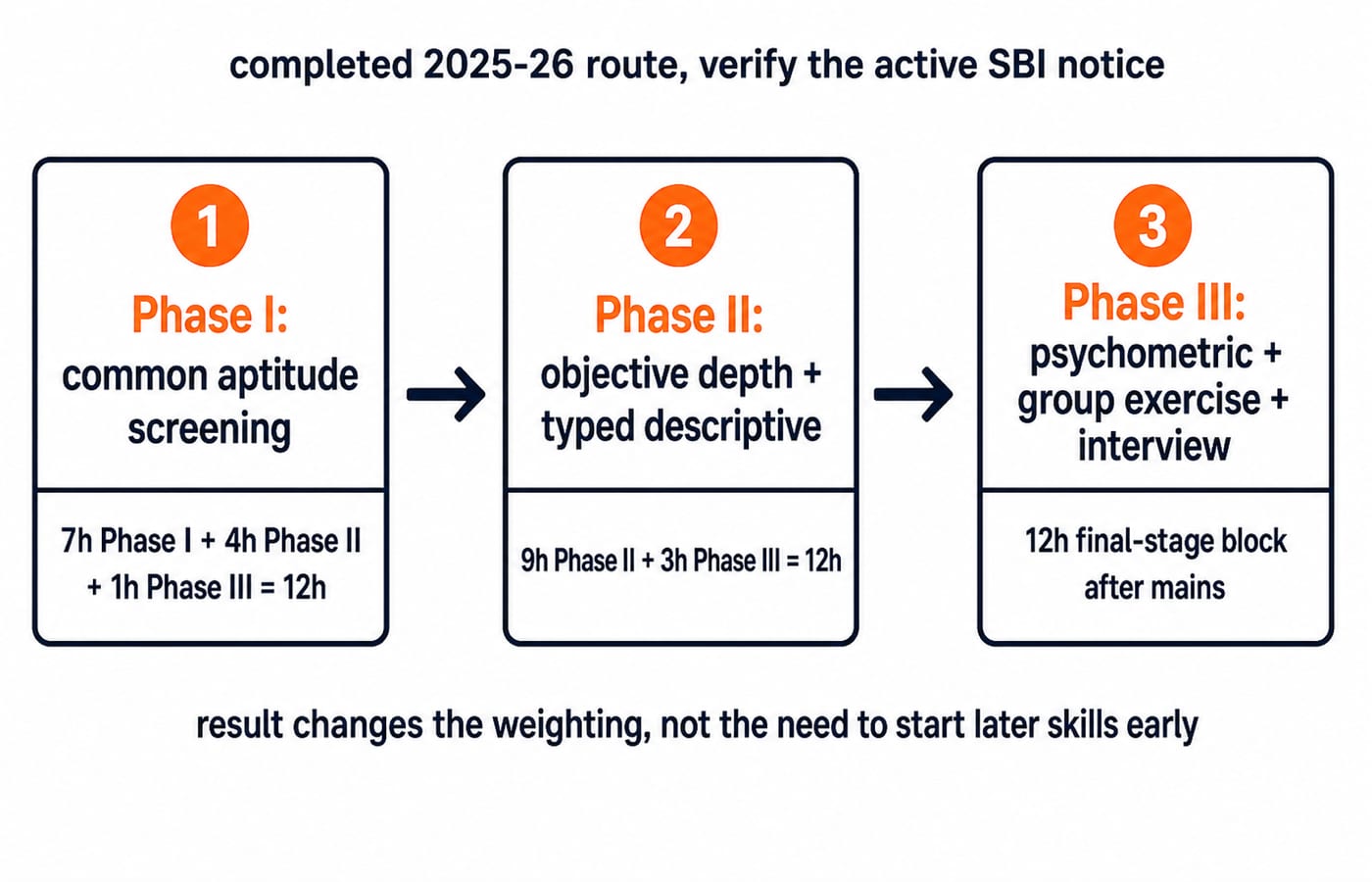
SBI's 2025-26 Probationary Officer advertisement ran three phases: Phase I, the preliminary examination; Phase II, the main examination; and Phase III, a psychometric test, group exercise and personal interview. Phase I marks did not enter final merit, so prelims is a gate you pass, not a score you carry.
The three jobs differ. Phase I rewards question selection and speed across common aptitude. Phase II wants objective depth plus typed descriptive communication under a clock. Phase III wants honest personality responses, collaborative discussion and evidence-backed answers. Passing one gate does not create the next skill.
The subjects inside each phase are set out in SBI PO syllabus and exam pattern 2026. Marks, timings and cutoffs move between cycles, so build preparation around skills and hours, which do not.
Use a 12-hour week that changes after each gate
Before prelims, split twelve study hours a week three ways. Common base, 7 hours: English 2, quantitative aptitude 2.5, reasoning 2.5. Mains carryover, 4 hours: reasoning and computer aptitude, data analysis, awareness and typed English, 1 hour each. Phase III evidence and speaking, 1 hour. Total: 2 + 2.5 + 2.5 + 1 + 1 + 1 + 1 + 1 = 12 hours.
After Phase I, mains takes 9 hours: reasoning and computer aptitude 2, data analysis 2, awareness 2, objective English 1 and descriptive work 2. Phase III takes 3 hours: psychometric familiarisation 0.5, group practice 1, interview evidence 1 and notice audit 0.5. Check: 2 + 2 + 2 + 1 + 2 = 9, 0.5 + 1 + 1 + 0.5 = 3, and 9 + 3 = 12. Once mains is written, all twelve move to the final stage: interview evidence 5, group practice 4, banking and economy reading 2, psychometric familiarisation 1, giving 5 + 4 + 2 + 1 = 12 hours.
Miss a two-hour session? Use a 45-minute recovery block on the weakest skill in your log, and do not double tomorrow's load; the doubled day is what ends most plans by week three.
Prelims practice: test your gate-clearing reliability
Phase I tests one narrow band, English language, quantitative aptitude and reasoning ability, for speed and selection rather than depth. The SBI PO complete bundle keeps prelims and mains in one plan, which matters because the mains lanes must start before the prelims result arrives.
Set yourself a 60-question paper under prelims timing. Say it returns 48 attempts: 41 correct, 7 wrong, 12 left blank. Check: 41 + 7 = 48 and 48 + 12 = 60. Attempt accuracy is 41 / 48 x 100 = 85.4%, but the full-set correct share is 41 / 60 x 100 = 68.3%. The 12 untouched questions cost more than the 7 wrong ones.
Sort the 7 wrong answers before repairing anything: say 3 concept gaps, 2 calculation slips and 2 poor-selection errors. Repair them with 90 minutes of reteaching, 60 of untimed calculation and 30 of selection practice: 90 + 60 + 30 = 180 minutes, or 3 hours out of next week's 12.
Mains is a new skill mix, not more prelims
Mains adds lanes prelims never tests: computer aptitude bolted onto reasoning, data analysis and interpretation, general, economy and banking awareness, and a typed descriptive paper. Awareness and descriptive writing reward slow accumulation and punish late starts, which is why each carries an hour a week even before prelims.
Set a 90-question mains-pattern paper. Suppose it returns reasoning and computer aptitude 18/24, data analysis 11/20, awareness 18/25 and English 17/21. Denominators total 24 + 20 + 25 + 21 = 90, and correct answers total 18 + 11 + 18 + 17 = 64. The 64/90 aggregate hides the signal; the block profile is 75%, 55%, 72% and about 81%.
Data analysis at 55% is dragging that aggregate down, so next week move one 60-minute new-practice block out of English into data analysis, keeping a 20-minute English review so the strong lane holds. Bank PO prelims versus mains preparation works through the same allocation shift across banking exams.
Descriptive paper: build typed control before the result
The descriptive paper is typed, timed and read by a human, which makes it the least forgiving part of mains if you have only practised objective questions. Formats vary by cycle: essay, letter, email, report, situation analysis and precis have all appeared. Practise the two you write worst.
Try this under a clock. A branch's token-display system fails for 45 minutes during a pension-hour rush; write an internal incident report covering the timeline, customer impact, immediate action and one prevention step. Allow 5 minutes to plan, 22 to type 180 to 220 words and 8 to edit: 5 + 22 + 8 = 35 minutes.
Mark it out of 5 on four axes. A first draft typically scores relevance 4, structure 4, clarity 3 and language 3, so 14/20. Rewrite it once and 4 + 5 + 4 + 4 = 17/20 is reachable. Those 3 marks come from a timestamped sequence, two vague claims deleted and four language fixes, not from typing faster.
Final stage: prepare for its demands without gaming them
Psychometric familiarisation means learning the instruction format and answering honestly, not manufacturing a preferred personality; the instrument reads consistency, and invented answers stop being consistent halfway through. Group practice trains listening, relevance, synthesis and speaking time. Interview work turns experience into defensible dates, numbers and outcomes.
Rehearse group discussion against a concrete case. A branch has 6 staff, 2 counters offline, 42 customers waiting and 60 minutes until closing. In an 8-minute discussion, spend the first 60 seconds framing priorities, make 2 evidence-based contributions, bring 1 quieter member in, offer 1 synthesis and keep the last 30 seconds for a recommendation.
Interview answers run in one order: situation, task, action, result. A 5-member college project running 2 modules late is enough material if the action is specific: 15-minute daily checks introduced, 3 named owners assigned, delivery 2 days before the revised deadline. Use your own truthful numbers; an interviewer can test a specific claim, and one that survives testing beats any adjective.
Audit the next 14 days, then check the live SBI notice
Tag every resource you own Phase I, Phase II objective, Phase II descriptive or Phase III. The bundle's prelims course is Phase I only; the SBI PO Mains course carries both Phase II tags; an interview evidence notebook is the only Phase III resource most aspirants own, and not having one is the finding.
Run two 12-hour weeks across the next 14 days, with a 60-question diagnostic on day 1 and day 14. Compare attempt accuracy and error mix across the two, not the raw score against a half-remembered cutoff. Course and practice material for both phases sits under SBI PO exam preparation.
Before you fix any of this in stone, open SBI's current openings page. The live advertisement is where the marks, timings, section list and descriptive format for your cycle come from.
Keep learning
SBI SO Cutoffs: Check Corrections and Build a Practice Target
A cutoff becomes useful only when its post, category and score basis match your comparison. Work through a real SBI correction and a hypothetical target-setting exercise to plan your next mocks.
5 Oct 20264 min readSBI Exams
SBI SO Syllabus: Section-by-Section Study Map for IT Aspirants
Build an IT/System study map around your exact SBI post. Use a historical exam table, original worked exercises and an eight-hour sample week to turn topic lists into practice.
1 Oct 20265 min readSBI Exams
SBI SO Preparation Strategy: A 12-Week Role-Specific Plan
Build an SBI SO plan around the exact Specialist Cadre Officer post you are targeting. This guide gives an 11-hour weekly calendar, diagnostics, repair loops and separate written-test and interview branches.
Updated 24 Sep 20266 min readSBI Exams
SBI SO Exam Pattern and Marking Scheme: Post-Wise Routes Explained
There is no single SBI SO paper pattern. Use this guide to identify your post's route, understand qualifying and merit components, and build a timetable from the official notice.
Updated 22 Sep 20264 min readSBI Exams