SBI Clerk English Preparation Plan: Build RC, Cloze and Grammar Accuracy
Build steadier English accuracy through one weekly system for reading comprehension, cloze tests and grammar. Measure attempts, review errors and retest weak rules.
KnowledgeGate Team
Exam prep & CS education
Updated 16 Aug 20265 min read
Many candidates study RC, cloze and grammar as unrelated chapters, then wonder why accuracy changes from set to set. A stronger SBI exam preparation routine uses one loop: read for meaning, apply rules in context, record why an answer failed, and retest that weakness. Six hours a week, split across the three areas and audited every Sunday, is enough to move accuracy from guesswork to a number you can compare week to week.
Start with a 36-question baseline, not a vague weakness list
Build a diagnostic with 12 RC, 12 cloze and 12 grammar questions. Record total, attempted, correct, wrong, skipped and minutes for each part. Accuracy is correct / attempted x 100; coverage is attempted / total x 100. Both figures keep skips visible.
Area | Correct | Wrong | Skipped | Attempted | Accuracy |
|---|---|---|---|---|---|
RC | 7 | 2 | 3 | 9 |
|
Cloze | 8 | 4 | 0 | 12 |
|
Grammar | 7 | 3 | 2 | 10 |
|
Overall, 7 + 8 + 7 = 22 correct and 9 + 12 + 10 = 31 attempted. Accuracy is 22 / 31 = 71.0%; coverage is 31 / 36 = 86.1%. Repair cloze first because its accuracy is lowest, although RC has more skips.
Those two figures are your Week 0 line. Compare every later set against them rather than against a target percentage, and hold the 12-12-12 split so the comparison stays honest.
Use a six-hour week with fixed solve-review ratios
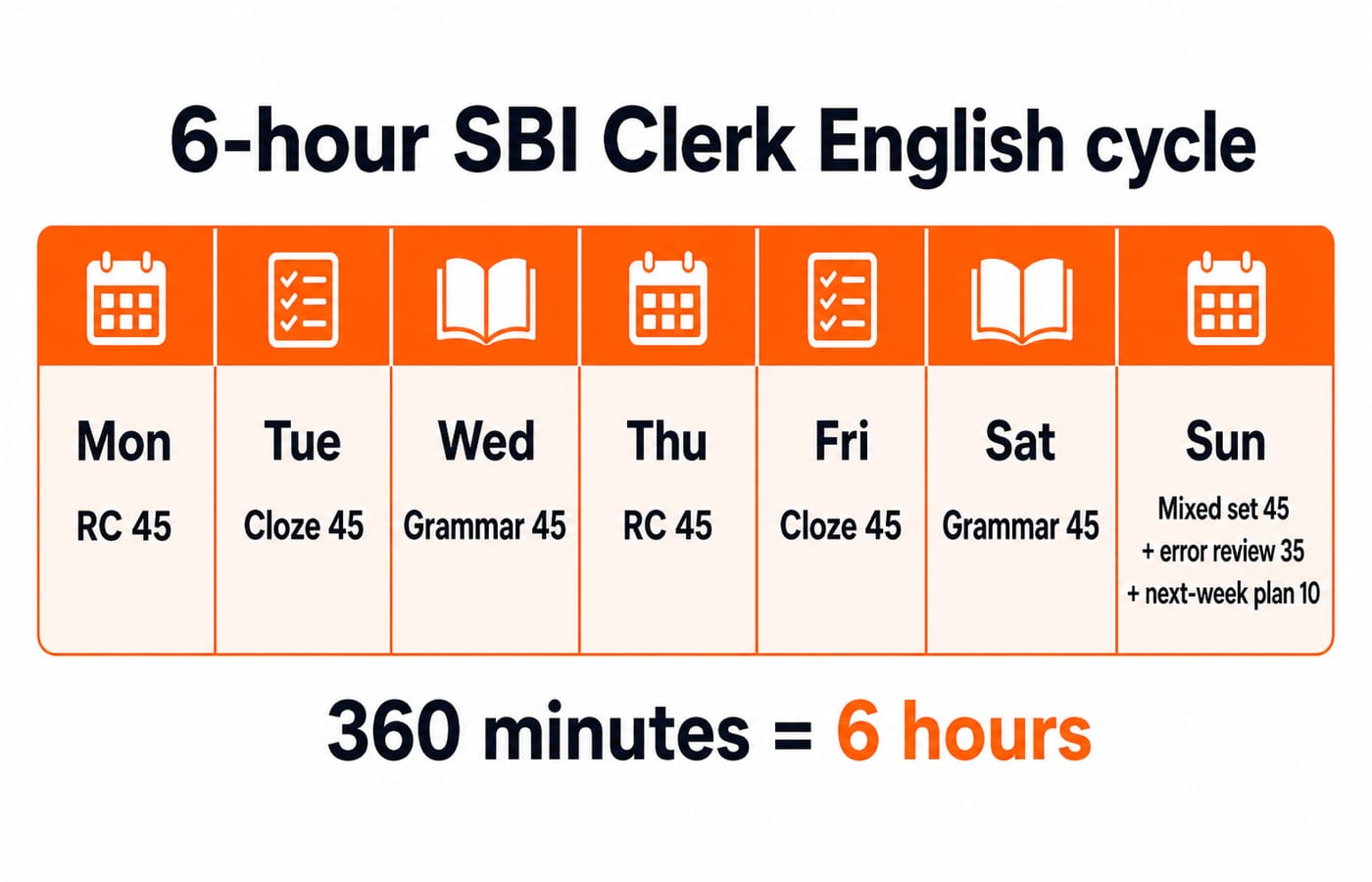
Schedule six 45-minute blocks: RC on Monday and Thursday, cloze on Tuesday and Friday, and grammar on Wednesday and Saturday. Use 25 minutes to solve and 20 to review. On Sunday, spend 45 minutes on a mixed set, 35 classifying every wrong or skipped item, and 10 choosing two repair priorities.
The total is 6 x 45 + 90 = 360 minutes, or six hours. Rotating the three areas rather than blocking them keeps grammar and vocabulary warm between cloze sessions. The Bank PO English section strategy orders the same three areas by weight if you would rather lead with reading.
Make RC review evidence-based, not answer-key based
Read this mini-passage:
After a rural branch replaced paper token slips with a mobile queue display, average waiting time fell from 28 to 19 minutes. However, visits by customers aged over 60 declined during the first fortnight. The branch then retained a staffed token desk, and waiting time settled at 21 minutes while senior visits returned to the earlier level.
Which conclusion is best supported? A hybrid queue system balanced speed with accessibility. The 21-minute wait and restored senior visits support it. Reject “digital systems always reduce access” because one corrected branch cannot support that general claim.
For every miss, write the question type, copy the decisive phrase, and explain why your option contradicted or exceeded it. Re-read those lines, then the passage if needed.
Cap your time per passage and tighten it only on evidence: 12 minutes in Weeks 1 and 2; 10 in Weeks 3 and 4 if accuracy holds; eight in Weeks 5 and 6 only after two consecutive sets meet your floor.
Solve cloze blanks through passage logic, grammar and collocation
Complete this passage:
The bank introduced an appointment app, but many customers ___(1) to visit the counter because they were not ___(2) with the interface. Staff therefore ___(3) short demonstrations, which ___(4) confusion and gradually ___(5) adoption.
The options are: (1) continued / prevented / forgot / denied; (2) familiar / similar / equal / common; (3) conducted / borrowed / scattered / postponed; (4) reduced / reducing / reduce / reduces; (5) increased / increase / increasing / increases.
The answer sequence is continued, familiar, conducted, reduced, increased. “But” supplies contrast for blank 1, “familiar with” the collocation for blank 2, and “conducted demonstrations” the verb-object fit for blank 3. “Reduced” and “increased” preserve past-tense parallelism. Re-read for overall coherence.
As in RC, predict continuation, contrast, cause or result, then inspect options. Put useful unfamiliar words in the same error log.
Turn grammar rules into short correction drills
Work from recall before reviewing the rule:
“Neither the branch manager nor the clerks was ready” becomes “Neither the branch manager nor the clerks were ready” because the nearer subject is plural.
“The report, along with the revised figures, were submitted” becomes “The report, along with the revised figures, was submitted” because the head subject is singular.
“Each of the applicants have received a message” becomes “Each of the applicants has received a message” because “each” takes a singular verb.
Record the original, correction, rule in at most 12 words, and one new example. Also lift two sentences from that day's RC or cloze and check agreement, tense, pronoun reference and modifier placement.
Let the Sunday error audit choose next week's work
Suppose you attempt 40 questions, with 31 correct and nine wrong. Accuracy is 31 / 40 = 77.5%. Classify the nine errors as evidence missed = 2, context or vocabulary = 3, subject-verb agreement = 2, and haste = 2. The categories total 2 + 3 + 2 + 2 = 9.
Retest all nine without notes. If seven are correct and two remain wrong, schedule those two unresolved rule types first next week. Record what changed for the seven too. Track accuracy and coverage separately, comparing like-sized mixed sets.
If English must fit around other sections, use the calendar-agnostic banking exam preparation plan. Move the six-hour block within the broader week if necessary, but preserve its solve-review ratio.
Progress for six weeks and recover honestly from missed days
Weeks 1 and 2 prioritise clean method and full review. Weeks 3 and 4 add mixed Sunday practice and lower your caps only where accuracy holds. Weeks 5 and 6 use exam-like mixed practice, followed by the audit. Size those sets from the current Clerk notification and information handout on the official SBI Careers page, which carries the section structure, marks and timing.
Miss one session, and do a 20-minute floor next day: 10 minutes solving and 10 reviewing. Miss two or more, and do not cram 90 or 135 minutes into Sunday. Preserve its 90-minute audit, carry forward the most frequent weakness, and restart Monday.
At six weeks, take a fresh 36-question set with the same 12-12-12 split. Recompute accuracy and coverage, keeping the plan only if both figures and the error mix improve. Draw every set from one source and at one size, because a comparison across differently pitched papers tells you nothing.
Short version and the next useful action
Measure 36 questions, follow the 360-minute rotation, review every wrong and skipped item, and retest the error log each Sunday. The aim is stable decision-making, not a dramatic one-day jump.
For adjacent structured preparation, explore the SBI PO Prelims Preparation Course and SBI PO Mains Preparation Course. Both are PO courses, so use them for the English section they share with Clerk rather than for Clerk-specific coverage. Begin today with the baseline and a one-page error log.
Keep learning
SBI SO Cutoffs: Check Corrections and Build a Practice Target
A cutoff becomes useful only when its post, category and score basis match your comparison. Work through a real SBI correction and a hypothetical target-setting exercise to plan your next mocks.
5 Oct 20264 min readSBI Exams
SBI SO Syllabus: Section-by-Section Study Map for IT Aspirants
Build an IT/System study map around your exact SBI post. Use a historical exam table, original worked exercises and an eight-hour sample week to turn topic lists into practice.
1 Oct 20265 min readSBI Exams
SBI SO Preparation Strategy: A 12-Week Role-Specific Plan
Build an SBI SO plan around the exact Specialist Cadre Officer post you are targeting. This guide gives an 11-hour weekly calendar, diagnostics, repair loops and separate written-test and interview branches.
Updated 24 Sep 20266 min readSBI Exams
SBI SO Exam Pattern and Marking Scheme: Post-Wise Routes Explained
There is no single SBI SO paper pattern. Use this guide to identify your post's route, understand qualifying and merit components, and build a timetable from the official notice.
Updated 22 Sep 20264 min readSBI Exams