SBI PO Job Profile: Branch Leadership, Rotations and Career Path
Understand what an SBI PO may learn across customer service, operations and credit, how early leadership works, and why career growth has no guaranteed clock.
KnowledgeGate Team
Exam prep & CS education
Updated 21 Aug 20266 min read
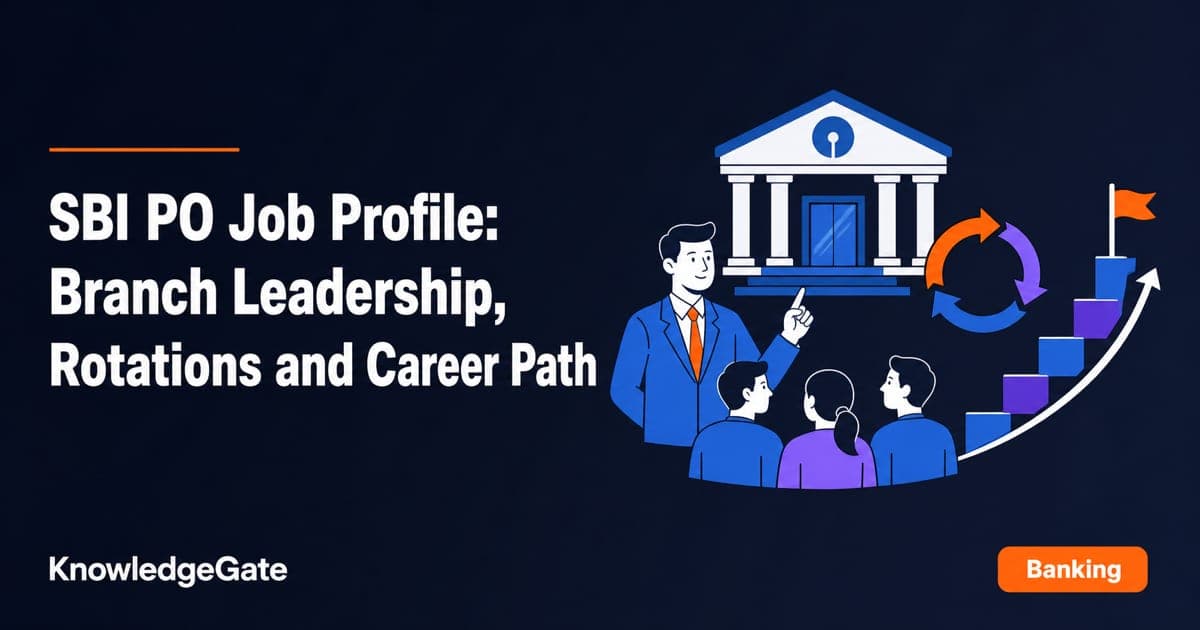
Clearing SBI PO gets you into the bank. What happens after joining is set out by SBI itself, on its own careers page for Probationary Officers: two years of probation with intensive training, then a screening process at the end of it. Officers who reach the standard the bank has set can be confirmed straight into Middle Management Grade Scale-II. Officers who qualify in the test but fall short of that standard are confirmed in Junior Management Grade Scale-I. Officers who do not qualify have their services terminated. Everything inside those two years is branch work: customer service, operational control, credit support and business follow-up, with responsibility widening as you show you can carry it.
Related reading: SBI PO and IBPS PO and SBI PO exam pattern.
SBI PO is an officer role, not one fixed desk
A Probationary Officer is not recruited for a desk, and SBI says so plainly in its own eligibility note: selected candidates are liable to be posted anywhere in India. The first desk, and the exposure that follows it, depend on the branch, the business unit and where the bank needs people. Three words that candidates tend to merge carry very different weight once you are inside:
Term | What it means at SBI | What decides it |
|---|---|---|
Probation | Two years of intensive training, assessed throughout | The screening process at the end of the two years |
Rotation | Exposure across branch functions and locations | Branch size, business unit and the bank's posting needs |
Leadership | Owning a queue or a control area, and knowing what to escalate | Your delegated authority, not your designation |
Reaching that first posting still means clearing prelims, mains and the interview stage. The SBI PO Exam Preparation page collects that material in one place.
SBI PO rotation: what exposure across desks actually teaches
Rotation moves you across functions and locations. On its own it teaches nothing. What turns exposure into competence is running the same five steps on every unfamiliar desk:
Learn the control.
Observe the transaction.
Perform under supervision.
Document and escalate.
Review the outcome.
Take a new account-maintenance request. You read the applicable checklist, watch one complete case, prepare the second yourself under supervision, send the exception to the authorised checker, and record how it was resolved. Banking runs on that maker-checker split: whoever inputs an entry is never the person who authorises it. Rotation widens your judgement across desks. It never widens your authority to approve.
Branch leadership starts with priorities and controls
Early leadership is practical. Make the workload visible, sequence or assign it within your authority, check completion, escalate the exceptions. On a branch morning that means opening readiness, the customer queue, the pending-service review, control checks, coordinating who takes what, and a clean end-of-day handover.
Take an 18-item morning inbox:
Intake: 7 customer-service items + 6 operations and control items + 5 credit-document follow-ups = 18 items.
A three-person team marks 8 to resolve today, 7 to verify or escalate, and 3 to schedule with a recorded reason. Check: 8 + 7 + 3 = 18.
At review, 12 are complete, 4 have moved to an authorised checker or senior, and 2 are carried forward with an owner and reason. Check: 12 + 4 + 2 = 18.
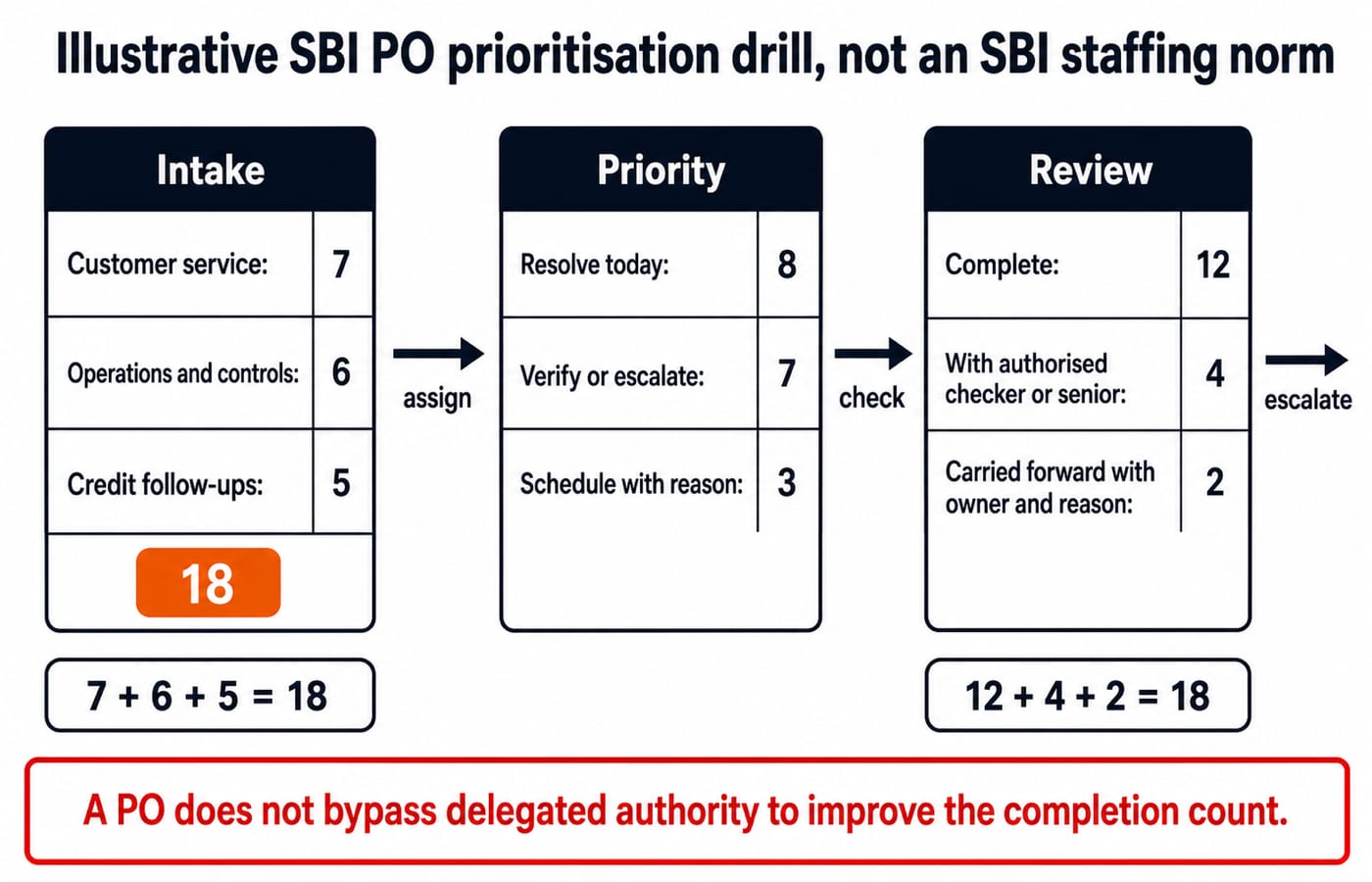
The numbers are a drill, not a branch norm. What transfers is traceable ownership: no item goes silently pending, and nothing gets approved outside delegated authority.
Customer and operations work makes judgement visible
For any service request, ask four questions: What is the customer asking? What evidence is required? What can I decide? What must I escalate?
Suppose an account shows “Riya S.” but the submitted identity document says “Riya Sen”. Another customer reports a failed digital transfer with a reference number but no resolution. A third submits a nominee-update form with one required field missing. In each case, acknowledge and classify the request, verify it through the approved process, protect customer data, record the action, and route exceptions to the authorised person. Do not promise an outcome before the checks. Good service pairs speed with accuracy and empathy with compliance. The screens, document lists and approval powers you will actually use are the bank's own and you learn them on the desk; those four questions work before you know any of them.
Credit work is analysis and documentation, not instant sanction
Credit exposure on probation means collecting information, checking a file for completeness, reading cash flow, drafting or reviewing a note, tracking documents and chasing follow-ups. Recommend, verify, escalate and sanction are four different actions, and only one of them is a sanction. Knowing which of the four you are performing is most of the discipline.
Take a unit-based credit-reading exercise. A sample business has monthly inflow of 100 units, operating outflow of 72 units, existing commitments of 12 units and a proposed repayment of 9 units.
Subtract operating outflow: 100 - 72 = 28.
Subtract existing commitments: 28 - 12 = 16.
Subtract proposed repayment: 16 - 9 = 7 units residual.
The full check is 100 - 72 - 12 - 9 = 7. A 90-day statement review also shows 12 expected credits, 2 returned items and 1 unexplained variance. The positive 7 is not an approval. It raises questions about volatility, returned items, the variance, relevant security or documents, and the authorised decision route. Arithmetic supports judgement, but policy, evidence and delegated authority determine the next step.
SBI PO career path: from probation to the officer grade scales
A posting can put you in a retail branch, a rural or semi-urban location, an operations or processing unit, a credit desk or a customer-acquisition role. Each builds something different: service judgement, control discipline, analytical depth, commercial awareness. What none of them comes with is an order, a minimum stay or a transfer interval you can plan around.
What is not open-ended is the ladder above that first confirmation. The officer grade scales continue through middle management (MMGS-III), senior management (SMGS-IV and SMGS-V) and the top executive grades (TEGS-VI and TEGS-VII). SBI's own framing is that its promotion policy lets meritorious officers reach the Top Management Grade in a reasonably quick time, and that postings abroad are among the openings it can offer. It attaches no number of years to any step, and nobody outside the bank is in a position to.
What you can control is evidence. A four-week personal log kept from your first week might read: 24 customer cases reviewed, 10 control checks documented, 4 credit notes shadowed, 3 escalation summaries written. Better decisions and cleaner handovers are worth more in that log than raw volume. The SBI PO vs IBPS PO comparison sets this ladder against the other national-bank route.
The short version: decide whether the role fits, then prepare
Can you explain decisions patiently, follow controls under pressure, learn from rotation, accept location uncertainty, and take responsibility without exceeding authority?
If the answer is yes, the job is a branch learned from inside, a screening at the end of probation, and a grade ladder you climb on evidence rather than on a calendar. Start with the SBI PO Prelims Preparation Course, progress to the SBI PO Mains Preparation Course, and use the Bank PO Prelims vs Mains preparation guide to plan the transition between them. Your appointment letter, when it comes, is the document that governs your own probation and posting terms.
Keep learning
SBI SO Cutoffs: Check Corrections and Build a Practice Target
A cutoff becomes useful only when its post, category and score basis match your comparison. Work through a real SBI correction and a hypothetical target-setting exercise to plan your next mocks.
5 Oct 20264 min readSBI Exams
SBI SO Syllabus: Section-by-Section Study Map for IT Aspirants
Build an IT/System study map around your exact SBI post. Use a historical exam table, original worked exercises and an eight-hour sample week to turn topic lists into practice.
1 Oct 20265 min readSBI Exams
SBI SO Preparation Strategy: A 12-Week Role-Specific Plan
Build an SBI SO plan around the exact Specialist Cadre Officer post you are targeting. This guide gives an 11-hour weekly calendar, diagnostics, repair loops and separate written-test and interview branches.
Updated 24 Sep 20266 min readSBI Exams
SBI SO Exam Pattern and Marking Scheme: Post-Wise Routes Explained
There is no single SBI SO paper pattern. Use this guide to identify your post's route, understand qualifying and merit components, and build a timetable from the official notice.
Updated 22 Sep 20264 min readSBI Exams