SBI PO Mock Analysis: Review Every Error and Plan the Next Mock
Turn one illustrative mock report into a section dashboard, an error log, a correction week and five measurable rules for the next attempt.
KnowledgeGate Team
Exam prep & CS education
Updated 20 Aug 20265 min read
A mock score tells you how the attempt ended. It does not show whether you lost marks through poor question selection, time sinks, weak accuracy, unsupported guesses or skipped questions you could actually solve. The fix is to use one section dashboard, one question-level error log and a short rule card for the next mock. The SBI PO Exam Preparation category holds the wider plan. The review system starts with the report you already have.
1. Freeze the SBI PO mock report before opening solutions
Save the report before solutions change your memory. Capture Question ID | Section | Attempted/skipped | Correct/wrong | Time spent | Confidence H/M/L | Revisited Y/N | First reason for the choice. Keep the reason to three to ten words: two options eliminated, formula not recalled, set looked familiar or ran out of section time.
The figures used here come from one illustrative three-section mock: 100 questions, 78 attempted, 60 correct, 18 wrong, 22 skipped and 60 minutes used. They are an example, not the current SBI PO pattern. For the current structure read the SBI PO syllabus and exam-pattern guide, then confirm official specifics against an already-issued notice on SBI Careers.
2. Build an SBI PO section dashboard, not just one total score
One total score hides three different problems. The same attempt, split by section:
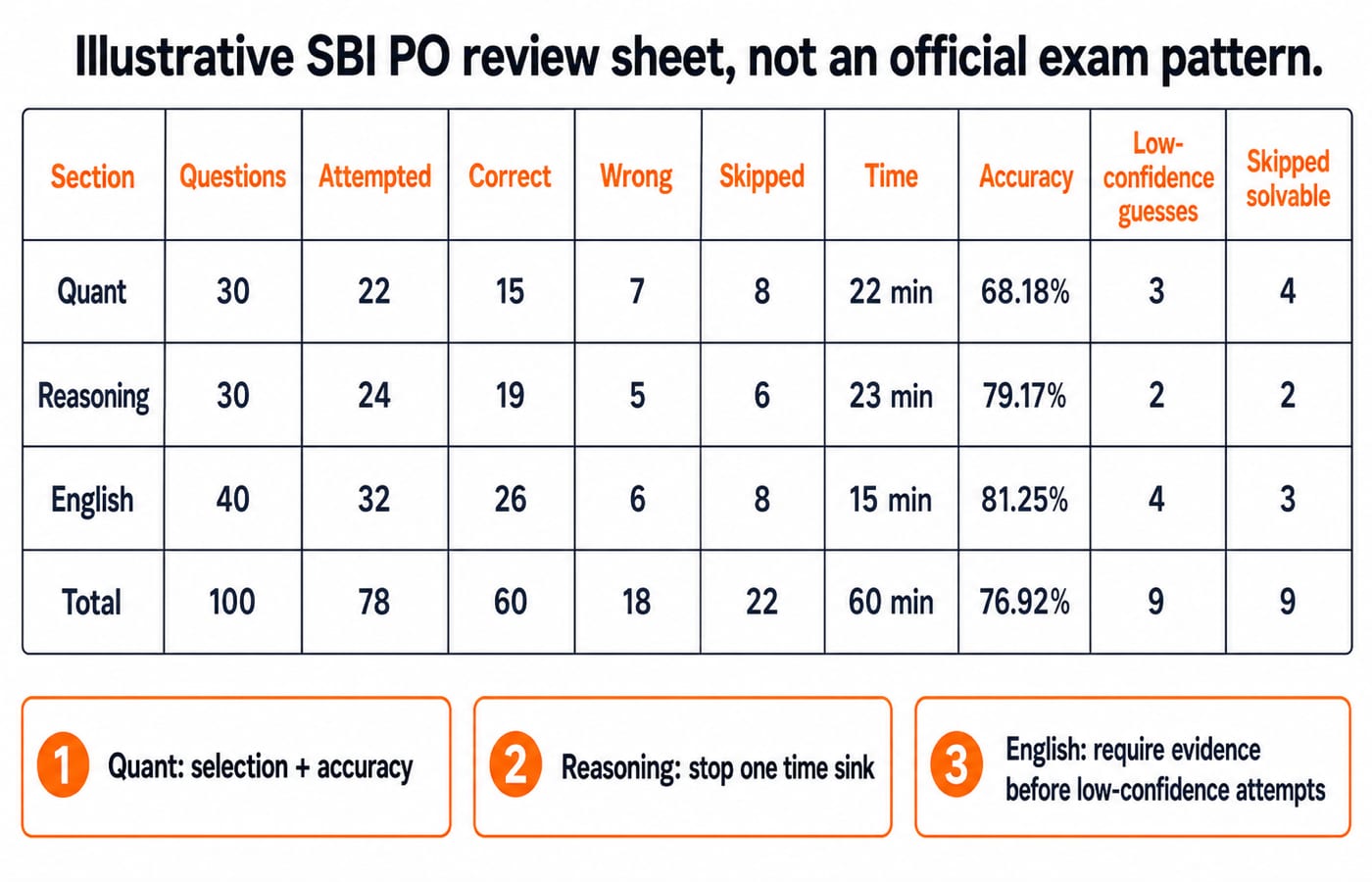
Section | Questions | Attempted | Correct | Wrong | Skipped | Time | Attempted-question accuracy | Low-confidence guesses | Skipped solvable |
|---|---|---|---|---|---|---|---|---|---|
Quantitative Aptitude | 30 | 22 | 15 | 7 | 8 | 22 min | 15 / 22 = 68.18% | 3 | 4 |
Reasoning Ability | 30 | 24 | 19 | 5 | 6 | 23 min | 19 / 24 = 79.17% | 2 | 2 |
English Language | 40 | 32 | 26 | 6 | 8 | 15 min | 26 / 32 = 81.25% | 4 | 3 |
Total | 100 | 78 | 60 | 18 | 22 | 60 min | 60 / 78 = 76.92% | 9 | 9 |
Accuracy uses attempted questions, not all questions. Quant needs accuracy and selection repair. Reasoning contains a time sink. English needs guess control.
3. Give every lost question one primary cause
Review all 18 wrong answers and 22 skips. Replace silly mistake with one primary cause. Wrong answers split into concept gap 6, method or calculation error 4, reading or attention error 3, bad selection or overinvestment 2, and unsupported guess 3. Check: 6 + 4 + 3 + 2 + 3 = 18. Skips split into 9 solvable after the mock and 13 justified or currently out of reach. Check: 9 + 13 = 22.
Log the question, then why it happened | what it cost | repair action:
Quant Q17, percentage change, 168 seconds, wrong denominator, method error| base omitted | long wrong attempt | write base first.Reasoning Q12, circular seating set, 210 seconds, only one usable clue found, bad selection| familiarity beat progress | 210 seconds | use a stop rule.English Q31, inference, 34 seconds, low confidence, no supporting line, unsupported guess| no evidence | unsupported attempt | require a passage line.Quant Q28, ratio, skipped, solved correctly in 42 seconds during review, skipped solvable| missed on scan | reachable question | collect standalone questions.English Q7, 19 seconds, missed the word not, reading error| qualifier overlooked | wrong answer | underline negatives.
4. Convert time loss and skipped solvables into selection rules
Review selection in two passes. Pass 1 asks whether you saw a valid route quickly. Pass 2 asks whether visible progress justified staying. For Reasoning Q12, a personal 120-second stop rule instead of 210 seconds releases 210 - 120 = 90 seconds. Quant Q28 took 42 seconds, leaving 90 - 42 = 48 seconds as buffer.
The 120-second figure is this learner's own experiment, not a prescribed limit, and not every interface lets you move back into a section you have left. Where yours does, test these:
No workable representation after 35 seconds: mark and move.
No new deduction in 45 seconds: stop the set.
Hard cap of 120 seconds on any single question, however close the answer feels.
Standalone solvable seen on the first scan: attempt it before returning to a heavy set.
Change only one time rule per mock, so you can measure its effect.
5. Audit guesses with confidence, evidence and arithmetic
Reconcile all 78 attempts by confidence:
Confidence | Attempts | Correct | Wrong | Accuracy |
|---|---|---|---|---|
High | 45 | 42 | 3 | 42 / 45 = 93.33% |
Medium | 24 | 15 | 9 | 15 / 24 = 62.50% |
Low | 9 | 3 | 6 | 3 / 9 = 33.33% |
Check: 45 + 24 + 9 = 78 attempts, 42 + 15 + 3 = 60 correct, and 3 + 9 + 6 = 18 wrong. Under an illustrative +1/-0.25 convention, low-confidence attempts contribute 3 - (6 x 0.25) = 1.50. One small positive sample does not make blind guessing sound.
Use an evidence rule, not guess more or guess less. Attempt at low confidence only with a concrete basis: two options eliminated, grammar rule identified or passage line located. English Q31 had none, so leave it.
6. Run a correction loop that fits into a real week
Use this two-mock week:
Day | Work | Minutes |
|---|---|---|
Monday | 60-minute mock + 75-minute review | 135 |
Tuesday | Error-log repair set | 45 |
Thursday | Section retest | 40 |
Saturday | 60-minute mock + 75-minute review | 135 |
Sunday | Rule-card audit | 25 |
Total: 135 + 45 + 40 + 135 + 25 = 380 minutes, or 6 hours 20 minutes. Within 48 hours, re-solve unaided, learn the missing rule, solve 3 more questions of the same type, then retest the original from a blank page.
For Quant Q17, write the base first: 80 to 100 is (100 - 80) / 80 x 100 = 25% increase; 120 to 90 is (120 - 90) / 120 x 100 = 25% decrease; 250 to 225 is (250 - 225) / 250 x 100 = 10% decrease. If Tuesday is missed, move the 45-minute repair to Thursday and drop the retest. Never stack two unreviewed mocks. The Bank PO Prelims vs Mains preparation split helps align the wider plan with your stage.
7. Write five rules for the next mock, then measure them
Finish with exactly five evidence-linked lines:
Q12 type: exit a reasoning set after 45 seconds without a new deduction.
Q17 type: write the denominator before percentage change.
Q31 type: no low-confidence inference answer without a passage line.
Q28 type: collect visible standalone questions before a long set.
All sections: record confidence at submission, not after seeing the answer.
For one cycle, test these targets: skipped solvable 9 down to at most 5, low-confidence attempts 9 down to at most 4, and a ceiling of 2 questions above 150 seconds. They are personal experiments, not cutoffs. Before comparing score, compare section accuracy, low-confidence accuracy, time sinks, skipped solvables and whether review finished within 24 hours. Record the numbers you actually got.
The short version
Capture, classify, repair, write five rules and retest. Build fundamentals with the SBI PO Prelims Preparation Course, or prepare for the later written stage with the SBI PO Mains Preparation Course. Either way the loop is the same: one mock, one honest review, five rules you can measure next week.
Keep learning
SBI SO Cutoffs: Check Corrections and Build a Practice Target
A cutoff becomes useful only when its post, category and score basis match your comparison. Work through a real SBI correction and a hypothetical target-setting exercise to plan your next mocks.
5 Oct 20264 min readSBI Exams
SBI SO Syllabus: Section-by-Section Study Map for IT Aspirants
Build an IT/System study map around your exact SBI post. Use a historical exam table, original worked exercises and an eight-hour sample week to turn topic lists into practice.
1 Oct 20265 min readSBI Exams
SBI SO Preparation Strategy: A 12-Week Role-Specific Plan
Build an SBI SO plan around the exact Specialist Cadre Officer post you are targeting. This guide gives an 11-hour weekly calendar, diagnostics, repair loops and separate written-test and interview branches.
Updated 24 Sep 20266 min readSBI Exams
SBI SO Exam Pattern and Marking Scheme: Post-Wise Routes Explained
There is no single SBI SO paper pattern. Use this guide to identify your post's route, understand qualifying and merit components, and build a timetable from the official notice.
Updated 22 Sep 20264 min readSBI Exams