SBI Clerk Quant Calculation Speed: 6-Week Arithmetic and DI Routine
Build faster arithmetic and cleaner data-interpretation habits through a measured six-week routine. Use accuracy gates, compact workings and an error log to decide when to increase speed.
KnowledgeGate Team
Exam prep & CS education
Updated 7 Aug 20266 min read
You may understand percentages, ratios and averages, yet still lose time to slow multiplication, repeated rereading and untidy DI working. Speed is not the first thing to fix. Accuracy is, and it has to be measured before the clock gets any shorter.
SBI Clerk asks for two versions of the same skill. Recent notifications have used Numerical Ability at prelims, where recognition and clean execution decide the score, then Quantitative Aptitude at mains, where the same arithmetic has to survive longer interpretation. Marks, question counts and sectional timing for your cycle are set by the SBI Junior Associates notification at sbi.co.in, and how SBI Clerk section demands change from prelims to mains maps that shift section by section.
Six weeks of number-fact recall, question selection and compact DI working serve both versions. Keep the routine beside your wider banking exam preparation.
Establish a baseline before trying to become faster
Start with one 30-minute diagnostic: 10 short calculations, five arithmetic word problems and one five-question table-DI set. Do not use a calculator during the drill. Record attempted, correct, wrong and unattempted questions separately, plus the time used by each block. Afterwards, use a calculator only to verify your arithmetic.
Suppose the scorecard shows 20 questions, 16 attempted, 12 correct, four wrong and four unattempted. Attempt accuracy is 12 / 16 x 100 = 75%. The correct-question rate is 12 / 30 = 0.40 correct questions per minute. The first weekly goal is not an arbitrary attempt count. Reach at least 85% attempt accuracy in three consecutive drills before shortening your own clock.
Label each lost question as a recall gap, calculation slip, wrong equation or poor selection. Compare each new drill with this baseline one label at a time, so you can see which category actually moved.
Use a six-week time model that survives missed days
In weeks 1 and 2, complete six 45-minute sessions per week: 6 x 45 = 270 minutes = 4.5 hours. Each session has 10 minutes of number facts, 20 minutes on one arithmetic family, and 15 minutes of checking and error-log repair.
In weeks 3 and 4, complete six 60-minute sessions: 6 x 60 = 360 minutes = 6 hours. Use 10 minutes for mental calculation, 25 for mixed arithmetic, 15 for one short DI set and 10 for review. Every third session repeats error-log questions instead of adding new material. The calendar-agnostic banking preparation plan can help you fit this block around any notification cycle.
In weeks 5 and 6, complete six 75-minute sessions: 6 x 75 = 450 minutes = 7.5 hours. Use 10 minutes for number facts, 25 for mixed arithmetic, 25 for DI and 15 for review. Move a missed session to the weekly buffer day, or continue with the next one. Never double a 75-minute block the following day. Progress only when the last three timed sets meet the routine's 85% accuracy gate.
Build a small calculation kit and retrieve it under time
Learn multiplication tables to 25, squares from 1 to 40, cubes from 1 to 15, and a few fraction-percentage pairs: 1/8 = 12.5%, 1/6 = 16 2/3%, 3/8 = 37.5%, 5/8 = 62.5% and 2/3 = 66 2/3%.
Use the recalled form that removes steps:
37.5% of 640 = 3/8 x 640 = 3 x 80 = 240. Check:240 / 640 x 100 = 37.5%.48 x 25 = 48 x 100 / 4 = 4,800 / 4 = 1,200. Check:1,200 / 25 = 48.996 x 37 = (1,000 - 4) x 37 = 37,000 - 148 = 36,852. Check:36,852 + 148 = 37,000.
Write 20 prompts on cards and answer them in four minutes. After the main practice block, repeat only the misses until recall feels immediate. Retire a card after three correct recalls on different days.
Select the shortest arithmetic route before writing equations
Ask: What is required? Which values suffice? Which is shortest: fraction, percentage, ratio or unit rate? Use the Bank PO quantitative aptitude high-yield topics guide to shortlist which arithmetic families repay practice first. Percentages, ratios, averages and time-and-work earn marks at Clerk for the same reason, even though the Clerk paper is shorter and faster.
For 480 to 612, the increase is 612 - 480 = 132. Percentage increase: 132 / 480 x 100 = 27.5%. Check: 27.5% of 480 = 132, then 480 + 132 = 612.
A takes 12 days and B 18, so daily rates are 1/12 and 1/18. Together: 1/12 + 1/18 = 3/36 + 2/36 = 5/36 per day. Time needed: 36/5 = 7.2 days. Check: 7.2 x 5/36 = 1 task. Rates first avoid a long setup.
On 12 questions, use 30 seconds to mark F (familiar), M (moderate) or L (long). Solve F, then M, and try L only if time remains.
Compress DI into a scan, table and calculation sequence
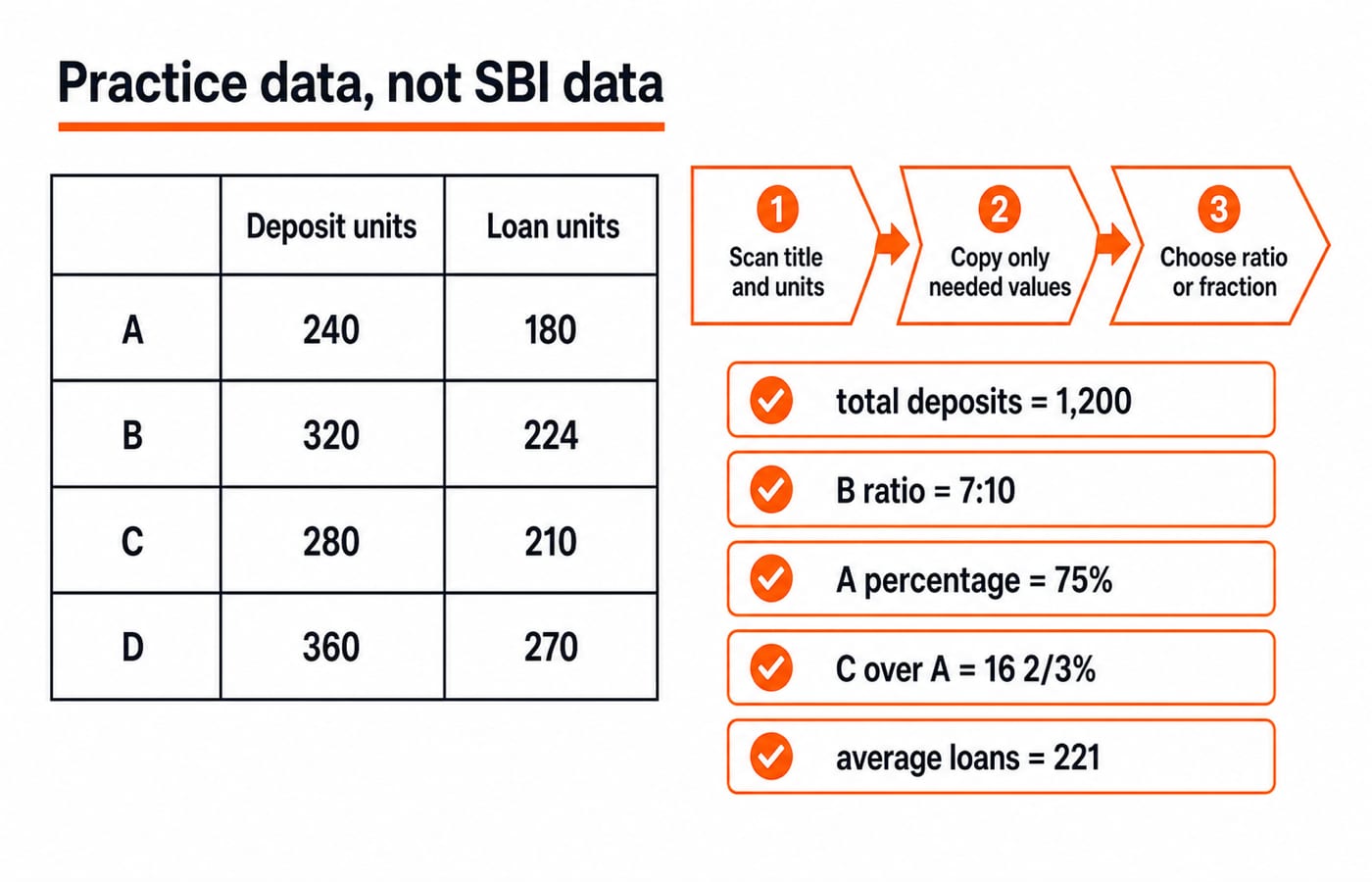
Mains is where Numerical Ability turns into interpretation, so DI working deserves a drill of its own. Work through this practice table; the units are invented so the arithmetic stays clean.
Branch | Deposit units | Loan units |
|---|---|---|
A | 240 | 180 |
B | 320 | 224 |
C | 280 | 210 |
D | 360 | 270 |
First scan the title, units, rows and columns. Next, copy only the values needed for a question. Finally, calculate with ratios or fractions before decimals.
Total deposits are
240 + 320 + 280 + 360 = 1,200 deposit units.Branch B's loan-to-deposit ratio is
224:320 = 7:10, or 7 loan units for every 10 deposit units.Branch A's loan-to-deposit percentage is
180 / 240 x 100 = 75%.C deposits exceed A deposits by
(280 - 240) / 240 x 100 = 40 / 240 x 100 = 1/6 x 100 = 16 2/3%.Average loans are
(180 + 224 + 210 + 270) / 4 = 884 / 4 = 221 loan units per branch.
Reverse-check the third answer: 75% of 240 deposit units = 180 loan units. Practise the dataset first without a clock and keep all working visible. Next, use an eight-minute round with a clean calculation grid. Move to six minutes only after two eight-minute attempts produce at least four correct answers out of five.
Convert every timed set into an error-reduction loop
Give each error-log row five fields: date, question type, error label, corrected step and revisit date. In an audit of 30 attempts, suppose there are three recall gaps, two calculation slips, one wrong equation and two poor selections: 3 + 2 + 1 + 2 = 8 errors. A week later, the repeat set has one error in each category: 1 + 1 + 1 + 1 = 4 errors. The count has halved, but inspect every category rather than speed alone.
For a recall gap, add a fact card. For a calculation slip, rewrite the faulty line. For a wrong equation, restate the known and required values. For poor selection, note the missed 30-second decision cue. Reattempt after 48 hours and seven days.
Each week, compare attempt accuracy, correct questions per minute and error-label mix with baseline. Shorten a drill by only one or two minutes when accuracy stays at or above 85% across three consecutive sets.
SBI Clerk quant speed: what to do in the next 30 minutes
Measure first, automate a small fact set, choose the shortest arithmetic representation, compress DI working, and let accuracy unlock more speed. Numerical Ability at prelims pays for the first four of those; Quantitative Aptitude at mains pays most for the DI compression. Schedule your first 30-minute diagnostic now and write the four-label error key before you attempt another random set. If SBI PO is also on your list, the SBI PO bundle carries this kind of block already built for both papers.
Keep learning
SBI SO Cutoffs: Check Corrections and Build a Practice Target
A cutoff becomes useful only when its post, category and score basis match your comparison. Work through a real SBI correction and a hypothetical target-setting exercise to plan your next mocks.
5 Oct 20264 min readSBI Exams

SBI SO Syllabus: Section-by-Section Study Map for IT Aspirants
Build an IT/System study map around your exact SBI post. Use a historical exam table, original worked exercises and an eight-hour sample week to turn topic lists into practice.
1 Oct 20265 min readSBI Exams
SBI SO Preparation Strategy: A 12-Week Role-Specific Plan
Build an SBI SO plan around the exact Specialist Cadre Officer post you are targeting. This guide gives an 11-hour weekly calendar, diagnostics, repair loops and separate written-test and interview branches.
Updated 24 Sep 20266 min readSBI Exams

SBI SO Exam Pattern and Marking Scheme: Post-Wise Routes Explained
There is no single SBI SO paper pattern. Use this guide to identify your post's route, understand qualifying and merit components, and build a timetable from the official notice.
Updated 22 Sep 20264 min readSBI Exams