Bank PO Prelims vs Mains: how to split your preparation
Bank PO Prelims vs Mains for IBPS and SBI: what each stage rewards, why Mains decides your rank, and how to split preparation across the two stages sensibly.
KnowledgeGate Team
Exam prep & CS education
Updated 25 Jul 20265 min read
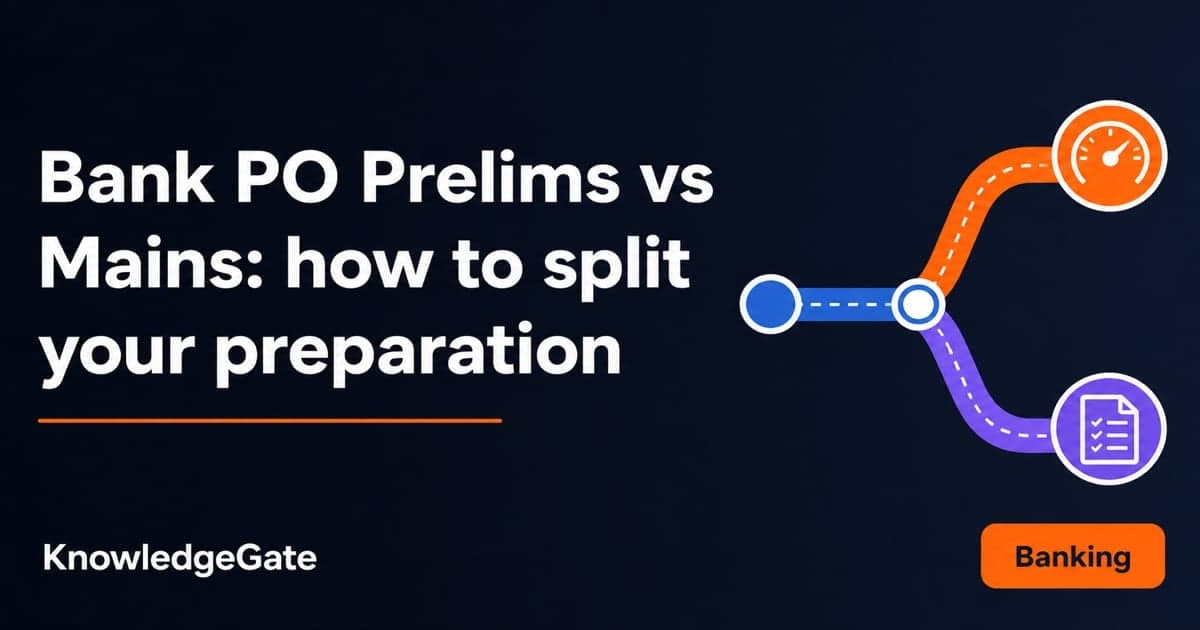
The most common planning error in bank PO preparation is treating Prelims and Mains as the same exam at two difficulty levels. They are not. They reward different things, they count differently toward selection, and preparing for them identically leaves you either over-drilled on easy questions or under-prepared on the paper that actually ranks you. IBPS PO and SBI PO are both built this way, so the same lopsided division of hours serves both.
The exact question counts, sectional timings, marks, negative marking and merit calculation change between cycles, so take those numbers from the official notification: ibps.in for IBPS PO, and SBI's own recruitment notification for SBI PO.
Two written stages, two different jobs
Both IBPS PO and SBI PO run a Preliminary stage followed by a Main stage. The selection process also includes a later interview stage, and the notification carries the full stage list.
Prelims is a screening gate. Its job is speed-and-accuracy filtering across a few objective sections. It decides who advances, and whether the score carries beyond that stage is specified in the notification.
Mains is where you are ranked. It is harder, broader, and it carries the weight that decides your final position, including data-analysis and general-awareness depth that Prelims does not test.
The consequence is uncomfortable: prepare the two stages one after the other and the paper that decides your rank is the one you leave yourself least time for.
What Prelims rewards: speed and accuracy
The Preliminary stage is built around quick, high-volume objective questions across quantitative aptitude, reasoning, and English. The skill it tests is not depth; it is the ability to clear a qualifying bar quickly and accurately under tight time pressure. If you want that stage sequenced for you, the stage-wise IBPS PO Prelims course covers it on its own.
Prepare Prelims for pace, not mastery. You need to clear the screen comfortably and move on, so drill common question types until they are fast and automatic.
Build accuracy under a clock. In a screening test, a fast wrong answer can cost more than a slow right one when negative marking applies, so train the speed at which you stay accurate.
Do not over-invest here. A few focused weeks of timed aptitude, reasoning, and English practice is usually enough to clear Prelims; a semester of it is time stolen from Mains.
What Mains rewards: depth and range
Mains is a different animal. It broadens the sections, deepens the difficulty, and adds general, economy and banking awareness, full data analysis and interpretation, computer aptitude paired with reasoning, and a descriptive English paper of essay and letter writing. The IBPS PO and SBI PO Mains stages are built on that same wider set, so this section of your plan looks the same for either exam. Because Mains decides your rank, it deserves the larger share of your preparation. The stage-wise IBPS PO Mains course maps to this second stage.
Go for genuine understanding, the kind that survives a harder twist on a familiar concept, not last-week memorisation.
Build data-interpretation stamina. Mains quant leans heavily on multi-step DI sets, which reward practice and a calm, systematic method.
Keep general and financial awareness current. This is a Mains-heavy area that rewards steady, daily reading rather than a last-minute cram.
Write the descriptive paper, do not read about it. Mains finishes with essay and letter writing, the one section that improves only by producing finished pieces against a clock. One essay and one letter a week, reread the next day with a pen, is enough if you start early and impossible to catch up on late.
How to split your time
Start from a 70:30 weekly split. Give 70 per cent of your study hours to Mains-depth learning and revision, and 30 per cent to timed Prelims practice. If you study 20 hours a week, that is 14 hours for Mains and 6 hours for Prelims.
Use the Mains share for depth. In a normal week it goes into harder concepts, longer data sets, current-affairs revision and error analysis, while the Prelims share goes into timed section practice and mock review. Casual question-solving does not count as timed practice.
Shift to about 50:50 in the last two or three weeks before Prelims. The extra Prelims time should sharpen question selection, pacing and accuracy under pressure, but keep half the week on Mains revision so the first stage does not break your continuity.
Move to roughly 85:15 once your Prelims attempt is done. The smaller slice maintains calculation speed and accuracy; the larger goes into full-depth revision, mixed practice and repair of weak areas.
When a week slips, protect three blocks rather than the whole plan. Keep one Mains-depth revision block, one timed Prelims session and one error-review block, then return to your normal split the following week.
Much of your Prelims practice serves Mains too, at a shallower depth; Mains simply demands that you push the same material further. Treat these percentages as guardrails, not a timetable: change them when your mocks show a clear weakness, but never let Prelims urgency eat into the preparation that decides your rank.
Two common traps and their fixes
The first trap is spending the first two months almost entirely on Prelims, clearing it, and then having only a few weeks for the far larger Mains syllabus. Candidates who do this often clear the screen and then rank poorly, or miss the cutoff, on Mains.
The fix is to start Mains-depth preparation early and run it alongside your Prelims speed work. Treat Prelims as a recurring maintenance task, timed practice a few times a week, while your main study block builds Mains-level depth in quant, reasoning, English, and awareness.
There is a second, quieter trap: general and financial awareness. Because Prelims does not usually test it, aspirants ignore it until Mains is close, then try to cram months of current affairs into a fortnight. It does not work, because awareness rewards steady accumulation, not a burst. The fix is to fold ten or fifteen minutes of daily reading into your routine from the very start, so that by the time Mains arrives the awareness section is a strength you maintained rather than a syllabus you are chasing.
Your next step
Prepare Prelims for speed and Mains for depth, give Mains the larger and earlier share of your time, and confirm the exact pattern and merit calculation in the official notification before you plan.
If you want both stages structured in one place, the IBPS PO bundle and the SBI PO bundle cover the Prelims and Mains preparation together. You can see the full banking line-up on the IBPS category page. Pick the bundle that matches your target exam, then set your weekly hours to 70:30 and let your mock results correct the ratio from there.
Keep learning
Mensuration and Geometry for Competitive Exams: Formulas, Shortcuts and Solved Examples
Learn how to choose the right mensuration formula, avoid common geometry traps, and solve 2D path and 3D recasting problems step by step.
Updated 6 Oct 20266 min readAptitude & Reasoning
Age Comparison and Multiple-Condition Problems: 12 Solved MCQs
Practise 12 age-problem MCQs with equations, timelines, back-checks, relation chains, changing ratios, birth years, and family conditions.
1 Oct 20268 min readAptitude & Reasoning
True, False and Cannot Say Questions: 10 Solved Passage MCQs
Learn how to separate contradictions from missing evidence, then apply the method to 10 previous-year passage MCQs with concise, evidence-led solutions.
26 Sep 20268 min readAptitude & Reasoning
TCS Aptitude Questions: High-Yield Quant and Reasoning Topics, Solved Step by Step
Learn the first move for common quant and reasoning question families through solved examples on ratios, work, trains, data, remainders, and seating.
Updated 25 Sep 20266 min read104 viewsAptitude & Reasoning