SBI PO Psychometric Test: Traits, Illustrative Question Types and Honest Practice
Understand what SBI has disclosed about its PO psychometric stage, then practise careful reading, workplace judgement and consistency without inventing an ideal personality.
KnowledgeGate Team
Exam prep & CS education
Updated 11 Aug 20265 min read
After months of numerical, reasoning and English practice, a personality-focused stage can feel vague. There is no formula sheet, and trying to look perfect usually makes your answers contradict one another. SBI has published very little about the format, so the preparation that actually helps is knowing your normal work behaviour and reading every statement slowly. Practise on personality inventories, situational questions and consistency checks, and treat any supposedly desirable option pattern as invented.
What SBI officially says the psychometric test is for
SBI's detailed PO advertisement dated 18 June 2026 places the psychometric test in Phase III. It says the test profiles shortlisted candidates' personalities and that its findings are placed before the interview panel for a broader perspective. All psychometric questions are mandatory, and SBI may conduct the test in proctored mode or at identified centres.
The advertisement does not disclose item formats, a response scale, question count, time limit, trait weights or a scoring algorithm. If a coaching page quotes you a question count or a pass mark for this stage, it is guessing rather than quoting. For the stages on either side of it, read SBI PO Syllabus and Exam Pattern 2026. The written papers are a separate job, and the SBI PO Mains Preparation Course is built for those.
The six SBI career traits, without a secret answer key
SBI's careers site lists six qualities under the heading What are we looking for:
Public trait | Behavioural example |
|---|---|
Willingness to Learn | Seeks feedback and learns a new process |
Team Player | Coordinates and helps the group deliver |
Effective Communication | Listens, explains and uses logic |
Strong Leadership Potential | Takes initiative and brings the team along |
Analytical Ability | Checks data and reasons before deciding |
Adaptability | Adjusts to new roles, needs and locations |
SBI publishes these as what it wants in an officer, not as a scoring key, and no option-to-score mapping exists in public. That is why rules like always choose leadership, or strong agreement everywhere, are invented: a branch morning forces you to choose between two of these traits, and any honest item set does the same.
Personality-inventory practice: read the statement actually written
For practice, borrow the five-point scale most personality inventories use, since SBI has published none of its own: 1 Strongly disagree, 2 Disagree, 3 Neither agree nor disagree, 4 Agree, 5 Strongly agree.
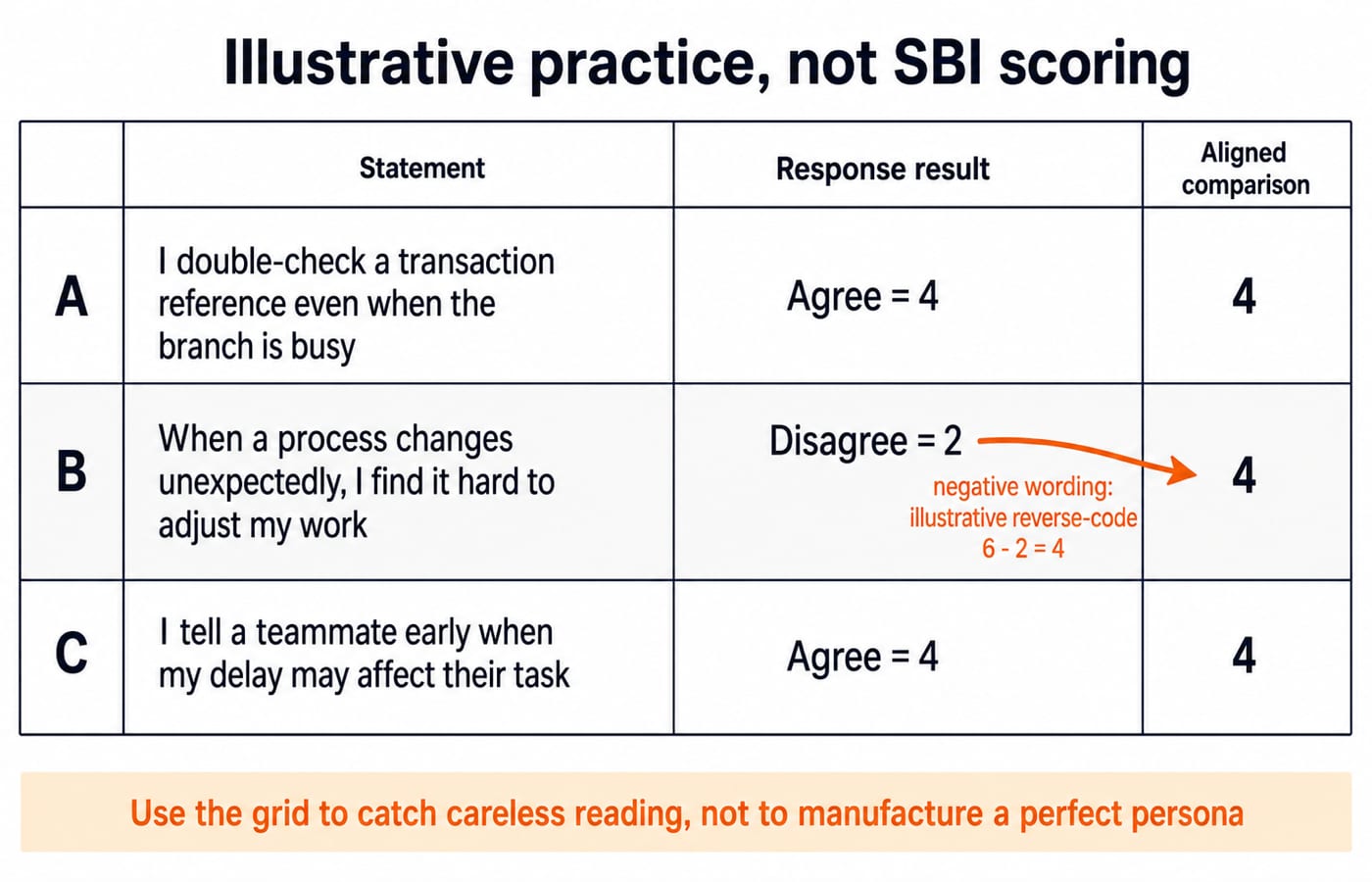
Kavya answers three practice statements:
A:
I double-check a transaction reference even when the branch is busy→Agree (4).B:
When a process changes unexpectedly, I find it hard to adjust my work→Disagree (2).C:
I tell a teammate early when my delay may affect their task→Agree (4).
Item B is negatively phrased, so agreeing with it means the opposite of agreeing with A and C. Reverse-code it the usual way, 6 - 2 = 4, and Kavya's raw answers of 4, 2, 4 line up at 4, 4, 4. She was steady throughout. A reader who skimmed past the words hard to adjust would have marked her as contradicting herself, which is the whole point of the exercise: the wording moved, not her behaviour.
Situational questions: combine care, process and teamwork
Here is a branch situation of the kind these items are built from. At 4:45 pm, a customer reports a disputed high-value debit, but the merchant says payment was not received. Three customers are waiting, and a teammate asks for help with end-of-day closure.
A: Promise an immediate refund and pay cash before checking.
B: Ask the customer to return tomorrow so closure stays on time.
C: Acknowledge the concern, verify reference and status, explain the documented next step and timeline, log or escalate through the proper route, and tell the teammate about a ten-minute delay.
D: Send the customer to the merchant without checking the bank-side status.
C avoids unauthorised promises, checks evidence, explains process and alerts the teammate. A ignores authorisation, B delays care, D skips bank-side verification.
Forced choice: Most like me: I volunteer to coordinate when roles are unclear versus Most like me: I analyse the details before the team decides. Neither is universally superior; choose typical behaviour, not grander-sounding traits.
What consistency checks can and cannot reveal
Inventories commonly run three mechanisms: near-duplicate statements written in different words, a positive statement paired with its negative, and forced choices between two behaviours that both sound good. SBI has not said which, if any, it uses. All three catch the same two things: an item read too quickly, and a persona invented on the spot that the candidate cannot hold steady across the paper.
Rohan answers four practice statements:
Strongly agree: I verify important details before submitting work.Strongly agree: I usually submit routine work without a final check.Agree: I stay calm when priorities change.Strongly agree: Small changes make it difficult for me to work.
Read items 1 and 2 together, then 3 and 4: each pair points in opposite directions. Neither answer is automatically dishonest. Item 1 says important details and item 2 says routine work, and that qualifier alone may be the whole explanation. Repeating one scale point is not automatically consistent, either. Changing an answer after noticing not, rarely or usually is careful reading, not gaming.
A 100-minute practice routine for honest self-observation
Use five sessions:
15 minutes: Write one genuine example for each of SBI's six public traits.
20 minutes: Answer 12 inventory statements you write yourself.
25 minutes: Work through five workplace scenarios.
20 minutes: Answer 12 fresh items, including four negatively worded prompts.
20 minutes: Review misread qualifiers, unexplained contradictions and rushed decisions.
The sessions add up: 15 + 20 + 25 + 20 + 20 = 100 minutes.
Keep four review columns: item, my first reading, the exact qualifier, what I normally do. Do not add a desirable answer column. If you miss a session, continue with the next and move the skipped block to the end. Do not compress two sessions into one fatigued sitting. What the five sessions buy you is a slower reading habit and a ready answer, in your own words, for how you actually handle a changed process or a queue you cannot clear.
Test-day short version and where to go next
Read every qualifier. Answer for normal behaviour, not a rehearsed ideal. In scenarios, balance customer care, evidence, process and teamwork. Follow the current SBI Careers notice and your call letter because the mode or instructions can change.
Candidates still weighing the two big PO routes can read SBI PO vs IBPS PO: Pattern, Difficulty and Career Differences. For the written stages that decide whether you reach Phase III at all, the SBI PO bundle carries Prelims and Mains in one plan, and Banking & Insurance Exam Preparation lists the rest of the bank track.
Keep learning
SBI SO Cutoffs: Check Corrections and Build a Practice Target
A cutoff becomes useful only when its post, category and score basis match your comparison. Work through a real SBI correction and a hypothetical target-setting exercise to plan your next mocks.
5 Oct 20264 min readSBI Exams
SBI SO Syllabus: Section-by-Section Study Map for IT Aspirants
Build an IT/System study map around your exact SBI post. Use a historical exam table, original worked exercises and an eight-hour sample week to turn topic lists into practice.
1 Oct 20265 min readSBI Exams
SBI SO Preparation Strategy: A 12-Week Role-Specific Plan
Build an SBI SO plan around the exact Specialist Cadre Officer post you are targeting. This guide gives an 11-hour weekly calendar, diagnostics, repair loops and separate written-test and interview branches.
Updated 24 Sep 20266 min readSBI Exams
SBI SO Exam Pattern and Marking Scheme: Post-Wise Routes Explained
There is no single SBI SO paper pattern. Use this guide to identify your post's route, understand qualifying and merit components, and build a timetable from the official notice.
Updated 22 Sep 20264 min readSBI Exams