Ripple Counter MCQs: 12 Solved Questions on Modulus, States and Delay
Solve 12 ripple counter MCQs by reading the clock chain, calculating modulus and state movement, and adding propagation delays correctly.
KnowledgeGate Team
Exam prep & CS education
Updated 4 Sep 20267 min read

A ripple counter can look simple until a question switches among physical clocking, modulus, binary state movement and accumulated propagation delay. The real difficulty is deciding which model to use before touching the options. Attempt each item before reading its explanation; first write either the modulus equation or the stage-delay equation, then test the result against the counter’s actual states.
Related reading: ring and Johnson counters and synchronous counter MCQs.
Ripple counter basics: clock chain, modulus and delay
In a ripple counter, only the first flip-flop receives the external clock. Each stage's output clocks the next, so a transition moves through the chain rather than reaching every stage together.
With n flip-flops, the natural modulus is 2^n, covering states 0 through 2^n - 1. For equal stage delay t_pd, the worst-case ripple delay is n x t_pd; the simplified synchronous comparison here uses one flip-flop delay.
For a cold-start check, a 3-bit up-counter follows 000, 001, 010, 011, 100, 101, 110, 111, 000. The sampled count is binary, but its physical bit transitions are not simultaneous. For a wider mixed set, revise Sequential Circuits MCQs: 11 Solved Flip-Flops.
Questions 1-3: identify the ripple-counter architecture
Question 1: Name the cascaded counter
A ______ counter is a cascaded arrangement of flip-flops where the output of one flip-flop drives the clock input of the following flip-flop.
A. Ripple
B. Synchronous
C. Ring
D. Cascaded
Answer: A
The clock connection is decisive, not the word "cascaded". A ripple counter sends one stage's output to the next clock, so changes propagate stage by stage. A synchronous counter shares one external clock; a ring counter circulates a stored bit.
Question 2: Identify which stage gets the external clock
A ripple counter is a(n) ______ counter where only the ______ flip-flop is clocked by an external clock.
A. Synchronous, First
B. Asynchronous, Second
C. Asynchronous, First
D. Synchronous, Second
Answer: C
Both blanks matter. The counter is asynchronous because the stages do not share a clock edge, and only the first receives the external clock. Each later stage is triggered by the preceding output.
Question 3: Recognise the two-stage diagram
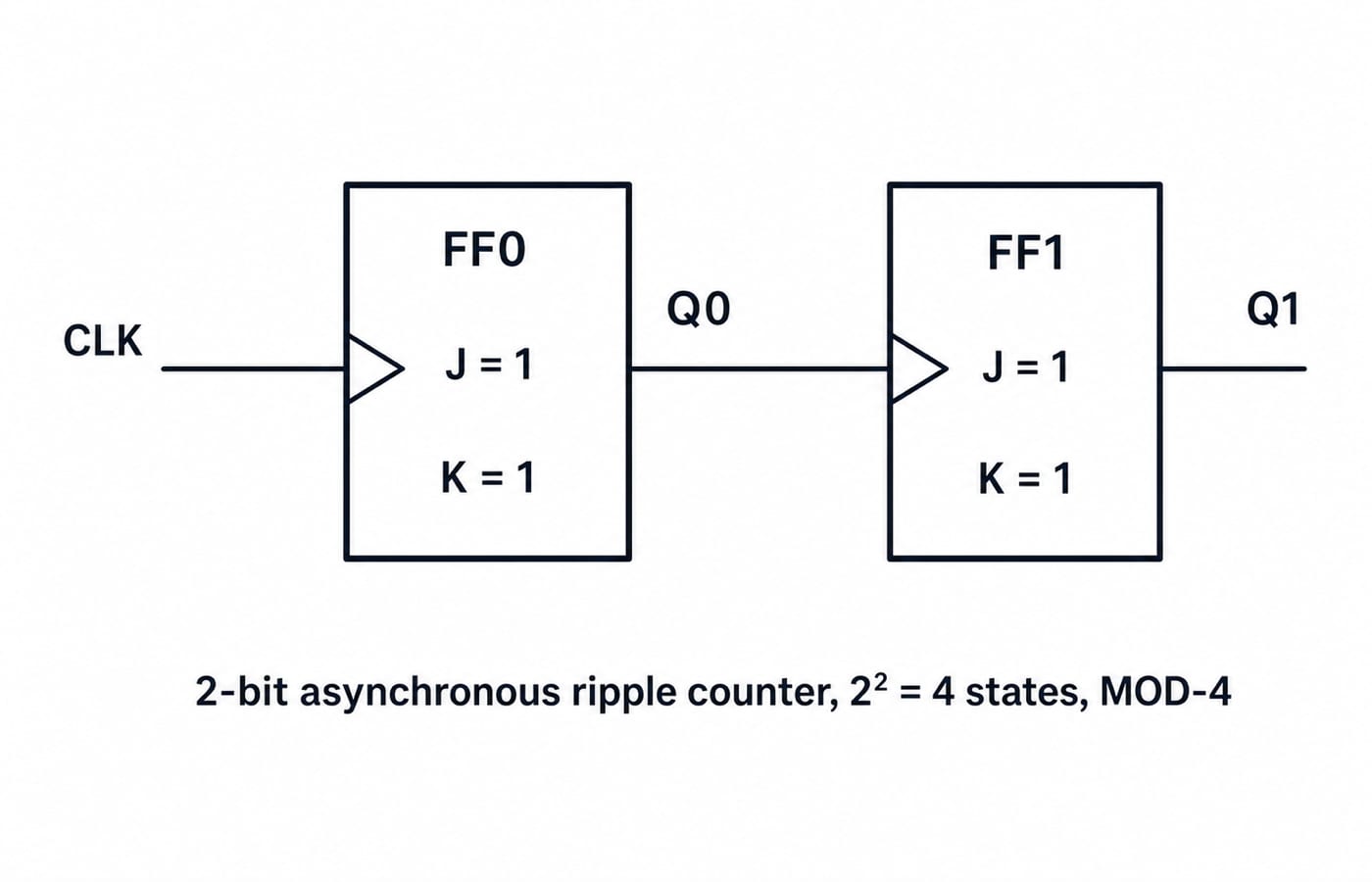
What does the following logic diagram represent ?
A. Synchronous Counter
B. Ripple Counter
C. Combinational Circuit
D. Mod 2 Counter
Answer: B
Both JK flip-flops have J=K=1, but the external clock reaches only the first and Q0 clocks the second. This is a 2-bit asynchronous ripple counter. Its 2^2 = 4 sampled states make it MOD-4, not MOD-2.
Questions 4-6: calculate flip-flop count, modulus and range
Question 4: Count up to 16383
A binary ripple counter is required to count up to 16383. How many flip-flops are required?
A. 16382
B. 8191
C. 512
D. 14
Answer: D
Including zero, reaching 16383 requires 16383 + 1 = 16384 states. Since 16384 = 2^14, exactly 14 flip-flops are required. The endpoint check is 2^14 - 1 = 16383.
Question 5: Find the minimum hardware for MOD-18
In order to build a MOD-18 counter, the minimum number of flip flops needed is equal to
A. 18
B. 9
C. 5
D. 4
Answer: C
Find the smallest n with 2^n >= 18. Four flip-flops give 2^4 = 16 states, but five give 2^5 = 32, so five is the minimum. The design must reset or redirect the 14 unused states.
Question 6: State the natural range of n stages
If n flip-flops are used in a ripple counter, then it will count from ______ to ______.
- A. 0, 2^n
- B. 0, 2^n - 1
- C. 1, 2^n
- D. 1, 2^n - 1
Answer: B
An n-stage binary counter has 2^n distinct patterns. They start at all zeroes and end at all ones, whose value is 2^n - 1. For n=3, the eight states run from 0 through 7.
Questions 7-8: advance a counter through wrap-around
Question 7: Start at 1 and apply nine pulses
In a three stage counter, using RS flip flops what will be the value of the counter after giving 9 pulses to its input? Assume that the value of counter before giving any pulses is 1.
A. 1
B. 2
C. 9
D. 10
Answer: B
A 3-stage counter has modulus 2^3 = 8, so (1 + 9) mod 8 = 10 mod 8 = 2. The sampled trace is 1 -> 2 -> 3 -> 4 -> 5 -> 6 -> 7 -> 0 -> 1 -> 2. It confirms the wrap-around.
Question 8: Move from binary 1001 to zero
A MOD-16 ripple counter using J-K flip-flop has a current state 1001. How many clock pulses are required to get the state 0000?
A. 8
B. 7
C. 6
D. 5
Answer: B
Convert 1001_2 to decimal 9. The next sampled values are 10, 11, 12, 13, 14, 15, 0, so pulse seven produces 0000. Six pulses only reach 1111; one more wraps to zero.
Questions 9-10: add propagation delay correctly
Question 9: Compare four-stage ripple and synchronous delay
A 4 bit ripple counter and 4 bit synchronous counter are made using flip-flops having a propagation delay of 10 nsec each. If the worst case delay in the ripple counter and the synchronous counter be R and S respectively, then:
A. R = 10 nsec, S = 30 nsec
B. R = 30 nsec, S = 10 nsec
C. R = 40 nsec, S = 10 nsec
D. R = 10 nsec, S = 40 nsec
Answer: C
Four serial stage delays give R = 4 x 10 nsec = 40 nsec. With flip-flop propagation as the only supplied delay term, all synchronous stages share the clock and settle after one flip-flop delay, so S = 10 nsec.
Question 10: Find the maximum delay of a 16-bit ripple counter
A flip-flop has a 20-nano second delay from the time its CP input goes from 1 to 0 to the time the output is complemented. What is the maximum delay in a 16-bit binary ripple counter that uses these flip-flops?
A. 20 ns
B. 320 ns
C. 36 ns
D. 16 ns
Answer: B
The worst case crosses all 16 stages, giving 16 x 20 ns = 320 ns. The tempting 20 ns covers one flip-flop. The 16 ns option incorrectly treats a bit count as time.
The companion set on Sync Counter Analysis MCQs moves from serial ripple delay to common-clock excitation and state analysis.
Questions 11-12: separate sequential logic from distractors
Question 11: Judge the JK and complemented-output statements
State whether the following statements are true or false. Statements: (i) The JK flip-flop is a basic building block of combinational logic circuits. (ii) In a ripple counter, if the uncomplemented output counts up, then the complemented output counts down.
A. (i) True, (ii) True
B. (i) True, (ii) False
C. (i) False, (ii) True
D. (i) False, (ii) False
Answer: C
Statement (i) is false because a JK flip-flop stores state and is sequential. Statement (ii) is true for the sampled word. If 3-bit Q is 000, 001, 010, then Q' is 111, 110, 101, or 7, 6, 5 descending.
Question 12: Pick the sequential circuit
Which of the following is a sequential circuit?
A. Full-Adder
B. Decoder
C. Binary ripple counter
D. Multiplexer
Answer: C
A binary ripple counter contains flip-flops, so its next output depends on stored state and the clock. A full-adder, decoder and multiplexer depend only on current inputs and are combinational. That memory distinction also explains Questions 1-3.
Ripple counter MCQ traps, score check and next step
trap | wrong move | repair |
|---|---|---|
capacity | compare | use |
wrap-around | stop at | count the extra pulse to |
delay | use one stage for a ripple chain | add |
classification | call every cascaded circuit synchronous | inspect which clock input receives the external clock |
Your score check
If you got 10-12 correct, redo Questions 8-10 without looking at the worked steps. At 7-9 correct, revise modulus and wrap-around before attempting another set. At 0-6 correct, rebuild the clock chain and the 3-bit trace from the first section. This is a learning diagnostic, not a prediction of any official exam score.
The short version
Identify the clocking topology first, write 2^n before calculating capacity, use modular arithmetic for state movement, and add serial stage delays only when propagation ripples through the chain. If the concepts still feel weak, follow GATE Guidance by Sanchit Sir to rebuild the sequence properly. If you are ready to practise under test conditions, use the GATE Test Series. To compare this topic with the wider preparation path, continue through GATE CS Exam Preparation. The reliable routine is topology, modulus, state movement, then delay.
Keep learning
Special Logic Circuits MCQs: 12 Solved Questions on Adders, Encoders, PLA and DAC
Solve 12 special logic circuits MCQs covering recognition, hardware counts, Boolean identities and numerical calculations. Each answer includes the reasoning you should reproduce in an exam.
19 Sep 20268 min read68 viewsDigital Electronics MCQs
Function Equivalence MCQs: 12 Solved Boolean Algebra Problems
Solve 12 function-equivalence questions step by step, from De Morgan's law and absorption to minterm sets, counterexamples and a four-option MSQ.
Updated 17 Sep 20268 min readDigital Electronics MCQs

CLA & Arithmetic Logic MCQs: 10 Solved Questions with Explanations
Solve ten CLA and arithmetic logic MCQs with compact workings for carry equations, timing paths, hardware sizing and operand-pair counting.
Updated 16 Sep 20267 min readDigital Electronics MCQs
Sync Counter Design MCQs: 11 Solved Questions on Modulus, State Sequences and Excitation Logic
Solve 11 synchronous-counter questions covering modulus boundaries, repeated outputs, common-clock tracing, excitation equations, enables and composite states.
Updated 14 Sep 20267 min readDigital Electronics MCQs