SOP, POS and Canonical Forms MCQs: 12 Solved Questions with Step-by-Step Explanations
Build speed and accuracy with 12 live question-bank problems, each explained from the relevant Boolean rule to the correct option.
KnowledgeGate Team
Exam prep & CS education
Updated 29 Aug 20267 min read395 views
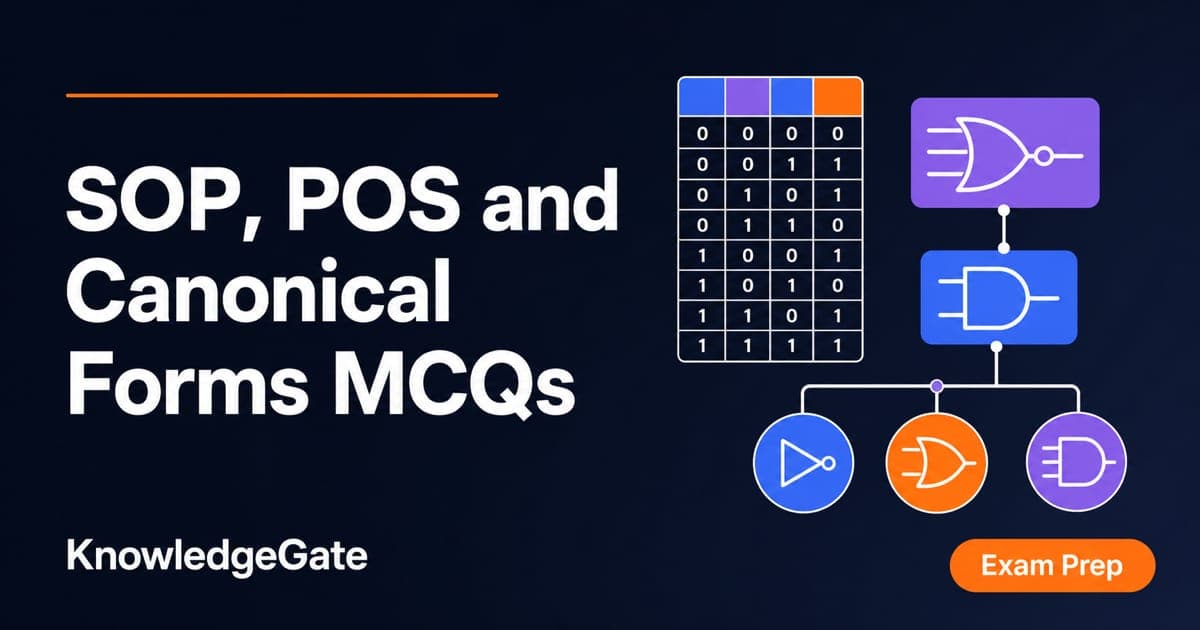
SOP and canonical SOP are not interchangeable, and neither are POS and canonical POS. Σm lists the rows where F=1, while ΠM lists the rows where F=0. Recognition, canonical expansion, Boolean simplification, minterm-maxterm conversion and two-level gate-input counting form the progression from notation to circuit implementation. The GATE CS Exam Preparation page places these skills in the wider Digital Electronics sequence.
1. SOP, POS and canonical forms: the one-minute reference
Form | Outer operation | Inner term | Row represented | Notation |
|---|---|---|---|---|
SOP | OR | Product term | Not necessarily a single row | Algebraic expression |
Canonical SOP / sum of minterms | OR | Minterm containing every variable |
|
|
POS | AND | Sum term | Not necessarily a single row | Algebraic expression |
Canonical POS / product of maxterms | AND | Maxterm containing every variable |
|
|
For variables A,B,C, index 5=101₂. Its minterm is AB'C because that product must become 1 at 101. Its maxterm is (A'+B+C') because that sum must become 0 at the same input. The polarity therefore reverses between a minterm and a maxterm.
The index sets provide a quick check. If F=Σm(1,3,5,6), the unused indices in {0,1,2,3,4,5,6,7} are {0,2,4,7}, so F=ΠM(0,2,4,7). Review the Boolean Algebra and K-map Minimization Guide if these identities or row conventions need a refresh.
2. SOP and POS basics: Questions 1-3
Try all three before reading the answers. The key terms are sum, product, minterm and maxterm.
Question 1: identify a sum of products
The term sum-of-product in Boolean algebra means : (UP LT Grade Assistant Teacher 2017)
(a)
The AND function of several AND functions.(b)
The AND function of several OR functions.(c)
The OR function of several AND functions.(d)
The OR function of several OR functions.
Answer: (c) Read “product” as AND within each term and “sum” as OR between those terms. In AB + A'C, AB and A'C are product terms, and + combines them with OR.
Question 2: distinguish minterms from maxterms
A product of sum (POS) form of logic function consists of only _____ while a sum of product (SOP) form of logic function consists of only _____. (UP LT Grade Assistant Teacher 2021)
(a)
maxterms; maxterms(b)
minterms; minterms(c)
minterms; maxterms(d)
maxterms; minterms
Answer: (d) Option (d) reflects the question's use of SOP and POS as shorthand for their canonical forms. Strictly, ordinary POS consists of sum terms and ordinary SOP consists of product terms; only canonical POS multiplies maxterms and canonical SOP adds minterms. On row A=0, B=0, minterm A'B' is 1 and maxterm (A+B) is 0.
Question 3: name the two canonical forms
What are the canonical forms of Boolean expressions? (UP LT Grade Assistant Teacher 2023)
(a)
OR and XOR(b)
NOR and XNOR(c)
SOM and POM(d)
More than one of the above(e)
None of the above
Answer: (c) SOM means Sum of Minterms, or canonical SOP, and POM means Product of Maxterms, or canonical POS. OR, XOR, NOR and XNOR are operators or gate families, not complete canonical truth-table representations.
3. Canonical expansion: Questions 4-6
Work every row or index explicitly here. The reusable skill is finding the assignments that make the output 1 or 0.
Question 4: expand a function into minterms
The minterm expansion of is (GATE 2010)
(a)
\( m_2 + m_4 + m_6 + m_7 \)(b)
\( m_0 + m_1 + m_3 + m_5\)(c)
\( m_0+ m_1 + m_6 + m_7 \)(d)
\( m_2 + m_3 + m_4 + m_5\)
Answer: (a) For R=0, the function becomes PQ+Q+P=P+Q, which is 1 at 010=m2, 100=m4 and 110=m6. For R=1, only PQ remains, adding 111=m7. Thus f=Σm(2,4,6,7)=m2+m4+m6+m7.
Question 5: turn a non-canonical SOP into canonical SOP
The Sum of Products expansion for the function F(x, y, z) = (x + y)z̅ is given as (UGC NET 2013)
(a)
x’y’z + xyz̅ + x’yz̅(b)
xyz + xyz̅ + xy’z̅(c)
xy’z̅ + x’y’z̅ + xyz̅(d)
xyz̅ + xy’z̅ + x’yz̅
Answer: (d) First distribute: F=xz̅+yz̅. Now xz̅=x(y+y')z̅ and yz̅=(x+x')yz̅; after removing the duplicate xyz̅, the terms are xyz̅, xy'z̅ and x'yz̅, with indices 6,4,2.
Question 6: write maxterm indices as canonical POS
What is the POS form of the Boolean expression F(A, B, C) = Π(1, 2, 4, 6)? (BPSC 2025)
(a)
(A + B + C′)(A′ + B′ + C)(A + B′ + C)(b)
(A′ + B + C)(A + B + C′)(c)
(A′ + B + C)(A + B + C)(A + B + C)(d)
(A + B + C)(A + B + C′)(A′ + B + C)(e)
None of the above
Answer: (e) Decode the indices as 001,010,100,110. Reversing each bit's polarity for a maxterm gives (A+B+C')(A+B'+C)(A'+B+C)(A'+B'+C). Options A to D each omit or change a required factor.
4. Boolean simplification into SOP and complements: Questions 7-9
Name the law on every line. An expression does not become canonical merely because it contains AND and OR.
Question 7: simplify by absorption and complement laws
The Boolean expression Y = (A + B' + A'B)C' is given by (ISRO 2007)
(a)
AC'(b)
BC'(c)
C'(d)
AB
Answer: (c) Absorption gives A+A'B=A+B, so Y=(A+B+B')C'. Since B+B'=1 and A+1=1, Y=1·C'=C'.
Question 8: simplify POS into SOP
The simplified SOP (Sum of Product) form the Boolean expression (P + Q' + R')(P + Q + R)(P + Q + R') (ISRO 2016)
(a)
(P'Q + R)(b)
(P + QR')(c)
(P Q' + R )(d)
(PQ + R)
Answer: (b) Use (X+R)(X+R')=X with X=P+Q, leaving (P+Q'+R')(P+Q). Then (P+X)(P+Y)=P+XY gives P+Q(Q'+R')=P+QR'.
Question 9: complement a factored Boolean expression
The complement of the Boolean expression AB ( B'C + AC ) is (ISRO 2015)
(a)
( A' + B' ) + ( B + C' )( A' + C' )(b)
( A' + B' ) + ( BC' + A'C' )(c)
( A' + B' )( B + C') + ( A + C' )(d)
( A + B )( B' + C )( A + C )
Answer: (a) Apply De Morgan's law directly: [AB(B'C+AC)]'=(AB)' + (B'C+AC)'=(A'+B')+(B+C')(A'+C'), which is exactly option A.
5. Minterm-maxterm conversion and gate realization: Questions 10-12
Use an index-set check for Questions 10 and 11, then count literal inputs in Question 12. For a broader mixed drill on Boolean laws, K-maps and minimisation, continue with Boolean Algebra and K-Map MCQs: 12 Solved.
Question 10: test equivalent Σ and Π statements
Given the function 𝐹 = 𝑃′ + 𝑄𝑅, where 𝐹 is a function in three Boolean variables 𝑃,𝑄 and 𝑅 and 𝑃′ = ! 𝑃 , consider the following statements. (S1) 𝐹 = ∑(4, 5, 6) (S2) 𝐹 = ∑(0, 1, 2, 3, 7) (S3) 𝐹 = ∏(4, 5, 6) (S4) 𝐹 = ∏(0, 1, 2, 3, 7) Which of the following is true? (GATE 2015)
(a)
(S1)- False, (S2)- True, (S3)- True, (S4)- False(b)
(S1)- True, (S2)- False, (S3)- False, (S4)- True(c)
(S1)- False, (S2)- False, (S3)- True, (S4)- True(d)
(S1)- True, (S2)- True, (S3)- False, (S4)- False
Answer: (a) P'=1 covers indices {0,1,2,3}, and QR=1 adds index 7. The 1-set is {0,1,2,3,7} and the complementary 0-set is {4,5,6}, so only S2 and S3 are true.
Question 11: convert a minterm list to a maxterm list
Minterm Σm(1, 3, 5, 6) equals to maxterm (UP Police Computer Operator 2013)
(a)
ΠM(0, 3, 7)(b)
ΠM(0, 2, 4, 7)(c)
ΠM(0, 3, 4, 7)(d)
None of these
Answer: (b) The largest index requires three variables, so enumerate 0 through 7. Removing the 1-set {1,3,5,6} leaves the 0-set {0,2,4,7}; the disjoint sets also contain 4+4=8 indices, as required.
Question 12: count gate inputs in a two-level SOP realization
Assuming complemented literals B̅ and F̅ are available, the total number of gate inputs in a direct two-level AND-OR realization of
ABC+AB̅CD+EF̅+AD, without Boolean minimisation, is: (UGC NET 2022)
(a)
12(b)
13(c)
14(d)
15
Answer: (d) The complemented literals are available, so no NOT-gate inputs are counted. The four AND gates take 3+4+2+2=11 inputs, and the final OR gate takes four inputs. The total is 11+4=15.
6. How SOP, POS and canonical-form MCQs set traps
Trap | Diagnostic | Fix |
|---|---|---|
Reading | The same rows appear in both lists | Take complementary sets over |
Using minterm polarity for a maxterm | The supposed maxterm becomes 1 on its indexed row | Check that a maxterm becomes 0 on that row |
Calling every SOP canonical | A product omits one or more variables | Confirm that every product contains every variable |
Counting product terms instead of gate inputs | The count stops after level one | Count literals into level-one gates, then inputs into the final gate |
As a timed self-check, start from F=Σm(1,3,5,6) and produce ΠM(0,2,4,7) in under 30 seconds. Then use 5=101₂ to write minterm AB'C and maxterm (A'+B+C') without a truth table.
The key skills are vocabulary, expansion, Boolean laws, representation conversion and circuit realization. Once canonical notation feels automatic, continue with Prime Implicants and EPI Counting for GATE.
7. SOP, POS and canonical forms: the short version
SOP is OR of products, while POS is AND of sums. Canonical SOP lists F=1 rows as minterms, and canonical POS lists F=0 rows as maxterms. Complementary index sets provide the fastest final check.
Redo Questions 4, 6, 10 and 11 without looking. Expansion, maxterm construction, statement checking and Σm↔ΠM conversion should each feel mechanical before you move on. The GATE Guidance by Sanchit Sir course provides a structured route through the wider Digital Electronics sequence.
Keep learning
Special Logic Circuits MCQs: 12 Solved Questions on Adders, Encoders, PLA and DAC
Solve 12 special logic circuits MCQs covering recognition, hardware counts, Boolean identities and numerical calculations. Each answer includes the reasoning you should reproduce in an exam.
19 Sep 20268 min read64 viewsDigital Electronics MCQs
Function Equivalence MCQs: 12 Solved Boolean Algebra Problems
Solve 12 function-equivalence questions step by step, from De Morgan's law and absorption to minterm sets, counterexamples and a four-option MSQ.
Updated 17 Sep 20268 min readDigital Electronics MCQs
CLA & Arithmetic Logic MCQs: 10 Solved Questions with Explanations
Solve ten CLA and arithmetic logic MCQs with compact workings for carry equations, timing paths, hardware sizing and operand-pair counting.
Updated 16 Sep 20267 min readDigital Electronics MCQs
Sync Counter Design MCQs: 11 Solved Questions on Modulus, State Sequences and Excitation Logic
Solve 11 synchronous-counter questions covering modulus boundaries, repeated outputs, common-clock tracing, excitation equations, enables and composite states.
Updated 14 Sep 20267 min readDigital Electronics MCQs